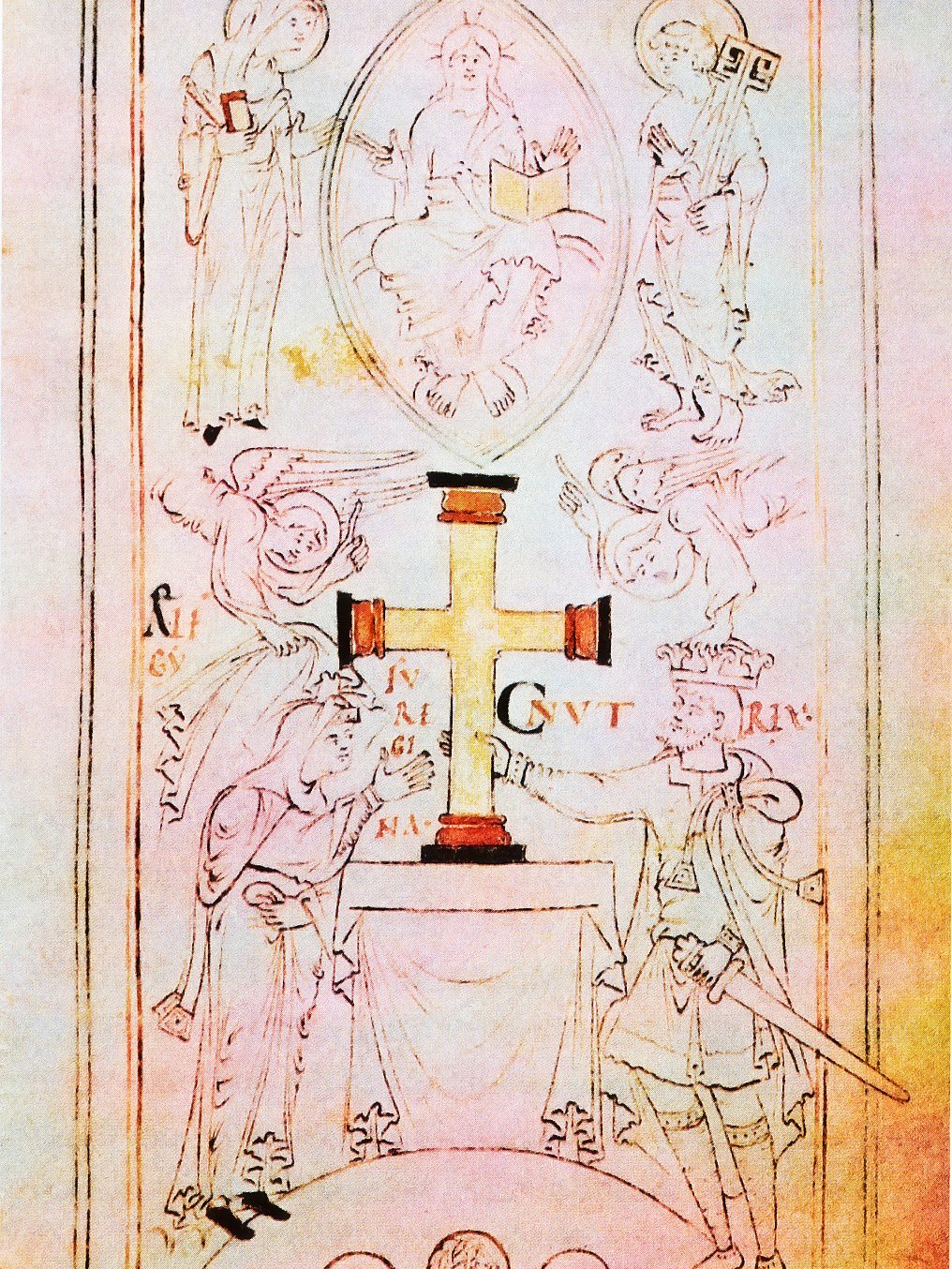
On history maps it glows in a single colour from Northumbria to Trondheim: the North Sea Empire of Cnut the Great. Cnut himself never used the phrase, and his contemporaries listed separate kingdoms. Did anything hold them together beyond the man, his fleet and his English silver? This article does not retell Cnut's life. It tests the structure instead: titles, regents, church, coins and the letter of 1027 read as a working document of government. It ends with the question of why the whole thing came apart so fast, and why two different dates are offered for the end.
"North Sea Empire" is a historians' label. I know of no eleventh-century use of it, and it does not appear in the sources I read for this article. English-language Wikipedia traces the label to historians of the early twentieth century and names John Speed's Historie of Great Britaine as an early forerunner of the idea, giving the year 1623, the second edition of a work first printed in 1611. I have not seen Speed's text or checked a first attestation, nor one for the German Nordseereich. On that point the evidence here is not conclusive.
The real question stands regardless. The word "empire" raises expectations: a shared capital, shared law, an administration that passes orders across borders, and above all survival beyond the death of its founder. Measured that way, Cnut's rule can be tested piece by piece, and that is what the sections below do. His life story, from the conquest to the legend of the tide, is told in the article on Cnut the Great.
The strongest statement from Cnut himself is the opening of his letter to the English, written in connection with his journey to Rome. The Latin, as printed by Jay Paul Gates, reads "Cnuto rex totius Anglie et Denemarcie et Norreganorum et partis Suanorum": king of all England and Denmark, of the Norwegians and of part of the Swedes. An older English translation of John of Worcester's chronicle smooths this into "king of all England, and of Denmark, Norway, and part of Sweden".
The formula already tells us a good deal. It lists; it does not sum up. There is no name for the whole, only a sequence that begins with England. "All England" sounds like firm possession. With the Norwegians, and even more with "part of the Swedes", the Latin names peoples rather than lands. That reads more like lordship over people than over a defined country. The letter does not say what its author meant by it, so the distinction cannot carry the argument alone.
What is missing also matters. The title "emperor" does not appear in the salutation, and Cnut had just watched someone else crowned emperor in Rome.
The word closest to the modern label did not come from Cnut. It stands in the Encomium Emmae Reginae ("Praise of Queen Emma"), written around 1041/42 by a monk whom scholars usually place at Saint-Bertin in Saint-Omer. The author tells how the father sent Harthacnut to Denmark, and then writes this:
"While King Cnut at first held only the rule of the Danes, he claimed lordship over five kingdoms, namely Denmark, England, Britain, Scotland and Norway, and so became emperor."Encomium Emmae Reginae II.19.1, Latin from the digital edition of the Université de Caen ("quinque regnorum […] vendicato dominio, imperator extitit"), my own translation
It is an attractive piece of evidence and it calls for caution. The Encomium was commissioned for Emma and her sons and is full of omissions: it largely passes over Emma's first marriage to Æthelred and denies that Harold Harefoot was Cnut's son. A panegyrist raising the father of his reigning king reaches for the biggest word available. Then there is the list. "Britain", according to the note in the Caen edition, means Wales. Scotland is included, although the Anglo-Saxon Chronicle reports only that King Malcolm submitted to Cnut. Submission is not government, and the texts I read mention no regent of Cnut's in Scotland or Wales.
The sentence still proves two things. For this author, less than a decade after Cnut's death, the size of his rule was worth advertising. And imperator here apparently has a simple meaning: someone who commands several kingdoms. That describes no institution.
The three crowns reached Cnut by three different routes, which explains a lot. He conquered England in 1016 and took over the whole government in 1017. The Chronicle records the division into four parts: Wessex for himself, East Anglia for Thorkell, Mercia for Eadric, Northumbria for Eric. In Denmark he took up his family's inheritance after the death of his brother Harald, probably in 1018 or 1019; a first-hand date is lacking. For 1019 the Chronicle notes only his voyage to Denmark with nine ships. Norway he took from an opponent in 1028, after many Norwegian magnates had already gone over to him, as later tradition tells it.
No single legal claim came out of this. In England Cnut was a conqueror who appealed to "Edgar's law". In Denmark he was the heir of a dynasty. In Norway he competed with a native royal tradition and used the family of the Earls of Lade for his own ends. And Sweden? The claim to "some of the Swedes" remains the real puzzle. The Chronicle reports for 1025 that at the "holy river" the Swedes held the field. Accounts differ on where this fight took place, and the battle matters here only for what it shows: Cnut's supremacy in the north was still being contested in 1025/26.
Look for an imperial administration and you find something else: trusted men, often relatives, who held a country in Cnut's place. These arrangements broke down again and again.
Denmark shows this well. Under 1023 the Chronicle says Cnut was reconciled with the previously outlawed Thorkell and entrusted Denmark and his son to him. For Cnut's brother-in-law Ulf, Wikipedia gives 1020, about 1024 or the time after Thorkell, depending on the article. I have seen no contemporary statement, and the order cannot be settled with certainty. The end is clearer. In 1025, according to the Chronicle, an Ulf, probably the same man, fought against Cnut alongside Eglaf, and Earl Ulf was later killed at Roskilde, on Cnut's instigation according to saga tradition. The date is uncertain: Snorri has Cnut ride to Roskilde the day before Michaelmas and Ulf die in St Lucius' church, while Wikipedia gives Christmas 1026 and Trinity Church. A regent who also held the king's son could pursue his own policy while Cnut was away. Later tradition accuses Ulf of exactly that.
Norway repeated the pattern at a quicker pace. Håkon Eiriksson of the Lade family governed until he was lost at sea in 1029/30; the Chronicle notes his death under 1030. Cnut then sent his son Svein and Svein's mother, Ælfgifu of Northampton. The later sagas call those years "Ælfgifu's time" and complain of harsh dues. How much of that is the hindsight of a hostile tradition cannot be cleanly separated.
England was a different case, because shires, earls and writing offices already gave it a working government. Even so it probably needed deputies: the prologue by Erin Goeres and Richard North to the volume Anglo-Danish Empire (2022) lists Thorkell 1017–1021, Eric 1021–1023 and Godwine 1023–1035 as viceroys. That is a modern classification; I found no office of that name in the sources I read. I know of no body responsible for England from Denmark or Norway, or the other way round. The English laws applied to England. No common code for all three countries survives.
The letter itself shows how such rule worked in practice. It survives in Latin chronicles of the twelfth century; John of Worcester places it in his entry for 1031, which fits the Chronicle's wrong date for the Rome journey. The imperial coronation of Conrad II at Easter 1027 fixes the correct year.
Its addressees are clear: the archbishop of Canterbury, the archbishop of York, the bishops, the magnates and the whole English people. Cnut reports that Emperor Conrad and King Rudolf of Burgundy promised his subjects safe passage and fewer tolls. The translation I read explicitly says "my people, English as well as Danes". A shared horizon shows through here, since Cnut negotiates for subjects on both sides of the North Sea. This is the strongest passage for anyone arguing for unity. Yet the phrase names only those two peoples, and it concerns travellers, not government.
Then comes the itinerary. He is now going to Denmark, Cnut writes, to make peace with the peoples who would have taken his "life and crown", and he will return to England in summer as soon as his fleet is fitted out. Until then his officers are to see that church dues come in. Nobody is to do injustice out of fear of him or favour to the powerful, and nobody is to extort money wrongfully on his behalf.
Here the limits of the construction appear. A problem in Denmark demands his presence, while England has to be managed by letter. The Chronicle's terse entries confirm the shuttling: 1019 to Denmark, 1020 back, 1023 arrangements for Denmark again, 1025 there with the fleet, 1028 to Norway, 1029 home to England once more. That at least is how the English source sees it, and it naturally knows only one side. Power sat wherever the king currently had his ships.
Abroad, Cnut appeared as a ruler of great weight, though not as the emperor's equal. His letter lists the honours he received in Rome, and that is enough to establish rank. The value of the alliance shows on Denmark's southern border. The Dictionary of National Biography of 1887 and, according to Wikipedia, Lawson report that Conrad II ceded him the march of Schleswig. The older reference work ties this to the betrothal of Cnut's daughter Gunnhild to Conrad's son Henry, and names Archbishop Unwan of Bremen as go-between. I could not check the date and exact terms in a primary source.
Timothy Bolton apparently goes further in his 2017 biography and, according to one review, argues that Cnut opposed Conrad's imperial title. The reviewer, Alice Hicklin, calls that "optimistic". I have no evidence for parity either, and I have not read the book itself.
Anyone searching Cnut's circle for a ruler named Lothar finds none. What can be found is Lotharingia, the region around the Meuse and Rhine named after the Carolingian Lothar II. Michael Hare published two notes as "Cnut and Lotharingia" in the journal Anglo-Saxon England (2000). According to the abstract, they deal with the close "Lotharingian connection" between English and German churches in the mid-eleventh century, which he traces back to Cnut's reign. Hare also explains Cnut's baptismal name, Lambert, and presents a hagiographical source suggesting that Cnut visited Cologne. I have seen no more than this abstract.
For the question of empire this means that Cnut's network probably reached the Rhineland through the church. Rule over Lotharingia does not follow from it.
The closest thing to a real link between the countries arose in the church. The Dictionary of National Biography reports that Cnut took many clergy from England to Denmark and made some of them bishops, and John Wordsworth's older survey of the Church of Sweden describes something similar: the bishops were chosen by the civil power and ordained in England. That made political sense. A bishop consecrated by Canterbury did not depend on Hamburg-Bremen, the German archbishopric claiming authority over the north.
The case of Gerbrand shows the conflict. Archbishop Æthelnoth of Canterbury consecrated him for Zealand or Roskilde, in 1022 according to the older reference work. Archbishop Unwan had him seized and forced him to profess obedience to Hamburg. Cnut gave way, and an agreement with Unwan followed. So the church bridge never became a province: I know of no joint ecclesiastical province of England and Denmark.
Coins are often cited as proof of empire, so they deserve a close look. There was no single imperial coinage. England kept its established system; the British Museum describes, for example, the Quatrefoil type, which brought the lily crown onto English coins for the first time and was in use by 1018, perhaps prompted by the great levy of that year. In Denmark, coins were struck on the English pattern. For Harthacnut's period, 1035–1042, the British Museum's records list Danish mints such as Lund, Roskilde, Ribe, Viborg, Aalborg and Aarhus. That fits the common view that technique and imagery travelled from west to east, though I could not check the details of Danish mints under Cnut himself in specialist literature.
A well-known penny carries the legend CNVT REX SW, read as "Cnut, king of the Swedes", which Wikipedia, drawing on Brita Malmer, places at either Sigtuna or Lund. But dies were copied. According to Wikipedia, drawing on Mats Hagerman, coins from Sigtuna also exist that call Olof Skötkonung king of England. A coin legend therefore proves no rule. It may be a claim, a boast or simply the imitation of a model. I have not read the numismatic literature on these pieces myself.
What actually carried the structure shows in the Chronicle's figures. In 1018, 72,000 pounds were raised in England, plus 10,500 pounds from the Londoners. Forty ships stayed with Cnut and part of the army went to Denmark. Ten years later he sailed to Norway, in the Chronicle's words with fifty ships "manned with English thanes". English money and English crews thus carried the conquest of Norway. The Swedish rune stones of the England-farers record the other side of this circuit: men boasting of the money they fetched in the west.
England was the source of power and not merely one part beside others. The authors of the British Museum catalogue of 1893 already called England the true centre despite the Danish conquest; I cite them via Wikipedia. This remains an interpretation, but it fits what happened after 1035: whoever failed to hold England lost the main source of money.
The fault lines were visible before Cnut died. Olaf Haraldsson fell at Stiklestad in 1030, but in 1034 Einar Tambarskjelve and Kalf Arnesson fetched his son Magnus back from Rus, according to the Store norske leksikon. In 1035 he became king and Svein and Ælfgifu fled to Denmark; the exact sequence rests on late tradition and is uncertain. Norway was thus possibly lost in Cnut's lifetime, or at least almost at the same moment as his death on 12 November 1035.
Cnut appears to have made arrangements for the succession, which the Encomium and the Chronicle reflect differently. The Encomium says he bound "the whole kingdom subject to him" by oath to the boy and sent him with picked warriors to rule the Danes. Lawson, according to Wikipedia, finds it unclear whether England was ever formally intended for Harthacnut, and the coinage may point to a division. The Chronicle reports that a council at Oxford chose Harold to hold the land for himself and his brother in Denmark, and that Godwin and the men of Wessex objected in vain.
Within two years this became an open break. Harthacnut stayed in Denmark, tied down by Magnus, and under 1037 the Chronicle notes that Harold was chosen king over all England and Harthacnut set aside. That meant three rulers in three countries. Anyone who understands the unity as a personal union, one person ruling separate countries, has to set the end at 1035. That was when the person disappeared.
The second date arises through chance. Harold died in March 1040, and Harthacnut, who had been with his mother in Bruges since 1039, landed at Sandwich with 60 ships. One ruler again held England and Denmark, but not Norway, which stayed with Magnus. Harthacnut and Magnus are said to have agreed that the survivor would inherit from the other. It appears in the later Norse sagas; I found no contemporary source. Wikipedia dates it to 1036 after Howard, to 1039 after Bricka and Lund, and elsewhere to 1040, and the Store norske leksikon considers it probably unhistorical.
This brief second life once more exposes the English financial base, now in its unloved form. Harthacnut raised heavy tribute for army and fleet and had Worcestershire laid waste in 1041 after two collectors were killed there. The Chronicle is hostile to him, and that has to be read along with it. Edward returned from Normandy in 1041. In June 1042 Harthacnut died at a wedding feast in Lambeth, in the act of drinking, and the English chose Edward, "as was natural", as the Chronicle remarks.
In Denmark Magnus followed, opposed by Svein Estridsson, Ulf's son; Magnus died in 1047. The later claim of Harald Hardrada to England rested, according to saga tradition, on that alleged treaty and ended at Stamford Bridge in 1066.
As far as I could consult the scholarship, the debate is less about yes or no than about emphasis. In the publisher's text for The Empire of Cnut the Great (2009), "empire" stands in quotation marks, and the book sets out to treat Cnut's rule as a political unit across the separate English and Scandinavian scholarship. According to Hicklin's review, the 2017 biography portrays Cnut as a hegemonic king, "all things to all men"; she sees the book's strength in the Scandinavian material but does not always find his trust in the late prose sagas convincing. Lawson's book was subtitled The Danes in England in the Early Eleventh Century in 1993 and later England's Viking King; both put England at the centre. Frank Stenton, according to the passage quoted on Wikipedia, denied that Cnut had "the deliberate intention" of founding a lasting northern empire, since he set different sons over different countries. The 2022 prologue, by contrast, writes without quotation marks of an "empire" that lasted until 1042.
The evidence thus yields a graded picture. A hegemony, in the sense of a superior power around the North Sea, existed for some years, most plainly between 1028 and the early 1030s. Relations reached across borders: paid warriors, bishops, coin patterns. An empire in the sense of an institution that outlives its founder cannot be shown from the sources.
Was the North Sea Empire a real empire? Not in the sense of a lasting institution with a shared administration. It is better described as a personal union with regional supremacy, held together by Cnut, his fleet and English money.
Which countries belonged to it? Certainly England and Denmark, and Norway from 1028 to about 1035. Sweden, Scotland and Wales appear only as claims, submissions or praise.
Did it end in 1035 or 1042? Both dates can be defended. In 1035 Cnut died and the countries went separate ways; in 1042 Harthacnut died, the last king of his line to hold England and Denmark.
Was there a capital? I have found no evidence for one. Cnut travelled a great deal, and the English Chronicle describes his return to England as coming home. Winchester became his burial place, which does not make it an imperial capital.
Cnut the Great: life and legend · Emma of Normandy · Sweyn Forkbeard · The England-farers on rune stones · Olaf the Holy · Stiklestad 1030 · The Earls of Lade · Harald Hardrada · The coins of Ribe

Cnut the Great · The Battle of the Helgeå: one fight, two victory reports and a dam nobody may ever have built · Housecarls: Cnut's retinue in England, a law from the wrong century and the question of a standing army · Emma of Normandy · Danegeld & the Battle of Maldon.
All History & Finds articles →
Between the Salzach, Mur and Drava, in today's Salzburg, Carinthia and Styria, there existed in the last centuries BC …
Read more →On Christmas Day 1130, in the cathedral of Palermo, a man was crowned king whose great-grandfather had been a minor …
Read more →There are peoples we can argue about because the sources contradict one another. And there are peoples we cannot even …
Read more →The sacrificial bog of Oberdorla in Thuringia is the largest known Iron Age cult site in Central Europe: at a small …
Read more →