She arrived from Rouen in 1002 as a young bride, married a king who would later flee from the Danes, and fifteen years on married the Dane who had beaten him. Two of her sons wore the English crown, another died after being blinded, and in the end she had a Flemish monk write a book setting down her version of events. Emma of Normandy, known in England as Ælfgifu, is one of the few eleventh-century women whose actions can be followed over decades. This article sorts the sources, separates chronicle, praise-poem and later legend, and shows why her family ties still mattered in 1066.
Emma of Normandy lived from about 984/985 to 1052. She was Queen of England at the side of two men who had fought each other: Æthelred II, whom later generations called "the Unready", and Cnut the Great, who conquered England in 1016 and later ruled Denmark and Norway as well. Her sons Harthacnut and Edward the Confessor also became kings. Anyone following the Vikings in England from the Danegeld payments of the 990s to 1066 meets her at almost every crossroads.
We know a good deal about her for three reasons. First, the Anglo-Saxon Chronicle mentions her several times; it is a set of year-by-year annals in Old English that survives in several manuscripts with slightly different wording. Second, charters record her presence at court, because she signed them as a witness. Third, there is the Encomium Emmae Reginae, a Latin "praise of Queen Emma" that she commissioned herself. It tells the story the way Emma wanted it told.
Emma was a daughter of Richard I of Normandy, whom later writers called "the Fearless", and of Gunnor, a woman from a family of Scandinavian descent in western Normandy. Richard was the grandson of Rollo, the Viking leader who received land on the lower Seine from the West Frankish king around 911. Emma was therefore Rollo's great-granddaughter. Her brother Richard II ruled the duchy from 996.
No contemporary source gives her year of birth. The usual figure, "around 984" or "around 985", is worked back from her marriage in 1002. It cannot be established with certainty.
Gunnor and Richard first lived in a union the Church did not recognise as marriage; later they married in church. By 1000 the court at Rouen had long spoken French, while Scandinavian roots lived on in families and sea links, as the article on Vikings in France shows.
Under the year 1002 the Anglo-Saxon Chronicle notes briefly that in the same Lent "the Lady Elfgive Emma, Richard's daughter" came to this land. Æthelred was then in his thirties, widowed or at least parted from his first wife, and had several sons, among them Æthelstan and Edmund, the later Edmund Ironside.
Why this marriage? Danish fleets used Norman harbours to sell plunder or to winter, and an alliance with Rouen was meant to close those refuges. That is the standard modern interpretation; no treaty text survives. In November of the same year Æthelred ordered the killing of the Danes in England, the so-called St Brice's Day massacre. A direct link between wedding and massacre is sometimes suggested but not proven.
In England Emma took the name Ælfgifu. It was an old royal name, with an awkward twist: Æthelred's first wife had also been called Ælfgifu. The new name explains why charters and the Chronicle so often speak of "Ælfgifu" where modern books write "Emma". There are at least three important women of that name in these decades, and one of them would become Emma's rival.
As her morning-gift, the bridegroom's gift after the wedding night, Emma received property, according to later evidence including Winchester and Exeter and estates in several shires. The historian Pauline Stafford has called her the richest woman in England before 1043. That is an estimate from estate lists and charters.
The marriage with Æthelred produced three children: Edward, born probably around 1003–1005, Alfred, and a daughter, Godgifu (Goda).
The marriage did not end the raids. As early as 1003 Exeter fell to a Danish army, and the Chronicle blames a Frenchman named Hugh, whom "the lady" had appointed as her reeve. Whether Hugh really betrayed the city cannot be settled. The passage does show that Emma had brought men from home into office.
In the following years England paid huge sums to Danish armies, the Danegeld. In 1013 Sweyn Forkbeard, King of Denmark, came with the aim of taking the whole country, and this time he succeeded. The Chronicle reports for 1013 that the lady then went over sea to her brother Richard, accompanied by Ælfsige, Abbot of Peterborough. Æthelred sent their sons Edward and Alfred after her with the Bishop of London and followed himself after Christmas.
Normandy became the exile of the English royal house. Edward spent much of his youth there, with consequences reaching to 1066.
Sweyn died as early as February 1014, Æthelred returned, and the war continued with Sweyn's son Cnut. Æthelred died in London on 23 April 1016. His son Edmund Ironside lost at Assandun in October 1016 and died at the end of November; Cnut was now king of all England.
What Emma did in these months is reported differently by different sources. Thietmar of Merseburg, a Saxon bishop writing at the time but far away, describes a queen negotiating with the Danes in besieged London. The Anglo-Saxon Chronicle says nothing of this. How reliable his report is remains disputed.
The next step is secure. Under 1017 the Chronicle says that Cnut divided England into four parts and that "before the calends of August" – before 1 August – he gave an order to fetch him the widow of the other king, Æthelred, the daughter of Richard, to wife. The wedding therefore took place in July 1017.
The match made sense for both sides. Cnut gained a crowned queen who knew the English court, and he neutralised Normandy, where Emma's sons by her first marriage lived. Emma remained queen, kept her estates and, according to the Encomium at least, secured a promise: only a son of her marriage to Cnut would become king, not the sons Cnut already had by another woman. Whether Cnut really made such a promise is known only from this partisan work.
Some historians also read the second marriage as protection for Edward and Alfred in Normandy – a plausible idea, not a statement in any source. More on Cnut's reign is in the article on Cnut the Great.
Cnut and Emma had two children: Harthacnut, probably born around 1018, and a daughter called Gunnhild, who married the future Emperor Henry III in 1036 and died as early as 1038. Harthacnut was sent to Denmark young, to rule there in his father's name.
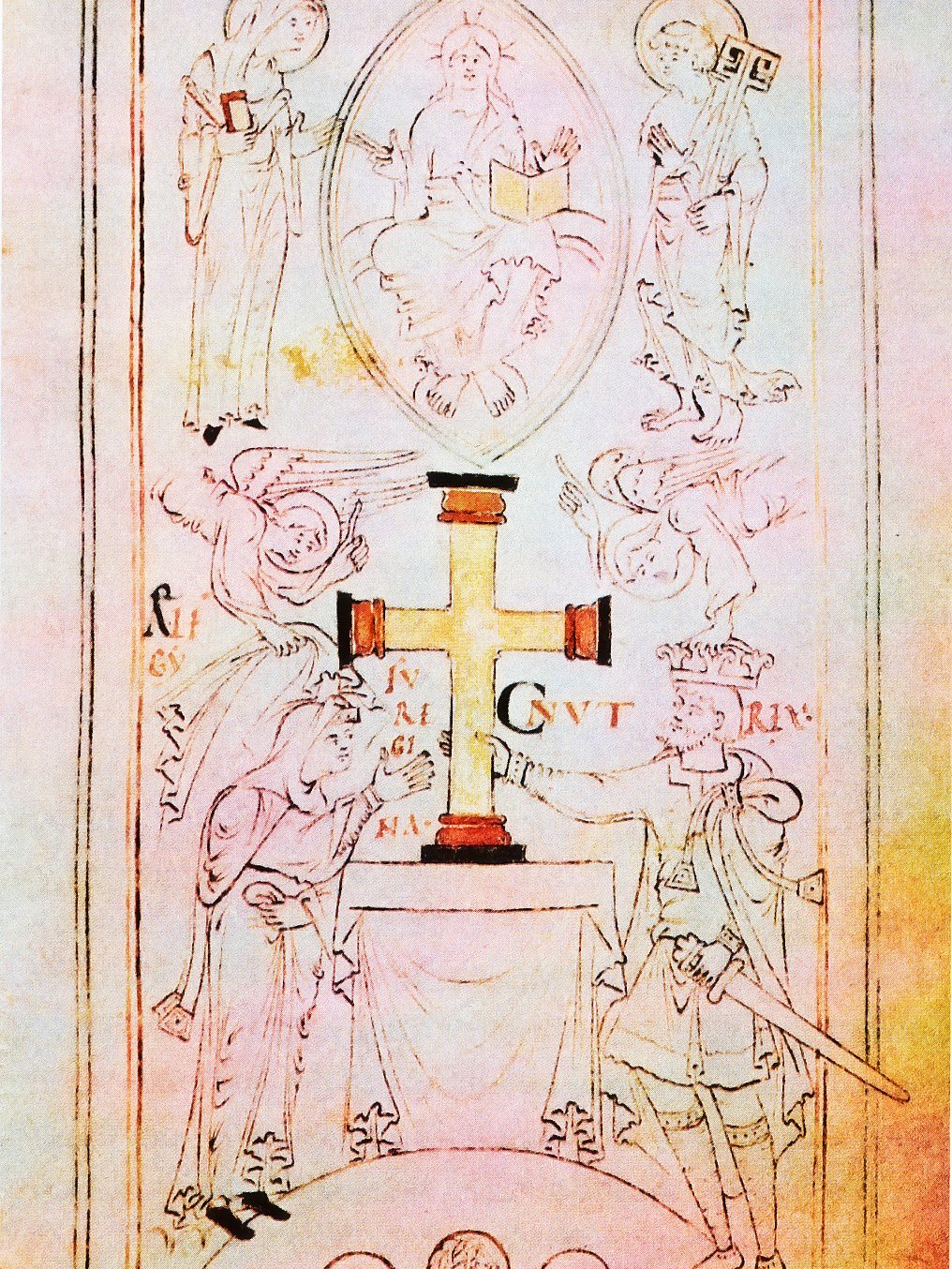
How Emma wished to be seen in these years is shown by a picture. The Liber Vitae ("Book of Life") of the New Minster at Winchester, now in the British Library (Stowe MS 944), was made in 1031. Such a book recorded benefactors for whom the monks prayed. On its opening page a king and a queen together set a large golden cross on the altar. The labels call them "Cnut rex" and "Ælfgyfu regina" – this Ælfgifu is Emma, not Cnut's first wife. Above them angels hold a crown and a veil, and above that Christ sits enthroned.
The picture is political. Emma appears on equal footing beside the king, as donor and ruler. Pauline Stafford has pointed out that it can also be read as the image of a woman whose standing depends entirely on her husband.
Emma also appears often as a witness in royal charters, though how much she actually decided cannot be read off witness lists.
Cnut was not unmarried when he took Emma. Around 1013 he had already married Ælfgifu of Northampton, a daughter of the Midland ealdorman Ælfhelm, who had probably been killed on Æthelred's orders in 1006. An ealdorman was the highest royal official of a region. The marriage tied her family in the north and the Midlands to the Danes. It produced two sons, Sweyn and Harold, later called "Harefoot", presumably for his speed.
The Church would not have recognised a second marriage alongside the first. Whether Cnut formally put Ælfgifu aside is not recorded, and some historians speak of a marriage "in the Danish manner", a secular union without the Church's blessing. What is certain is that Ælfgifu did not disappear. From about 1030 to 1035 she governed Norway for Cnut together with her son Sweyn. Norwegian tradition remembers those years as "Álfífa's time", associated with harsh dues, and the regime collapsed when the Norwegians brought back Magnus, the son of Olaf the Saint.
So two women of the same name, each with her own sons, stood side by side, and there was no fixed rule of succession. What happened after Cnut's death was at heart a struggle between these two camps.
Cnut died at Shaftesbury on 12 November 1035 and was buried at Winchester. Harthacnut was in Denmark and stayed there, on the usual interpretation because Magnus of Norway threatened the kingdom. According to the Chronicle, an assembly at Oxford decided that Harold should hold the realm for himself and his brother. Earl Godwin, the most powerful man in Wessex, and the West Saxons opposed this but could not prevent it. Emma was to remain at Winchester with her son's household troops. One manuscript of the Chronicle adds that Harold had the best of her treasures taken from her.
The Chronicle also notes doubts about Harold's parentage: some said he was not Cnut's son at all. The Encomium goes further and claims that Ælfgifu passed off another woman's child as her own. Such rumours were a common weapon in succession disputes.
In 1036 came the worst episode of Emma's life. Alfred, her younger son by her first marriage, crossed from Normandy to England, according to the Chronicle to visit his mother. He was intercepted, his companions were killed, sold or mutilated, and Alfred himself was blinded. He died of his injuries at the monastery of Ely.
Who was to blame? The Chronicle has Godwin stop Alfred but names Harold as the power behind it. The Encomium makes Harold the culprit and largely clears Godwin, which suits Godwin's position in 1041/42, when he served Harthacnut. Norman writers after 1066 blame Godwin heavily. The Encomium also claims that Harold forged a letter in Emma's name to lure her sons to England. Other scholars think it more likely that Emma really had summoned them and that the Encomium wanted to lift that responsibility from her. The accounts differ, and no secure decision is possible.
By 1037 Harold's victory was complete. The Chronicle describes what it meant for Emma with unusual sympathy, and the passage deserves to be quoted in full.
"This year men chose Harold king over all; and forsook Hardacnute, because he was too long in Denmark; and then drove out his mother Elgiva, the relict of King Knute, without any pity, against the raging winter! She, who was the mother of Edward as well as of King Hardacnute, sought then the peace of Baldwin by the south sea. Then came she to Bruges, beyond sea; and Earl Baldwin well received her there; and he gave her a habitation at Bruges, and protected her, and entertained her there as long as she had need."Anglo-Saxon Chronicle, entry for 1037; translation by James Ingram (1823), text as given by the Avalon Project
Where Emma went is telling: not to Normandy, where her nephew Robert, the father of William the Conqueror, had meanwhile died and a child ruled, but to Flanders and Count Baldwin V.
In exile she planned her return. According to the Encomium she turned first to Edward, who declined, and then to Harthacnut. He came to Flanders with ships in 1039 and spent the winter with his mother. Death made the decision for them: Harold died at Oxford on 17 March 1040. Harthacnut landed at Sandwich with sixty ships in June 1040, and Emma came back with him.
Harthacnut's reign was short and unpopular. He had his half-brother's body dug up and desecrated, and he raised heavy taxes for his fleet. In 1041 he brought Edward from Normandy to court, and according to the Chronicle Edward was sworn in "as king", evidently as co-ruler and successor. Whether Emma drove this is not recorded.
In these years, probably 1041 or 1042, the Encomium Emmae Reginae was written. The author does not give his name; he was a monk, very probably of the abbey of Saint-Bertin at Saint-Omer, then part of Flanders. Emma presumably came to know him during her exile. The main manuscript is in the British Library (Add. MS 33241). Its frontispiece shows Emma enthroned, the author kneeling before her to present the book, and at the edge two young men usually identified as Harthacnut and Edward.
The work has three books. The first tells of Sweyn Forkbeard's conquest of England, the second of Cnut's victory, his wooing of Emma and his rule, the third of the years after Cnut's death: Harold's usurpation, Alfred's death, Emma's exile and Harthacnut's return.
Its bias is unmistakable. The Encomium passes over Emma's marriage to Æthelred almost entirely, as if she had come to Cnut as an unmarried princess. It presents Cnut as a pious, just king, disputes Harold's parentage, does not treat Ælfgifu of Northampton as a wife and pins the blame for Alfred's death on Harold. Emma herself appears as a wise counsellor who deserves her sons' loyalty. For the court of 1041/42, where Harthacnut and Edward lived side by side, the message was: both are Emma's sons, and there should be harmony between them.
Views of the work have changed. Alistair Campbell, who published the standard edition in 1949, and Simon Keynes in his introduction to the 1998 reissue stress its distortions. Elizabeth Tyler and others read it as a deliberate political intervention on Emma's behalf. For events, the Encomium is usable only where other sources support it; for Emma's view of herself it is irreplaceable.
In 2008 a late medieval copy came to light, the so-called Courtenay Compendium, now owned by the Royal Library in Copenhagen. It preserves a revised version, probably made after Harthacnut's death, that gives Edward considerably more space. Emma's book was apparently adapted to the new situation.
Harthacnut died at Lambeth on 8 June 1042, according to the Chronicle suddenly, while drinking at a feast. Edward was chosen king in London and crowned at Winchester on Easter Day 1043. For the second time Emma had a son on the throne, this time the one from her first marriage.
Relations were cool. In November 1043 Edward rode unannounced to Winchester with Earls Leofric, Godwin and Siward and had his mother's gold, silver and other treasures taken from her. The Chronicle gives as the reason that she had earlier been very hard on him and had done less for him than he wished, both before and after he became king. At the same time Stigand, Bishop of Elmham, was deposed because he had been closest to Emma's counsels. Stigand soon returned and later became Archbishop of Canterbury; Emma stayed in Winchester.
What lay behind Edward's move the sources do not say; resentment over the years when his mother favoured her son by Cnut is suspected. Later stories that Emma encouraged Magnus of Norway to invade are not attested by contemporaries. By 1044 at the latest she appears again as a witness to charters, which points to a reconciliation; her former power did not return.
According to the Chronicle Emma died at Winchester on 6 March 1052 and was buried in the Old Minster beside Cnut and Harthacnut. Her bones later ended up in mortuary chests that Parliamentary troops threw into confusion in the seventeenth century. In 2019 a research project announced that the bones of an older woman of Anglo-Saxon date might be Emma's – a cautious attribution, not a secure identification.
The most famous story about Emma is a legend. In it she is accused of an affair with Bishop Ælfwine of Winchester and proves her innocence by ordeal: she walks barefoot over nine red-hot ploughshares in the cathedral without being burned and thanks St Swithun with gifts. An ordeal was a judgement of God in which a test by fire or water was supposed to decide guilt.
The tale appears in the Winchester annals and, on current knowledge, cannot be traced before the thirteenth century, some two hundred years after Emma's death. No contemporary source mentions any such accusation. The Dictionary of National Biography already rejected it as baseless in the nineteenth century, along with the related legend that Emma was complicit in Alfred's death or tried to poison Edward. The poet and painter William Blake still drew the scene.
Emma's brother Richard II was the grandfather of William the Conqueror. William was thus Emma's great-nephew, and Edward the Confessor was a first cousin of William's father Robert. When Edward died childless in January 1066, William invoked this kinship and a promise that Edward had supposedly made him his heir. English sources do not confirm such a promise; they report that Edward commended Harold Godwinson as his successor on his deathbed.
Without Emma there would have been no such link to Rouen, and without Edward's youth in Normandy the Norman influence at his court would hardly be conceivable. Yet the claim that Emma prepared the way for 1066 oversimplifies: the question was decided by force, first at Stamford Bridge against Harald Hardrada, then at Hastings. According to Norse tradition, Hardrada's claim also went back to an agreement between Magnus of Norway and Harthacnut, another son of Emma.
Emma's life thus links three worlds: Rollo's Scandinavian-rooted Normandy, the Anglo-Saxon kingship of the West Saxons and Cnut's northern empire. The article Vikings, Normans, Varangians asks when Vikings became Normans. Emma shows that those transitions took place in families, not only on battlefields.
Was Emma of Normandy a Viking? Not in the sense of a seafarer or warrior. But she descended from Rollo, the Scandinavian founder of Normandy, and her mother Gunnor came from a family of Scandinavian origin.
Why do the sources often call Emma Ælfgifu? She took this English name on her marriage in 1002. Since Æthelred's first wife and Cnut's first wife were also called Ælfgifu, every passage has to be checked for which woman is meant.
What is the Encomium Emmae Reginae? A Latin work of praise, written around 1041/42 by a Flemish monk on Emma's commission. It is an important but highly partisan source for Sweyn Forkbeard, Cnut and the succession struggles after 1035.
Where is Emma buried? In the Old Minster at Winchester, beside Cnut. Her bones now lie among the mortuary chests of Winchester Cathedral; no individual bones can be securely assigned to her.

Cnut the Great · Sweyn Forkbeard · The St Brice's Day massacre 1002 · Rollo of Normandy · The Battle of Hastings.
All History & Finds articles →
Engern, or Angria, is a name with two faces: for some it stands for the Angrivarii whom Tacitus knew on the Weser, for …
Read more →Most runestones tell of death. One in Uppland tells of a career. Ulf of Borresta, it says, took payment in England …
Read more →Eric Bloodaxe (Old Norse Eiríkr blóðøx) was a son of Harald Fairhair who ruled Norway for only a few years around 930 …
Read more →Erik the Red (Old Norse Eiríkr rauði) was the Icelander who explored Greenland from around 982 and founded its first …
Read more →