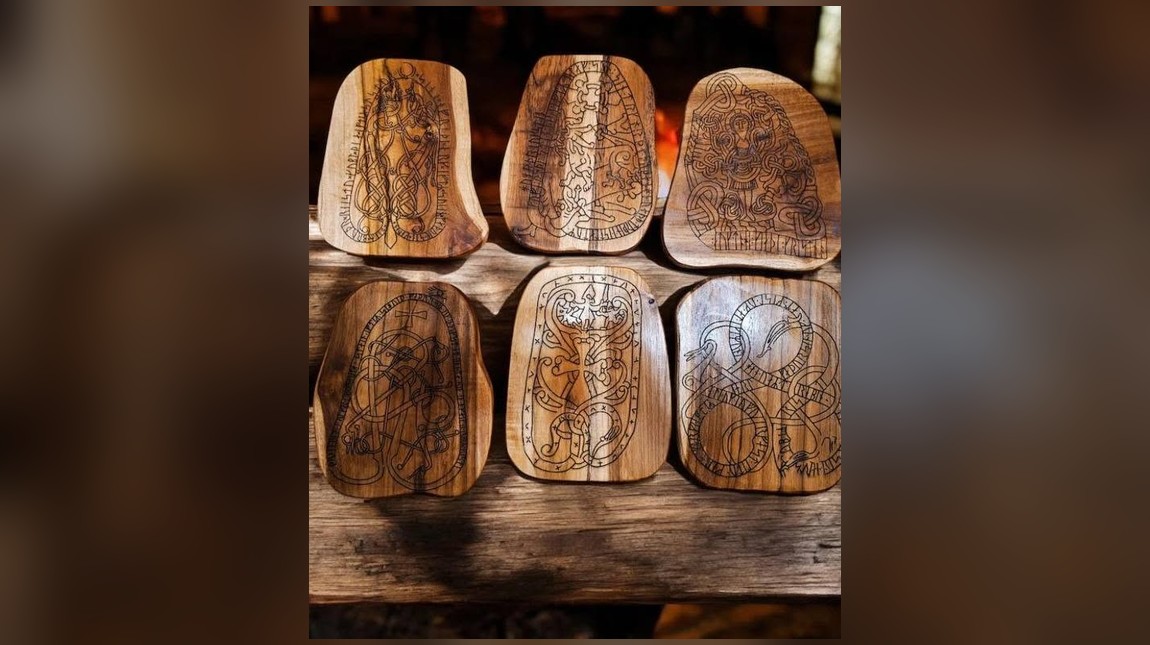
Thor's hammer, valknut, vegvisir, helm of awe: the symbols now sold as "Viking protection signs" have very different origins. Some lie in graves and settlements by the hundred, some appear on picture stones without our knowing their name, and one is, on current evidence, first visible in an Icelandic manuscript of 1860. This article sorts them by quality of evidence: what is archaeologically secure, what appears in texts, what is later tradition, what is modern interpretation. Where the sources are silent, it says so.
Type "Viking protection symbol" into a search engine and you get lists in which a hammer pendant from the tenth century sits beside a sign copied by an Icelandic scribe in 1860. Both are called "Norse", both "ancient". Roughly nine hundred years separate them. This article therefore asks the same three questions of every sign: Is there an object from the Viking Age (very roughly the eighth to eleventh centuries)? Is there a contemporary or at least medieval text that names it? And do we know what it was for?
The three questions often get three different answers. An image can be attested without our knowing what it was called. A name can be attested without our knowing what the sign looked like. And a protective function is almost never attested directly; it is inferred from find circumstances. Everything below rests on that distinction.
A note on transparency: the details here rest on overview articles and summaries that I could read through a retrieval tool, not on the specialist publications in full. The end of the article lists this. Where a figure or attribution comes only from such a summary, the text says "according to".
Four kinds of source exist for the Viking-Age North, and each has its own weakness.
Finds are the hardest kind: a pendant, a mould fragment, a scrap of textile. But they say nothing about intent. A hammer pendant in a grave may have been an amulet, a statement of belief, jewellery or an heirloom. We infer from context, not from a label.
Runic inscriptions are contemporary and sometimes strikingly direct, but short, formulaic and often readable in more than one way. An example follows in which specialists still disagree.
Medieval texts such as the Eddas and sagas were mostly written down in thirteenth-century Iceland or later, two to four centuries after the Viking Age, by Christian authors. They preserve old material but also reshape it. A passage in the Edda shows that people told something in a certain way in the thirteenth century, not that it was believed that way in the ninth.
Early modern grimoires, finally, such as the Icelandic manuscripts of so-called galdrastafir ("magical staves", meaning signs, not sticks), document a tradition of their own from the late Middle Ages into the nineteenth century. They are valuable for Icelandic folk magic. For the Viking Age they prove nothing unless an older witness stands beside them.
If one Viking-Age protective sign is unmistakably in the ground, it is the little hammer. According to the English-language overview of Thor's hammer, about 1,000 pendants are known from the Nordic countries, England, northern Germany, the Baltic and Russia. Most are plain, of iron or silver; around a hundred are more elaborately decorated. One example from Bornholm (Rømersdal) is dated there to roughly 790 to 1100 CE, a span that shows how loosely such pieces can be dated.
Handsome numbers, but what do they say? First, that the hammer was widespread, across borders and in very different kinds of site. Second, a caveat: the count depends on what one accepts as a hammer. The article notes that researchers have developed typologies, which Jörn Staecker ordered by decoration and material in 1999 and Katherine Beard extended in 2019 by shape and suspension. Beard also launched a database, the Eitri Norse Artifacts Database.
A second observation sounds unspectacular but matters: the hammer pendant was an everyday object. It turns up in settlements and graves, in plain and costly versions. That speaks against a sign reserved for a warrior elite and in favour of a common pendant. The sheer quantity allows nothing more.
Find circumstances help with the question of how hammers were worn. According to the overview, as of 2004 about one find in ten came from a grave, nearly all cremations, and the graves are often identified as women's graves. Then there are the so-called hammer rings: iron rings carrying several amulets, many hammer-shaped, found in the Mälaren region, on Åland and in Russia, in graves of both sexes but more often women's. The earliest examples go back to the Vendel period; they become more common in the late Viking Age. What exactly such a ring was for is unknown.
Wording needs care here. "Woman's grave" is an assignment usually based on grave goods such as jewellery and tools, not on bone analysis, especially with cremations. That women wore Thor's hammers seems plausible and fits the ring finds. That hammers were "women's protective signs" is more than the finds support.
Besides pendants, runestones show the hammer as an image. The overview names DR 26, DR 48 and DR 120 for Denmark and VG 113, Sö 86 and Sö 111 for Sweden. On the Altuna stone in Sweden and the Gosforth cross in England, Thor appears in the fishing scene with his hammer, a story the Edda also knows. That the hammer is a protective sign is written on none of these stones. It is Thor's attribute, as the club is Heracles'.
The Kvinneby amulet is an important witness because it offers not just an image but a text. It is a square copper plate about five centimetres across with a small hole near the edge, probably for wearing on a cord, found at Södra Kvinneby on Öland and dated, according to the Wikipedia article, to about 1050 to 1130. Some 143 runes are cut in alternating direction (boustrophedon), plus a fish.
The official reading (Rundata) takes the text as a protective charm for a man named Bófi. It invokes lightning and Thor, who is said to protect the man with a hammer that came from the sea, asks evil to flee, and says the gods are "under him and over him". That sounds clear, but it is not. The article lists six other serious interpretations: Nilsson read a plea for protection at sea tied to Thor's fishing trip, Lindquist a prayer to an earth goddess and to a Thor who strikes the demon Ámr, Westlund a magical rather than devotional text and considered that the wearer might have been baptised. Grønvik and Louis-Jensen continue Lindquist's line; Pereswetoff-Morath reads the opening as encryption.
What follows: that a hammer god appears in a protective formula around 1100 is attested. How the formula is to be understood in detail is open. And Westlund's idea of a Christian wearer fits a picture many finds give: the passage from old to new belief did not happen on a single day.
A frequently cited idea comes, according to the overview, from Katherine Beard: the growing popularity of hammer pendants in the Viking Age, and some shape variants, may have been a response to the spread of Christian cross pendants. The article presents this as a proposal, not a settled result. The Foss piece from Iceland, a silver pendant of the eleventh century, is called a "wolf cross" (vargkors) there and could be read "both as a Christian cross and as a heathen Thor's hammer". The piece shows ambiguity, not intent.
Another observation from Beard's work: the archaeological hammers do not resemble the club-like weapons described by Adam of Bremen and Saxo. We see a pendant hammer and read a weapon description; the two come from different worlds, one from the ground, the other from a cleric's pen. That fits a general rule of thumb: finds and texts complement each other; they do not automatically confirm each other.
Three interlocked triangles: that is how the sign is known. It is called "valknut" only in modern times. According to the English-language Wikipedia article the term is a modern coinage and the historical name unknown. The meaning of the word, understood in modern Norwegian roughly as "knot of the fallen in battle", rests on a reading through Odin and the slain and is no tradition from the Viking Age.
As an image, by contrast, the sign is well attested, in two forms: a single continuous line (topologically a trefoil knot, like the triquetra) and one made of three separate links (topologically the Borromean rings). The article names the Stora Hammars I picture stone on Gotland with the three-link form, the Tängelgårda stone with the continuous form, finds from the Oseberg ship in Norway (a carved sign on a bedpost and signs on the tapestry fragments, according to the article) and an Anglo-Saxon gold ring from the River Nene, about the eighth to ninth century. Hilda Ellis Davidson reports, according to the article, similar signs on urns in East Anglia beside wolves and ravens. Whether all of these pieces really show the same sign cannot be seen from the article.
What the sign means is open. Davidson links it with Odin's power to bind and unbind; Rudolf Simek thinks a link to death rituals possible because it occurs beside Odin images and in burial goods. Both phrase it cautiously, and that is the decisive point: "may" and "possible" are the honest words here. As an amulet in the sense of a protective sign, the symbol is not attested on this evidence.
A connection with the hrungnishjarta, "Hrungnir's heart", is also discussed. Chapter 17 of the Skáldskaparmál in the Prose Edda describes the heart of the giant Hrungnir as a stone with three sharp corners, "just like the carved symbol". Researchers have drawn the comparison; according to the article it is not proven. The comparison with the three-horned motif on the Snoldelev stone is called speculative too. More is on our valknut page.
Behind the name "helm of awe" (Old Norse ǿgishjalmr, Icelandic ægishjálmur, usually translated "helm of terror" or "of awe") lie two things that must be kept apart.
The first is an object of heroic poetry. According to the overview article, the helm belongs to the dragon Fáfnir. In the prose before stanza 15 of the Reginsmál it says all living creatures feared it. In the Fáfnismál (stanzas 16 to 17 and 19) Fáfnir says he wore the helm to frighten people while guarding his gold. Sigurd replies later that the helm protects no one who faces a valiant opponent. In the Völsunga saga Sigurd takes the helm from the hoard. In the sources it is thus a prop of myth, and the passage even says it does not protect reliably.
The second is a sign: the eight-armed, spoke-like symbol that is sold today as "Ægishjálmur". It comes from the world of Icelandic magical signs (galdrastafir). When it first appears there I could not establish in this research. The often-read claim that it stands in the Huld manuscript I have not verified. One pointer is telling: the further reading of the overview article includes an essay by Storesund titled "Clubbing Solomon's Seal: The Occult Roots of the Ægishjálmur", which suggests occult rather than Viking-Age roots. I have not read the essay itself.
The finding can be put like this: the name is old (attested in the Edda), the object of the saga is a helmet, and the link between the name and today's radiating sign is a later development whose date and originator stay open here. More is on the page on Vegvisir and Ægishjálmur.
Hardly any sign is so often called a "Viking compass" as the vegvísir ("wayfinder"). The evidence is quickly told. According to the Wikipedia article the earliest known attestation is the Huld manuscript (ÍB 383 4to), compiled in Akureyri in 1860 by Geir Vigfússon and now in the National Library in Reykjavík. The sign stands on page 60 (leaf 27r). No older witness of the sign is known, according to the article, which cites Vlasatý (2019) and Skjalden (2019). I have seen neither.
A correction: some accounts, including the brief for this article, speak of a seventeenth-century grimoire. For the vegvísir, what I could check does not support that date. The Galdrabók, the better-known older collection, is dated to about 1600 (four scribes, late sixteenth to mid-seventeenth century); whether the vegvísir appears in it I did not establish.
The function is stated by the manuscript itself. In sense it says:
"If this sign is carried, one will never lose one's way in storms or bad weather, even when the way is not known."Paraphrase, not an original quotation: Huld manuscript (ÍB 383 4to, Akureyri 1860), p. 60; as quoted in the English-language Wikipedia article, quoted here without checking the original
That a word can be older than a sign is shown by the article too: Old Danish veivisere and Old Swedish væghvisare, attested in the fifteenth century, mean "wayfinder". Those are words, not depictions of the sign. The existence of the word tells us nothing about its appearance.
Odin's two ravens are well attested in texts, but not as protective signs. According to the overview article, Odin says in the Grímnismál that Huginn and Muninn fly daily over the world, that he fears Huginn may not return and fears more for Muninn. The Gylfaginning (chapter 38) describes them on Odin's shoulders, sent out at dawn and back by dinner; the Ynglinga saga (chapter 7) shows Odin as a man with two speaking ravens that bring news. They are messengers and scouts; protection is not mentioned.
Archaeologically there are many raven and bird images, but no inscription naming Huginn or Muninn. According to the article these are cited: Migration Period gold bracteates with a rider and birds, Vendel-period helmet plates with a rider and two birds, a pair of bird brooches from Bejsebakke in northern Jutland (which "may" show Huginn and Muninn), Oseberg tapestry fragments, casting moulds from Ribe, Thorwald's Cross on the Isle of Man, and the silver figure from Lejre. Each shows birds; every attribution to Odin and to exactly these two ravens is interpretation. Rudolf Simek thinks the names can hardly be much older than the ninth or tenth century and sees the ravens themselves as older than the names.
For this article's question that means: the raven is an attested motif of Norse imagery. That Huginn and Muninn were worn as protective signs is not attested. Background on Odin is on the Odin page.
The triskele, a three-armed whirl, is far older than the Viking Age. The Wikipedia article names triple spirals on Malta (4400 to 3600 BCE), at Newgrange in Ireland (about 3200 BCE) and on Mycenaean vessels, plus motifs of La Tène art, Greek vases and coins, coins from Syracuse (date given in the article not checked by me) and the arms of the Isle of Man (13th century; flag since 1932). A Viking-Age use is not mentioned in the article. The triskele is thus a sign that appears in many epochs and should not be assigned to a single culture.
The triquetra is topologically related to the continuous valknut, namely as a trefoil knot. On its history, for instance in the early Middle Ages, I could check nothing reliable. A detailed account is on our triquetra page. What matters here: similarity of form proves neither common origin nor common meaning.
Runes are not symbols in the sense of a logo but letters, and that is exactly why rune amulets are the better-attested form of "protection in signs": one can read them. The Kvinneby piece shows that a runic protective formula invoking Thor was common enough around 1100 to be scratched into copper. On other amulet groups (Ribe, Lindholm, Sigtuna, Bergen) I can contribute nothing secure from the literature checked. The field is large and is treated further on our page on rune research and in the article Runes for protection.
Two rules of caution apply to claims about rune magic. First: reading a rune does not prove an effect. Second: modern meaning tables ("rune X stands for protection") rest on interpretation and reconstruction that the finds do not state so unambiguously.
Anyone seeing a sign online, on a piece of jewellery or in a book can place it with a few questions.
Is there a Viking-Age object bearing this sign? If not, it is later tradition or modern. Does the sign have a contemporary or medieval name supported by a text? Is the name in the text tied to the same sign or only to an object of similar name, as with the helm? Is a function stated in the source itself, or only by present-day authors? And who is interpreting: a scholarly paper that writes "possibly", or a sales text that writes "ancient"?
By these questions Thor's hammer does best, the valknut image middling, Huginn and Muninn as protective signs poorly, and the vegvísir in its present form stays, with its earliest attestation of 1860, clearly outside the Viking Age. That does not make the later signs worthless: the Icelandic magical signs are a living folk tradition of their own. They should simply be filed under their proper date.
Which Viking-Age protective sign is best attested? The Thor's hammer pendant. According to the English-language overview some 1,000 are known, plus hammer images on runestones and the Kvinneby text.
Is the vegvísir a genuine Viking symbol? On the evidence examined here the sign is first visible in the Huld manuscript of 1860. A Viking-Age witness is not known.
Was the valknut called that in the Viking Age? No, the name is a modern coinage, as the English-language article puts it. What the sign was called then, we do not know.
Was the Ægishjálmr an amulet? In the Edda and the Völsunga saga it is a helm worn by Fáfnir to frighten others. The radiating sign of that name today is a later magical sign whose first attestation I could not check.
Are the triskele and triquetra Norse? The triskele is far older and attested in many cultures. The source checked mentions no Viking-Age use.

Thor's Hammer · The Valknut · Vegvísir & Ægishjálmr · Norse symbols: real or invented? · Runes on Weapons.
All History & Finds articles →
A sainted king, a murdered bishop, a castle builder and a peace treaty: these are the ingredients of the story of the …
Read more →A great deal has been written about Viking swords: about pattern welding, about inlaid blade inscriptions, about hilt …
Read more →The Scordisci were a tribal confederation at the confluence of the Sava and the Danube, on the ground where Belgrade …
Read more →Seven names stand side by side in one line: Harudes, Marcomanni, Triboci, Vangiones, Nemetes, Sedusii, Suebi. Six of …
Read more →