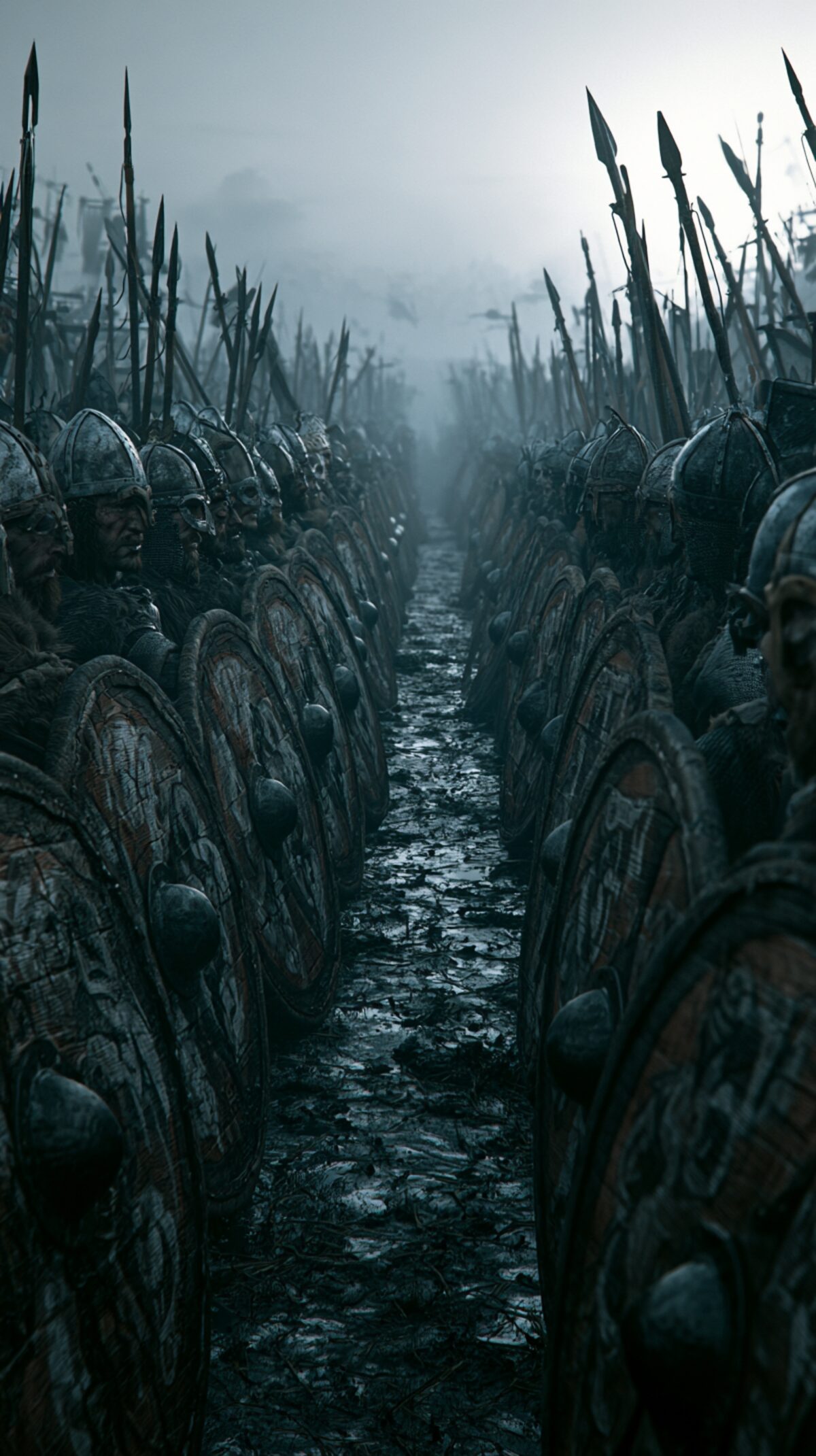
Caesar gives them only a few sentences, yet they sit at the centre of one of early history's most stubborn questions: who were the "Germans on this side of the Rhine"? The Segni and Condrusi lived between the Eburones and the Treveri, in the country of Liège, Namur and the Ardennes. This article sets the passages side by side, tests what names and finds can carry, and says openly where the evidence stops.
Some peoples of antiquity come with battle accounts, king lists and graves. The Segni and the Condrusi come with a handful of sentences. Julius Caesar names them in his report on the Gallic War, and after that they vanish as actors from the written record. What remains is a set of imperial-period inscriptions, a landscape name and a good deal of disagreement among specialists.
It is still worth looking closely. Both peoples belong to the group Caesar labels with a collective term, Germani cisrhenani, the Germans "this side" of the Rhine, meaning the Gaulish side from a Roman point of view. That sounds like a tidy ethnic category. It is not. Read closely, the passages show Caesar assigning a political and military label that overlaps with language and descent only in part. That is why the Segni and Condrusi make a good test case for how carefully Roman tribal names must be handled.
The region lies in the middle of today's Euregio. From Aachen it is roughly 70 to 100 kilometres south-west to the Condroz, the hill country south of the Meuse. That distance is my own rough estimate from a map, not a source claim. That the area around Aachen, Liège and the Eifel mattered in Caesar's world is well documented, and this article shows where.
The source situation fits into one paragraph, and that is already a finding.
First, Caesar himself. His Commentarii de bello Gallico (notes on the Gallic War) were written during or shortly after the campaigns of 58 to 50 BC. The Condrusi appear in Book 2 (chapter 4), Book 4 (chapter 6) and Book 6 (chapter 32); the Segni only in Book 6, chapter 32. That is practically the whole written record for the early period of both peoples. Caesar writes as a commander justifying his actions, about regions he saw only in part. In Book 2 his informants on the Belgic tribes were the Remi, an allied people with their own interests.
Second, the imperial period. The Condrusi name lives on in a district, the pagus Condrustis, named in an inscription from the middle of the 2nd century AD, and in dedications to a goddess apparently tied to the tribe. The Christian writer Orosius spells the name Condurses in the early 5th century. That is what English Wikipedia reports, citing the specialist literature; I did not see the inscriptions myself.
Third, linguistics and archaeology. Both are thin for these peoples, as shown below.
A caution: the identification of the Segni with the later Sunuci, which older scholarship considered, is a 19th-century guess and not a finding. What Pliny or Ptolemy say about the two names I cannot document, because I read no passage in either. I do not treat them as witnesses here.
In 57 BC Caesar stands in the territory of the Remi, and the Belgic tribes have joined forces against him. He asks the Remi what the Belgae can field. They answer at length: most Belgae, by their own tradition, descend from Germans who crossed the Rhine long ago and drove out the Gauls. Alone among the Gauls, the Belgae had kept the Teutones and Cimbri out of their land, which explains their confidence in war.
Then comes the list of numbers. The Bellovaci can raise a huge force on the Remi's account; Suessiones, Atrebates, Ambiani, Morini and others get figures of their own. At the end of the list stand the Condrusi, Eburones, Caeraesi and Paemani, "who are called by the common name of Germans", and for them together about forty thousand men are estimated. The wording carries weight: the Remi gather four peoples under one name. Whether the four called themselves that is not stated.
Two points need recording. The figure is an estimate Caesar takes from third parties. It is not a count, and nobody can say how the Remi arrived at it. And the Segni are missing from this list. English Wikipedia reads that as a deliberate omission, perhaps because the Segni did not yet appear as a separate people or counted within one of the other groups. That cannot be proved; it is one possibility among several, and Caesar does not explain it.
Something else stands out: the Aduatuci, whom Caesar describes as descendants of the Cimbri and Teutones, are kept apart from these four. For Caesar they are not "Germans" in the narrow sense, although their origin too is sought in the east. So his label does not simply map descent. More on that people appears in the article on the Aduatuci.
The second passage dates to 55 BC. Two peoples, the Usipetes and Tencteri, had been pressed by the Suebi and crossed the Rhine. Caesar hears of it and fears the Gauls might join them. He learns that the newcomers had advanced into the territory of the Eburones and Condrusi, "who are clients of the Treveri". The Latin phrase reads in fines Eburonum et Condrusorum, qui sunt Treverorum clientes, pervenerant.
A client stands in a relationship of protection and dependence. It does not mean the Condrusi were Treveri, and it does not mean they paid tribute, since Caesar says nothing on that. It does show that, north of the Moselle, the Condrusi were an appendage of the powerful Treveri in the political landscape and not a people standing alone. About the Segni the passage says nothing; they do not appear in it.
The story of the Usipetes and Tencteri is told in the article on Tencteri and Usipetes. For our topic it is enough to note that the two peoples passed through the land of the Condrusi and Eburones. The left bank of the Rhine was no closed world but transit and settlement country, where groups constantly shifted.
In the winter of 54/53 BC the Eburones rose under Ambiorix and Catuvolcus against the Roman garrison, and the Romans lost an entire winter camp. The Eburones do not belong in this article; their story is on the page about the Eburones. What matters is what followed for their neighbours.
In the summer of 53 BC Caesar marches against them again. The Eburones have no closed army, no town and no fortified camp, and the survivors hide in valleys, forests and marshes. Some flee into the Ardennes. Catuvolcus, who rules one half of the tribe, takes his own life with yew poison according to Caesar. And now the Segni and Condrusi appear.
The decisive passage is short. The Segni and Condrusi, who live between the Eburones and the Treveri, send envoys to Caesar. They ask not to be treated as enemies. They had neither planned a war nor helped Ambiorix.
"Segni Condrusique, ex gente et numero Germanorum, qui sunt inter Eburones Treverosque, legatos ad Caesarem miserunt." – "The Segni and Condrusi, of the stock and number of the Germans, who live between the Eburones and the Treveri, sent envoys to Caesar."Caesar, De bello Gallico 6,32, opening of the sentence in Latin (Latin Library, read through a fetch tool); English rendering my own. Public domain as an ancient text.
The phrase ex gente et numero Germanorum resists a literal rendering. It can be read as "from the people and the class of the Germans". In essence it says: these two count among those called Germans. Whether Caesar means descent or only membership in the category he has used since Book 2, the sentence does not decide.
Caesar's answer is matter-of-fact. He demands that any Eburones who fled to the two peoples be handed over, and promises in return not to touch their territory. Then he divides his army, has the baggage brought to Aduatuca and leaves Legion XIV there under Quintus Cicero. The negotiation stands in the text directly before the army units set out. It shows what the two peoples did: they negotiated instead of fighting. In their position that was sensible.
The briefing for this article mentioned a "devastation of the Segni and Condrusi". I checked and cannot confirm that. Chapters 6,33 and 6,34 describe how Caesar distributes his legions. Labienus goes with three legions to the Menapii, Trebonius with the same number into the region bordering the Aduatuci, and Caesar himself takes the remaining three towards the Scheldt and the edge of the Ardennes. The target is the devastation of the Eburones, not of the Segni or Condrusi, and Caesar also calls on neighbours to plunder so that Roman soldiers need not risk their lives in the forests.
Whether the neighbours called upon included the Segni and Condrusi, the text does not say. The only people chapter 35 names explicitly are the Sugambri from the right bank, who cross the river with a cavalry force of about two thousand and then attack Aduatuca. More on them in the article on the Sugambri. Anyone claiming the Segni and Condrusi joined in plundering the Eburones goes beyond the text.
The conclusion one may draw from the silence is modest. After chapter 32 we hear nothing more of the two peoples. Caesar mentions no battle against them, no submission and no destruction. That they were left in peace is conceivable but not attested.
Here lies the core of the interest. Caesar calls the two peoples Germans, yet their names carry features that linguists read as Celtic.
For the name of the Condrusi, English Wikipedia points to Günter Neumann (1999) and Peter E. Busse (2006): the prefix con- or com- ("with, together") is Gaulish, and the element -drūs- is usually regarded as Celtic too, although its meaning is unknown. Neumann holds a Celtic origin to be the most likely explanation. This is a second-hand citation; I have not read the works themselves.
For the Segni there are two rival readings. The Celtic one derives the name from an element sego- ("victory, force"). The Germanic alternative explains the spelling -gn- as the Latin rendering of a Germanic -ng- (compare names such as Reudigni and Marsigni) and reconstructs a form that might mean "those living in a dry region". This too I report after English Wikipedia, which cites Neumann (1999). Both readings are hypotheses, and a name comparison alone cannot decide between them.
Behind this lies a larger problem. The picture of the "Germans left of the Rhine" has been fiercely debated. According to English Wikipedia, Timpe (1993) argues that the word "Germani" did not reflect real ties among all the peoples concerned. Roymans (2004) and Steinacher (2020) see a narrow use in Caesar for the groups along the Rhine and a wider one for peoples of similar perceived ancestry. Steinacher even suggests Caesar created a new category of barbarian between Gauls and Scythians. Wightman (1985) sketches two scenarios: an arrival already in prehistoric times, perhaps in the Urnfield period, or a descent from the Hunsrück-Eifel culture on the Moselle, whose bearers would then have moved north across the Ardennes. I read none of these works; the references come from the Wikipedia summary.
One finding is undisputed: the names of the Usipetes and Tencteri and many names in the Lower Rhine area also look Celtic, as the same summary notes. Anyone who infers from "Germani" that the Segni and Condrusi spoke Germanic languages infers too much. The names that survive cannot settle the linguistic question. More on language history is in the article on the Germanic language, on the boundary in the article on the Celts.
A good century after Caesar, Tacitus approaches the subject from the other side in the Germania. In chapter 2 he writes that the name "Germania" is new and came up only recently: those who first crossed the Rhine and drove out the Gauls are now called Tungri, but were then called Germani. The Latin reads qui primi Rhenum transgressi Gallos expulerint ac nunc Tungri, tunc Germani vocati sint. The name was then transferred, first by the victor out of fear and soon by the people themselves, to all, as his thought continues. I read the passage in Latin and summary through the Latin Library.
Tacitus names neither the Segni nor the Condrusi. That they count among the ancestors of the Tungri is therefore an inference of scholarship. It is plausible because the civitas Tungrorum later arose in the same area, a Roman administrative district to which, according to English Wikipedia, the district of Condrustis belonged as a subunit. What is certain is only that after Caesar the area was absorbed into the administration of the Tungri. More on this people and its city is in the article on the Tungri.
The tribe of the Condrusi can be located fairly well because its name clings to a landscape. The Condroz is a hill country north-west of the Ardennes, south and west of the Meuse, south-west of Liège and south-east of Namur. English Wikipedia sums it up after Marie-Thérèse Charlier (2013); for Caesar's time the area lay between that of the Treveri and that of the Eburones (Wightman 1985).
From the imperial period come inscriptions that show the tribe as a community within the Tungri. Wikipedia names a dedication to the protective goddess Viradecthis (also Virodactis), venerated around AD 200 to 250 in a sanctuary at Strée in Modave, as well as soldiers from the Condroz at Hadrian's Wall and Tungrian sailors who invoked her. There are also dedications to the Matres Cantrusteihiae, which Busse (2006) interprets as "mother goddesses of the Condrusi". A military diploma shows men of the tribe serving as auxiliaries and receiving citizenship after service. All this is again second-hand. It does give the name a life after Caesar that the Segni lack: of them we know nothing certain after 53 BC.
In the Middle Ages the name continues in charters. Wikipedia gives as the earliest record a donation by Carloman to the abbey of Stavelot-Malmedy in 747, then the Treaty of Meerssen of 870, which mentions the district. The place name Condroz holds to this day.
Research has not answered the question whether an archaeologically recognisable "Condrusi territory" existed in the Iron Age in a way I could document here. A search for excavation reports yielded mainly individual publications, which I did not evaluate systematically.
One example shows what is tangible in the Condroz at all. At the "Rocher du Vieux-Château" near Pont-de-Bonne (municipality of Modave) a team around Emmanuel Delye excavated in 2012. The short report in the Chronique de l'archéologie wallonne (volume 21, 2014) mentions postholes with La Tène pottery, slag and iron-working debris. The authors consider it possible that these finds relate to building a late La Tène rampart of the murus gallicus type. That is a preliminary report, not proof, and it mentions neither Condrusi nor Eburones. The site must therefore not be assigned to a tribe. It only shows that in the Condroz, in the decades before Caesar, there were fortified places and iron working.
Here lies the methodological problem. A culture can be described archaeologically, a tribe only through texts. Whether the people at the Vieux-Château saw themselves as Condrusi, we do not know, and pots and slag cannot tell us.
The regional link is real but needs measure. According to English Wikipedia the Segni are presumed to have lived in the Luxembourgish and Belgian Ardennes, between the Treveri and the Eburones, not far from the Condrusi. Caesar does not name the Eifel in this context; that the Ardennes reach into the northern Eifel is a modern geographical convention. Whoever moves the Segni to the Eifel follows a conjecture.
For the later Sunuci, whom some scholars equate with the Segni, a settlement area between Tungri and Ubii is assumed according to Wikipedia, and one proposal names Kornelimünster near Aachen (Haeussler, King and Andrews 2007). That points to a debate, not to a location. The line Segni to Sunuci is not attested, and the link to Kornelimünster even less. More on the history of the land is in the articles on the Germanic peoples in the Rhineland, the Ubii and the Treveri.
Three questions the record cannot answer. How large were the two peoples? Only the forty thousand for four tribes exist, an estimate by third parties. Did they speak Germanic, Celtic or a mixture? The names lean towards Celtic, Caesar's label towards Germanic, and the rest is missing. And what became of the Segni? After 53 BC the sources fall silent. That they merged into the Tungri is probable, but no evidence exists.
Engaging with these peoples teaches above all how thin the foundation of our "tribal history" often is. A collective name such as "Germans" tells more about Caesar's viewpoint than about the people. The neighbours to the west and north, Nervii and Menapii, are similarly hard to grasp, as the articles on the Nervii and Menapii show.
Were the Segni and Condrusi Germans? Caesar calls them so. Whether that means language, descent or only a political category is disputed. Their names can partly be read as Celtic.
Where did they live? The Condrusi in the Condroz south of the Meuse, the Segni probably in the Ardennes between Eburones and Treveri. Exact borders are not recorded.
Did they fight Caesar? Not in the sources. The Condrusi stand in the list of Belgic contingents of 57 BC, and in 53 BC both peoples send envoys so as not to count as enemies. Caesar names no battle against them.
What does the name Condroz mean? It derives from the Condrusi. The meaning of the tribal name is uncertain; a Celtic prefix con- is thought likely, the second element is unexplained.
What became of the peoples? The area was absorbed into the civitas of the Tungri. The district of Condrustis survived as an administrative name; of the Segni there is no certain trace.

The Eburones · The Treveri · The Atuatuci · The Tungri · The Menapii.
All History & Finds articles →
Some peoples leave behind vast empires. Others leave behind a single sentence. The Segusiavi managed neither, but they …
Read more →Tacitus calls the Semnones the oldest and noblest people of the Suebi. Somewhere between the Elbe and the Oder, he …
Read more →Long before the Edda and the Viking Age, a Roman described a Germanic cult between the Elbe and the Oder: a wood that …
Read more →The Senones are the Celtic people who took Rome around 390 BC, all but the Capitol. Their leader Brennus is said to …
Read more →