A man who feeds eighty followers through the winter on an Orkney island, sows his fields in spring and then sails off to plunder: that is how the Orkneyinga saga draws Svein Asleifarson. About a quarter of the saga revolves around him, and since the nineteenth century he has been called “the last Viking”. This article separates what the tradition tells from what can be checked independently – which is a good deal less. I read secondary accounts for it, not the full saga text; the source list says so, and where the evidence is thin I say that too.
Svein Asleifarson (Old Norse Sveinn Ásleifarson, usually Sweyn Asleifsson in English) lived in the twelfth century in the Earldom of Orkney, the earls’ realm over Orkney and Shetland, whose influence also reached Caithness on the Scottish mainland. According to the saga he was born in Caithness; his father was Olaf Hrolfsson and his mother was called Åsleik, from whom his metronymic comes. The usual dates are roughly 1115 to 1171. The “roughly” is meant seriously: his birth year is not recorded but worked backwards from the story.
What sets him apart from the Vikings of the ninth and tenth centuries is the setting. The early raids that people link with Lindisfarne in 793 lay more than three centuries behind him. The Norse in the west were by then landowners, Christians, vassals and kin of the locals. Svein continues the old pattern by other means: he owns land, keeps a household and fits out ships for booty. The saga takes this for granted and does not judge it morally – later readers do that.
For an overview of the earls, see our article on the earls of Orkney; the Scottish side of Norse expansion is in the piece on the Vikings in Scotland.
Almost everything known about Svein comes from a single source, the Orkneyinga saga. In the account I read, it was written by an unknown Icelandic author, probably in the orbit of Oddi. The original late twelfth-century version is lost. The surviving text dates to the early thirteenth century, probably around the death of Harald Maddadsson in 1206; by the 1220s, according to Alex Woolf as cited there, a version was in circulation. The oldest complete manuscript is the Flateyjarbók of the late fourteenth century.
Two points matter for Svein. First, his story takes up about a quarter of the saga. In Guðbrandur Vigfússon’s 1887 division, chapters 56 to 59 and 61 to 118 form the “history of Earl Rognvald and Svein”; chapter numbers differ between editions (the Penguin translation counts differently), so I give no chapter numbers for single episodes. Second, there are signs that the oldest version ended with Svein’s death: a Danish translation of 1570 stops there, and later additions are dated to about 1234/35. That makes the Svein chapters close to the events, at least closer than the chapters on the earls’ early history, which lie centuries back.
Closeness is not neutrality, though. The saga is not a chronicle but narrative literature, with dialogue, punchlines and figures that serve story arcs. Outside it, only traces survive for Svein’s life: Scottish and Irish sources report events that could overlap with saga episodes, such as the recapture of Dublin in 1171. In my sources they do not name him unambiguously. That needs saying before any detail is passed on as fact.
For the genre, see our overview of the sagas and the piece on the sagas of Icelanders. The Orkneyinga saga belongs to the kings’ and earls’ sagas, closer to historical narrative than to the family sagas, though the borders are not sharp.
The sequence below follows the saga plot as modern summaries give it. Most years are calculated from the narrative and should be read as approximate.
About 1134: a killing and a flight. In the saga the young Svein kills Earl Paul’s cup-bearer in a quarrel over a drinking game. He flees to the Hebridean island of Tiree and is taken in by Holdbodi Hundason. Whether the incident happened in this form and year cannot be confirmed independently. I give no location, because I did not find it supported in the accounts I read. A killing of one “Swein Brjostrof” (Sweyn Breast-rope) at Orphir on Orkney Mainland, which stood as a question in my topic brief, I could not confirm either, so I leave it out of the chronology.
1140/41: Wales and Man. Holdbodi invites Svein on a raid against the Welsh coast in 1140. They are repulsed; Holdbodi withdraws to Man, Svein to Lewis. In early summer 1141 Svein goes to Man, where Holdbodi has meanwhile allied with the Norman-Welsh lord Robert, who had defeated them the year before, and attacks him. Friends become enemies. The saga goes on to say that Olvir Rosta killed Svein’s father; Svein later attacked Olvir and killed his grandmother, whereupon Olvir fled to the Hebrides. This strand is a textbook case of saga-style feud.
Quarrels at home and with Rognvald. Svein falls out with his ship captains under his brother-in-law Thorbjorn Thorsteinsson. Earl Rognvald Kali Kolsson drives him out of Orkney, but King David I of Scotland brokers a peace. The episode shows how closely Orkney politics was tied to the Scottish court.
The Isle of May. Svein and his companion Margad Grimsson, banished by Rognvald, raid the Scottish east coast and, according to the saga, the monastery on the Isle of May in the Firth of Forth. The monks grow suspicious; Svein escapes into the Firth. King David receives him in Edinburgh, says the saga, and compensates the victims from his own purse. A striking twist: the king pays for the raider. As saga storytelling it rings true in tone; as fact it is not secured.
1153 to 1158: three earls. In 1153 the three earls Rognvald Kali Kolsson, Erlend Haraldsson and Harald Maddadsson fall out. Svein, backed by the new Scottish king Malcolm IV, sides with Erlend. He attacks the other earls’ ships and raids the Scottish east coast. After Erlend dies in 1154, Harald drives Svein into hiding, but Svein regains his position. The saga has him raiding as far as the Isles of Scilly. After Rognvald’s death in 1158 Harald and Svein reconcile, and Svein becomes foster-father to Harald’s son Hakon.
1171: Dublin. Svein dies while trying to take Dublin. More on that below.
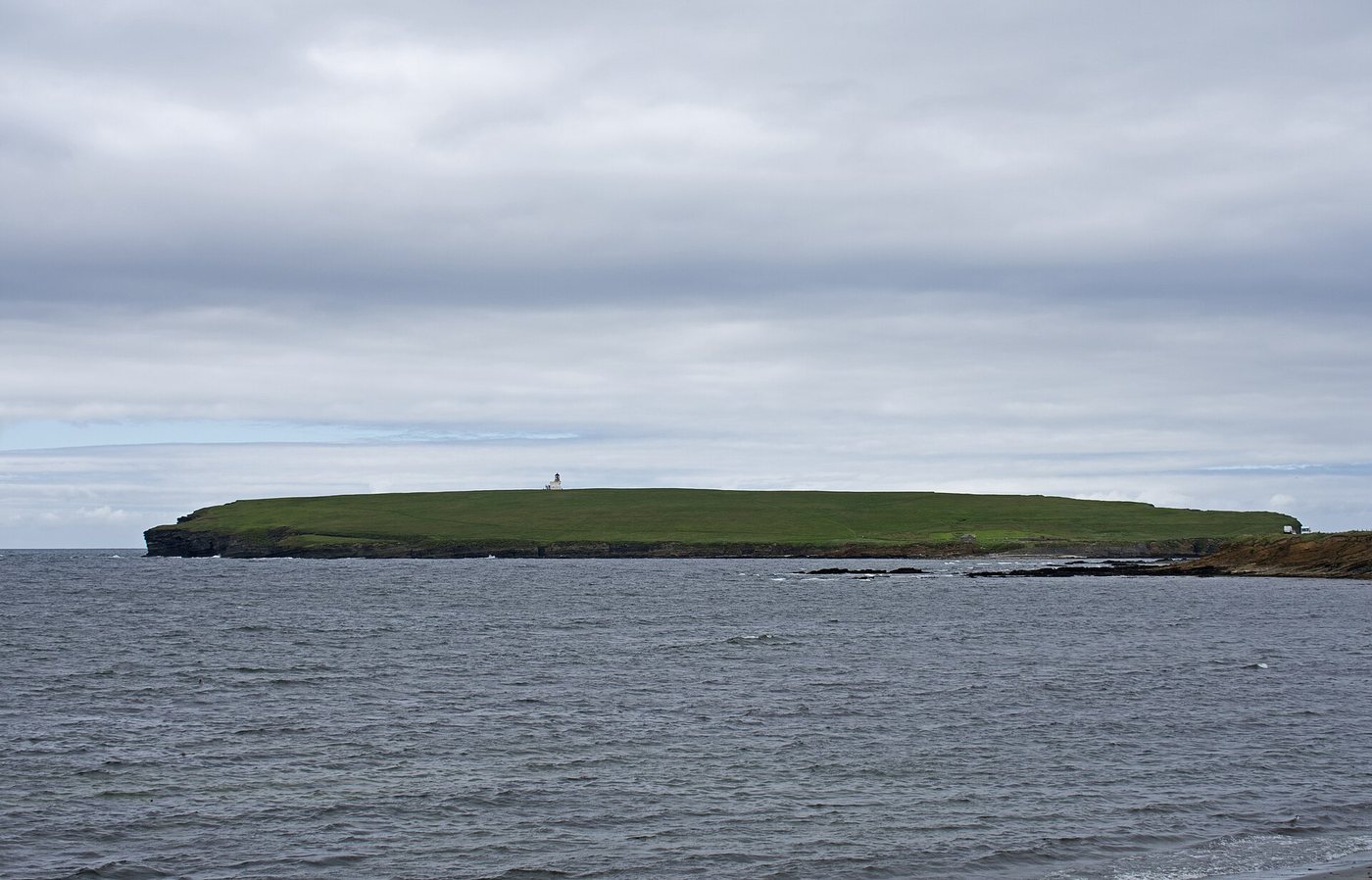
Gairsay is an island about 2.4 kilometres off the Orkney Mainland coast, in the parish of Rendall. It measures roughly 3.2 by 1.6 kilometres (two by one miles) according to Wikipedia, covers about 240 hectares and rises to a conical hill of 102 metres. Only a handful of people live there today. According to the saga, Svein kept his main farm here. He worked the land in summer, spent the winter on the estate with some eighty armed men, and set out after the spring sowing to raid the coasts of Scotland, England and Ireland. The summary I read gives the rhythm as two voyages a year, spring and autumn. I could not see the saga’s exact wording and therefore do not put it in quotation marks.
What carries the picture is the economy behind it. Eighty men must be fed, housed and kept occupied in winter. A 240-hectare island, partly hill, could hardly have done that alone. The saga solves the puzzle through plot: the booty fills the stores. Whether eighty is an exact count or a round figure for “a large following” cannot be decided.
Archaeologically, Gairsay is barely attested in the accounts I read. No excavations, dated finds or Norse buildings are named. The only visible older remains mentioned, in an 1840 gazetteer, are of a house on the south shore linked to the Craigie family; it is post-Norse. A seventeenth-century mansion, Langskaill, is said to stand on the site of Svein’s estate – the claim names no archaeological basis. I cannot rule out that investigations exist which I did not find; a hall of Svein’s has not been shown from the ground so far. A visitor sees a landscape, not a feature.
Svein was no earl. The saga gives him no such title, yet his backing becomes a lever in earldom politics. That is the core of his role: he commanded ships and men that no earl could simply bind to himself. The saga puts him now for, now against a ruler, depending on who needs or threatens him. In 1153 he stands beside Erlend and attacks his opponents’ ships. After the peace with Harald he becomes foster-father to Harald’s son Hakon – a social bond that was very binding in Norse custom.
Rognvald Kali Kolsson, born around 1100 and died in August 1158, was, according to the account I read, appointed Earl of Orkney and Shetland by King Sigurd in 1129 and hailed as earl in 1136. The two dates probably mark different stages of his rise. In 1137 he began St Magnus Cathedral in Kirkwall; in 1138 he took Harald Maddadsson on as co-earl. Harald was then a child, a nephew of Paul Haakonsson, who inherited Caithness and stood under Rognvald’s guardianship. Rognvald was killed in 1158 by Thorbjorn Klerk, whom he had outlawed. His canonisation is given as 1192; whether it had the rank of a formal canonisation is doubted, since no surviving records confirm it.
A name trap: the Rognvald of this article, Rognvald Kali Kolsson, is not the Rognvald Eysteinsson of the earls’ early days, the figure told as founder of the earldom; he has his own article, Rognvald Eysteinsson. They share a name, not an era.
How to weigh Svein’s power depends on a source question. Some scholars read the saga as a counter-draft to Norwegian royal propaganda and Rognvald as a cultured, non-despotic ruler; the saga presents him as a poet and in the end a saint, while Svein at times blackmails him. The picture of Svein as a blackmailing retainer may therefore also have a literary function – as a foil to the cultured earl. That cannot be settled clearly.
Harald Maddadsson ruled Orkney for decades; the saga was probably written close to his death in 1206. For the Svein chapters that has a consequence: the author presumably knew people who had known Svein, but wrote at a time when the earls’ court rested on Harald’s line. The reconciliation of 1158 with the foster-fatherhood of Hakon fits that interest, though no intention of the author can be proven.
The saga has Svein die in 1171 in an attack on Dublin. The circumstances are confused. The events seem to match Haskulf Rognvaldsson’s (Ascall mac Ragnaill’s) attempt to retake Dublin in 1171 (English Wikipedia calls it a brief retaking in the Svein entry but a failed assault in the Ascall entry); when the Normans won the city back, Svein and Hakon are said to have fallen together. Saga and Anglo-Norman accounts conflict on many details. Whether Giraldus Cambrensis’s “John the Mad” (Johannes Wode) means Svein has been suggested but not confirmed. 1171 is therefore the usual date, and Svein’s participation is saga tradition. For Dublin as a Norse town see Dublin in the Viking Age; for Irish ties in general, the Vikings in Ireland.
According to the summary I read, Svein’s last words say that he belongs to the bodyguard of Saint Earl Rognvald. That fits the narrative, since it ties the raider to the saint who once drove him out. Whether it reflects a cult the author wished to promote, or a memory, remains open.
The label “the last Viking” is not from the saga but from later reception. It is a tag: Svein is neither the last Norseman on a raid nor the last to be called a “viking”; sea-raiding in the North Atlantic went on long after, and where the Viking Age is said to end depends on the country. As a slogan, though, it does a job: it casts Svein’s biography as the closing image of an era.
On everyday life, Svein’s yearly round shows how closely farming and raiding could be linked. For the wider image of the Viking, from horned helmets to clichés, see “typically Viking”. For the Norse in southern Europe, whose voyages ended very differently, see the article on Normans and Varangians.
“Let it be known to all … that I belong to the bodyguard of Saint Earl Rognvald.”
Svein’s last words in the Orkneyinga saga, as rendered in the English Wikipedia article “Orkneyinga saga”; I could not identify the translator of the English wording quoted there, and the Old Norse text was not accessible to me. Treat as a secondary rendering; public-domain status of the English wording is unclear (possibly Anderson 1873), so read it as a paraphrase, not a verbatim quotation.
Svein shows how an author around 1200 narrates a landowner from his grandparents’ generation. Three readings stand side by side. The first takes the saga as a substitute for annals and calculates years back from the plot. The second reads it as literature and asks what role Svein plays in the story’s structure, for instance as a counterpart to Rognvald. The third looks for traces in the ground and in other texts and so far finds little. All three are legitimate; they should not be mixed up. Whoever writes “1141 on Man” or “Isle of May” into a CV is retelling a saga, not citing a charter.
The summaries behind this article refer to Pálsson and Edwards (Penguin, 1981), Thomson, The New History of Orkney (2008), Beuermann (2011) and Gray (2006). I did not have these works at hand; figures and attributions are therefore subject to the caveat that they come through summaries.
Who was Svein Asleifarson? A landowner and raid leader from Caithness and Orkney in the twelfth century, the main figure of the last part of the Orkneyinga saga. Almost everything we know comes from that saga.
Where was his farm? On Gairsay, an island off Orkney Mainland. According to the saga he lived there in winter with about eighty men. In my sources no hall has been excavated there.
When and where did he die? By the usual tradition in 1171 in a fight for Dublin. The circumstances are confused, and saga and Anglo-Norman accounts disagree on details.
Why is he called “the last Viking”? It is a slogan from later reception, not a saga title. It marks the end of a raiding tradition, not the end of sea-raiding in the North Atlantic.
Is the Orkneyinga saga reliable? The Svein chapters are considered closer to events than the early chapters, but remain narrative literature. Anyone who wants to establish a detail needs a second source.

The Earls of Orkney · Rognvald Eysteinsson · Viking Dublin · Vikings in Scotland · Norse Kings.
All History & Finds articles →
Sweyn Forkbeard (Old Norse Sveinn tjúguskegg) was the Danish king who conquered England in 1013: by the end of that …
Read more →Around 1176 a priest raised in the Faroe Islands leaves the islands, claims to be a king's son, and a year later leads …
Read more →Around the year 1000, King Olaf Tryggvason of Norway lost his fleet, his throne and most likely his life, somewhere in …
Read more →Few questions reach our workshop as often as this one: „Is that symbol really old?" We love engraving Norse signs – but …
Read more →