The Trinovantes appear rarely in ancient texts: as petitioners in Caesar, in a single clause of Tacitus's account of the great revolt, and not by name in Cassius Dio at all. Yet their territory holds one of the best-explored archaeological landscapes in Britain. This article tells their story from their side of the map, keeps text, find and interpretation apart, and says plainly where the sources fall silent or disagree.
The Trinovantes, written Trinobantes by Caesar, lived in the late Iron Age in what is now Essex and southern Suffolk, north of the Thames estuary. Where their borders ran is uncertain. Tribal territories in Britain are not recorded anywhere; they are inferred from coin distributions, settlement finds and later Roman administrative boundaries, and the edges towards the Catuvellauni in the west and the Iceni in the north cannot be drawn to the mile. Some surveys add parts of Hertfordshire and even London. That is reconstruction.
The written evidence can be listed quickly. Caesar names the tribe in book five of his Gallic War, in the account of his second British expedition in 54 BC. Augustus, in his own record of achievements, mentions two British kings who sought refuge with him, and one of them was probably a Trinovantian. Tacitus uses the name once in the account of the revolt I have read, in Annals 14.31, which concerns the uprising of 60/61 AD. On top of that come coins bearing royal names and the excavations in and around Colchester. That is all, which is why nearly every sentence about "the Trinovantes" is an inference from a few fixed points.
A note on spelling: Caesar's manuscripts give Trinobantes, while the Latin text of the Annals I consulted gives Trinovantes. Both mean the same tribe. The meaning of the name is guesswork. One proposal combines a Celtic intensifier tri- ("very") with an element that may mean "new", yielding something like "the very vigorous" or "the newcomers". It is a proposal, nothing more. Geoffrey of Monmouth's medieval "Trinovantum", a New Troy that he identified with London, belongs to legend rather than history; it merely shows that the tribal name was still alive in learned circles centuries later.
One warning, because it will be needed later: the Trinovantian leader Mandubracius has no demonstrable connection with the Gallic Mandubii of Alesia. The echo between the two names is striking, but whether it is more than coincidence or a shared Celtic name element cannot be shown.
The region lies in eastern England, flat to gently rolling, cut by rivers such as the Colne, Stour and Blackwater that open into deep estuaries. For the Iron Age that meant access to the sea on one side and to the interior on the other, with short crossings to the Continent. This position helps explain why imports from the Mediterranean world and Roman Gaul turn up early here. It does not by itself explain why the tribe became politically important; for that we need the story of its kings.
The finds suggest farmsteads, hamlets and a few fortified places. In the core area around Colchester, a curious structure grew up during the first century BC that researchers call an oppidum: a large, loosely built-up area marked out not by a closed wall but by long lines of bank and ditch. More on that below. For the wider picture of the island's peoples, see The Britons; this article sticks to what is attested for the Trinovantes themselves.
In late summer 54 BC Caesar stands north of the Thames with several legions. His opponent is Cassivellaunus, whose tribe Caesar does not name; scholars usually assume he belonged to the Catuvellauni, but that is an assumption. Cassivellaunus wages a guerrilla war with chariots and avoids pitched battle (for that style of fighting see Celtic chariots). At this point the Trinovantes send envoys to Caesar. Chapter 5.20 is the only narrative we have that touches their politics at all, even though it was written by a Roman.
"The Trinobantes, almost the strongest tribe of those regions …"Caesar, De bello Gallico 5.20.1: Trinobantes, prope firmissima earum regionum civitas (public domain; own translation of the opening of the sentence)
What Caesar goes on to say can be summarised in a few steps. From this tribe came the young Mandubracius, who had put himself under Caesar's protection and had come to him on the Continent, in Gaul. His father had held the kingship in the community and had been killed by Cassivellaunus; Mandubracius himself had escaped death by fleeing. In some manuscripts the father is called Imanuentius, in others the name is missing, and the spelling varies (variants such as Inianuvetitius or Imannuetitius are recorded). The Latin Library text I consulted does not contain the name. Whether Imanuentius is what Caesar wrote therefore remains a question of manuscripts; the Celtic scholar John Koch has proposed an original form such as Mannuētios, but that is reconstruction, not a manuscript reading.
The envoys, Caesar says, promised submission and asked him to protect Mandubracius from Cassivellaunus and to send him back as ruler of the tribe. Caesar demanded forty hostages and grain for the army, and sent Mandubracius to them. The Trinovantes delivered promptly. The next chapter shows why this mattered to Caesar: he forbade his soldiers any outrage against the Trinovantes, and the Cenimagni, Segontiaci, Ancalites, Bibroci and Cassi then submitted as well. From them Caesar learned where the main stronghold of Cassivellaunus lay, in woodland and marsh, and he attacked it from two sides. In the end (5.22) Cassivellaunus negotiates through Commius the Atrebatian (on him see the Atrebates); Caesar demands hostages and an annual tribute and forbids Cassivellaunus to harm Mandubracius or the Trinovantes.
What of this is secure, and what is not? The sequence of embassy, hostages, restoration and protective clause stands in Caesar. Everything else is reading. Caesar writes for a Roman audience and for his own career; a tribe that submits of its own accord makes a good story. Whether the Trinovantes really counted on Caesar's help or simply played him against a neighbour cannot be decided. The phrase "almost the strongest tribe" (prope firmissima) also calls for caution. Firmus means "firm, strong"; some commentators read military strength, others reliability, and Caesar gives no numbers. Popular accounts have turned it into "the most powerful tribe in Britain", which is not in the text.
It is just as firm what is not there. Caesar names no Trinovantian place, no Camulodunum and no other settlement. The man who returns as king vanishes from the sources afterwards. What became of Mandubracius we do not know. I know of no coins that could be attributed to him, and I will not invent any.
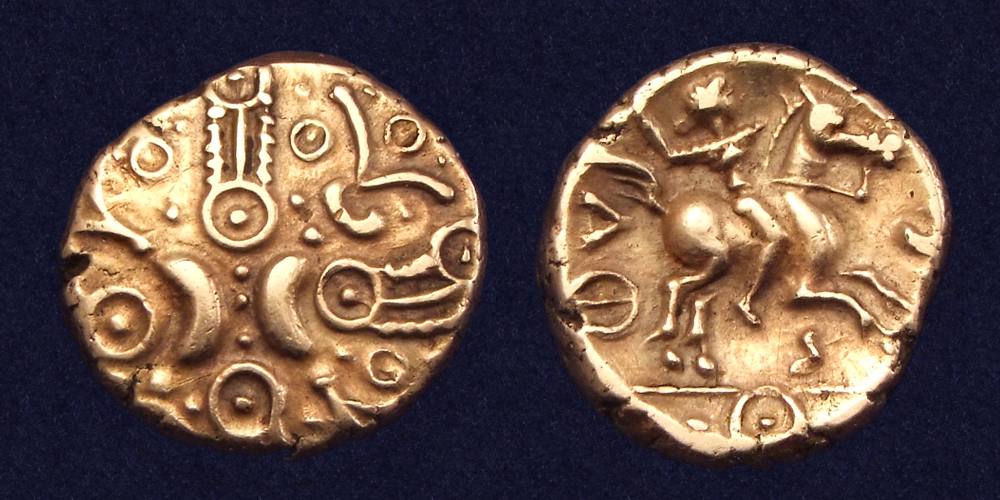
After Caesar the written record breaks off for almost a century. What we know about the Trinovantes of this period comes from coins and graves. British rulers began in the late first century BC to put their names on coins, often in Latin letters and on Roman models. For the Trinovantian area the first ruler we can grasp is Addedomaros, who set his name on coins. Which motifs and metals occur I do not go into, since I have not consulted coin catalogues myself; statements about coins here rest on general surveys.
The chronology of these kings is disputed, and the dates given are approximations. English Heritage places Addedomaros's move of the power centre to Camulodunum around 25 BC, while other surveys put his reign at roughly 20–15 BC; the scholarly literature discusses shifts of a decade or two. On the usual reading Addedomaros was followed by a son called Dubnovellaunos (also Dumnovellaunus), who came to power around 10 to 5 BC. Here the uncertainty begins: there was also a Dubnovellaunos in Kent, and whether they are one person is debated. Wikipedia summarises the research by saying the Trinovantian Dubnovellaunos is probably the king who appears in Augustus's Res Gestae (chapter 32). The text I could see breaks off after "Dumnobellaunus and Tim…"; the second king is usually read as Tincomarus of the Atrebates (see the article on the Atrebates). The line shows that British kings sought help in Rome; it says nothing about timing or occasion.
That Britain's kings knew the Roman emperor is also shown by the burial at Lexden near Colchester. According to English Heritage it dates to between 15 and 10 BC: a pit beneath a large round mound. In it lay a mature man, on one reading probably Addedomaros, with a chain-mail shirt, bronze figurines, gold and silver work and a small medallion of Augustus from 19–15 BC. This is today read as a sign of Roman favour or connection. That the dead man is Addedomaros remains interpretation; the grave goods point to a ruler of the period, no more.
The name Camulodunum means "fortress (dunon) of Camulos"; Camulos is regarded as a Celtic war god, a reading that is common but cannot be proved from the place name alone. On coins the place appears in abbreviations such as CAMV or CAMU, first with Tasciovanus, whom research usually links with Verlamion (later St Albans). Wikipedia dates these coins very loosely to "some time between 20 and 10 BC". That is a striking observation: the name of the town first appears on the coin of a king regarded as a Catuvellaunian. It allows two readings. Either Tasciovanus ruled Trinovantian land for a time and struck coins there, or the mint merely lay within his sphere of influence. Both are interpretation. English Heritage, by contrast, writes that Cunobelinus displaced Dubnovellaunos around AD 9 and then reigned for roughly thirty years; his coins carry the CAMU mark and a portrait in Roman style, and Suetonius calls him "King of the Britons". The two accounts disagree on timing; scholars debate whether Tasciovanus or only Cunobelinus brought the tribe under his rule, and whether the Trinovantes were independent again in between. The two kings are usually read as father and son, which is again an interpretation.
More important for understanding the Trinovantes: to archaeology, Camulodunum is neither a village nor a town in the Roman sense but a landscape complex. A system of dykes and ditches some 24 kilometres long closes off an area between the rivers. Size figures vary by source: one description gives about a thousand hectares, English Heritage speaks of more than twelve square miles (roughly 3,100 hectares), and the two do not fit together unless it is clear whether the inner core or the whole dyke system is meant. The earliest parts are placed between 50 and 25 BC, the bulk of the banks in the first century AD. Who built them and why is unknown; one suggestion is a response to threats from neighbouring tribes, probably the Catuvellauni.
Inside this ring lie three zones that are mentioned again and again. Sheepen on the River Colne is an industrial and harbour area with iron and leather working and a mint; two coins from there show boats, the only known depictions of Iron Age British ships. Finds such as iron bars, slave chains and storage vessels point to trade with the Roman world. Gosbecks, further south-west, is a high-status farmstead regarded as a seat of the rulers, later a sanctuary within an Iron Age enclosure. Whether Cunobelinus was buried there cannot be decided. Lexden, finally, is the burial zone with the mound grave mentioned above and further cremation burials.
Then there is Stanway, a cemetery with chamber graves from around AD 40–60 in the vicinity of Camulodunum. A grave became famous there with cremated remains, a board game with blue and white glass counters, a cloak with brooches and a set of thirteen surgical instruments, plus traces of mugwort in a cup. Whether a doctor, a druid or a healer lay there is open; even the sex of the person is not certain. The finds are real; the label "Druid of Colchester" is journalistic sharpening. One general overview assigns the cemetery to the Catuvellauni; geographically it lies near Camulodunum, in the Trinovantian heartland, where Cunobelinus ruled at the time.
Here we meet a question that the article on the Catuvellauni answers from the other side: who ruled Camulodunum? There Cunobelinus stands at the centre; here we ask what it meant for the Trinovantes. The answer is uncomfortable. No text describes whether the Trinovantes felt conquered, whether they carried the new masters or whether conditions in Essex were less clear-cut than a king list suggests. From coins we read changes of power: first a ruler with a Trinovantian name, then coins with the mint mark CAMU and the names of the neighbouring dynasty. What these changes looked like in daily life at a court near Colchester we do not know. And whether the Trinovantes saw themselves as a people of their own, or whether the name was fixed only by Caesar and his readers, cannot be shown.
In 43 Aulus Plautius lands in Britain with four legions. Cassius Dio describes the campaign in book 60 (chapters 19–23), and it is the only continuous narrative of it. According to Dio, Plautius first defeats Caratacus, then Togodumnus, the sons of Cunobelinus (spelled "Cynobellinus" in Dio); they belong to the house that, going by the coins, ruled Camulodunum. Dio stresses that the Britons were not united but divided among several kings. Part of the Bodunni, who according to Dio were subject to a tribe of the Catuellani, surrender, and Plautius leaves a garrison there. At one river crossing, in the translation I read, Germans in Roman service swim across and attack the horses of the British chariots; the Britons fall back to the Thames. When Togodumnus dies, the Britons close ranks; Plautius halts and sends for Claudius.
The emperor arrives, crosses the river, defeats the Britons and, as Dio has it, takes Camulodunum, "the capital of Cunobelinus". He then wins over many tribes, some by surrender and others by force, and is hailed imperator several times. By Dio's account Claudius stays in Britain only sixteen days. The Trinovantes do not occur in this report. Whether their community fought, negotiated or waited, no text says. Whether the tribe in 43 still stood under the kings of Camulodunum or already counted as part of a Catuvellaunian sphere is likewise open. In the narrative the capital is a Roman objective, not a tribal centre, and that is a viewpoint to keep in mind while reading.
Archaeology answers at once. On the ground of Camulodunum the army built the first permanent legionary fortress in Britain. According to general accounts it lay on a spur downstream of Sheepen and housed Legio XX; it was founded around 44, had an annexe and partly used the older earthworks. Beside Gosbecks stood a smaller fort for auxiliaries, according to the source for cavalry and mixed units. Two tombstones mention a centurion of the legion and cavalrymen, but whether they were stationed there is not certain. The source puts the legion's departure at about 49. Sheepen became the harbour.
What happened to the population in these years remains an open question. Where the kings' farmsteads had stood there was now a fort, and the nearest administration was the army. Whether the Trinovantes negotiated, rendered services or gave up land in this period is not described. Anyone who speaks of an "occupation" uses a word the sources do not.
Tacitus reports in Annals 12.32 that, to speed up the subjugation, a colony of veterans was founded at Camulodunum on captured land. It was to be a safeguard against rebels and to teach the allies respect for Roman law. The section I read gives no precise year; scholars usually put the foundation around 49, from the context of the governor Ostorius Scapula. The passage belongs to Ostorius's campaigns: first he disarmed suspect tribes, the Iceni rose first (see the Iceni), and later came the Cangi, the Brigantes and the Silures.
For the Trinovantes this means: the land of the colony was, according to Tacitus, conquered, confiscated land. Whose land he does not say. The place lay in the heart of Trinovantian territory, and so the conclusion suggests itself that the veterans were settled on land that Trinovantes had farmed before. That is an inference from location, not a quotation. The colony was later called Colonia Victricensis; whether it was originally Colonia Claudia is uncertain. According to the descriptions it was at first the only colony in Britain and is regarded as the provincial capital; the procuratorial office moved to Londinium around the time of the revolt.
Public buildings went up on the former fort annexe: a theatre, an arch at the later Balkerne Gate (probably built around 50) and the temple. The Temple of Claudius is where text and ground meet. Tacitus calls it a temple "to the deified Claudius", and Claudius was deified only after his death in 54; the building therefore dates to the years afterwards at the earliest, and the accounts say "in the 50s". The podium of this temple was built into the Norman castle of Colchester in the Middle Ages and counts as the earliest substantial Roman stone building in Britain that is visible today. The precinct had a colonnade and a monumental entrance arch. Whether the apse of the temple dates to the fourth century or to Norman times has not been settled, according to the town history.
For the people on the spot the temple had a function that Tacitus himself names, and it is an uncomfortable one: it was a cult building for the ruler, and the priesthoods, he writes, ruined the men chosen for them financially. Tacitus thus passes on a complaint of contemporaries; whether it was as sharp as he puts it cannot be checked archaeologically.
The revolt has its place in the article on the Iceni, with Prasutagus's will, Boudicca's appearance and the battle. Here the question is the one touched on only briefly there: why did the Trinovantes join? The answer is in Tacitus, Annals 14.31, and it is short. After the death of the Icenian king Prasutagus, the report says, his kingdom was plundered by centurions and his house by slaves, his wife was flogged, his daughters violated, nobles lost their land, and relatives were enslaved. The Iceni rose, and with them the Trinovantes "and others not yet broken by servitude", as the sentence runs in sense; they had, Tacitus continues, secretly resolved to win back their freedom.
Their sharpest hatred, Tacitus writes, fell on the veterans who had recently been settled in the colony of Camulodunum. These men drove people from their houses and fields, called them captives and slaves, and the soldiers who backed them hoped for the same licence. The temple was seen as a "citadel of eternal rule". Taken literally, this is the only passage in Tacitus that can be read as a reason for the Trinovantes' participation. The order of the accusations deserves attention: first the arbitrariness of the centurions against the Iceni, then the land seizure at the colony, then the symbol. The core of Trinovantian anger, as Tacitus draws it, is land and expulsion.
Cassius Dio (62.1–2) does not know the Trinovantes by name. He names two other causes: the procurator Decianus Catus demanded back the sums Claudius had given to leading Britons, and Seneca had lent the Britons forty million sesterces they had not asked for and then called it all in at once with harshness. Whether this debt question mattered to the Trinovantes we do not know; by Dio's wording it concerned the leading Britons. Both authors also wrote long after the events, Tacitus decades and Dio more than a century later, and both pursue their own narrative aims. Where they complement each other, that is not automatically independent confirmation, because we do not know whether Dio drew on related material.
The date of the revolt appears in the literature as 60 or 61; I follow the usual "60/61". The burnt layer in Colchester is placed around the year 60 archaeologically. For the sequence that is enough: the revolt follows the campaign against Mona (Anglesey), which Tacitus describes just before (14.29–30), when the governor Suetonius Paullinus stood in the north-west with large parts of the army.
Tacitus describes the fall of Camulodunum in 14.32. Before the attack, he writes, there were omens: the statue of Victory at Camulodunum fell, turned away as if yielding to the enemy. Women in ecstasy prophesied destruction. The veterans asked the procurator Catus Decianus for help, and he sent about two hundred men, scarcely armed. The colony had neither ditch nor rampart; Tacitus reproaches those responsible with preferring comfort to usefulness. The Britons overran the place, the defenders withdrew into the temple, and it was stormed after two days. The legate Petillius Cerialis brought the Ninth Legion to relieve the town, was defeated, and his infantry was wiped out; he escaped with the cavalry to the camp. Catus Decianus fled to Gaul.
The ground confirms the event in a way that is rare for ancient battles. In Colchester a continuous burnt layer lies over the remains of the town, covering the centre and Sheepen. In it archaeologists found charred furniture, stocks of samian ware (red Roman tableware) and glass, wall plaster, floors, and burnt dates and plums. It counts as one of the few firmly datable horizons in Britain. There is also the "Fenwick Treasure", a jewellery hoard discovered in 2014 in a building destroyed in the revolt. It is read as the hiding place of someone who never came back; the find offers no more than that reading.
It remains open who exactly was in the crowd of attackers. Tacitus writes "Iceni and Trinovantes", and linking the burnt layer with Boudicca has become second nature. The sources do not allow the shares to be separated. The colony stood on Trinovantian ground; that Trinovantes took part in its destruction Tacitus says explicitly with his sentence on the joining. How large their share was he does not say, and in the rest of his account he speaks only of "the Britons".
The rebels moved on. Suetonius Paullinus, according to Tacitus (14.33), marched with few troops to Londinium, a trading place without colonial status, and abandoned it; Verulamium met the same fate. Tacitus gives about 70,000 citizens and allies killed at these places, while Dio speaks of 80,000 Romans and allies and of two cities destroyed, without naming them. These are reported figures and cannot be checked archaeologically. The Britons, Tacitus says, wanted to kill, crucify and burn rather than take prisoners or plunder. Such descriptions belong to the repertoire of ancient war reporting; they need not be false, but they are not a neutral count.
How the battle ended is told elsewhere. The Romans won; according to Dio, Boudicca died of an illness. What happened to the Trinovantes afterwards is the question I cannot answer: I have not read the punitive measures Tacitus mentions in the following chapters (Annals 14.38–39), and I will not invent details. That there was retribution is plausible, but on whom it fell, every statement is interpretation.
Colchester was rebuilt, on the old plots but never as densely built as before. The town wall, the first in Britain, is probably dated to the years around 65 to 80; Tacitus had just named the lack of fortification as a cause of the catastrophe. The link suggests itself but is the observer's conjecture, not a finding. In Roman administration Londinium rose; the procuratorial office moved there. Colchester remained large, with town houses, more than thirty known mosaics (mostly dated 150–250) and a pottery industry that peaked roughly between 140 and 200.
Two buildings show how much effort the town could afford. In 2005 a circus was discovered on the southern edge of town, the only known Roman circus in Britain: about 450 metres long, with eight starting gates, built in the early second century, for at least 8,000 spectators. At Gosbecks, in the old ruling area, a theatre for around 5,000 people stood next to the sanctuary, together with a large Romano-Celtic temple in a square enclosure with a colonnade said to have had 260 columns. I have no reliable construction dates for either complex. Gosbecks in particular is an example of a ruler's place that remained a cult place in Roman times; whether by design or habit cannot be shown.
The Roman administrative unit of the Trinovantes, the civitas, had its chief town according to a statement I read only in a general survey at Caesaromagus, modern Chelmsford. That would mean the town that grew out of their old capital was a colony with its own law, while the tribe as an administrative district was centred elsewhere. How that worked in daily life I cannot describe. The statement needs checking.
It pays to look at the order of the evidence. Caesar knows the Trinovantes as petitioners, and his account is a Roman success story. The coins show a dynasty that for a time had a power centre at Camulodunum before the coins carry the name of another house. The conquest passes them by in the narrative. In Tacitus they appear once, as participants in a revolt whose trigger lay elsewhere. That these traces are assembled into a "people with a history" is the work of modern times, not of the sources. A particular feature is that the picture of the tribe is fed mainly by one place, Colchester, whose finds outshine the surrounding country. Archaeological statements about rural Essex remain thinner for that reason; I consulted no studies on that.
For more on the fighting style of the period see Celtic warriors. The events of 60/61 from the Icenian side are told in the article on the Iceni; the rulers who controlled Camulodunum before 43 appear in the article on the Catuvellauni.
Neighbours and the story from other directions: Iceni, Catuvellauni, Atrebates, Mandubii (the Gallic ones, not Mandubracius's people), The Britons, Celtic chariots and The Celts.

The Iceni · The Catuvellauni · The Mandubii · The Atrebates · The Britons.
