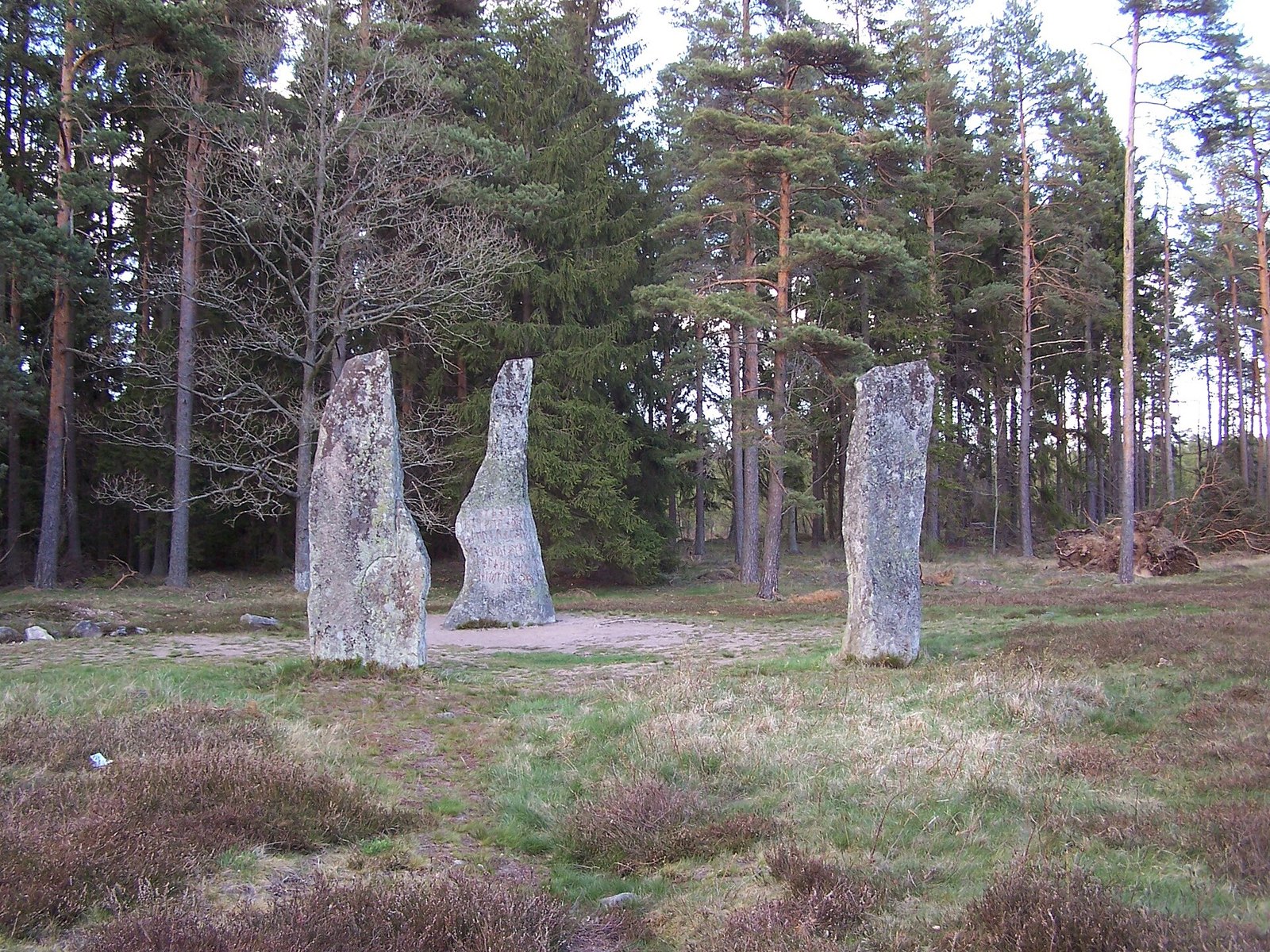
West of Listerby, in the southern Swedish province of Blekinge, three tall stones stand in a triangle. One of them carries runes: six lines on the broad face and a single line on the narrow side. The text names no dead person, no sponsor and no god. It says only that mighty runes have been laid away here, and it threatens whoever “breaks this” with dishonour and a treacherous death. This article goes through the inscription word by word, shows which parts are secure and which are not, sets the sister stone from Stentoften beside it, and asks what archaeologists have found at the site – and what they have not.
The Björketorp Runestone, Swedish Björketorpsstenen, stands about a kilometre west of the village of Listerby in Ronneby municipality. The County Administrative Board of Blekinge (Länsstyrelsen) gives its height as 4.2 metres and calls it the second-tallest runestone in Sweden. Others round differently: German Wikipedia says “about four metres”, the Encyclopaedia Britannica “more than 12 ft (3½ m)”. The Swedish monuments register lists it as granite and undamaged.
The runestone does not stand alone. Two more tall stones without inscriptions (bauta stones) form a triangle with it. None of the sources I read gives their exact height. Nearby there is also a domarring, a “judge’s ring”: a circle of raised stones of a kind common on Iron Age cemeteries in southern Sweden. Länsstyrelsen describes it as a separate monument further along the path; German Wikipedia instead counts seven further stones together with the three as one ring. The sources differ here.
The position is striking. According to Länsstyrelsen the boundary of the villages of Listerby, Björketorp and Leråkra and of the parishes of Edestad and Listerby runs right through the stones. Parishes are medieval units, many centuries younger than the inscription; whether the stone attracted the boundary or an older boundary attracted the stone cannot be shown. Equally unexplained: a hollow has been pecked into its top, and according to Länsstyrelsen neither its age nor its purpose is known.
In the scholarly literature the stone is DR 360. “DR” stands for Danmarks Runeindskrifter, the great corpus edition by Lis Jacobsen and Erik Moltke published in 1941. Blekinge, like Scania and Halland, long belonged to the Danish realm and only passed to Sweden in the early modern period. Danish runologists therefore edited these inscriptions, and the numbers have stuck. The Scandinavian runic text database at Uppsala University (Rundata) uses the same signum; the Swedish National Heritage Board records the site as “Listerby 381”.
In the seventh century, of course, there was neither a Danish nor a Swedish kingdom in the later sense. In Sweden the period is called the Vendel Period; the Viking Age is still a good hundred years away.
The inscription is written in a transitional form between the Elder Futhark with its 24 characters and the Younger with 16. Our comparison of the futharks explains the two rows. The language was changing fast: unstressed vowels dropped out and words grew shorter. Scholars call this phase the syncope period (syncope: loss of a vowel inside a word).
The clearest sign is the a-rune. On the Björketorp stone it has the shape that later stands for h in the Younger Futhark. Runologists transliterate it with a capital A. The usual handbook explanation: the old j-rune was called jāra (“year, good year”); when initial j disappeared from the spoken language, its name began with a, and the character took over that sound value. Länsstyrelsen mentions only three other stones in this style, all of them in Blekinge.
Second, the carver writes vowels that were probably heard in speech only as a brief glide. What is normalised as falh’k appears on the stone as fAlAhAk; argiu becomes ArAgeu, brytz becomes bArutz. Such insertions are called svarabhakti or epenthetic vowels. Third, the line on the narrow side has sbA where later Old Norse leads us to expect spá: b for p. The stock of characters was already shrinking.
On spelling: Rundata writes word-final z where other editions have R; hAidz and haidR are the same.
The broad face carries six lines, the narrow side one. Rundata transliterates side A as follows, the slash marking a line break here: hAidz runo ronu / fAlAhAk hAiderA g/inArunAz ArAgeu / hAerAmAlAusz / utiAz welAdAude / sAz þAt bArutz. Side B: uþArAbA sbA. The word ginArunAz is split across the end of a line.
“Haidz runo ronu, falahak haidera ginarunaz. Arageu haeramalausz, utiaz weladaude, saz þat barutz. – Uþaraba sba.”
“The row of bright runes I laid away here, runes of power. Restless through baseness, outside, given over to a treacherous death is he who breaks this. – Ruin I foretell.” Björketorp Runestone, DR 360, sides A and B; transliteration after the Samnordisk runtextdatabas (capitals of the transliteration set in lower case here), my own translation. The rendering of “haidz”, “haeramalausz” and “utiaz” is uncertain; see the next section.
The translation in the box is one of several possible. Rundata’s English version runs, in substance: I, master of the runes (?), conceal here runes of power; incessantly plagued by maleficence, doomed to insidious death is he who breaks this; I prophesy destruction, or: prophecy of destruction. The question mark is the database’s own, and for utiAz it leaves a gap.
haidz runo ronu. The characters themselves are clearly legible; what is disputed is how to divide them. One reading takes haidz as a separate word for the speaker, hence Rundata’s “master of the runes (?)”. The other joins it to runo as a single term that can be rendered “bright runes” or “runes of brightness”; German Wikipedia does this, and so does my translation above. ronu is mostly understood as “row, sequence”. Michael Schulte (2008) translates likewise: “a row of brightness-runes”, “mighty runes”.
falahak haidera ginarunaz. This part counts as the most secure. falh’k is “I hid” or “I laid away”, with the pronoun “I” (ek) attached. The Old Norse verb fela means both “to hide” and “to entrust”; which shade is intended here remains open. haidera corresponds to Old Norse heðra, “here”. ginarunaz are “runes of power”; the prefix ginn- is known from Old Norse as an intensifier in the sense of “vast, sacred-mighty”, most famously in the name of the primeval void Ginnungagap. Schulte points out that Björketorp has the past tense (“I hid”), Stentoften the present (“I hide”).
arageu haeramalausz. According to Schulte, ArAgeu (normalised argiu) is a dative singular meaning “perversion” or “unmanliness”; he compares it with Old Norse ergi. More on that below. Rundata renders hermalausz as “incessantly”, while Schulte translates “through baseness restless”. Either way the offender finds no peace.
utiaz weladaude. This is the hardest nut. weladaude itself is transparent: “treacherous death”, “death by guile”, in the dative. But what is utiAz? Rundata does not translate the sequence. Schulte reads it as the local adverb uti (“outside”) with the copula attached: “outside is”. German Wikipedia turns it into a treacherous death “abroad”. The linguist Jóhanna Barðdal devoted an article of her own to the passage in 1998 (“Björketorpstenens ‘utiar weladaude’”); I know her result only from Schulte’s brief, critical mention.
saz þat barutz. “He who breaks this.” The normalised form brytz is already close to later Old Norse brýtr. The text does not say what “this” is: the stone, the whole monument, the inscription, or a peace attached to the place.
The short line on side B is normalised as uþarba spa. uþarba is connected with a word for “harm, misfortune”, literally something like “un-need, un-benefit”; spa belongs with Old Norse spá, “prophecy” and “to prophesy”. Rundata gives two options: “I prophesy destruction” or “prophecy of destruction”. Carl Marstrander translated it in 1952 into Norwegian as “ulykkesspådom”, Wolfgang Krause in 1966 into German as “Schadenprophezeiung”. I take both from Schulte’s article.
Schulte calls the line a heading that gives a clue to the function of the text, and classes the curse formula as a whole as a “commissive speech act”. The text, then, does not describe a misfortune; it pronounces one.
The word argiu deserves a sober look, because it is the sharpest part of the threat. In later Old Norse, argr (with the variant ragr) describes a man accused of unmanliness; the corresponding noun is ergi. It could mean cowardice, the passive role in sex between men, or the practice of forms of magic regarded as women’s business. The charge was aimed at a man’s honour and so at his standing among equals. The medieval Icelandic law texts treat it as a grave slander; the details are in our article on insults and níð. According to Länsstyrelsen the accusation could lead to a holmgang, a formal duel.
Two caveats belong here. First, some six hundred years lie between the stone and the Icelandic law and saga texts. That the word had the same range in seventh-century Blekinge is an assumption. The stone does show that argiu was already something one wished on one’s worst enemy; the two Blekinge stones are the earliest witnesses to this word family that I know of. Second, the text treats the person addressed as a law-breaker; Schulte speaks of his “inferior status and low prestige”.
Loss of honour, restlessness, death by guile rather than in open fight: for a warrior society, the opposite of a good death.
The same formula appears a second time in Blekinge, on the Stentoften stone (DR 357), some tens of kilometres further west. The dean O. Hammer found it in 1823. It lay face down, surrounded by five large stones forming a pentagon, so it too belonged to a larger setting. In 1864 it was moved into the church at Sölvesborg, where it stands today.
Stentoften says more than Björketorp, because a separate text precedes the curse. It names a Haþuwulfz and, after a damaged passage, a Hariwulfz. The opening lines (niuhAborumz niuhagestumz) are now widely read as “with nine bucks, with nine stallions”, followed by the statement that Haþuwulf gave “j” – a single old j-rune standing for its name jāra, “good year, harvest”. On this interpretation the stone reports an animal sacrifice for a good harvest. English Wikipedia attributes the sacrificial reading, with reference to Tineke Looijenga (2003), to a runologist it does not name.
Then comes the formula. Normalised, it runs on Stentoften roughly: … ginnurunoz. Hermalausaz argiu, weladauþs, sa þat briutiþ. The building blocks are the same; the differences are small. Stentoften has the older verb form bAriutiþ against bArutz, the word uti is absent, the “is” is absent, and the relative word is shorter (sa rather than saz).
How do the two texts relate to each other? The older answer was given by Wolfgang Krause in 1966: Björketorp offers the more reliable text, and Stentoften is a faulty copy with omissions. Ottar Grønvik remarked in 1996 that scholarly opinion on the relationship between the two texts rested largely on Krause.
Michael Schulte disagreed in 2008 in the Arkiv för nordisk filologi. For him the inscriptions are “independent versions of one and the same orally transmitted formula”. What looks like error on Stentoften he explains from speech: where words meet, sounds merge and function words drop out. Stentoften thus sounds “elliptical and almost fragmentary”, Björketorp spelled out. Schulte sums up the contrast as “an older minimalistic mode versus a younger, more explicit one”. Accordingly he dates Stentoften to about 600–625 and Björketorp to about 625–650.
On this view the formula was probably not one carver’s invention. It was a fixed wording that people in Blekinge knew, spoke, and cut into stone when needed. German Wikipedia assigns the formula to galdralag, the “incantation metre” of later eddic poetry. Alliteration is audible (haidz – haidera – haeramalausz); assigning the text to a metre described centuries later is a modern classification.
Two more inscriptions belong with Björketorp and Stentoften. The Istaby stone (DR 359) is now in the Swedish History Museum in Stockholm. Its text: “In memory of Hariwulf. Haþuwulf, son of Heruwulf, wrote these runes.” The Gummarp stone (DR 358) no longer exists. It was taken to Copenhagen and lost there in the city fire of 1728; the inscription is known only from older depictions. It read: “Haþuwulf placed three staves: fff.” The three f-runes are mostly understood as ideographs for the rune name fehu, “cattle, property, wealth”.
Hariwulf, Haþuwulf, Heruwulf: “army-wolf”, “battle-wolf”, “sword-wolf”. The names alliterate and all end in the wolf. Olof Sundqvist and Anders Hultgård devoted a study to these “lycophoric”, that is wolf-bearing, names in 2004. Such series count as typical of chieftain families, so scholars see Istaby, Stentoften and Gummarp as monuments of a single kin group. Whether warrior bands with wolf symbolism stand behind them, of the kind that later appear as úlfheðnar, is a conjecture, not a finding.
Björketorp holds a special position in the group. It names no one and stands apart from the other three; it belongs to the group solely through the shared rune forms and formula. Who had it raised is unknown; the same family is likely, but nothing says so.
No runestone of this period can be dated scientifically; granite has no radiocarbon age. The dating rests on language and script, and the figures vary accordingly. Rundata gives the frame 500–700. English Wikipedia, Länsstyrelsen and the Britannica place it in the seventh century. German Wikipedia gives “around 675”, Schulte about 625–650.
Only the order of magnitude is secure: very probably the seventh century, certainly before the Viking Age. Any more precise year is a linguistic estimate.
What does the curse protect? The obvious answer is a grave; the Britannica calls the inscription “obviously intended to protect a grave”. The ground has not confirmed this. According to English Wikipedia the site was excavated in 1914 and nothing was found either by the runestone or in the stone circle. Länsstyrelsen gives no year and states that the area between the stones has been investigated without any trace of further activity; the graves and the domarring have also been investigated and contained neither finds nor burials. I have not seen the excavation report itself, and a dig of 1914 did not use modern methods. The empty result weakens the grave theory without refuting it.
Four proposals have come out of this, which English Wikipedia lists side by side:
Länsstyrelsen adds two further thoughts: an upper class may have raised the stones to display power, and the place may have served for assemblies, in other words a thing. The idea that the triangle stands for the world tree Yggdrasil is also mentioned by the authority; nothing in the text supports it.
The interpretations are not mutually exclusive, and none is proven.
Björketorp and Stentoften stand at the head of a series. In the Viking Age, two to three centuries later, several Danish and Swedish stones end their memorial text with a threat against anyone who damages or removes the stone. The best-known example is the Glavendrup stone on Funen, whose curse word ræte is unexplained to this day. There the curse is an appendix to the memorial text. At Björketorp it is the whole text.
Whether a continuous tradition runs from Blekinge to Funen, or a similar need simply produced similar sentences, cannot be clearly shown. How later literature imagined rune magic is described in our article on rune magic in the sources; on dedicating inscriptions to a deity see rune consecration.
Who is speaking in the inscription – a rune expert working to order, the lord of the place himself, a ritual voice? What exactly are runes that have been “laid away”: the visible inscription, or something imagined in or under the stone? What does utiAz mean? And what did the three stones stand for, if not for a grave? None of these questions has an agreed answer.
The site is easy to visit. According to Länsstyrelsen it is signposted from the E22 at Leråkra; from the car park it is about 150 metres on foot. The stone is a protected ancient monument. Motifs like this still travel onto jewellery and engravings; in our workshop the wording of an original is never taken over unchecked.
What does the Björketorp Runestone say? In substance: the speaker has laid away mighty runes here; whoever breaks “this” shall be dishonoured, restless and given over to a treacherous death. The narrow side adds a prophecy of ruin. Some words, above all haidz and utiAz, are disputed.
How old is the stone? The inscription is dated by language and rune forms, mostly to the seventh century. Figures range from 500–700 to estimates such as 625–650 or “around 675”.
Is the Björketorp Runestone a gravestone? That cannot be clearly shown. According to the available accounts, the 1914 excavation found nothing either at the stone or in the stone circle. Cenotaph, cult or assembly site and boundary marker are also discussed.
What does the stone have to do with the Stentoften stone? Both carry the same curse formula in slightly different versions and the same distinctive rune forms. Stentoften also gives names and, in the current reading, a sacrifice for a good year. Schulte sees them as independent versions of an oral formula.
What does “argiu” mean in the inscription? The word belongs with Old Norse argr and ergi and denotes an unmanliness felt to be shameful. The curse therefore wishes loss of honour on the offender. How far the later Icelandic meanings apply to the seventh century is open.
The Glavendrup stone · The Rök Stone · The Oklunda Inscription – Gunnarr, the Sanctuary and the Earliest Evidence of Asylum in the North · Elder & Younger Futhark · Rune magic – alu, laukaʀ and the formula words.
All History & Finds articles →
An Icelandic merchant is blown far to the west, falls among strangers who seem to speak Irish, and finds himself before …
Read more →There was probably a real Viking behind Björn Ironside – just not the one the sagas and the TV series describe …
Read more →“Blood mead” sounds like a feast hall, a ritual and a dare. In nearly every case it points to a single myth: two …
Read more →A single word is all that survives of the Bobrzanie. It stands in a boundary description of the bishopric of Prague …
Read more →