Anyone looking for the Chutizi finds a name on parchment and hardly anything behind it. In charters of the Ottonian kings and in the chronicle of Thietmar of Merseburg, "Chutici" or "Chutizi" stands as the name of a stretch of land around present-day Leipzig, never as a people that acts, with princes, wars or gods. This article takes the attestations one by one, shows what they reveal about strongholds, dioceses and counts between the Saale and the Mulde, and says openly where the step from district to tribe is an interpretation.
The Chutizi are a case in which the state of the sources is itself the subject. About the Hevelli the chroniclers report princes, strongholds and campaigns, about the Daleminzi a besieged chief stronghold and a sacred lake. For the Chutizi there is nothing comparable. What we have is a name that appears in Latin texts of the tenth and eleventh centuries as a pagus (district), regio (region) or provincia. We know of no sentence in which the Chutizi do anything.
Using "Chutizi" for the people is a modern step, derived from the district name. That a Slavic settlement community with a name of its own originally stood behind the district is plausible and the usual assumption in onomastics. The name has a shape common among West Slavic group names, and other districts in the region recognisably bear former tribal names. But this step is not attested. When this article speaks of the Chutizi, it means the Slavic-speaking inhabitants of the district of Chutici, without claiming that they understood themselves as a tribe.
A few terms first. A gau or district (Latin pagus) is in Ottonian charters a spatial reference used to locate property; it may go back to an older settlement unit, but in the source it is first of all an ordering word of the chancery. A burgward is a district around a stronghold, from which dues and services went to that stronghold; the institution is typical of the land between the Saale and the Elbe in the tenth and eleventh centuries. A march is a border district under a margrave. Sorbs, finally, is the scholarly name for the Slavic-speaking groups between the Saale and the Elbe as a whole; they have an article of their own (Sorbs).
The name is handed down in several spellings. Thietmar of Merseburg writes in pago Chutici in one passage of his chronicle and Gutizi orientalem, "eastern Gutizi", in another. The onomastician Walter Wenzel, in his study "Die Frühgeschichte der Sorben im Licht der Namen" (Sorbian Institute), gives the attestations 973 in provintiis … Chuntici and 974 in regione Chutizi. A charter of Henry III from 1046, which we saw in the Codex diplomaticus Saxoniae, locates property in Misnensi marchia et in pago Chut[i]ci dicto, "in the March of Meissen and in the district called Chutici"; the digitised text reads "Chutibi dieto" at this point, which we take as a reading or recognition error for "Chutici dicto". The German Wikipedia also lists the form Gudici.
The spellings vary, as is usual for Slavic names in Latin texts: scribes heard a foreign sound and rendered it with the means of their alphabet. The initial ch stands for a fricative as in Scottish "loch", the z or c for a sibilant. Wenzel reconstructs an Old Sorbian form *Chutici and interprets it as "the people of Chuť", a derivation from a personal name belonging to a Common Slavic word for "desire, will, pleasure". Names in -ici usually denote the descendants or people of a man. That is a reasoned derivation by a specialist, but a reconstruction: no source knows a Chuť.
Important for everything that follows: none of these passages contains a word such as gens (people) or populus. The texts speak of a space. Whether the inhabitants of that space in the tenth century still formed a group with a shared name, shared cult and their own leaders, they do not say.
The location can only be inferred from places that the sources expressly put "in the district of Chutici". As far as we have seen them ourselves or they are reported with good references, these are: the stronghold of Medeburu, interpreted as Magdeborn south-east of Leipzig (in Thietmar); the stronghold of Zwenkau south of Leipzig (charter of Otto II of 30 August 974, according to Wikipedia citing the Regesta Imperii); and the burgwards of Rochlitz, Leisnig and Colditz on the Mulde (charter of Henry III of 1046). To these comes Thietmar's "eastern Gutizi" beyond the Mulde.
These points yield a space between the Saale and the Mulde with Leipzig roughly in the middle and a strip east of the Mulde. This is also how Wikipedia and Wenzel ("Slavic district in the area around Leipzig") describe it. The borders are a modern reconstruction; maps that draw a sharp outline rely on single attestations and on the assumption that rivers formed boundaries. A local historian who drew up such a map himself calls the source situation "meagre".
A correction to widespread short descriptions: according to our evidence, Zeitz and Altenburg did not lie in the district of Chutici. Altenburg belongs to the district of Plisni, Zeitz was an episcopal seat in a setting of its own. Whoever places the Chutizi "between Leipzig, Altenburg and Zeitz" merges three areas that appear separately in the sources. They are nonetheless closely linked, as the history of the dioceses shows.
The most detailed passage on the district stands in the chronicle of Thietmar of Merseburg. Thietmar (975 to 1018) was bishop of Merseburg from 1009 and wrote his chronicle in the last years of his life. He knew the land between the Saale and the Mulde at first hand, since it belonged to his diocese, and he had a strong interest in his church's property rights. When he lists estates, he writes as an interested party.
In the second book he tells of Boso, the first bishop of Merseburg, who died in 970. Boso came from the monastery of St Emmeram in Regensburg, had first preached among the Slavs, and when the dioceses were founded in 968 was allowed to choose between Meissen, Zeitz and Merseburg. He took Merseburg "because it was the most peaceful". Then follows one of the few passages in which the Slavic inhabitants of the region appear with their own words, and immediately afterwards the mention of the district of Chutici.
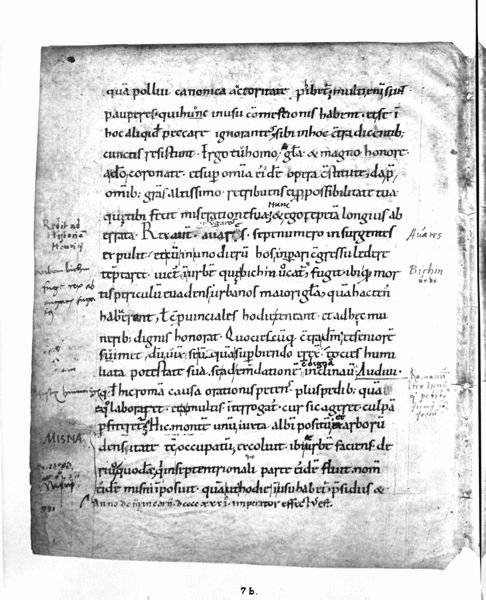
In order to instruct those entrusted to him more easily, he had written down Slavic words and asked them to sing the Kyrie eleison, explaining its benefit to them. But the foolish mockingly twisted it for the worse into "Ukrivolsa", which in our language means "The alder stands in the thicket", and said: Thus spoke Boso, although he had spoken otherwise. The emperor granted him some estates belonging to the aforementioned town and a stronghold situated in the district of Chutici, which is called Medeburu, which translated means "Forbid the honey".Thietmar of Merseburg, Chronicon, Book II, ch. 23 (numbering of the older Lappenberg/Kurze edition and of the Wikisource translation; the MGH edition by Holtzmann, 1935, may number differently, not checked). Latin text after the Dresden manuscript in the Bibliotheca Augustana: "… et in pago Chutici positum quoddam castellum, quod Medeburu vocatur – interpretatur autem hoc: mel prohibe – …"; own translation. The online version reads "paucas vitas"; we translate by sense as "villas" (estates, villages).
Three things can be gained from this passage, and one cannot. First: Boso preached in the vernacular of his diocese, and the people heard in the Greek Kyrie eleison something Slavic, which Thietmar renders with a German sentence about an alder. It is a small, rare snapshot of how mission between the Saale and the Mulde sounded in daily life. Second: the emperor (Otto I) gave the diocese a stronghold in the district of Chutici, long identified with Magdeborn. Third: Thietmar interprets the name Medeburu as Slavic for "Forbid the honey"; whether that is right is a question for onomastics. What cannot be gained is that the mockers were "Chutizi". Thietmar says only that they belonged to Boso's flock. The diocese of Merseburg reached beyond the district of Chutici.
In the fourth book Medeburu appears once more. After the death of Otto II in 984, the Bavarian duke Henry the Quarrelsome travelled with a Bohemian escort through the districts of the Nisani and Daleminzi (Nisani, Daleminzi) to Mügeln and from there to Medeburu, where supporters came to meet him. The stronghold was thus a place where people met; about its inhabitants we again learn nothing.
The second major Thietmar passage shows the district as an asset to be disposed of. In 981 the diocese of Merseburg was dissolved, for Thietmar an injustice he laments at length. Its territory was divided among the neighbours, and in the third book Thietmar lists who received what. The part between the Saale, Elster and Mulde together with the districts of Plisni, Vedu and Tuchurini went to Bishop Frederick of Zeitz. The bishop of Meissen received a part with the villages of Wissepuig and Lostatawa, "which belongs to eastern Gutizi" and is bounded by the rivers Caminici and Elbe. Archbishop Giselher of Magdeburg, previously bishop of Merseburg himself, kept nine strongholds: Scudici, Cotug, Vurcin, Bigni, Hilburg, Dibni, Paug, Liubanici and Gezerisca.
Most of these names are today equated with places on the lower Mulde and around Leipzig, for instance Scudici with Schkeuditz, Vurcin with Wurzen, Hilburg with Eilenburg, Dibni with Düben; for some, especially Gezerisca, the identification is uncertain. Whether all nine strongholds lay in the district of Chutici, Thietmar does not say. But the passage shows how the area was organised around 980: as a network of strongholds whose allegiance could be shifted between bishops. In 1004 Henry II restored the diocese of Merseburg, as Thietmar describes at the start of the sixth book. More on Merseburg itself is in our article on Merseburg.
The form "eastern Gutizi" is worth noting. It presupposes a western part, even if Thietmar does not name it here. The historian Leo Bönhoff devoted a study of its own to this eastern part in 1910; we know it only from bibliographies.
The charters show the district as part of the Ottonian order of rule. According to Wikipedia, a charter of Otto II of 30 August 974, issued at Frohse, names the stronghold of Zwenkau "in the district of Chutizi in the county of Gunther". Gunther of Merseburg, attested there as count, fell in 982 at the battle of Cotrone in southern Italy. For 983 Rikdag is listed as count in the district of Chutizi, for 1028 Hermann I of Meissen. This sequence comes from Wikipedia and the works cited there; apart from the one of 1046 we have not seen the charters in their wording.
That charter of 1046 is particularly revealing for the burgward order. On 8 July 1046, at Rochlitz, King Henry III granted his wife Agnes estates in the March of Meissen in the district of Chutici, namely in the burgwards of Rochlitz (Rochideh in print), Leisnig (Lisnich) and Colditz (Cholidistcha); two further names in the passage, Grobi and Bolechma, we could not identify with certainty. Here one sees that "Chutici" was still in use as a spatial name around the middle of the eleventh century and included areas on the Mulde that one would rather expect as a fringe zone from the Leipzig perspective.
What a burgward was in practice can only be seen in outline from such charters. Gerhard Billig studied burgward organisation in the Upper Saxon and Meissen region comprehensively in 1989. In the picture drawn by research, the stronghold was the centre where a royal or episcopal official sat; the surrounding villages had to render dues and maintain the stronghold. Whether these strongholds went back to older Slavic sites has to be tested archaeologically for each place. Thietmar uses the word too: in the seventh book he speaks of estates "in the burgwards of Bichni and Vurcin", that is Püchau and Wurzen.
South of the district of Chutici lay a second area whose name is often mentioned together with it in research: Plisni. The name is connected with the river Pleisse. Thietmar names Plisni twice in the third book: once in Merseburg's endowment with a forest "between the rivers Saale and Mulde and the districts of Siusuli and Plisni", once in the division of 981, when the districts of Plisni, Vedu and Tuchurini went to Zeitz. According to Wikipedia this forest bears the name Miriquidi in the charter of 974, long wrongly equated with the Ore Mountains.
On 1 August 976, according to Wikipedia, Otto II gave the stronghold of Altenburg to the diocese of Zeitz; the town of Altenburg counts this date as its first mention. Later attestations explicitly connect the place with the district name: in 1132 it appears as castro Plysn, and a charter of Otto IV of 1209 names the curia in Aldenburg que alio nomine Plisne nuncupatur, "the court at Altenburg, which by another name is called Plisne". The name of the district thus lived on in the name of the stronghold.
In the twelfth century this district became the Pleissenland, Latin terra Plisnensis. In 1143 Conrad III names the Pleisse forest as a royal forest (in regali silva Blissinensi); Frederick I Barbarossa developed the area after 1158 into an imperial territory, with Altenburg as a palace. That is already the history of German territorial lordship, no longer of Slavic districts. For Plisni too: no source names a people of this name. The German Wikipedia on Altenburg speaks of a Sorbian tribe that named itself after the river; that is an interpretation from the district name, not a finding of the sources. Wenzel calls Plisni a "Slavic district".
Zeitz belongs in this story as an ecclesiastical centre, not as part of the district of Chutici. Together with Merseburg and Meissen, the diocese of Zeitz was founded in 968, all three under the new archdiocese of Magdeburg. Thietmar names Hugo as the first bishop of Zeitz. The diocese received the Merseburg territories mentioned above in 981 and Altenburg in 976; its influence thus reached into the Pleisse area.
The position on the border was dangerous. Thietmar reports in the third book that the church of Zeitz was taken and plundered by a Bohemian army under one Dedi; the context points to the unrest of about 982/983, but he gives no exact year at this point. In the sixth book he says that someone led the Bohemians against the church of Zeitz. According to Wikipedia, Zeitz remained under threat until the Peace of Bautzen in 1018; in 1028/29 the episcopal seat was moved to Naumburg, hence the later name diocese of Naumburg-Zeitz. In the seventh book Thietmar mentions Bishop Hilliward (Hildeward) of Zeitz.
For the question of the Chutizi this means: the inhabitants of the district lived in an area that three dioceses divided among themselves and along whose edge foreign armies marched. How they themselves stood towards Church and empire, whether they took part in the uprising of 983 or not, no one records. According to Thietmar, the great Slavic uprising of 983 mainly concerned the Lutici and areas further north (Lutici).
The oldest mention of Leipzig also stands in Thietmar. In the seventh book he tells of the death of Bishop Eid of Meissen, who returned from Poland, fell ill and died "in the town called Libzi" (in urbe Libzi vocata) on 20 December; by the usual dating this was 1015. Thietmar names the town without a district. That Leipzig lay in the district of Chutici is inferred by research from its position between the attested places. The name Libzi is usually derived from a Slavic word for the lime tree; that is the common interpretation, which we cannot check here.
For Leipzig, its place in the district of Chutici is today part of the town's history. It is worth being aware that the connection runs through geography. No text says "Leipzig, chief place of the Chutizi"; whether there was a chief place at all is unknown.
In the late eleventh century the old district names gradually disappear from the charters. In their place come lordships of individual noble families. A well-known example is Wiprecht of Groitzsch (c. 1050 to 1124). He came from the Altmark and, according to Wikipedia, in 1070 exchanged his inherited Balsamgau for the stronghold of Groitzsch south of Leipzig, in the so-called Osterland. After years in Bohemia he returned around 1080, founded the Benedictine monastery of St James at Pegau in 1091 (consecrated 1096) and brought settlers from Franconia into the land. In 1123 he acquired the marches of Meissen and Lusatia but lost them again at once, and died in 1124 at Pegau from the effects of a fire.
The main source on Wiprecht is the Pegau Annals, written in the monastery he founded. We have not read them in their wording. Two points matter for our subject. First: we know of no attestation that expressly places Groitzsch in the district of Chutici; some accounts assign the place to the Pleissenland, others to the Osterland. Second: with Wiprecht begins the period in which German peasants arrived in large numbers. The Slavic-speaking population did not disappear at once, but it stands out in the sources even less than before. After the Groitzsch line died out in the male line in 1135, part of its property passed to the Wettins, another part via Rapoto of Abenberg to Barbarossa and into the imperial territory of Pleissen.
The Chutizi are often placed in a row with other Sorbian groups. To the east lay the Daleminzi around Lommatzsch, about whom Thietmar tells considerably more (Daleminzi), further east the Milceni in Upper Lusatia (Milceni). West of the Saale began the territory that had belonged to the Thuringian kingdom and after its end came under Frankish and then Saxon rule. The rulers whose chanceries wrote the name Chutici into charters were the Saxon Ottonians (Saxons). For the wider context of the Sorbs, their immigration and language, we refer to the article on the Sorbs; for the Hevelli as a counter-example of a well-attested Elbe Slavic tribe, to the article on the Hevelli.
Wenzel himself makes clear in his study how fluid the terms are. He defines a tribe as a community held together by kinship, shared cult and the same dialect, but for small units speaks sometimes of a "small district", sometimes of a "tribal area". He considers it certain that there once were Slavic tribal names that remain "hidden" in some regions. With the Chutizi the name has survived; everything else remains hidden.
We do not know how many people lived in the district, who led them, to which gods they sacrificed and when they were baptised. According to Wikipedia, Slavic settlement of the area between the Saale and the Mulde begins in the late sixth century; the exact dating is disputed in research and has to be argued archaeologically, not from the charters. Nor do we know whether "Chutici" was still a living group name at the time of the first attestations or already only the name of a district that the chancery had taken over from an earlier time.
Whoever writes about the religion of the Chutizi usually transfers reports from other groups, such as the sacred lake of the Daleminzi or the temples of the Lutici. For the district of Chutici itself there is no such report. The only scene that allows a glimpse of the people is Boso's Kyrie, and even that cannot be securely assigned to this district.
Established are the name Chutici as a district in charters and in Thietmar, the location of individual places such as Magdeborn, Zwenkau, Rochlitz, Leisnig and Colditz in this district, the division of 981 and the mention of the district of Plisni. Plausible is that the district name goes back to a Slavic settlement community and that Leipzig belonged to this area. Interpreted are the derivation from a personal name Chuť, the borders of the district on modern maps, the assignment of Boso's mockers to the Chutizi, and every narrative that turns the district into a tribe with a history of its own. Whoever reads a sentence about the Chutizi can check whether it speaks of a space or of people who do something. Only the former is attested.

The Merseburg Charms · The Nisans · The Liutizi · The Daleminzi · The Sorbs.
All History & Finds articles →
Drive today through the country around Teterow, Gnoien or Demmin and you see fields, avenues of trees, brick churches …
Read more →The Cotini and Osi were two peoples in the highlands on the edge of Germania, in the Carpathian region. Tacitus names …
Read more →