In September 2014 a metal detector sounded in a field in Galloway, and just below the turf lay a silver arm-ring. What followed is now regarded as the most varied Viking-age find from Britain and Ireland: silver ingots and folded arm-rings, an Anglo-Saxon pectoral cross, gold, rock crystal, silk and a lidded vessel whose silver came from what is now Iran. Whether the Galloway Hoard is also the “richest” find depends on how you measure wealth. This article goes through the discovery, the contents and the dating, sets the interpretations side by side, tells the story of the dispute over where the hoard should go, and says plainly where research is still searching: this is open.
Derek McLennan from Ayrshire was no beginner: in 2013 he had found a large hoard of medieval silver coins near Twynholm. In September 2014 he was searching land in the parish of Balmaghie, in the historic county of Kirkcudbrightshire, together with two friends, the Reverend David Bartholomew and Pastor Mike Smith. The land belongs to the Church of Scotland, and the three had permission. After about an hour McLennan turned up a silver arm-ring with a pattern resembling a saltire and, as the story goes, shouted “Viking!”
The exact findspot has never been made public. Only the parish is known. In the same month Historic Scotland scheduled the whole field as a monument of national importance.
McLennan reported the find to Scotland’s Treasure Trove Unit, which records finds made in Scottish soil. The county archaeologist, Andrew Nicholson, led the excavation. Because specialists lifted the objects in position, we know today how the hoard was packed.
At a depth of about 60 centimetres the excavators reached a first layer. Below it, separated by a thin band of soil, lay a second. Research at National Museums Scotland now describes the hoard as four parcels:
The upper layer held the “loose change” of the Viking age, the lower layer the rarer and more exotic things. Why remains uncertain. One reading sees the upper layer as a decoy: anyone stumbling on it would think they had found everything. Another allows that the hoard was buried in two stages. Both are hypotheses.
A geophysical survey by the University of Glasgow later showed traces of a rectangular timber building with a double row of posts, and the hoard lay beneath one corner. Whether building and hoard belong together has not been settled.
In total the hoard contains more than 5 kilograms of precious metal and other material. Most of it is silver: cast ingots, hacksilver and broad arm-rings, many flattened or folded. Hacksilver means cut-up silver used as payment by weight; how that economy worked is explained in the article on hacksilver.
One measurement stands out. The silver from the lower layer weighs 2,713.6 grams. That is within half a gram of 8½ pounds on a weight standard known from Dublin, and many rings and ingots are multiples of a unit of about 26.6 grams, an ounce in that system. Somebody weighed this silver carefully before it went into the ground.
The folds are telling too. Most arm-rings are folded in one of four patterns, from which the researchers cautiously infer four people or groups who contributed unequal shares. It is not certain.
Four arm-rings in the lower layer carry scratched runes; some early reports speak of five. One would expect Scandinavian runes. These, however, are Anglo-Saxon, written in the English rune-row known as the futhorc, and they record Old English names or name elements. The runologist David Parsons read one of them as Ecgbeorht, spelled EGGBRECT. The differences between the rune-rows are covered in the article on runes.
In February 2025 the National Museums Scotland team presented a new reading of the fourth ring. The inscription runs along the inside of its curved half. Transliterated, it begins DIS IS, continues with a group of characters ending in …IGNA, and closes with an F-rune. For a long time the sequence “…IGNAF” made no sense in any language spoken in early medieval Britain or Ireland. The key was the final character: the F-rune stands between dots. That suggests it is meant as a concept rune, standing for its own name, feoh, “cattle, property, wealth”. The rest the team reads as Old English higna, “of the community”, with an unusual spelling of the first letter. The proposal: “This is the community’s wealth.”
Two caveats belong with it. First, it is a proposal. Parsons himself called the inscription “difficult and unusual” and the reading “challenging”. Second, higna often refers to a religious community in Anglo-Saxon charters, but the word can also mean a household or group in general. If the reading holds, at least this ring belonged to a community rather than an individual.
The Galloway Hoard holds the largest and most varied group of Viking-age gold objects yet known from Britain and Ireland, and no two pieces are alike. The wooden box among the arm-rings contained a gold ring, a gold ingot and a pin in the shape of a bird. There are also three gold filigree mounts strung on a silk cord, perhaps parts of a belt; earlier they were thought to be manuscript pointers. A gold filigree pendant frames a dark schist stone with traces of precious metal on it: a touchstone, used to test the purity of gold and silver.
Perhaps the most astonishing piece is a gold-mounted rock crystal jar about five centimetres high. Martin Goldberg, principal curator of medieval archaeology at National Museums Scotland, takes the carved crystal to be the reworked capital of a small Corinthian-style column, perhaps of Roman date. He suggests it was about 500 years old when someone had it turned into a gold-mounted jar in the late eighth or early ninth century. The meaning of the material is discussed in the article on rock crystal.
3D X-ray imaging carried out with the British Museum revealed an inscription on the base before the jar had even been unwrapped. In gold letters it says in Latin, in substance, “Bishop Hyguald had me made.” Who Hyguald was has not been established; the museum’s announcements do not tie him to a see, and I know of no secure identification. Whithorn, the Northumbrian bishopric in present-day Galloway attested in the eighth century, comes to mind. Evidence for that link is lacking so far.
The vessel is about 15 centimetres tall with a rim diameter of just over 9 centimetres, and it is the only one of its kind from a Viking-age hoard found with its lid still in place. It lay at the very bottom, upside down, wrapped in several layers of cloth, and was X-rayed in November 2014 before it was opened.
At first it was taken to be Carolingian, a product of the Frankish empire like the silver vessels from the Cuerdale and Vale of York hoards. That attribution has been abandoned. Laser cleaning and 3D scans brought out the decoration: a fire altar within four roundels, typical of Zoroastrian religion, together with triple-pointed crowns, leopards, tigers and other motifs from West Asian art. Zoroastrianism was the state religion of the Sasanian empire, which ruled Persia until the seventh century.
Analysis of the metal supports this origin. X-ray fluorescence showed an alloy of silver with fairly pure copper, typical of Sasanian silver and not found in contemporary Europe. Lead isotopes, above all from the niello, the black silver-sulphide inlay, point to the Nakhlak mine in central Iran. The vessel was probably more than a hundred years old when it was buried. Its route west is unknown. How far the networks reached is shown in the article on Viking trade. From September 2024 to February 2025 the vessel was shown in the British Museum’s “Silk Roads” exhibition.
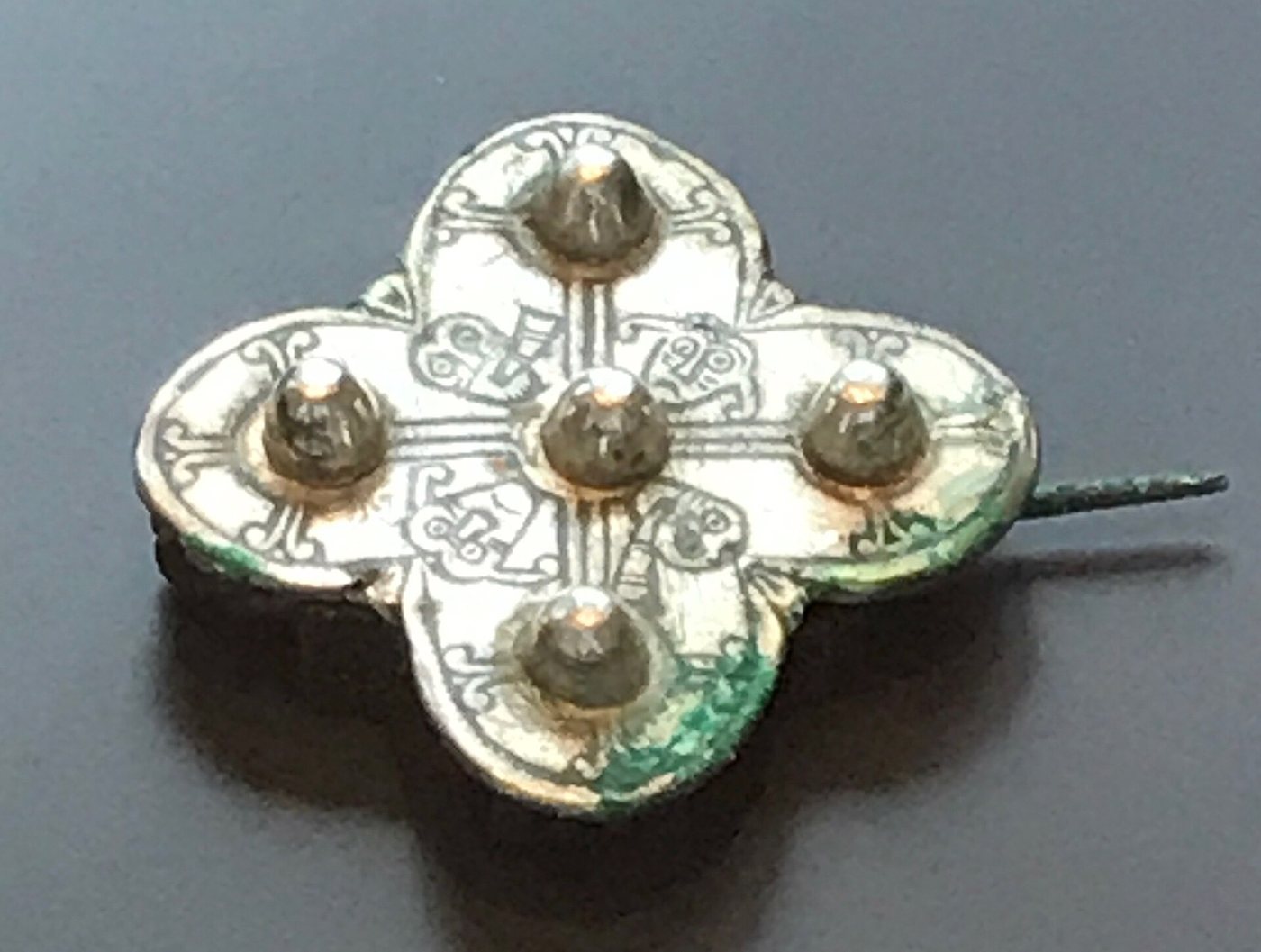
Inside, according to the museum, were 27 objects, “a hoard within a hoard”: glass and other beads, pendants, curios and heirlooms, seven late Anglo-Saxon brooches – the first such group from Scotland – a belt fitting, the rock crystal jar and two balls of earth. These might be soil from holy places of the kind pilgrims brought home, but that is a guess. Two quatrefoil brooches carry images read as symbols of sight and hearing. One pendant is capped by a perforated coin of Coenwulf, king of Mercia until 821. It does not date the burial; it is one more heirloom.
The silver pectoral cross from the upper layer is highlighted with gold and inlaid with niello. Its four arms carry symbols interpreted as the four Evangelists. The central boss or stone is missing. Its style, named Trewhiddle after a find in Cornwall, points to late Anglo-Saxon work. Around it lay a fine chain of silver wire less than a millimetre thick, wound around gut, which suggests the cross was still being worn shortly before burial. Goldberg thinks of a high-ranking cleric or a king as its wearer; an origin in Dublin has also been suggested.
The organic remains matter almost as much as the metal. Leather, linen, wool, silk and gut survive, largely because the copper-rich environment inside the sealed vessel kept microbes at bay. Two bundles of silk and other fabrics enclose gold objects; they may be the oldest surviving silk in Scotland, and the silk has been attributed to the Byzantine world. The wool wrapped around the vessel gave a preliminary radiocarbon range of AD 680 to 780 – at least a century older than the silver.
The Galloway Hoard lacks the tool archaeologists usually rely on for hoards: a run of coins whose latest example limits the date of burial. The only coin, Coenwulf’s, is much older and pierced. The date “around 900” therefore rests on comparison. Broad arm-rings of the same type also occur in coin-dated hoards, Cuerdale in Lancashire above all, and these comparisons give the ring type a range of about 880 to 930. The style of cross and brooches fits the later ninth century as well. If the date is right, Galloway is the earliest known Viking-age hoard from Scotland.
Further radiocarbon dates, for example on the silk, are meant to refine the chronology. Many objects were already old when buried, some by centuries; the hoard is not a snapshot of one generation but a collection that grew over a long time.
Around 900 Galloway was a borderland. In the eighth century the area belonged to the Anglo-Saxon kingdom of Northumbria, with a bishopric at Whithorn, and Irish sources call this shore the “Saxon coast”. At the same time Galloway faced the Irish Sea, across which Scandinavian groups moved between Dublin, the Isle of Man, the Hebrides and north-west England. The mix of Norse and Gaels produced the Gall-Goídil, after whom Galloway was later named. No find can be assigned to them directly, but the hoard shows what came together in this region and period. More in the article on the Gall-Goídil.
One event that shook the whole region in these years is recorded in the Annals of Ulster: the expulsion of the Scandinavians from Dublin in 902.
“The expulsion of the heathens from Ireland, that is, from the ship-camp of Áth Cliath, by Mael Finnia son of Flannacán with the men of Brega, and by Cerball son of Muiricán with the Leinstermen, so that they left behind a large part of their ships and got away half-dead, after they had been wounded and routed.”
Annals of Ulster, year 902, entry 2 (Old Irish text after CELT, G100001A); own translation
Áth Cliath is the Irish name for Dublin. The exiles are often linked with the burial of the Cuerdale hoard and with Norse settlement in north-west England. For the Galloway Hoard such a link is conceivable, nothing more. The Dublin weight standard shows only that the owners belonged to the same economic system.
There is no secure answer, but there are several interpretations.
Scandinavian owners. Silver used by weight, folded arm-rings and the Dublin standard belong to the Viking world. Stuart Campbell of the Treasure Trove Unit saw the find as evidence that Galloway was not just a target of raids but an area where people spoke Norse and lived Norse lives. Art Fund considers Vikings in retreat possible, as well as others who feared a raid.
Anglo-Saxon owners. The runes are Anglo-Saxon, the names Old English, the cross and brooches Northumbrian or broadly Anglo-Saxon. Parsons suggested early on that the names on the rings might identify owners who could also have buried the hoard.
A religious community. Since the 2025 reading this idea has gained ground: a ring as “the community’s wealth”, a pectoral cross, a bishop’s crystal jar, balls of earth that might be relics. National Museums Scotland points to this connection itself. “Monastery”, though, says more than the evidence allows.
Several contributors. The four folding patterns and the rings of unequal value point to several people or groups hiding their property together. Goldberg and his colleagues think of a kind of communal treasury, perhaps a family treasure with heirlooms.
These readings are not mutually exclusive. The more that is learned about the hoard, the less it fits the picture of Vikings looting a church, although a cross taken in a raid remains possible. Nobody came back for the hoard. Campbell compared it to a safety deposit box that was never claimed.
National Museums Scotland and Art Fund call the Galloway Hoard “the richest collection of rare and unique Viking-age objects ever found in Britain or Ireland”. “Rich” here refers to variety, rarity and preservation, not to weight.
By weight another find is far ahead. The Cuerdale hoard, found in 1840 on the bank of the Ribble near Preston, contained about 40 kilograms of silver and some 7,000 coins. The Galloway Hoard weighs in at just over 5 kilograms. What sets Galloway apart are the gold objects, the West Asian vessel with its lid, the inscribed rock crystal, the silk and the packing in parcels. An overview of the great hoards is given in the articles on Viking-age silver hoards and on the Spillings hoard from Gotland, which with more than 65 kilograms of silver outweighs Cuerdale too.
Scotland has its own rule: under the common law of treasure trove, ownerless finds belong to the Crown, whatever they are made of. Responsibility lies with the Queen’s (now King’s) and Lord Treasurer’s Remembrancer; a panel values the find and recommends a museum. The finder normally receives a reward of up to the valuation, which the museum has to raise.
The Galloway Hoard brought a second dispute. The Church of Scotland, as landowner, took legal action against McLennan, claiming an equitable share of the reward. Later the finder and the Church’s General Trustees agreed to share it. In 2017 the valuation panel put the hoard at £1.98 million.
Where it should go was fiercely contested. Dumfries and Galloway Council wanted it for the new Kirkcudbright Galleries, for which it had received £1.2 million from the Heritage Lottery Fund. A local campaign, the Galloway Viking Hoard Campaign, demanded that it stay in the region; its chair, Cathy Agnew, put it simply: it was buried here and found here, so it should stay here. National Museums Scotland applied as well.
In May 2017 the Remembrancer allocated the hoard to National Museums Scotland. The council appealed and lost. The museum had six months to raise the money; had it failed, the hoard would have gone back for revaluation. The National Heritage Memorial Fund gave £1 million, the Scottish Government £150,000, and Art Fund made a major contribution alongside donations from more than 1,500 people. According to Goldberg, the campaign closed two weeks before its deadline.
In September 2018 museum and council signed a 25-year partnership. It provides for a “significant and representative portion” of the hoard to be shown long-term in Kirkcudbright, with the rest staying in Edinburgh. The announcements I read gave no fixed dates for these long-term displays.
The hoard was first shown publicly in the exhibition “Galloway Hoard: Viking-age Treasure” at the National Museum of Scotland in Edinburgh from 29 May to 12 September 2021. It then went to Kirkcudbright from 9 October 2021 to 10 July 2022, and to Aberdeen from 30 July to 23 October 2022. More than 30,000 people came in Kirkcudbright, the gallery’s most popular exhibition since it opened in 2018. From 2025 the hoard travelled abroad for the first time, to Adelaide, Melbourne and finally Sydney until October 2026. More museums are introduced in the article on Viking museums.
Alongside ran the research project “Unwrapping the Galloway Hoard” from 2021 to 2024, funded with £1 million by the Arts and Humanities Research Council and led by Martin Goldberg for National Museums Scotland together with the University of Glasgow. The team included the textile specialist Susanna Harris, Alexandra Makin, Mary Davis for the inorganic finds and Adrián Maldonado for the silver. Partners such as the British Museum, the SUERC radiocarbon laboratory and a Brussels institute for dye analysis supplied scientific data. Many results are not yet fully published; the 2021 book by Goldberg and Davis serves as an introduction.
A brief note of our own: the beasts on the great double ring are a reminder of how much of the period’s visual language lives in metal. The motifs we engrave in our workshop draw on the same tradition.
Where exactly was the Galloway Hoard found? In the parish of Balmaghie in Kirkcudbrightshire, Dumfries and Galloway, on Church of Scotland land. The precise spot is withheld to protect the scheduled site.
How many objects does the hoard contain? The museum speaks of “more than 100 objects”. An exact number is hard to give, because parcels, fragments and strings of beads can be counted in different ways. The lidded vessel alone held 27 objects.
What does the runic inscription mean? According to the 2025 reading, one arm-ring says in Old English “This is the community’s wealth”. Other rings bear names or name elements such as Ecgbeorht. The runes are Anglo-Saxon, not Scandinavian.
Who owns the hoard today? National Museums Scotland. Under a 2018 agreement a representative portion is to be shown long-term at Kirkcudbright Galleries.
Why does the find matter so much? It is well preserved and was professionally excavated, and its mix of Norse, Anglo-Saxon, Byzantine and West Asian pieces shows how interwoven the Irish Sea world was around 900.

The Gall-Goídil · Hacksilver – silver as currency · The silver hoards · The Spillings Hoard · Viking jewellery.
All History & Finds articles →
Some peoples leave us a history. Some leave us a place. And some leave us nothing but a name – a name that actually …
Read more →The Geats (Old Norse Gautar, Old English Gēatas) lived in the south of present-day Sweden, in Götaland between the …
Read more →The Gepids were an East Germanic people of the Carpathian Basin. When Attila's empire collapsed, their king Ardaric led …
Read more →Between the Rhine, the Meuse and the Eifel hills, barely a stone's throw from our workshop in Alsdorf, peoples lived …
Read more →