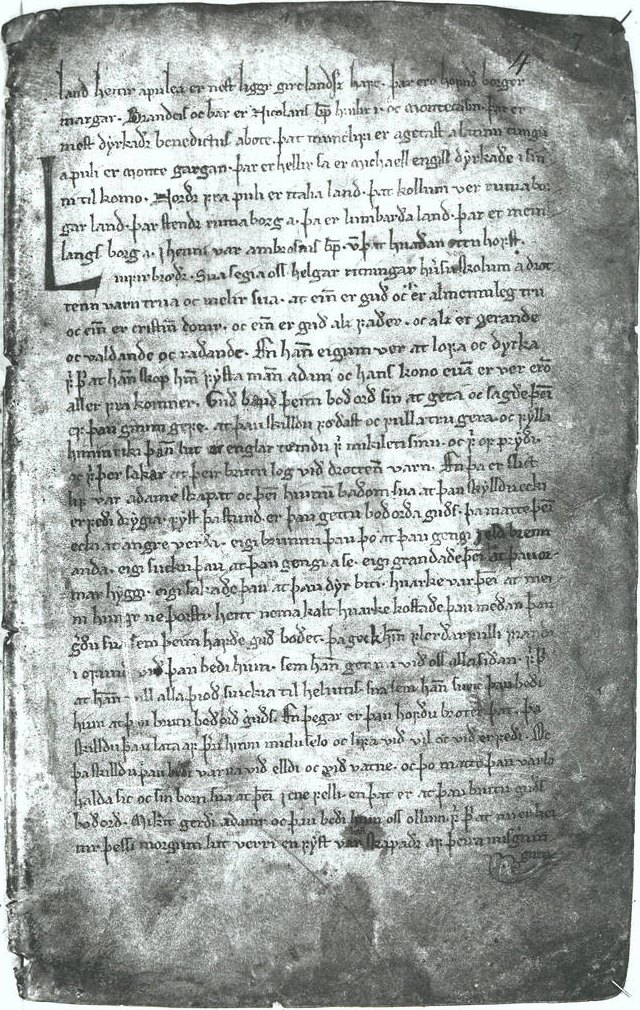
Early in the fourteenth century an Icelandic lawman in the service of the Norwegian king had a book made and wrote most of it himself: the settlement of Iceland, the voyage to Vinland, Troy and Britain, a treatise on arithmetic, theological dialogues. Decades later someone copied a poem about the gods onto pages that had been left blank. This article shows who Haukr Erlendsson was, what his book contains, how it came into being, and why three added pages are now among the most important witnesses to Völuspá.
Most of Iceland's famous manuscripts have a subject. The Codex Regius collects poems, Flateyjarbók kings' sagas. Hauksbók, the “book of Haukr”, collects whatever its owner thought worth knowing. History sits beside theology, sagas beside natural lore, a mnemonic verse for the church calendar beside a treatise on reckoning.
According to the English Wikipedia it preserves the earliest or only surviving copy of many Old Icelandic texts; which ones, I have not checked. What is certain is that anyone who reads Landnámabók, the Saga of Erik the Red or Völuspá in a scholarly edition meets the siglum H.
For hardly any other medieval Icelandic compilation do we know the patron's name, office and year of death, and here he also did the writing.
Haukr Erlendsson died in 1334. His year of birth is not recorded; the historian Sverrir Jakobsson puts it “probably around 1264”. According to the English Wikipedia his father was Erlendr Ólafsson, called the Strong, who died in 1312, and his mother was called Jórunn.
The sources call Haukr a lögmaðr, literally “lawman”; English accounts usually say “lawspeaker”. According to Wikipedia he held the office in Iceland by 1294 at the latest and kept it until 1299. Around 1301 he went to Norway, where he was lawman from 1303 to 1322, in Oslo and in the Gulathing district. The figures vary slightly: the Gripla article of 2008 knows him as lögmaðr of Oslo already in 1302 and gives 1311 as the first year in which he is called lögmaðr of the Gulathing.
Haukr sat on the king's council. In 1309 he is addressed as “herra”, in 1311 called a knight, says Wikipedia; the Árni Magnússon Institute gives 1304 as the year he was knighted, so the information differs. According to Wikipedia he was among the men who recognised Magnus of Sweden as king of Norway. After 1311, the Gripla article says, he remained for about ten more years in the book-loving circle of officials in Bergen.
An Icelander, then, who rose high in Norway. That matters for understanding the book, because scholars disagree about whom Haukr made it for: himself, pupils, or the men around the king.
Hauksbók was originally a single volume. Today it survives in three parts, which bear the shelfmarks AM 371 4to, AM 544 4to and AM 675 4to after the collection of the Icelander Árni Magnússon. “4to” means quarto, a medium book format.
AM 371 4to contains Landnámabók and Kristni saga. AM 544 4to is the largest part, with 107 leaves. AM 675 4to contains Elucidarius, a theological dialogue. The Árni Magnússon Institute counts eighteen leaves for AM 371 and sixteen for AM 675.
The parts are not kept in one place. When Árni Magnússon's collection was divided between Denmark and Iceland, AM 371 4to went to Iceland and the other two parts stayed in Denmark, according to the Árni Magnússon Institute in Reykjavík. A manuscript database for the legendary sagas accordingly lists AM 544 4to in the Arnamagnæan Collection in Copenhagen. The English Wikipedia, which places all three parts in Reykjavík, is wrong on this point.
None of the parts is complete. The Gripla article of 2008 sums up the editors' findings: AM 371 probably consisted of six quires, that is, gatherings of folded parchment sheets. One quire is missing entirely, and none of the others is complete. The present leaf 1 was once the fourth leaf from the beginning of Landnámabók. AM 544 originally had at least seventeen quires; three or more are lost.
Some of what is lost can be recovered. In the first half of the seventeenth century Björn Jónsson of Skarðsá copied extracts from Hauksbók when it was more complete. According to Finnur Jónsson these included Haukr's own genealogy and a list of the bishops of Greenland. That list ran down to a Bishop Árni, who received the see in 1314 – a sign that entries were still being added in Haukr's lifetime.
The following overview follows the list of contents in the English Wikipedia; the leaf numbers for AM 544 agree with the catalogue entry on handrit.is. In AM 371, leaves 1 to 14 hold Landnámabók and leaves 15 to 18 Kristni saga.
AM 544 opens with encyclopaedic matter: geography, natural phenomena and biblical stories on leaves 1 to 14, philosophy and theology on 15 to 19. Völuspá follows on leaf 20 and the recto of leaf 21. Then come Trójumanna saga, the saga of the Trojans (leaves 22 to 33), a short text on seven precious stones and their nature, Cisiojanus – a Latin mnemonic verse for the church festivals – and Breta sögur, the stories of the Britons, including Merlínússpá, the prophecy of Merlin (leaves 36 to 59).
Next are two dialogues between soul and body (leaves 60 to 68), Hemings þáttr Áslákssonar, Hervarar saga ok Heiðreks, Fóstbrœðra saga (leaves 77 to 89), Algorismus, Eiríks saga rauða (leaves 93 to 101), Skálda saga, a piece on the kings of the Uplands, Ragnarssona þáttr on the sons of Ragnar, and finally Prognostica temporum, a kind of weather forecast.
Among the learned matter on leaves 1 to 19 and in AM 675 the Gripla article counts, besides Elucidarius, the Disciplina clericalis, sermons, homilies and a didactic dialogue, together with astronomy, geography and meteorology.
The usual dating comes from the Icelandic manuscript scholar Stefán Karlsson. On the evidence of the script, that is palaeographically, he placed the parts written by Haukr in the years 1302 to 1310; the catalogue handrit.is gives the same span for AM 371 and 1290 to 1360 for AM 544 with all its additions. For AM 371, Gunnar Harðarson and Stefán Karlsson consider the years 1306 to 1308, according to the Gripla article; the German Wikipedia gives that narrower span for the whole book.
Two observations support the dating. Jón Helgason, who published the facsimile in 1960, found Norwegian influence in the spelling; Haukr therefore wrote when he was already living in Norway. And in one passage the wife of a certain Kolbeinn Auðkýlingr is called “frú”. That title presupposes that her husband was a knight, which he became in 1300 or 1301. The passage cannot have been written earlier.
The book was not made in one go. The Gripla article distinguishes layers. First came the lapidary and Cisiojanus, which Haukr probably copied or acquired in Iceland before 1302; the mnemonic verse names Icelandic saints. Then, after his appointment in Norway, leaves 1 to 19 of AM 544 and the whole of AM 675 were added. Some of their scribes were undoubtedly Norwegian, the article says, and the rest probably were too. The last major addition was the dialogues between soul and body, which the article dates to 1311 (handrit.is: about 1310). After that the book stopped growing.
Several scribes worked on Hauksbók. By far the greater part is in Haukr's own hand according to the English Wikipedia; the German Wikipedia is more cautious and says the book was written for him and that he took part in the work. Gunnar Harðarson and Stefán Karlsson attribute AM 371 to him. The catalogue entry on handrit.is distinguishes fourteen hands in AM 544. It gives Haukr Trójumanna saga, the lapidary, Breta sögur, the dialogues between soul and body, Hemings þáttr, Hervarar saga and the end of the volume, with parts of Fóstbrœðra saga and Eiríks saga. Two other hands wrote Algorismus, and an Icelandic hand wrote Völuspá.
Haukr did not simply copy. He often worked from older manuscripts that are now lost, and he altered his exemplars, usually by shortening. Jón Helgason speaks of a “marked inclination to shorten”. The appearance of the book fits: Haukr used damaged parchment too and wrote in a very compressed script. The Gripla article reads this as a possible sign that a large book had to be produced quickly.
The redactor shows most clearly in Landnámabók, the register of Iceland's first settlers. Haukr is the only medieval redactor of that work who names his sources: the book of Sturla Þórðarson and a second, now lost, by Styrmir the Learned. As the first authors he names Ari Þorgilsson and Kolskeggr the Wise. That single sentence is the entire evidence that a Landnámabók already existed in the early twelfth century. Ari's surviving work is the subject of our article on Íslendingabók.
Haukr added material about the heathen period, including the well-known section on Úlfljótr's law with its ban on approaching land with dragon heads on the prow. The wording, and the question of how much of it is learned reconstruction of the thirteenth century, is discussed in our article on Landnámabók.
The historian Helgi Þorláksson holds, according to the Gripla article, that Haukr made his Landnámabók early in order to document his descent and with it his fitness for royal office. It fits that his own genealogy stood in the book.
Landnámabók is followed by Kristni saga, by its name the “saga of Christianity”. As far as I know, without having checked a source here, it tells of the conversion of Iceland. Only part of it survives in Hauksbók: the remaining leaves of the last quire of AM 371 contain the middle of the saga, according to the Gripla article.
Eiríks saga rauða, the saga of Erik the Red, is one of the two narratives about the voyages to Vinland. It exists in two versions: in Hauksbók and in Skálholtsbók of the fifteenth century. Our article on Þorfinnr Karlsefni records that Haukr smoothed the language of the text, while Skálholtsbók is regarded as a faithful but careless copy.
Haukr had a personal interest in the material. He counted Karlsefni, leader of the great Vinland expedition, among his ancestors, and in his version a genealogy to that effect stands at the end of the saga. For him the saga was family history as well.
The Gripla article draws a further conclusion. Hauksbók may have served to show the king's men that Haukr knew Icelandic affairs and the whole North Atlantic: northern Norway, Greenland, Vinland. Such a man would have been useful as an adviser on the northern possessions. That is an interpretation, not evidence; Haukr himself nowhere says why he made the book.
Between Fóstbrœðra saga and the Saga of Erik the Red stands a text that has nothing to do with heroes: Algorismus. According to the English Wikipedia it is a short mathematical treatise in Old Icelandic and “the oldest text on mathematics in a Scandinavian language”.
It mainly translates the Carmen de Algorismo of Alexander of Villedieu, a Latin didactic poem of about 1200, which in turn goes back to the writings of al-Khwarizmi. The word algorithm comes from his name.
One often reads that Algorismus is the first presentation of Hindu-Arabic numerals in the North. I have not seen that attested, and the claim “oldest text on mathematics” also rests on Wikipedia alone here.
For mythology one text in Hauksbók matters above all, and that very text was not part of Haukr's plan. Völuspá, the prophecy of the seeress, stands on leaf 20 and the recto of leaf 21 in AM 544. Those pages had at first been left blank.
According to a dating by Stefán Karlsson reported in the Gripla article, a gap on the verso of leaf 18 and the blank pages of leaves 19 to 21 were filled around 1350 with four texts: a translation of the tract on the twelve abuses of the world (De duodecim abusivis saeculi), a plan of Jerusalem, a fragment of the Summa decretalium, a work of canon law, and Völuspá. The dating is regarded as uncertain. Gunnar Harðarson and Stefán Karlsson think it possible that the texts on leaf 19 were written only after Haukr's death; Gunnar Harðarson, on the other hand, links the legal fragment to Haukr's milieu in Bergen.
If “around 1350” is right, Haukr never saw the Völuspá of his own book. He died in 1334, and according to Jón Helgason the manuscript probably reached Iceland shortly afterwards. The poem would then have been entered there by an unknown hand.
The text is not easy to read. Edward Pettit, who edited the Hauksbók version separately in 2023, writes that much is hard to make out in the facsimile and that parts of leaf 20 verso and 21 recto are illegible or torn. His edition therefore relies heavily on that of Eiríkur Jónsson and Finnur Jónsson of 1892 to 1896.
Völuspá survives as a whole in two manuscripts, the Codex Regius and Hauksbók; in addition there are the stanzas quoted by Snorri Sturluson. Pettit counts 58 stanzas in Hauksbók, the last but one a half-stanza. Our overview of Völuspá follows the same count.
The most striking difference: Hauksbók lacks the account of Baldr's death. The seeress does not mention the killing by Höðr. At the end Baldr returns all the same – in stanza 54 by Pettit's count – and dwells with Höðr in Odin's halls. A reader who knows only this version learns of a homecoming without the death before it. Pettit speaks of “narrative disjunctions” and finds the version harder to follow and on the whole less satisfying than that of the Codex Regius.
The order differs too. The refrain of the howling hound Garmr stands in Hauksbók, according to Pettit, in stanzas 31, 36, 41, 46 and 50; the list of dwarfs in stanzas 10 to 16 follows the council of the gods in stanza 9 and in part gives other names.
Then there are readings that have already played a part in our articles. In stanza 7 the gods of the Codex Regius raise “altar and temple”; Hauksbók has a different line at this point, in which they test their strength (see Iðavöllr). Gjallarhorn is “shrill” (galla) in the Codex Regius and “old” (gamla) in Hauksbók, as the article on Gjallarhorn shows. According to Pettit, Hauksbók alone also has a line about the “greedy ones” in stanza 37, the second half of stanza 39 with “Surtr's kinsman”, and the image of the world serpent gaping across the sky in stanza 47.
The text in our source archive is put together from both manuscripts. A short stanza about Váli and the fetters (no. 34 there) is given by the translator Bellows only as a Hauksbók variant.
Most ink has been spilt over two lines found only in Hauksbók. Shortly before the end, after the gold-roofed hall on Gimlé, the text reads: “Þá kemr inn ríki / at regindómi / öflugr ofan, / sá er öllu ræðr.”
There comes on high, all power to hold,
A mighty lord, all lands he rules.Völuspá, st. 65 in the numbering of our source archive (Hauksbók, H 57 in Pettit), translation by Henry Adams Bellows (1923)
Simrock's German translation renders the stanza in four lines; the two extra ones say that the Mighty One settles strife and ordains everlasting laws. They have no counterpart in the Old Norse text of our archive or in Pettit's Hauksbók text, and Bellows does not translate them. Where Simrock took them from I have not checked. Bellows is free as well: more literally, the powerful one comes “to regindómr, strong, from above, he who rules all”.
Who is meant? Pettit considers the identity uncertain. The figure is suggestive of Christ – or of Heimdallr, Odin or Baldr as possible types of Christ. The word regindómr is unclear too; some scholars detect a reference to the Last Judgement. Whether the half-stanza is a late Christian addition is disputed. Bellows thought it probably spurious. The wider question is treated in our article How Christian is the Edda?
For Hauksbók this is a reason for caution. The stanza stands in an addition of the mid-fourteenth century, between a plan of Jerusalem and a piece of canon law. That does not prove that a cleric composed it. It does show in what surroundings the poem was being copied at the time.
How do the versions relate to one another? According to Pettit the relationship between the Codex Regius, Hauksbók and Snorri's source “has not been precisely determined”. He explains the differences by oral diffusion, which may have involved recomposition, by interpolation, scribal error and other damage in transmission. No original version from which both could be derived is available.
Several proposals about the book's purpose are set side by side in the Gripla article of 2008. Sverrir Jakobsson sees Hauksbók as the expression of a world view and its redactor as an interpreter and teacher; he finds parallels in medieval schoolbooks rather than in encyclopaedias. That the book was actually used for teaching is not attested, the article says. Gunnar Harðarson understands it as a witness to the literary culture of royal officials. Rudolf Simek, according to the summary, holds that Haukr embedded his Landnámabók in the Icelandic version of a large monastic encyclopaedia.
The article itself stresses the use for a career: Haukr needed evidence of his qualifications, and once the Gulathing was his, the book stopped growing. It is therefore no disinterested picture of his world view but a deliberate selection. The dispute cannot be settled, because Haukr does not speak on the matter.
After Haukr's death the book probably soon reached Iceland. In the seventeenth century Björn Jónsson of Skarðsá used it; later it belonged to Bishop Brynjólfur Sveinsson. After the bishop's death Árni Magnússon acquired AM 544 and AM 675, according to handrit.is. The eighteen leaves of AM 371 reached him separately, says the Árni Magnússon Institute: fourteen from Súgandafjörður, four from the farm Bær. Exactly when the volume fell apart I have not seen. Hauksbók was printed in full in 1892–1896 by Finnur Jónsson and Eiríkur Jónsson; Jón Helgason's facsimile followed in 1960.
When was Hauksbók made? By the usual dating between 1302 and 1310. Individual items are older, the dialogues between soul and body are placed in 1310 or 1311, and the additions including Völuspá around 1350.
Where is it kept today? AM 371 4to is in Reykjavík at the Árni Magnússon Institute; AM 544 4to and AM 675 4to are in Denmark, in the Arnamagnæan Collection in Copenhagen.
Why does its Völuspá matter? Beside the Codex Regius it is the only complete medieval version, and it shows that the poem circulated in more than one form.
Which version is the original? That cannot be established with certainty. Pettit calls the relationship between the versions “not precisely determined”.
Is there an English translation of Hauksbók? I know of no translation of the whole book and have not searched for one specifically.
The Codex Regius · Flateyjarbók · Landnámabók · Völuspá – the Seeress's Prophecy · Íslendingabók: Ari the Learned and the oldest history of Iceland.
All History & Finds articles →
Sixteen sagas from legendary prehistory to 1177, and not one author's name on the parchment: Heimskringla is the most …
Read more →Some time around 1026 the fleet of Cnut the Great met the ships of Olaf of Norway and Anund Jacob of Sweden at a water …
Read more →Few sentences about Viking Age religion are quoted as often as the one about Helgi the Lean: he believed in Christ, but …
Read more →On an island in Lake Mälaren, a few kilometres from Stockholm, an excavation team under Wilhelm Holmqvist found a …
Read more →