Few sentences about Viking Age religion are quoted as often as the one about Helgi the Lean: he believed in Christ, but called on Thor when he went to sea. Behind it stands a man whom the Icelandic Book of Settlements describes as the son of a Scandinavian and an Irish king's daughter, raised between Ireland and the Hebrides, and later lord of the largest fjord in northern Iceland. This article checks what the text actually says, how old it is and where the tradition reaches its limits.
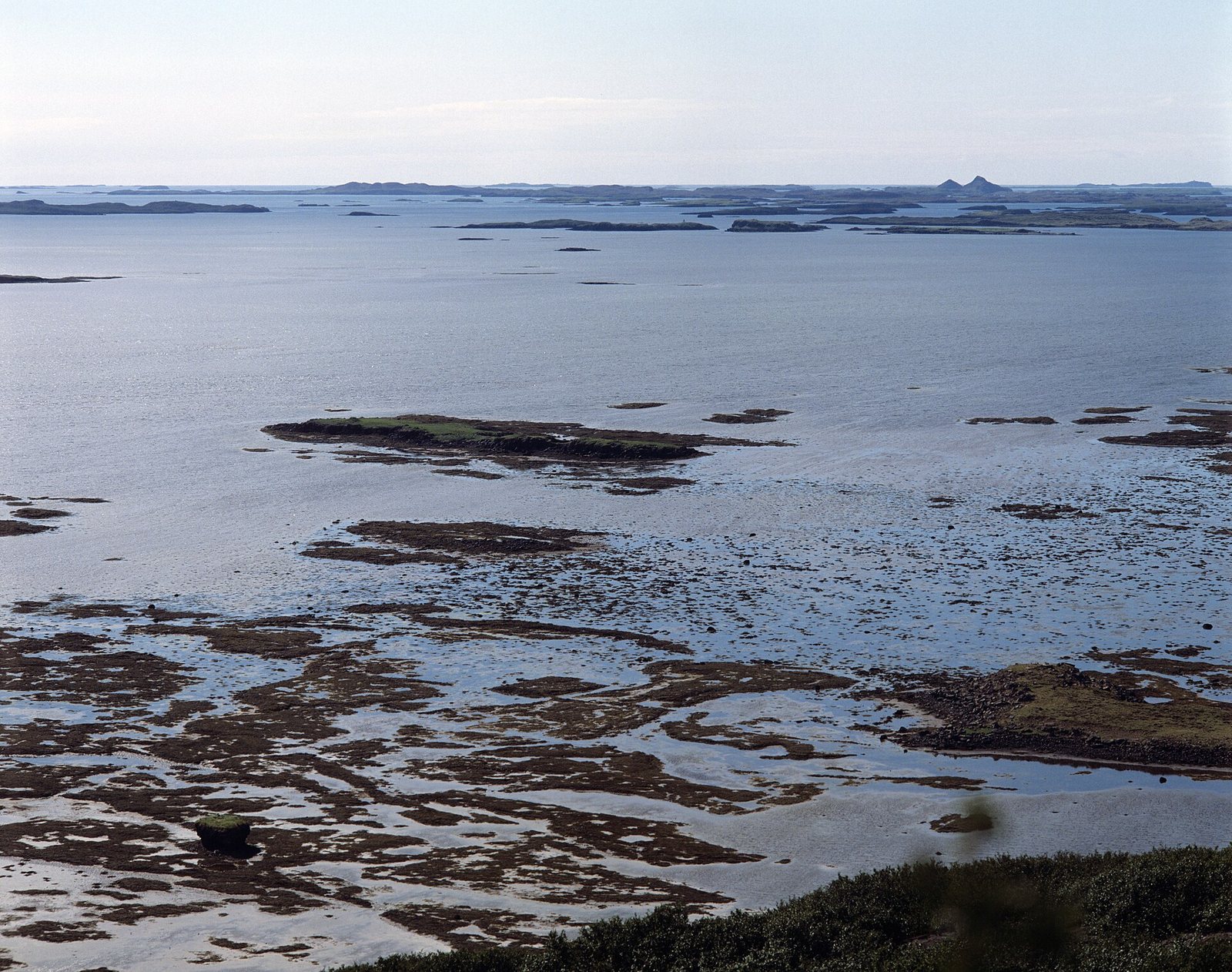
In Old Norse he is Helgi inn magri, also Helgi Eyvindarson after his father. Icelandic tradition counts him among the most important landnámsmenn, the "land-takers" who claimed Iceland in the late ninth and early tenth centuries. His territory was Eyjafjörður in the north, the long fjord on which Akureyri stands today. The Eyfirðingar, the people of Eyjafjörður, were said to descend from him.
What makes Helgi interesting to historians is less his land than his background and his faith. According to Landnámabók his mother was Irish, he was born in Ireland and spent part of his childhood in the Hebrides. He thus represents a milieu that Icelandic sagas often touch only in passing: the mixed Norse-Gaelic families of the Irish Sea. He is also the best-known example of a religious attitude that modern writers like to call "mixed faith".
One confusion can be cleared up at once. Helgi the Lean has nothing to do with the legendary hero Helgi Hundingsbani, lover of the valkyrie Sigrún in the Helgi poems of the Edda. That Helgi belongs to heroic poetry; see the article on Helgi and Sigrún. Nor is he Helgi bjóla, a son of Ketil Flatnose who settled at Kjalarnes in the south-west, although Helgi the Lean did marry into that family.
There is no contemporary evidence for Helgi. No Irish annal names him, no inscription, no grave can be linked to him. Everything we read about him comes from two Icelandic texts.
The older is Íslendingabók ("Book of the Icelanders") by Ari Þorgilsson, usually dated to around 1122–1133. Ari is brief. In his second chapter he names one outstanding settler for each quarter of the country: Hrollaugr in the east, Ketilbjǫrn in the south, Auðr in the west and, for the north, Helgi inn magri, a Norwegian (norrænn), son of Eyvindr austmaðr, who lived in Eyjafjörður and from whom the Eyfirðingar descend. Helgi appears once more in the genealogy of the bishops at the end of the book, as the settler who lived "north in Eyjafjörður at Kristnes". From him Ari traces a line down to Bishop Ketill of Hólar.
The detailed source is Landnámabók, the "Book of Settlements". It lists Iceland's settlers, their land and their descendants. The original version is lost; what survives are reworkings from the thirteenth and fourteenth centuries, above all Sturlubók, associated with Sturla Þórðarson, and Hauksbók by Haukr Erlendsson. Helgi's story is in the third part, which covers the Northern Quarter, in chapter 12 and some of the following chapters. I read these chapters in the edition on heimskringla.no through a retrieval tool that returns only short verbatim excerpts; I saw the key sentences in their Old Norse wording and the rest as a summary.
Some 300 to 400 years thus separate Helgi's lifetime from the surviving manuscripts. Landnámabók also has its own agenda: it supports property rights and the prestige of families that were powerful in the twelfth and thirteenth centuries. That does not make it false, but it calls for caution.
Landnámabók opens Helgi's chapter not with him but with his parents. His father Eyvindr was the son of Bjǫrn, a man of standing from Gautland, today's Götaland in Sweden, and of Hlíf, a daughter of Hrólfr Ingjaldsson. According to the text Eyvindr took over his father's warships, went raiding in the west and operated off Ireland. There he married Rafarta, "daughter of Kjarvalr, king of the Irish" (dóttur Kjarvals Írakonungs), and settled down. "That is why he was called Eyvindr Austmaðr," the text says.
The nickname needs a word of explanation. Austmaðr literally means "east man". In Ireland and Britain, "Ostmen" was a common term for Scandinavians, who had come across the sea from the east. Landnámabók explicitly links the name to Eyvindr's life in Ireland: only there was he the man from over the water.
Helgi himself, according to Landnámabók, was born in Ireland (Hann var fæddr á Írlandi). Ari, by contrast, simply calls him a Norwegian. This need not be a contradiction. What mattered to Ari was apparently the paternal line, and that led back to Scandinavia.
We learn nothing precise about Eyvindr's raids: no date, no place, no battle. Whether he was a leader in one of the Scandinavian bases in Ireland, such as Dublin, Landnámabók does not say.
Several Icelandic families trace their descent to Kjarvalr. Scholars usually identify him with Cerball mac Dúnlainge, king of Osraige, roughly the area of modern Kilkenny, from 842 until his death in 888. Cerball is well attested: Irish annals record that he fought Vikings but also allied with them at times. The fullest source on him, the Fragmentary Annals of Ireland, was probably compiled in Osraige for one of his descendants and is therefore partisan.
A king who made pacts with Norse warriors is a plausible father-in-law for a Scandinavian. The identification is not secure, however. According to the summary of current research I was able to read, there are objections. The names of some supposed daughters, Rafarta among them, do not look clearly Irish. The number of generations between Kjarvalr and his Icelandic descendants fits poorly. It has also been suggested that Norse people from Ireland carried stories about the famous Cerball to Iceland, where families later attached him to their pedigrees.
That leaves an honest interim result: that Helgi's mother was Irish is quite conceivable and fits many traces of Gaelic names and people in early Iceland. That she was a daughter of Cerball in particular cannot be proven.
The story behind the nickname is short and harsh. Eyvindr and Rafarta sent their son to be fostered in the Suðreyjar, the "Southern Isles", as the Hebrides are called in Old Norse. Fosterage was common in the North and bound households together. When the parents came back two winters later (tveim vetrum síðar), the boy was so starved that they did not recognise him: "þá var hann sveltr, svá at þau kenndu hann eigi." They took him away with them and called him Helgi the Lean.
That is all the text says. It does not name the foster family, does not explain why the child went hungry and gives no age. Whether the foster parents neglected him or there was a famine remains open. It is also possible that Helgi was simply a gaunt man and the anecdote explains the nickname after the fact. There is no way to decide.
The episode is revealing all the same: a child born in Ireland and fostered in the Hebrides moves within a network of islands and coasts shared by Scandinavians and Gaels. For an overview of that world see the articles on the Vikings in Ireland and the Vikings in Scotland.
According to Landnámabók, Helgi married Þórunn hyrna, a daughter of Ketill flatnefr, Ketil Flatnose. Her nickname hyrna is usually understood as "the horned one"; what it meant exactly is unclear. Tradition makes Ketil a Norwegian magnate who built up a lordship in the Hebrides. Whether he existed in the form the sagas give him is an open question, discussed in the article on Ketil Flatnose.
This marriage made Helgi the brother-in-law of Aud the Deep-Minded, whom Laxdæla saga portrays as a devout Christian. Two of the four great settlers on Ari's list, Auðr in the west and Helgi in the north, thus belong to the same Hebridean kin group. Whether that link reflects historical reality or the work of later genealogists who joined prominent families together, no one can say for sure. More on Aud in the article on Aud the Deep-Minded.
Landnámabók gives Helgi and Þórunn two sons, Hrólfr and Ingjaldr. Later chapters also name daughters: Þóra, Helga, Hlíf, Ingunn and Þorbjörg, whose birth in Iceland is told separately.
The text does not say when Helgi sailed to Iceland. The section I could check contains no date and no reference to King Harald Fairhair, whom other chapters often use to date their stories. Ari gives the whole settlement a span of about sixty winters, usually converted to roughly 870–930. Helgi's arrival belongs somewhere within it.
On board, according to Landnámabók, were his wife and children as well as Hámundr heljarskinn ("Hell-skin"), described as his mágr, a relative by marriage. According to chapter 16, Hámundr married Helgi's daughter Ingunn.
Then comes the famous scene. When Helgi sighted Iceland, "he went to seek an oracle from Thor as to where he should take land, and the oracle directed him north around the country" (gekk hann til frétta við Þór, hvar land skyldi taka, en fréttin vísaði honum norðr um landit). The phrase ganga til frétta means seeking a prophetic answer. How this was done, whether by casting lots or otherwise, the text does not describe. What matters is what the sentence assumes: a man whom the same text calls a believer in Christ consults a pagan god on the most important decision of his life.
Helgi landed, the text says, "outside Hrísey but inside Svarfaðardalr", on the western side of outer Eyjafjörður, where the island of Hrísey still lies in the fjord. He spent his first winter at Hámundarstaðir.
In spring, according to Landnámabók, Helgi climbed the Sólarfjöll ("Sun Fells") to survey the land and later reached Galtarhamar. He explored the district over the summer. Then he took possession of it in a striking way: he "made a great fire at every river mouth and so hallowed for himself the whole district" (gerði eld mikinn við hvern vatnsós ok helgaði sér svá allt herað).
The verb helga means "to hallow, consecrate", and in a legal sense also "to claim for oneself". Landnámabók mentions fire as a sign of land-taking elsewhere too. Whether this reflects an old legal custom or a literary formula through which the narrators imagined the settlement is disputed. The scale is remarkable: Helgi claimed not a farm but an entire fjord with its valleys.
He spent the next winter at Bíldsá. The following spring he moved to Kristsnes and lived there "as long as he lived" (færði Helgi bú sitt í Kristsnes ok bjó þar, meðan hann lifði).
On this journey Þórunn also gave birth. On an island in the river Eyjafjarðará, since called Þórunnarey, she bore a daughter: Þorbjörg hólmasól, literally "sun of the islet". Such place-name explanations are typical of Landnámabók and not always reliable.
Kristsnes, spelled Kristnes in later chapters and today, means "Christ's headland". The farm lies in inner Eyjafjörður south of Akureyri, and the name survives. Landnámabók explicitly links it to Helgi's faith, and Ari also names Kristnes as his home.
The question is what the name can prove. It proves that the place was associated with Christ by the twelfth century at the latest. That Helgi himself named it so is a statement of Landnámabók that we cannot verify. It is also conceivable that the name came later and the story attached it to the famous settler. The text says nothing about a church or chapel at Kristnes in Helgi's day. Nor do I know of any archaeological evidence for a Christian place of worship there in the settlement period.
The sentence that made Helgi famous stands in the middle of the chapter, just before the oracle scene. I give it here in the Old Norse wording of the Landnámabók edition on heimskringla.no, with my own translation:
"Helgi var blandinn mjök í trú. Hann trúði á Krist, en hét á Þór til sjófara ok harðræða."
Landnámabók (Sturlubók), part 3, ch. 12; Old Norse text from heimskringla.no, own translation
"Helgi was very mixed in his faith. He believed in Christ, but called on Thor and made vows to him when it came to sea voyages and hard undertakings."
Two words need explaining. Heita á means "to call upon someone", usually with a vow: one promises a deity something in return for help. Harðræði are difficult, dangerous ventures that take courage. So the sentence does not describe a wavering conviction but a division of labour: Christ for belief, Thor for the sea and for danger.
How reliable is this characterisation? It comes from Christian authors writing some 300 years after the settlement, who knew how the story ended: with the acceptance of Christianity at the Althing around the year 1000. In their eyes Helgi was a man of transition. That may be true. But it may also be a narrative pattern that later Christians used to place their pagan ancestors without condemning them.
The background speaks for a genuine core. Anyone born in ninth-century Ireland to an Irish mother very probably came into contact with Christianity. Ireland had been Christian for centuries, and some Scandinavian settlers there were baptised or married into Christian families. At the same time Thor remained an obvious helper for seafarers. More on the thunder god in the article on Thor.
The material culture of the Viking Age shows the same coexistence. From Denmark comes a casting mould from Trendgården in which both crosses and Thor's hammers could be cast. It shows no individual's mixed religion, but a craftsman serving both groups of customers. The articles on Thor's hammer and on the Christianisation of the Germanic peoples take this further.
Unlike his father, Helgi is not a warrior with fights to his name. Landnámabók reports not a single battle. His power shows in a different way: he handed out land. Because he had claimed the whole of Eyjafjörður, later settlers could only gain a foothold there with his consent.
The following chapters show how this worked. Helgi advised Þorsteinn svarfaðr where to settle in Svarfaðardalr (chapter 13). He gave a man called Ásmundr the area of Kræklingahlíð, and Ásmundr lived at Glerá (chapter 15). Above all he provided for his family: his son Hrólfr received land at Gnúpufell, Ingjaldr at Þverá; his sons-in-law also received shares (chapter 16). Among them were Hámundr heljarskinn, Auðunn rotinn, Gunnarr, a son of Úlfljótr, who according to tradition brought the first law code to Iceland, and Þorgeirr, son of Þórðr bjálki.
The pattern is typical of the great settlers: whoever took a lot of land and passed it on created a network of dependants and allies. From this grew the later position of the goðar, the chieftains who represented their people at the assembly. How that system worked is explained in the articles on the Icelanders and on the Thing. Whether Helgi himself already held such a chieftaincy, the text does not say.
For the Icelandic authors, Helgi's importance lies in his descendants. Ari traces through him the ancestry of Bishop Ketill of Hólar, successor to the first bishop, Jón.
Another line is just as well known. According to Landnámabók, Helgi's son Ingjaldr married Salgerðr Steinólfsdóttir; their son Eyjólfr was the father of Víga-Glúmr, "Killer-Glúmr", the hero of Víga-Glúms saga, which is set in Eyjafjörður. The saga takes place in the pagan period before the conversion; I have not rechecked its content for this article and therefore give no details. The genealogy alone shows that only two generations separate the Christ-believing ancestor from the tenth-century saga hero.
Through Hrólfr's son Valþjófr, Landnámabók traces a line down to Sturla of Hvammur, ancestor of the Sturlungs. Since Sturlubók is connected with this family, caution is called for: genealogists like distinguished ancestors.
In 1815 or 1816 a small bronze figure was found at a farm called Eyrarland near Akureyri in Eyjafjörður. It is only 6.7 centimetres high and dated to about the year 1000. It shows a seated figure holding an object with both hands and is usually interpreted as Thor with his hammer. The archaeologist Kristján Eldjárn suggested instead that it was the king piece of a board game (hnefatafl). It is now in the National Museum of Iceland in Reykjavík.
The figure is often placed next to Helgi's story because both come from the same landscape. But there is no connection with Helgi: it is around a century younger than his land-taking, and nothing links it to his farm. At most it shows that Thor mattered in Eyjafjörður around 1000, if the identification as Thor is correct.
In modern writing Helgi has above all become a quotation. Hardly any survey of the Christianisation of Scandinavia does without the sentence about Christ and Thor. It sums up a widespread idea: conversion was not a break on a single day but a long period of coexistence. It is easily overlooked that this is a late, Christian interpretation of a man about whom we know little else. Anyone quoting Helgi as proof is really quoting thirteenth-century Landnámabók.
Was Helgi the Lean a Christian or a pagan? According to Landnámabók, both at once: he believed in Christ but called on Thor at sea and in danger. Whether this reflects the attitude of the historical Helgi or a later interpretation cannot be tested.
How did Helgi get his nickname? Landnámabók says that as a child he spent two winters in fosterage in the Hebrides and was afterwards so starved that his parents did not recognise him. So they called him "the Lean".
Is Helgi the Lean the same as Helgi from the Edda? No. Helgi Hundingsbani of the Helgi poems is a hero of poetry. Helgi the Lean is a settler recorded in Landnámabók who is regarded as a historical person, even if the details are uncertain.
Where did Helgi the Lean live? According to Íslendingabók and Landnámabók, at Kristnes in Eyjafjörður in northern Iceland, south of present-day Akureyri. Before that he spent one winter each at Hámundarstaðir and at Bíldsá.
When did Helgi come to Iceland? The sources give no year. He belongs to the settlement period, which following Ari is dated to roughly 870–930. Anything more precise is a modern estimate.
Ketil Flatnose · Aud the Deep-Minded · Ingólfr Arnarson · Vikings in Ireland · Norse Kings.
All History & Finds articles →
On an island in Lake Mälaren, a few kilometres from Stockholm, an excavation team under Wilhelm Holmqvist found a …
Read more →Five names stand in a single sentence of the Germania: Harii, Helvecones, Manimi, Helisii, Naharvali. Four of them come …
Read more →Five names stand in a single sentence in Tacitus, and one of them belongs to the Helvecones. After that, the record …
Read more →A whole people burned its villages and set out to find a new homeland, and ran straight into Caesar's campaigns: the …
Read more →