The gods of Völuspá begin their story on a field, and the survivors return to the same field once the world has burned. Its name is Iðavöllr; older English translations call it Ithavoll or the plains of Ida. The poem names it exactly twice, Snorri Sturluson twice more, and with that the record is almost complete. This article reads the four passages one by one, compares the manuscripts, sorts the proposals about the name and says plainly where knowledge stops.
Völuspá, the “Prophecy of the Seeress”, names the place in two stanzas: once shortly after day and night have been set in order, once after the old world has gone under. Henry Adams Bellows remarks in his note on the first passage that the field is mentioned only there and in the later stanza as the meeting-place of the gods. Two prose passages in Gylfaginning, the narrative part of Snorri's Edda, complete the list, and both visibly rest on the poem. I know of no other medieval attestation.
Stanza numbers differ from edition to edition. The source archive on this site, which follows the text of Guðni Jónsson, has stanzas 7 and 60, and Bellows counts the same way. Edward Pettit, whose dual-language edition of the Codex Regius appeared in 2023, numbers the second passage as stanza 58. In Snorri the passages stand in chapters 14 and 53, again in the archive's numbering.
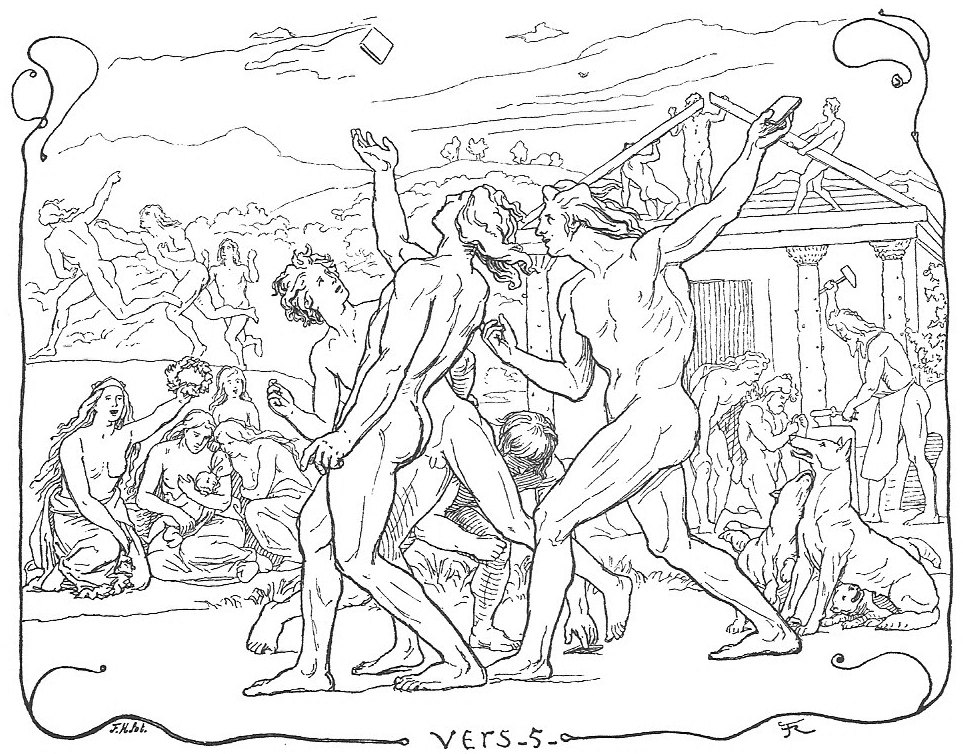
In Völuspá the gods have just named night, morning, midday and evening, “the years to number”, as Bellows has it. Then they meet:
“At Ithavoll met the mighty gods,
Völuspá, stanza 7, translated by Henry Adams Bellows, The Poetic Edda, 1923
Shrines and temples they timbered high;
Forges they set, and they smithied ore,
Tongs they wrought, and tools they fashioned.”
The Old Norse of the Codex Regius reads: Hittusk æsir á Iðavelli, þeir er hörg ok hof hátimbruðu; afla lögðu, auð smíðuðu, tangir skópu ok tól gerðu. Four actions are packed into it. The Æsir meet. They raise hörgr and hof, two words for places of worship which Pettit renders as “altar” and “temple”; he notes that the difference between the two is unclear. They set up forges and work auð, “wealth” or “treasure” (Bellows: “ore”, Pettit: “treasure”). Finally they make tongs and tools.
The gods first establish cult buildings and then a workshop, one that produces its own tools. The poem does not say to whom the Æsir would sacrifice in their temple.
The next stanza belongs with it, although the name Iðavöllr is not repeated: Tefldu í túni, teitir váru, var þeim vettergis vant ór gulli. The gods play í túni, they are merry, and they lack nothing in gold. Pettit explains tún as the cultivated meadow beside a farmhouse in medieval Iceland, and as the yard between farm buildings in Norway.
Then the idyll breaks off: uns þrjár kvámu þursa meyjar, ámáttkar mjök, ór Jötunheimum – until three giant maidens came, immensely mighty, out of Jötunheim. Völuspá does not say who they are or what they do. Pettit sums up the position briefly: their names, purpose and actions are unknown; it has been suggested that they stole the gods' gold or introduced avarice. Bellows in his note takes them to be “perhaps the three great Norns”, while allowing that a lost passage may have explained them otherwise. The text itself does not make the identification.
Immediately afterwards the gods go to their “assembly-seats” (Bellows) and deliberate on the making of the dwarfs.
Völuspá survives as a complete poem in two medieval manuscripts: the Codex Regius of the Poetic Edda, written around 1270 according to our source archive, and Hauksbók (AM 544 4to), which Pettit places in the fourteenth century and Bellows at “about the year 1300”. At the Iðavöllr passages the two differ.
In Hauksbók the line about hörg ok hof is absent from stanza 7. In its place Pettit's edition prints afls kostuðu, alls freistuðu – “they tested their strength, tried everything”. Pettit records that this line appears only in Hauksbók. The gods of Hauksbók build no temple on Iðavöllr.
Which version is the older does not emerge from the editions available to me. The difference matters for interpretation: anyone who concludes from stanza 7 that the gods' first act was to found a sanctuary is relying on one of the two manuscripts. Snorri evidently knew a version with the cult buildings, for his retelling mentions both a hof and a hörgr.
The stanza of the return differs as well. The Codex Regius opens with Finnask æsir á Iðavelli, Hauksbók (stanza 52 there in Pettit) with Hittask æsir á Iðavelli; both mean that the Æsir meet or find one another. The line ok minnask þar á megindóma, “and there remember great dooms” in Pettit's translation, stands only in Hauksbók and is missing from the Codex Regius; Bellows notes the same. The text in our archive prints it all the same and is therefore a composite of both manuscripts.
After the fire the seeress sees the earth rise from the sea a second time, iðjagræna, which Bellows gives as “all green”. Then comes the stanza that concerns us: Finnask æsir á Iðavelli ok um moldþinur máttkan dæma. The Æsir meet on Iðavöllr and speak of the mighty “girdler of earth”. Bellows explains the word in his note as the Midgard serpent, which lay in the sea and surrounded the land. They also call to mind the ancient runes of Fimbultýr; Bellows translates the name as “the Ruler of Gods” and identifies him with Odin.
The scene consists of talking and remembering. Nothing is built. The stanza does not say which gods are present; it speaks only of æsir. Names follow later: Baldr and Höðr come back, and Hœnir chooses the lot-twig.
Then the image no retelling omits: Þar munu eftir undrsamligar gullnar töflur í grasi finnask, þærs í árdaga áttar höfðu. There, in the grass, the wondrous golden töflur will be found again, those they had owned in the earliest days. The word töflur takes up the tefldu of stanza 8. Beginning and end are tied together by the same place and the same object. What else happens on the renewed earth is the subject of What comes after Ragnarök?
What the gods lose and recover in the grass is translated differently by almost everyone. Karl Simrock's German version of 1851 has them throwing dice in stanza 8 and finding “golden balls” in stanza 61, while his Gylfaginning has “Goldtafeln”, gold tablets, at the corresponding point. Bellows writes “tables” in both stanzas and concedes in his note that the exact nature of the game is open, including whether it more closely resembled chess or checkers. Rasmus B. Anderson rendered Snorri's word as “golden tables” in 1880. Pettit opts for “gaming-pieces” and takes the tefla of stanza 8 to be a board game of the hnefatafl kind.
Whether töflur means the boards or the pieces cannot be settled from the two stanzas alone. That they are found in the grass speaks for pieces.
Pettit's note mentions a further reading. If the game was more than a pastime, it may have enacted the struggle between gods and giants or served to control the destiny of the world. He offers this as a possibility; Völuspá itself says only that the gods were merry.
Snorri Sturluson wrote his Edda around 1220 on the usual dating, probably a good two centuries after the poem was composed. In chapter 14 of Gylfaginning Gangleri asks what All-father did once Asgard had been built. The answer: he appointed rulers who were to judge with him the fates of men and decide on the ordering of the stronghold. Þat var þar, sem heitir Iðavöllur í miðri borginni – that was at the place called Iðavöllr, in the middle of the stronghold.
Snorri then lists the buildings. First a hof with twelve seats and All-father's high seat, “within and without like solid gold” in Anderson's words, the best and largest house built on earth; the place is called Glaðsheimr. Then a second hall, a hörgr belonging to the goddesses, called Vingólf. Then a house with forges, where they make hammer, tongs, anvil and all other tools. They work metal, stone and wood, and so much gold that all their household goods are golden. Ok er sú öld kölluð gullaldr, and that age is called the golden age – until the women from Jötunheim arrive and spoil it.
Set beside stanza 7, the chapter shows how Snorri works. From the word pair hörg ok hof he makes two named buildings, one for the gods and one for the goddesses. The names do not come from Völuspá. Grímnismál knows Glaðsheimr in its stanza 8 as the place where Valhalla stands; Iðavöllr is not mentioned there. The twelve seats, the giving of judgement and the term “golden age” are Snorri's additions or come from sources we do not have. He says nothing in this chapter about the gods' board game, and the three giant maidens become simply “the women”, without a number.
Above all, Snorri gives the field a location. In Völuspá Iðavöllr is a meeting-place with no position stated. In Snorri it lies at the centre of Asgard, and Asgard is a borg, a fortified town. Völuspá does not use the name Asgard at either Iðavöllr passage.
The second prose passage stands at the very end of Gylfaginning. Gangleri wants to know whether any gods are alive after the fire. Hárr answers: the earth rises from the sea, green and fair, and the fields bear unsown. Víðarr and Váli live, ok byggja þeir á Iðavelli, þar sem fyrr var Ásgarðr – they dwell on Iðavöllr, “where Asgard was before”, as Anderson translates. Thor's sons Móði and Magni join them and have the hammer Mjöllnir. Baldr and Höðr come from Hel. They sit down together, talk, remember their runes and speak of the Midgard serpent and the wolf Fenrir. Then they find in the grass the gulltöflur that had belonged to the Æsir.
As his authority Snorri quotes here not a stanza of Völuspá but one from Vafþrúðnismál (stanza 51 there): Víðarr and Váli inhabit vé goða, the “sanctuary of the gods”, when Surt's flame goes out, and Móði and Magni shall have Mjöllnir. Vafþrúðnismál does not name Iðavöllr. Snorri thus equates the “sanctuary of the gods” of one poem with the field of the other and fills the nameless æsir of Völuspá with the list from Vafþrúðnismál. Hœnir, whom Völuspá names after the return, is missing from his enumeration.
The clause “where Asgard was before” implies that the stronghold no longer stands while the field is still there. In chapter 14 the field lay inside the stronghold; in chapter 53 the stronghold is an earlier state of the field. The construction is Snorri's; Völuspá tells neither of the building nor of the destruction of a stronghold here.
The second element of the name is undisputed. Völlr means “field, plain”; Vafþrúðnismál uses the same word for the battlefield Vígríðr (Vígríðr heitir völlr). The form Iðavelli in the stanzas is the dative. The first element is the difficulty.
In his note on stanza 7 Pettit calls the meaning uncertain and lists four suggestions: “Activity Plain”, “Eternal Plain”, “Eddy Plain” as a term for the sea and, perhaps most attractively in his view, “Renewal Plain”. Bellows glosses the name in his note as “Field of Deeds”, with a question mark. German-language Wikipedia gives “field of activity” (Feld der Betriebsamkeit) and lists Rudolf Simek's dictionary of Germanic mythology as its literature; I have not consulted the dictionary entry itself.
English Wikipedia mentions further approaches, which I could not check against the scholarly literature. Andy Orchard, it reports, gives “possibly splendour-plain” in his dictionary of 1997. Another proposal links iða- with iðja- and an Icelandic word for lush green, which would make Iðavöllr a “green plain”. One observation on the text fits this: a stanza before the return to Iðavöllr the new earth is called iðjagræna, which Pettit translates as “green again”. Whether the echo is intended cannot be proved.
Several interpretations stand side by side, and none has prevailed.
Vígríðr is the field of battle. Vafþrúðnismál in stanza 18 calls it the völlr on which Surtr and the gods meet in combat, a hundred rastir in every direction (Anderson: “a hundred miles”). Snorri quotes the stanza in his Ragnarök chapter. No source says that Vígríðr and Iðavöllr are the same place, nor is it stated anywhere how the two fields lie in relation to each other.
In Snorri Gimlé is a hall. Völuspá sees a hall standing towards the end of the poem, “more fair than the sun”, roofed with gold, á Gimléi; Bellows notes that in the poem Gimlé seems rather to be the place on which the hall stands, and that it is Snorri who makes it the name of the hall itself. There dyggvar dróttir, faithful or worthy hosts, are to dwell. Snorri in chapter 17 places Gimlé at the southern end of heaven and supposes it to be in the third heaven, Víðbláinn; it will stand when heaven and earth have perished, and good and righteous people will inhabit it. Chapter 52 says that the best place to be then is “in Gimlé, in heaven”.
In Snorri Gimlé belongs to heaven and is meant for human beings. Iðavöllr is the place of the gods, and it evidently lies on the earth: the earth rises from the sea, fields grow, the gaming pieces lie in the grass. Of Glaðsheimr on Iðavöllr Snorri even says expressly that it is the best house built “on earth”. That the surviving gods found a new city on Iðavöllr, or build Gimlé there, as one occasionally reads, is stated neither in the poem nor in Snorri.
What the gods do on Iðavöllr has counterparts in the human world. People meet in the open, there are cult buildings, judgement is given, tradition is recalled, and games are played. Snorri adds a fixed seating order: twelve seats and a high seat. That recalls the thing, the Norse assembly.
The comparison is a modern observation, not the testimony of a source. The word þing does not occur in the Iðavöllr passages. For the gods' deliberations Völuspá uses an image of its own: they go á rökstóla, to the seats of judgement, several times in the poem and without any place being named. Only Snorri brings seats, judgement and field together in one sentence.
Simrock's German has “Idafeld”, which is still the usual German form. Anderson's English Gylfaginning of 1880 writes “Idavold” in one place and “the plains of Ida” in another, Bellows has “Ithavoll”, and Pettit leaves Iðavǫllr untranslated. The adapted forms have a side effect: “Ida” sounds like a proper name, as though the field were called after a person or after Mount Ida. The Old Norse text offers no support. I know of no documented role for Iðavöllr in more recent literature, film or games.
Völuspá is a poem of unknown origin. Pettit names Iceland around the conversion to Christianity in 999/1000 as an often favoured setting, and about 1065 as a rough upper limit, because a stanza of the poem seems to be echoed in a poem by the skald Arnórr Þórðarson. The text we read was written down only in the thirteenth and fourteenth centuries. Bellows speaks of some two hundred years in between, during which the poem may have changed to an extent that is largely a matter of guesswork.
For Iðavöllr this means: the name is secured by two manuscripts and by Snorri. The details are less so. Whether temples stood on the field depends on a line found in only one of the two manuscripts. Whether the gods there remember “great dooms” depends on a line in the other. Location, building names and seating come from Snorri alone, who in Pettit's judgement draws on the poem as a major source but whose interpretation should not be assumed to be wholly correct, complete or unbiased.
Then there is the old question of Christian influence. A garden of the beginning, a loss, a renewed earth without toil or want: this recalls biblical images, and the article on Völuspá traces the debate. Hauksbók moreover contains a half-stanza about a “mighty one” who comes from above and rules all; it stands only there, and according to Pettit scholars disagree about whether it is a late Christian addition. Bellows thought it probably spurious. The question cannot simply be transferred to the Iðavöllr stanzas: board games, forges and runes are not biblical motifs.
Finally, everything that might point beyond the texts is missing. There is no archaeological find, no evidence of cult and no image that could be related to Iðavöllr. Any statement that goes beyond a few lines of verse and two paragraphs of prose is interpretation.
What is Iðavöllr? A field on which the Æsir meet in Völuspá at the beginning of the age of the gods and find one another again after the end of the world. Snorri Sturluson places it in the middle of Asgard.
Where is Iðavöllr mentioned? In two stanzas of Völuspá (7 and 60 in the numbering of our source archive) and in two chapters of Gylfaginning (14 and 53). I know of no other medieval attestation.
What does the name mean? The second element means “field”. For the first there are several proposals, among them activity, eternity, eddy, renewal, splendour and green. None counts as established.
What are the golden tables in the grass? Old Norse gullnar töflur, very probably equipment for a board game. The text leaves open whether boards or pieces are meant; recent translations such as Pettit's choose “gaming-pieces”.
Is Iðavöllr the same as Asgard or Vígríðr? No. In Snorri Iðavöllr lies within Asgard and remains when the stronghold has gone. Vígríðr is the field of the last battle; no source connects the two fields.
Völuspá: structure, manuscripts, dating
What comes after Ragnarök?
Asgard: the stronghold of the Æsir
Vígríðr: the field of the last battle
Ragnarök: sequence and sources
Gylfaginning
Hnefatafl: the board game of the North
The Codex Regius
Víðarr and Váli
Asgard – Home of the Norse Gods: What the Eddas and Sagas Really Say · What comes after Ragnarök · Ragnarök · Völuspá – the Seeress's Prophecy · Vígríðr: the last battlefield.
Idun (Old Norse Iðunn) is the Norse goddess who keeps the gods young: according to Snorri Sturluson she guards apples …
Read more →The Sagas of Icelanders (Íslendingasögur), often called the family sagas, are around forty anonymous prose narratives …
Read more →Jörmungandr, the Midgard Serpent, is the gigantic sea serpent of Norse mythology that lies in the world ocean, coils …
Read more →The Jomsvikings were, according to the Icelandic Jómsvíkinga saga, a brotherhood of professional warriors who operated …
Read more →