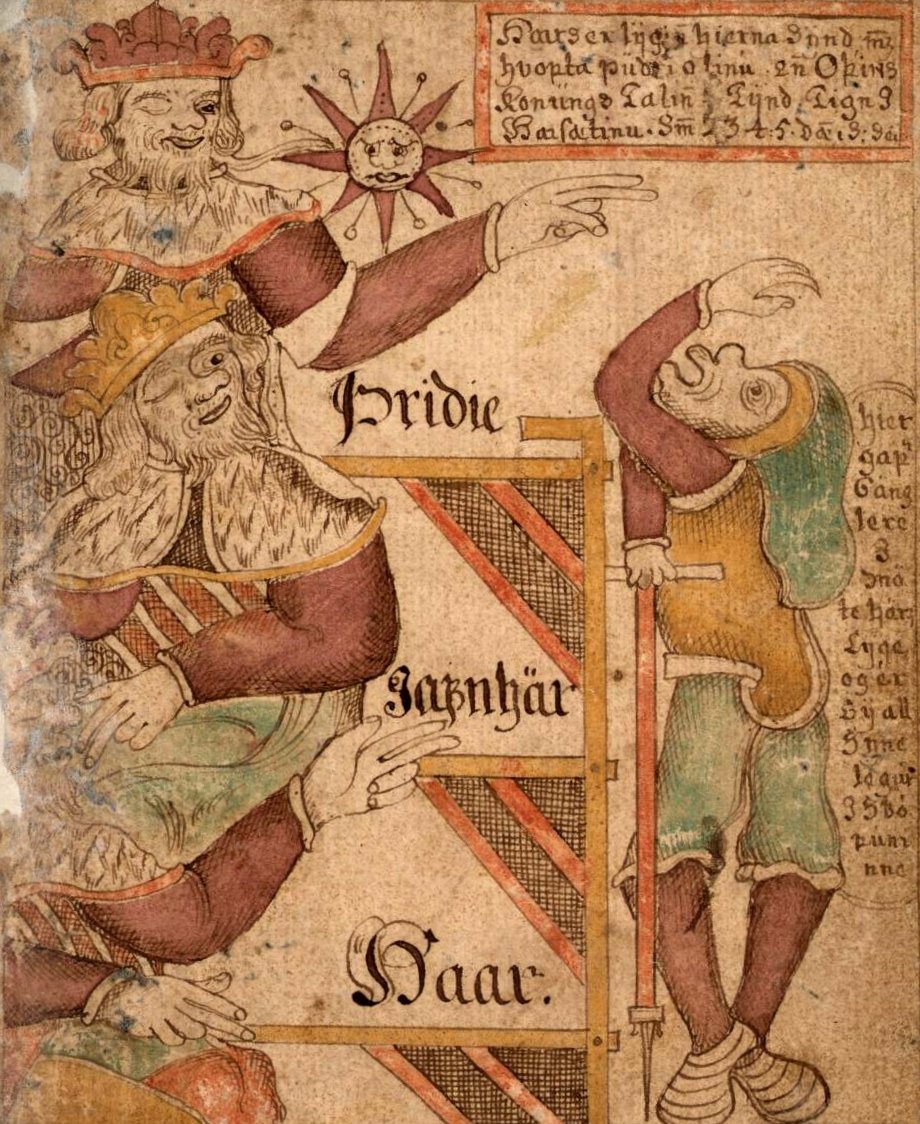
Almost everything retold today as “Norse mythology” follows the thread of a single text: Gylfaginning, the first main part of Snorri's Edda. A Swedish king asks questions, three figures on high seats answer, and at the end the hall is gone. This article is about the work itself: how it is built, which poems it quotes, which manuscripts carry it, and why a Christian Icelander of the thirteenth century wrapped the old gods in a deception.
The text opens with a land deal. King Gylfi, ruler of “the lands that are now called Svithjod” (Rasmus B. Anderson's 1880 translation), gives a wayfaring woman as much plough-land as four oxen can turn in a day and a night. The woman, Gefjun, is of the race of the Æsir. Her four oxen tear the land loose so deeply that they drag it west into the sea; it becomes Zealand, and a lake remains where it used to be. More on this in the article on Gefjon.
The second chapter draws the consequence. Gylfi, we are told, was a wise man and skilled in magic (Old Norse fjölkunnigr, literally “knowing much”). He wonders whether the Æsir owe their success to their own nature or to the gods they sacrifice to. So he travels to Asgard in secret, in the shape of an old man. The Æsir see him coming, because they have the gift of prophecy, and prepare sjónhverfingar for him – deceptions of the eye.
Gylfi sees a hall so high he can hardly look over it, its roof laid with gilded shields like shingles. At the door a man is juggling short swords, seven in the air at once. Gylfi calls himself Gangleri, and the door shuts on his heels. Inside, three men sit on three high seats, one above the other.
Gylfaginning means “the deluding of Gylfi”; handbooks also give “The Beguiling of Gylfi” (Andy Orchard and John Lindow, as cited in the English Wikipedia). The title names the frame, not the content: everything that follows is told to a man who is being deceived.
The English Wikipedia overview of the Prose Edda notes that the name Gylfaginning is one of the features of Codex Upsaliensis not found in the other three main manuscripts. I have not seen the wording of that heading. Jürg Glauser (2013) quotes a later note in the same manuscript, on folio 26v beside a drawing: Her er Har, Jampnhar ok þriþi sem segir i Gylva ginning – “Here are Hár, Jafnhár and Þriði, as it says in Gylfaginning.” Glauser thinks it was probably written in the seventeenth century.
The man who leads Gangleri in gives the names. On the lowest seat sits the king, called Hár (“High”); above him Jafnhár (“Just-as-High”); at the top Þriði (“Third”).
Hár sets the rules. Gangleri asks whether there is a wise man in the house, and Hár replies that he will not get out unharmed unless he is the wiser. Then comes a half-stanza, in Anderson's words: “And stand now forth / While you ask; / He who answers shall sit.” A wisdom contest with a stake, then, of the kind Vafþrúðnismál tells of between Odin and a giant.
The text does not say who the three are. They are often presumed to be three guises of Odin; the English Wikipedia notes that this is never stated. Gylfaginning itself offers a clue. In chapter 20 it quotes a list of Odin's names, and the list contains Hárr, Jafnhárr and Þriði – and Gangleri as well.
The reading text in our source archive follows Guðni Jónsson's edition and counts 54 chapters. Five blocks can be told apart.
Frame (ch. 1–2). Gefjun and Gylfi, the journey to Asgard, the three high seats.
The making of the world (ch. 3–19). Gangleri first asks about the highest and oldest god. Then back to the beginning: Niflheim and Muspell, the rivers Élivágar, Ginnungagap, the primeval giant Ymir and the cow Auðhumla. Then Ymir's killing, earth and sky made from his body, the first humans Ask and Embla, day and night, sun and moon with the wolves that chase them, the bridge Bifröst, the dwarfs, the ash Yggdrasil with its wells and norns, and finally wind, summer and winter.
Catalogue of gods (ch. 20–36). Odin and his names, Thor, Baldr, Njörðr and Skaði, Freyr and Freyja, Týr, Bragi and Iðunn, Heimdall, Höðr, Víðarr, Váli, Ullr, Forseti. Then Loki, his children and the binding of the Fenris wolf, the goddesses, the valkyries.
Stories (ch. 37–50). Freyr's wooing of Gerðr, the life of the einherjar in Valhalla, the master builder and the birth of the eight-legged horse, the ship Skíðblaðnir, Thor's journey to Útgarða-Loki in four chapters, Thor's fishing trip with Hymir (compare Hymiskviða), Baldr's death and Loki's binding.
End and new beginning (ch. 51–54). Ragnarök, the dwellings afterwards (including the passage on Ókólnir), the survivors – and the end of the frame.
This arrangement is Snorri's achievement, or that of his redactors. Heimir Pálsson sums it up: most of the knowledge about the gods comes from Vafþrúðnismál and Grímnismál, the time axis mostly from Völuspá (Scripta Islandica 68, p. 210).
Gangleri probes, doubts, needles. When he hears that a giant grew from the venom drops of the Élivágar, he asks whether Hár believes that being to be a god. The answer, in my translation of Fyr engan mun játum vér hann guð: “By no means do we acknowledge him a god; he was evil, and all his kin.” When he asks what road leads from earth to heaven, Hár laughs and says that is not a clever question (Eigi er nú fróðliga spurt) – has no one told him that the gods built a bridge, which he may call the rainbow?
The balance of power shows most clearly before the Útgarða-Loki story. Gangleri wants to know whether Thor ever met anything too strong for him. The three hesitate. Gangleri insists (my translation): “Here I will stand and listen for whether any answer is to be had; otherwise I declare you beaten, if you cannot tell what I ask.” Only then does Þriði tell the tale, in which Thor is fooled by a giant's illusions and ends up facing an empty plain.
The author allows himself irony. Hár lists what the fetter Gleipnir was made of and offers as proof that women have no beards, a cat's step makes no sound and mountains have no roots. Then he assures Gangleri that everything else is just as true, though some things he cannot test (þótt þeir sé sumir hlutir, er þú mátt eigi reyna).
Verse is set into the prose. The edition our source archive follows numbers the quotations straight through and reaches 70; some numbers cover only two lines, others a full stanza.
The poem named most often is Völuspá: the phrase “í Völuspá” occurs eleven times in the Old Norse text of the archive, once of them for a “short Völuspá” (Völuspá in skamma). In the Ragnarök chapter, the formula “so it is said in Völuspá” is followed by a block of nine numbers in a row. Grímnismál is named three times: for Thor's hall Bilskirnir, for the names of the valkyries and for the doors of Valhalla. Once “the giant Vafþrúðnir” speaks; I did not find the poem title Vafþrúðnismál in the text.
Two quotations point to poetry that no longer exists as a poem of its own. Of Heimdall the text says that he himself says in Heimdallargaldr: “I am the son of nine mothers, I am the son of nine sisters” (my translation of Níu em ek mæðra mögr, níu em ek systra sonr). The stanza from the “short Völuspá” is referred by Anderson, in his translation, to the Lay of Hyndla.
There are also verses with no source given, such as an exchange between Njörðr and Skaði about mountains and sea, or the reply of the giantess Þökk, who will not weep for Baldr. Skaldic stanzas, that is, verses by named poets, stand only at the beginning: one by Bragi the Old about Gefjun, one by Þjóðólfr of Hvinir about shield-roofed Valhalla (on him see Haustlǫng). The stanza Gangleri speaks on entering – look to every doorway before you go in – is the first stanza of Hávamál (so too in the Hávamál text of our archive); Gylfaginning gives no title.
Whether Snorri knew the poems from books or from memory is not documented. The main manuscript of the Poetic Edda was written later than Snorri's Edda (see Edda). Gylfaginning is therefore an early witness to stanzas otherwise known only from younger copies. For some of the stories Heimir Pálsson assumes a direct origin in oral tradition (p. 210, n. 40).
After Ragnarök, Gangleri asks whether any gods will then live and whether there will be an earth or a sky. Hár describes the new earth rising green from the sea, the surviving sons of the gods, the human pair Líf and Leifþrasir. Then he breaks off: if Gangleri can ask any further, he does not know where he gets it from, for he has heard no one tell the course of the world beyond this – “and now make use of what you have learned” (my translation). Anderson translates the close like this:
“Then Ganglere heard a terrible noise on all sides, and when he looked about him he stood out-doors on a level plain. He saw neither hall nor burg. He went his way and came back to his kingdom, and told the tidings which he had seen and heard, and ever since those tidings have been handed down from man to man.”
Gylfaginning, ch. 54 (Guðni Jónsson's numbering), translated by Rasmus B. Anderson, The Younger Edda, 1880
Karl Simrock's German translation ends at this point. The Old Norse goes on: the Æsir sit down to take counsel, recall all the tales that were told to Gangleri, and give the same names that occurred in them to the people and places among themselves – so that after a long time no one should doubt that the Æsir of the tales and the bearers of those names were one and the same. Anderson's version adds further sentences that equate Thor with Hector of Troy and Loki with Ulysses.
Glauser sets two readings side by side: either it was all one great deception, or the frame collapses because the Æsir run out of answers. Unlike in the Útgarða-Loki story, no deceiver steps forward to explain. The English Wikipedia notes that some scholars regard the Troy ending as an addition by a different author.
In the manuscripts a Prologue precedes Gylfaginning. Glauser summarises it: it tells of creation, the Flood and the forgetting of God, traces Odin and Thor back to Priam's Troy, and has Odin migrate north. Explaining gods as deified humans of the distant past is called euhemerism, after the Greek author Euhemerus. In the Old Norse wording (Prologue in our archive) Thor is called Tror there and is the son of a daughter of Priam. The text calls the incomers Ásíamenn, er æsir váru kallaðir – “men of Asia, who were called Æsir”. So in the Prologue the Æsir do come from Asia; I did not find an explicit derivation of the word “Æsir” from “Asia” there.
Gylfaginning picks this up abruptly at one point. After the gods have made humankind, they build a stronghold in the middle of the world, Asgard, and the Old Norse text adds: Þat köllum vér Trója – “that we call Troy”. In Simrock's German version, as our archive gives it, the sentence is missing.
How much of this is Snorri's is disputed. The English Wikipedia reports, after Anthony Faulkes, editor of the standard edition, that it has also been argued that the Prologue, the first paragraph and part of the last paragraph of Gylfaginning are not by Snorri in their surviving forms; it does not say who argues this. Heinrich Beck, according to Glauser, sees in one group of manuscripts an expansion by historical matter such as the Troy legend.
Gylfaginning survives in the four main manuscripts of Snorri's Edda. The datings vary from author to author.
Codex Regius (R), GKS 2367 4to, Reykjavík. Heimir Pálsson: around 1300–1325; Glauser: c. 1300–1350; Wikipedia: first half of the fourteenth century. Basis of most editions. Not to be confused with the Codex Regius of the Poetic Edda, GKS 2365 4to.
Codex Upsaliensis (U), DG 11 4to, Uppsala. Glauser: c. 1300; Wikipedia: first quarter of the fourteenth century; the MyNDIR image database: c. 1325. Heimir Pálsson calls it “possibly the earliest manuscript” (p. 204).
Codex Wormianus (W), AM 242 fol., Copenhagen. Around 1350 in all accounts.
Codex Trajectinus (T), Utrecht 1374. A paper copy of about 1600 (Glauser: c. 1595) from a lost parchment manuscript; its text is very close to R.
Glauser groups the other manuscripts as the “X version” and sets them against U. U is markedly shorter. Heimir Pálsson gives figures: the Útgarða-Loki story is some 25 per cent shorter in U than in R, Thor's fight with the Midgard serpent less than half the length. In U Thor kills the giant, in R he only throws him overboard; U calls him Eymir, not Hymir. U also places stories in Gylfaginning that the other manuscripts have in Skáldskaparmál. An oddity of the familiar version fits this: in the chapter on Bragi and Iðunn, Hár laughs and says he could tell how the apples once came close to being lost – and in Gylfaginning he never does.
Which version is closer to Snorri remains open. In 1940 Elias Wessén held Codex Regius to be the manuscript closest to Snorri's text; in 1931 Finnur Jónsson conceded that U might in places have the more original wording (both after Heimir Pálsson, p. 193). Heimir Pálsson himself explains the differences by two redactors with different ideas of a good textbook (p. 219).
Unlike the other medieval manuscripts, U contains many drawings (Glauser). On folio 26v Gangleri stands before the three figures; the MyNDIR image database describes them as Odin in three forms.
That Snorri Sturluson is the author is stated by a heading in Codex Upsaliensis: Bók þessi heitir Edda. Hana hefir saman setta Snorri Sturluson … – “This book is called Edda. Snorri Sturluson has compiled it in the manner in which it is arranged here.” The heading lists the parts: first about the Æsir and Ymir, then the language of poetry, last Háttatal, which Snorri composed on King Hákon and Duke Skúli. “Compiled” leaves open how much he worded himself. According to Faulkes (via Wikipedia), all the manuscripts were written more than half a century after Snorri's death.
The dating hangs on Háttatal. Snorri stayed with Earl Skúli and King Hákon in Norway in 1218–1220 and returned to Iceland in 1220; the praise poem on both presupposes that stay. Wessén placed it in the winter of 1222–23, and the most common dating is 1220–1225 (Heimir Pálsson, p. 195). For the Edda as a whole, Wessén's approach would give 1222–1225 (p. 209).
The purpose follows from the work as a whole. Snorri's Edda is a textbook of poetry; it sets out to teach young poets the language of the skalds. Skaldic verse constantly paraphrases with kennings, and many of them make sense only to someone who knows the stories behind them. Gylfaginning supplies that background, in roughly 20,000 words (Wikipedia).
Anyone citing “Gylfaginning 34” should say which edition is meant. The 54 chapters used here belong to Guðni Jónsson's edition. Anderson's English translation of 1880 divides differently and arrives at higher numbers; according to the concordance in our archive, the ending is number 57 there.
Gylfaginning is the most coherent account of Norse mythology there is. As testimony to pagan belief it has to be read at a distance, for three reasons.
First, distance. What Snorri writes down as a Christian of the thirteenth century is learned knowledge about a past religion, gathered from poetry.
Second, the Christian colouring. The very first information the three give sounds like a catechism: All-father lives through all ages, made heaven and earth, and gave man a spirit that shall never perish; the righteous shall be with him in Gimlé or Vingólf, the wicked go to Hel and on to Niflhel. An afterlife sorted by good and evil sits awkwardly beside Valhalla, where in the same text those who fall in battle go. Elsewhere Hár makes a confession of faith: it is his belief (mín trúa) that Odin and his brothers govern heaven and earth. Cult – sacrifices, festivals, priests – hardly appears in Gylfaginning at all.
Third, order. Snorri connects and explains. The ebb tide is Thor's draught from the drinking horn; earthquakes are Loki writhing in his bonds. How much of that is old tradition can rarely be decided.
Readings of Snorri's attitude differ. The English Wikipedia, citing Hilda Ellis Davidson (1964), calls the frame a possible means of recording a vanishing, largely oral tradition in a Christian setting. Glauser speaks of a “de-sanctification” of the myths (German Entheiligung) and argues that in Codex Upsaliensis mythical narration can “implode” through framing and distance.
What remains is considerable: early attested stanzas, pointers to lost poetry, and the picture an educated Icelander formed of his own tradition. With every statement it is worth asking: is this also in a stanza Snorri quotes – or only in his prose?
What does Gylfaginning mean? “The deluding of Gylfi”. The illusion is the one the Æsir prepare for the disguised king.
Who is Gangleri? The name Gylfi uses in the hall. Gangleri also appears in the list of Odin's names that Gylfaginning itself quotes.
Is Gylfaginning the same as the Edda? No. It is one part of Snorri's Edda, alongside the Prologue, Skáldskaparmál and Háttatal. The Poetic Edda is a different book.
Which translation is in the public domain? In English, Rasmus B. Anderson's of 1880; in German, Karl Simrock's of 1851, which abridges in places and ends before the close about the Æsir. Both stand beside the Old Norse text in our source archive: Gylfaginning in full.
Can I rely on Gylfaginning for what the Vikings believed? Only with reservations. It shows what a learned Christian around 1220 gathered about the gods from older poetry. The quoted stanzas carry the most weight.
The Edda: two books, one name · Snorri Sturluson · Völuspá · Vafþrúðnismál · Grímnismál · Gefjon and King Gylfi · Élivágar · Ragnarök · Kennings · Heimskringla

The Edda · Snorri Sturluson · Völuspá – the Seeress's Prophecy · Vafþrúðnismál – Odin's Head-Wager with the Wisest Giant · Grímnismál: Odin between the fires.
A man called Þorleifr gives a poet a shield with gods and giants on it. The poet thanks him the way skalds do, in …
Read more →A poem that opens by advising you to look around when you enter a house, to see where the enemies are sitting. It …
Read more →A king's daughter promised to a husband she does not want picks a hero for herself. He wins her in war and dies at her …
Read more →Hermod (Old Norse Hermóðr) is the god who, after Baldr has been killed, rides Odin's eight-legged stallion Sleipnir for …
Read more →