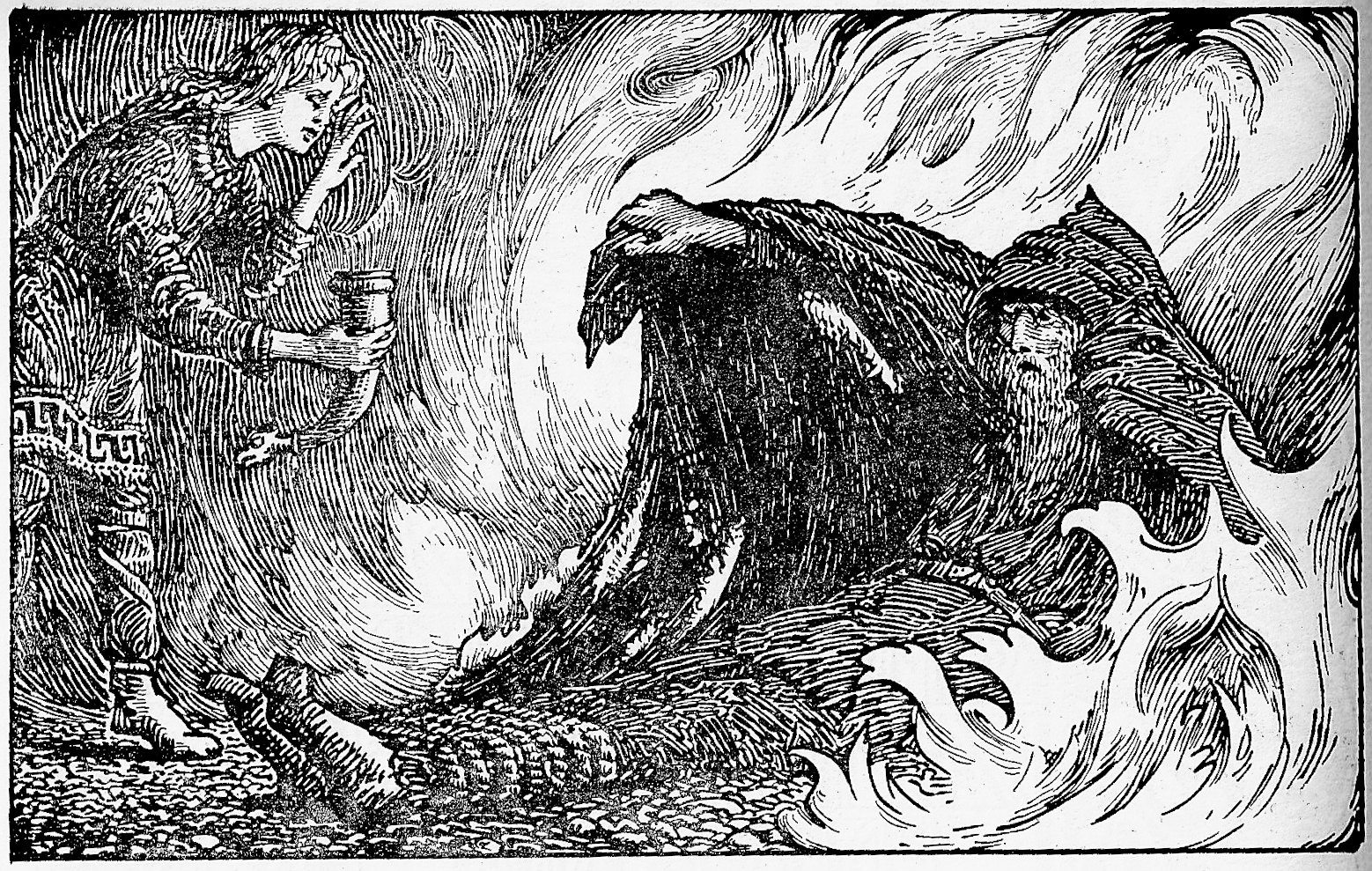
A man in a blue cloak sits between two fires for eight nights and says nothing about himself. Then a ten-year-old hands him a full horn, and the stranger starts to talk: about the homes of the gods, the doors of Valhalla, the ash tree and the animals that feed on it, and finally about his own names. Grímnismál is the eddic poem behind much of what is told today about Valhalla and Yggdrasil. This article looks at the poem as a whole: what stands in prose and what in verse, how it survives, what Snorri took from it, and where scholars can only guess.
The first stanza addresses no person. It addresses the fire. Hot you are, flame, and far too great, the speaker says; move away from me. His cloak is singeing although he holds it up. Only the second stanza explains the situation:
'Twixt the fires now eight nights have I sat,
And no man brought meat to me,
Save Agnar alone, and alone shall rule
Geirröth's son o'er the Goths.Grímnismál, stanza 2, translated by Henry Adams Bellows (1923), public domain
Who the speaker is, why he sits there and who Agnarr and Geirrøðr are is told in a piece of prose before the poem and a second, short one after it. Between them lie 54 stanzas spoken by one voice. The title means “the sayings” or “the speech of Grímnir”. Grímnir belongs with gríma, “mask, hood”, so the name means something like “the hooded one”.
Individual stanzas have their own articles here, for instance on Heiðrún, the four stags or Valhalla. The full Old Norse text with Simrock's German translation is in our reading edition.
King Hrauðungr has two sons, Agnarr, ten winters old, and Geirrøðr, eight. The two row out with fishing lines to catch small fish. The wind drives them out to sea, in the dark of night the boat breaks up on a shore, and they find a smallholder. They stay the winter. The man's wife fosters Agnarr, the man fosters Geirrøðr.
In spring the old man gives them a ship. As he and his wife walk them down to the beach, he speaks with Geirrøðr in private. With a fair wind the brothers reach their father's landing place. Geirrøðr jumps ashore from the bow, shoves the ship back out and curses his brother, roughly: go where the fiends may take you. The word used, smyl, is obscure; Edward Pettit renders it loosely as “fiends” in his 2023 edition.
The ship drifts out. Geirrøðr walks up to the farm, is welcomed and learns that his father has died. He is made king. The prose names no country. Only stanza 2 speaks of Gotna land, the land of the Goths, and Pettit thinks the phrase may simply mean humankind there.
Now the prose turns to the gods. Odin and Frigg sit on Hliðskjálf and look out over all the worlds. Odin needles her: does she see her foster-son Agnarr, begetting children on a giantess in a cave? His own foster-son Geirrøðr is a king. Frigg retorts that Geirrøðr is a matníðingr, a man mean with food, who torments his guests if he thinks too many have come. Odin calls that the greatest lie. They make a bet.
Frigg does not play fair. She sends her maid Fulla to the king with a warning: a man skilled in magic has come to the country, recognisable because no dog, however fierce, will go for him. The prose adds that it was idle talk to call Geirrøðr inhospitable. The king nevertheless seizes the man the dogs will not attack. He wears a blue cloak (í feldi blám; Bellows and Pettit both translate “dark-blue”), calls himself Grímnir and says nothing more about himself. Geirrøðr has him tortured to make him speak and sets him between two fires. There he sits for eight nights.
The king has a ten-year-old son, named Agnarr after his uncle. The boy goes to the prisoner, gives him a full horn and says his father does wrong to torment an innocent man. Grímnir drains it. By now the fire is so close that the cloak is burning on him. Then he speaks.
Three things are often retold more precisely than the text allows. First, the prose never says that the smallholder and his wife were Odin and Frigg. It speaks only of karl and kerling, the old man and the old woman. That the divine couple is meant follows only from the talk on Hliðskjálf, where Odin speaks of “your” and “my” foster-son.
Second, we never learn what becomes of the elder Agnarr; the cave and the giantess are the last we hear. Third, the private words stay unspoken. Per Pettit the second manuscript adds, already at the sentence on the fostering, that the old man gave Geirrøðr advice; what advice, it does not say. Pettit suspects the curse at the landing place is a spell of banishment taught during the private talk; that cannot be proved.
How old this prose is, nobody knows. Henry Adams Bellows wrote in his 1923 translation that its language points to the twelfth or thirteenth century, and he suspected the compiler of the Poetic Edda as its author, summarising an orally circulating story. If that is right, anyone who infers pre-Christian ideas from the colour of the cloak or from the dogs is leaning on what is probably the youngest part of the whole.
Grímnismál survives in two medieval manuscripts. One is the Codex Regius of the Poetic Edda (GKS 2365 4to), written in Iceland around 1270; per Pettit the poem stands there on folios 8v to 11r, directly after Vafþrúðnismál. The other is AM 748 I a 4to, a fragment of six leaves from the early fourteenth century. That manuscript as a whole is a fragment, but Grímnismál is complete in it (folios 3v to 5v, again following Pettit), likewise after Vafþrúðnismál and before Hymiskviða.
Both witnesses carry the prose at beginning and end. Their wording diverges in many places. Pettit gives examples: in the Codex Regius stanza 9 stands after stanza 10, and the scribe corrected the order afterwards; the two number stanzas 23 and 24 also stand there in reverse order, Bilskírnir first, then Valhalla's doors. The usual numbering, followed here, matches the order in AM 748.
The metre is mostly ljóðaháttr, the “song metre” also used for other wisdom and gnomic poetry in the Edda. Pettit also notes some stanzas in the expanded galdralag and passages in fornyrðislag, the narrative metre. Bellows counted about 225 proper names in the last 47 stanzas and thought it likely that a number of stanzas had drifted in from other poems.
The poem has a firm frame and a loose middle. Stanzas 1 to 3 belong to the scene: the address to the fire, the eight nights, the thanks to Agnarr. Stanza 3 promises the boy the best of rewards for one drink.
Stanzas 4 to 17 name homes of the gods: Þrúðheimr for Thor, Ýdalir for Ullr, Álfheimr for Freyr, then Valaskjálf, Sǫkkvabekkr, Glaðsheimr with Valhalla, Þrymheimr, Breiðablik, Himinbjǫrg, Fólkvangr, Glitnir and Nóatún, and last Víðarr's land. The poet counts: Valaskjálf is “the third” homestead, Nóatún “the eleventh”. Count along and there is a snag: three names already stand before the third homestead. Whether Álfheimr is left out or stanzas have been moved is open.
Stanzas 18 to 26 circle around Valhalla, 27 to 30 list rivers and horses, 31 to 35 belong to Yggdrasil. Then come valkyries, sun and wolves (36 to 39), the world made from Ymir (40 and 41), a puzzling kettle stanza (42), the “best things” (43 and 44) and the turn in stanza 45, followed by the names (46 to 50), the address to Geirrøðr (51 to 53) and the revelation (54).
Almost everything known about the inside of Valhalla stands here. The roof is raftered with spear shafts and thatched with shields, mail coats lie on the benches; a wolf hangs before the west door, an eagle above (stanzas 9 and 10). The cook boils Sæhrímnir in the cauldron; Odin feeds Geri and Freki and himself lives on wine alone; Huginn and Muninn fly over the earth every day. On the hall stand the goat Heiðrún and the stag Eikþyrnir, feeding on the tree Læraðr. The poem does not say that this tree is Yggdrasil.
The best-known number is in stanza 23: “five hundred doors and four tens”, and through each of them eight hundred einherjar march out when they go to fight the wolf. The word is dura, “doors”; “gates” is a translators' habit. And the speaker says svá hygg ek, “so I think”: an estimate. Then, what does “hundred” mean? Pettit reckons with the old long hundred of 120: for the same formula in the Bilskírnir stanza he gives 640, for the “eight hundred” einherjar 960. Applied to Valhalla that makes 640 doors and 960 warriors to a door. The popular sum of 540 times 800 assumes the decimal hundred. Stanza 24 uses the same number for Thor's hall Bilskírnir, which suggests a formula for sheer size.
Drops fall from the stag's antlers into Hvergelmir, and from there, says stanza 26, all waters take their course. The next two stanzas name 37 rivers, among them Rín, the name of the Rhine; the last, we are told, run close to humans and fall from here to Hel. Thor wades four rivers daily on his way to the court at the ash, because the bridge of the Æsir is ablaze. The other Æsir ride; stanza 30 names ten horses.
Then Yggdrasil. Three roots run three ways: Hel lives under one, the frost giants under the second, humans under the third. The squirrel Ratatoskr carries the eagle's words down to Níðhǫggr. Four stags browse on the shoots, and more serpents lie beneath than any fool imagines. Stanza 35 sums up: the ash suffers more than people know. The stag bites above, the side rots, Níðhǫggr gnaws below.
The eagle has no name in Grímnismál, and the hawk Veðrfǫlnir between its eyes appears in no stanza; it comes from Snorri's prose (see the eagle and Veðrfǫlnir). Nor does the poem list nine worlds.
Stanza 36 switches abruptly to a wish: Hrist and Mist shall bring “me” the horn. It names thirteen valkyries, who serve ale to the einherjar.
The horses Árvakr and Alsviðr draw the sun, cooled by something the gods fixed under their shoulders. A shield stands before the sun; were it to fall, mountains and sea would burn. The wolf Skǫll follows the sun, Hati, son of Hróðvitnir, runs ahead of it (see Skǫll and Hati). Stanzas 40 and 41 then tell how the world was made from the body of the primeval giant Ymir: the earth from his flesh, the sea from his blood (literally “sweat”), the mountains from his bones, the trees from his hair, the sky from his skull, Miðgarðr for humankind from his eyebrows and the clouds from his brain.
Stanza 42 counts as the darkest in the poem. Roughly: Ullr's favour and that of all the gods goes to whoever first lays hold of the fire, for the worlds lie open to the sons of the Æsir when the kettles are lifted off. Its meaning is unsettled. Pettit calls the sense unclear and presumes the kettles held the fires and hung from the roof or stood on stands.
After two stanzas on the best of each kind, from Yggdrasil among trees to Garmr among hounds, comes stanza 45. The speaker says he has now lifted his face (so Simrock), in Pettit's translation his disguises, before the sons of the victory gods; all the Æsir shall come in, to Ægir's benches, to Ægir's drinking. Its key word vilbjǫrg is hard to pin down; Simrock writes “Heil” (good fortune), Pettit “welcome relief”. Whether Odin is summoning the gods or wishing himself at a distant feast cannot be said for certain.
From stanza 46 on the speaker names himself. Grímr and Gangleri, Herjann and Hjálmberi, Þekkr and Þriði: the series runs through five stanzas and starts up once more in the last. In the text of our reading edition I count 55 mentions, some of them doubles. Some names are transparent, such as Síðhǫttr, “long hood”, Síðskeggr, “long beard”, or Alfǫðr, “all-father”; others are opaque. Stanza 48 sums up: he has never gone by one name alone since he went among the peoples.
Stanza 49 ties names to occasions. He was Grímnir at Geirrøðr's, Jálkr at Ásmundr's, Kjalarr when he drew a sledge. The stories behind this have not come down to us. Stanza 50 too alludes to a tale no other source preserves: at Sǫkkmímir's he was called Sviðurr and Sviðrir and killed the son of Miðvitnir.
In stanza 51 the speaker turns to the king. Geirrøðr is drunk; he has lost much, now that he lacks the support of Odin and all the einherjar. Stanza 52: he has told him much, and the king has kept little; he sees his friend's sword lying there, all covered in blood. Stanza 53: Yggr will have the sword-weary slain; the dísir are hostile, and now he may see Odin: “Come closer, if you can.” The final stanza gives the name Odin and ten more, all of which have come “from me alone”.
The verse foretells a death by the sword. How it comes about is told only in the closing prose. Geirrøðr sits with his sword across his knees, half drawn from the scabbard. Hearing that Odin is there, he stands up to take him from the fire. The sword slips from his hand, hilt downwards. The king stumbles, falls forward, and the blade goes through him. Odin vanishes. Agnarr is king for a long time afterwards. Whether Geirrøðr's death is punishment, accident or both, the text does not say.
Snorri Sturluson used Grímnismál extensively. Bellows wrote that Snorri quotes over twenty stanzas; Pettit counts 22 quoted in whole or in part in the Prose Edda and at least six more that Snorri draws on. Per Pettit's notes they include the stanzas on Valhalla's doors, the serpents under the ash and Ymir.
The frame of his Gylfaginning also draws on the poem. The visitor there calls himself Gangleri, and the three who answer him are Hár, Jafnhár and Þriði. All four names stand in stanzas 46 and 49 as names of Odin.
For source criticism this means: where Snorri and Grímnismál agree, a reader confirms his source, not a second witness the first. Where Snorri knows more, the hawk's name for example, it is open whether he knew older tradition or filled gaps himself. I know of no retelling of the story of Geirrøðr and the fires in Snorri, and neither Bellows nor Pettit mentions a second version in the parts I consulted. That has not been checked exhaustively.
Accounts differ. In 1923 Bellows placed the poem in the first half of the tenth century, a dating still often repeated. Pettit is more cautious in 2023: date and place of composition are uncertain, though the poem may have oral roots in pre-Christian times. Vittorio Mattioli stresses in the abstract of his critical edition (St Andrews thesis) that pre-Christian belief varied by place and time and that a single poem cannot establish a general “Norse mythology”.
Only the lower limit is firm. Around 1220 to 1225 Snorri had a text close to the surviving one, and around 1270 the Codex Regius was written. Everything earlier is inference from language, metre and content. On Christian influence in the eddic poems see How Christian is the Edda?
That a drama lies beneath the catalogue of names was, Bellows reports, already seen by Müllenhoff in the nineteenth century: a tortured man talks his way towards his own unmasking, and with the last name the king falls. In the title of a 2002 essay Carolyne Larrington sets the poem as “cosmic geography” beside Vafþrúðnismál as “cosmic history”.
More contested is what the fires mean. Schröder (1958), as Jere Fleck presents him, read Odin in Grímnismál as a kind of shaman, though with reservations. Fleck objected in 1971 in an article that carries the rejection in its title: single shamanic traits do not make shamanism. He compared the scene instead with ancient Indian tapas, ascetic heat, and the consecration rite dīkṣā, in which the candidate endures heat beside the sacrificial fire; Schröder and de Vries, Fleck says, had already noted this. Fleck also read the poem as the instruction of an heir: through Odin's speech Agnarr receives the special knowledge that qualifies him to be king.
Schjødt (1988), according to Pettit, opposes this view. Haugen in 1983 imagined a priestly speaker driven into ecstasy by heat and fasting. Pettit himself considers a dramatic monologue, perhaps masked and, if the roots are pre-Christian, linked to initiation rites. He also notes that Grímnir probably speaks on the ninth night; nine nights Odin hangs on the tree in the Rúnatal.
All of these are hypotheses. For a ritual of sitting between fires there is no archaeological evidence from the North and no report outside this poem. The text itself shows less: knowledge is spoken under pain, a drink releases the speech, and the man who mistreats his guest loses rule and life.
What does the title Grímnismál mean? “The speech” or “the sayings of Grímnir”. Grímnir is the name Odin uses at Geirrøðr's court; it is related to gríma, “mask, hood”. Old Norse mál can be singular or plural, so the title is treated either way.
Why does Geirrøðr have the stranger tortured? Because Frigg, through her maid Fulla, warns him of a sorcerer no dog will attack. The stranger gives only the name Grímnir.
Are there two Agnarrs? Yes. The elder is Geirrøðr's brother, whom he shoves back out to sea. The younger is Geirrøðr's ten-year-old son, named after his uncle, who hands over the horn and ends as king.
Which familiar motifs come from this poem? Among others Valhalla's roof of spears and shields, its doors, Sæhrímnir, Geri and Freki, Huginn and Muninn, Heiðrún, Ratatoskr, the four stags, Skǫll and Hati and the world made from Ymir.
Is the poem evidence of a pagan ritual? That cannot be clearly shown. The scene has been read as initiation, as a technique of ecstasy or as the instruction of an heir. Independent evidence for such a ritual in the North is lacking.
Vafþrúðnismál: Odin's wisdom contest with the giant · Valhalla: what the sources say · Yggdrasil, the world ash · Heiðrún and Eikþyrnir on Valhalla's roof · The four stags in the crown · Geirröd, the giant of Þórsdrápa · Frigg · Odin · The Edda and its manuscripts · Garmr, the hound before Gnipahellir
Vafþrúðnismál – Odin's Head-Wager with the Wisest Giant · Valhalla · Yggdrasil – the world tree · Heiðrún – the mead-goat · The Four Harts of Yggdrasil: Dáinn, Dvalinn, Duneyrr & Duraþrór.
A Danish king buys two giantesses, sets them to a magic mill and has them grind gold and peace without ever letting …
Read more →Gullinbursti ("Gold-Bristle") is the golden boar of Freyr, the Norse god of fertility: according to Snorri's Prose …
Read more →Gungnir is the spear of the god Odin: according to the Prose Edda it was forged by the dwarf sons of Ívaldi and handed …
Read more →The mead of poetry turns anyone who drinks it into a skald or a scholar. It lies in the mountain Hnitbjorg, guarded by …
Read more →