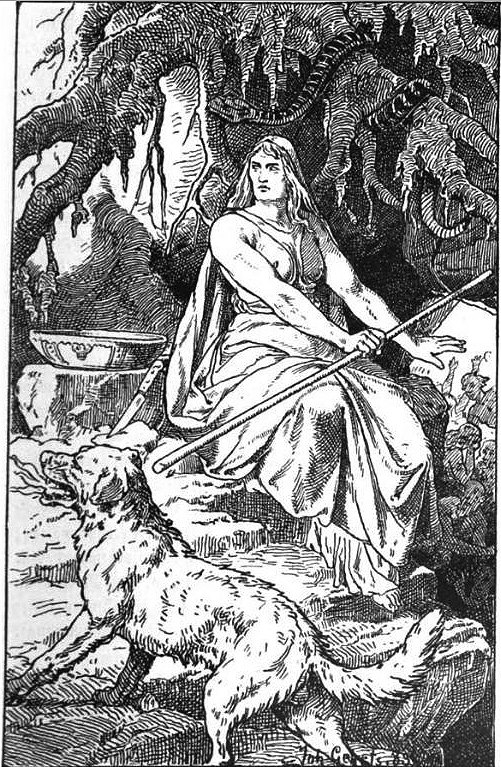
A dog barks in front of a cave, and a fetter is going to break. That is all Völuspá says about Garmr, but it says it several times, as a refrain that beats time for the end of the world. One line in Grímnismál calls him the best of all hounds, and Snorri Sturluson sends him into the last battle against the god Týr. Hellhound, gatekeeper of Hel, a second Fenrir: those roles were given to him by later interpretation. This article goes through the few passages one by one and separates the wording from what has been read into it.
Garmr is named in three places in the Old Norse mythological tradition: in the refrain of Völuspá, in a list in Grímnismál, and in a short paragraph of Gylfaginning, the narrative core of the Edda by Snorri Sturluson. A fourth text is usually quoted with them although it lacks the name: in Baldrs draumar, Odin meets a dog with a bloody breast on his ride to the underworld.
There is no story about Garmr. Nobody says where he comes from or who bound him. Snorri gives the binding of the wolf Fenrir a whole chapter; for Garmr he has a few sentences.
A good deal has been added accordingly: Garmr as the watchdog at the gate of Hel, as a giant wolf, as a Norse Cerberus. Each of these ideas has some foothold in the texts, but none of them is stated there.
Völuspá, "the prophecy of the seeress", tells the history of the world from its beginning to its destruction and return. In the last third one stanza keeps coming back. In the bilingual reading edition on this site (Old Norse text after Guðni Jónsson) it runs:
Geyr nú Garmr mjök / fyr Gnipahelli, / festr mun slitna, / en freki renna; / fjölð veit ek fræða, / fram sé ek lengra / um ragna rök / römm sigtíva.
Literally, in my own rendering: "Now Garmr barks loudly before Gnipahellir; the fetter will break and the greedy one will run. I know much lore, I see further ahead, to the mighty fate of the victory gods." The verb geyja means "to bark"; many translations turn it into howling. Henry Adams Bellows translated the stanza in 1923 as follows:
"Now Garm howls loud before Gnipahellir,
The fetters will burst, and the wolf run free;
Much do I know, and more can see
Of the fate of the gods, the mighty in fight."Völuspá, refrain (stanza 44), translated by Henry Adams Bellows, 1923
Bellows makes a decision here that the original leaves open: he turns freki into "the wolf". Karl Simrock's German translation of 1851 keeps "Freki" as a proper name.
Anyone who looks the refrain up will find different stanza numbers. Völuspá survives complete in two medieval manuscripts, the Codex Regius from the 1270s and Hauksbók from the early fourteenth century. They arrange the stanzas differently, and printed editions combine them in different ways.
The text after Guðni Jónsson, used in our reading edition, has the refrain four times: as stanzas 44, 49, 54 and 58. The Codex Regius has it only three times, written out the first time and abbreviated afterwards. Bellows says so in the notes to his translation, and so does Edward Pettit's edition of that version, which numbers the places 43, 47 and 56. The common numbering is 44, 49 and 58; Gustav Neckel (1914) has the refrain as stanzas 44 and 58. The fourth place in Guðni Jónsson, stanza 54, has no counterpart in the Codex Regius and evidently goes back to one of the extra repetitions in Hauksbók.
Pettit prints the Hauksbók version separately in his dual-language edition of the Poetic Edda (2023). There the refrain appears five times, as stanzas 31, 36, 41, 46 and 50; Bellows also reports five places. It is written out in full only the first time; after that the scribe abbreviates. At the last occurrence a piece of the first verse is torn away, and the edition supplies the word nú from the Codex Regius.
At its first occurrence the little word nú, "now", is missing in Pettit's text of both manuscripts; the line is simply Geyr Garmr mjǫk. Neckel likewise prints stanza 44 without nú and stanza 58 with it. The familiar "Geyr nú Garmr" thus holds only from the second place on; only the text after Guðni Jónsson has it throughout. The second half reads slightly differently in Hauksbók: "I see further ahead, I can say many things." And the cave is called Gnúpahellir at the first two occurrences there, Gnipahellir later. Pettit notes that the form with u is found only in Hauksbók, which has both spellings. Simrock's German "Gnupahöhle" matches this reading.
In the text after Guðni Jónsson it first sounds after three cocks have crowed: one among the giants, one among the gods, and a soot-red one "in the halls of Hel". Then come the stanzas about kin turning on kin, Heimdall's horn and the trembling of Yggdrasil. The second refrain stands before the enemies advance, when the giant Hrymr drives from the east and the ship Naglfar comes loose. The third follows the stanza in which Odin goes to fight the wolf. The last comes after the sun has turned black and the earth has sunk into the sea, immediately before the seeress sees a new green earth rise.
In Hauksbók the series begins earlier. There the first refrain follows the stanza about Sigyn sitting by her bound husband Loki. An image of binding is answered at once by a fetter that will break. Whether that is the older arrangement cannot be decided. Pettit attributes the differences between the two versions in general to oral diffusion, interpolation, scribal error and damage in transmission.
The tense is striking. Garmr barks now, but the fetter "will" break, and that is still so the last time, when the sun is already black. A refrain does not adjust to the state of the action.
The second line, festr mun slitna, en freki renna, is the real point of dispute. Festr is a rope or fetter. Freki means "the greedy one" and is a poetic word for the wolf. One of Odin's two wolves bears it as a name in Grímnismál; we write about them in the article on Geri and Freki. The word occurs a second time in Völuspá itself: in the stanza about the ship from the east a host travels "with the freki" (með freka), which Simrock renders as "with the wolf".
On a first reading, the greedy one is Garmr himself under a second word. The dog then lies bound before the cave, and his fetter breaks. Snorri evidently understood the stanza this way, since in his account Garmr is expressly "bound before Gnipahellir". On a second reading two animals are meant. Garmr barks, and the greedy one whose fetter breaks is Fenrir. That is how Bellows translates.
The wording does not settle it. For the first reading, no new animal is introduced. For the second, a bound wolf is a fixed part of the tradition. A third possibility combines them: Garmr and Fenrir are one animal under two names. More on that below.
How open the poem is at such points is shown by a stanza between the first and second refrain. There Yggdrasil trembles, "and the giant gets loose" (en jötunn losnar). The stanza does not say who this giant is. Pettit's synopsis names Garmr or Fenrir, or Loki, and does not commit itself.
The second passage is a single half-line. In Grímnismál, Odin sits between two fires under the name Grímnir and recites mythological lore. Towards the end, in stanza 44 of the reading edition, he lists what is foremost of its kind: Yggdrasil among trees, Skíðblaðnir among ships, Odin among the Æsir, Sleipnir among horses, the bridge Bilröst among bridges, Bragi among skalds, Hábrók among hawks, en hunda Garmr, "and among hounds Garmr". Bellows translates: "Hobrok of hawks, and Garm of hounds."
Garmr is clearly classed as a dog here, alongside horse and hawk, the animals of a noble household. There is no mention of blood, cave or the end of the world.
How this praise fits Snorri's monster is open. "The best" may mean the most terrible of his kind; the list may also preserve a more harmless idea of Garmr. This cannot be clearly established. What is certain is that Grímnismál has separate stanzas for Odin's two wolves and for the wolves Sköll and Hati, who chase sun and moon, and connects Garmr with none of them.
Around 1220 Snorri Sturluson retold the myths in prose. In the chapter on the end of the world, Gylfaginning 51, he describes the battle on the field of Vígríðr. Freyr fights Surtr and falls. Then comes Garmr, then Thor and the Midgard Serpent, and last the wolf swallows Odin. Of Garmr he says: Þá er ok lauss orðinn hundrinn Garmr, er bundinn er fyrir Gnipahelli, "Then the hound Garmr has also got loose, who is bound before Gnipahellir". Snorri calls him a great monster and ends: Hann á víg móti Tý, ok verðr hvárr öðrum at bana, "He fights against Týr, and each becomes the other's death."
Of the three statements in these sentences only one is found in the Poetic Edda. Völuspá says that Garmr is before Gnipahellir. That he lies bound there is already Snorri's reading of the line about the fetter, and his fight with Týr is not in any surviving poem. Snorri quotes a series of Völuspá stanzas in this chapter, yet the refrain is not among them, and Týr does not appear in any of the quoted stanzas. Völuspá names the fights of Odin, Freyr, Thor and Víðarr; about Týr it is silent.
Nobody knows where Snorri got the pairing. He may have known a lost source, or closed the gap himself because his account gives every major god an opponent. Neither can be proved. The duel is transmitted in Gylfaginning alone.
In Snorri's mythology Týr is the god who lost his hand. When the gods bound the wolf Fenrir with the fetter Gleipnir, he laid his right hand in the wolf's mouth as a pledge, and the wolf bit it off. Lokasenna also alludes to the lost hand. One therefore expects Týr to face his old enemy at the end of the world.
That does not happen. In Snorri as in Völuspá, Fenrir belongs to Odin, and Víðarr avenges his father. Týr is given another bound animal instead. Some see in this a sign that Garmr was originally another name for the wolf: Týr would then once have fought the animal that took his hand, and tradition later split the figure in two. The conjecture is reasonable but cannot be demonstrated from the texts, and Snorri himself treats hound and wolf in the same chapter as two different beings with two different opponents.
Snorri does not tell how the fight goes. The whole sequence is covered in our overview of Ragnarök.
Baldrs draumar, "Baldr's Dreams", is a short Eddic poem that is not in the Codex Regius but is preserved in another manuscript. The gods deliberate why Baldr has bad dreams, and Odin rides down to Niflhel on Sleipnir. Stanzas 2 and 3 of the reading edition say: mætti hann hvelpi, þeim er ór helju kom. Sá var blóðugr um brjóst framan ok galdrs föður gól of lengi. In my own rendering: "He met a whelp that came out of Hel. It was bloody on the front of its breast and barked long at the father of the spell-song." Odin rides on, the earth resounds, and he reaches the high house of Hel.
The Old Norse word is hvelpr, "whelp, young dog". Bellows translates "hound"; Simrock has "Hund" and adds gaping jaws that are absent from the Old Norse text of our edition. The animal has no name. Nothing says that it is tied up or guards a gate.
That this dog is Garmr is a widespread identification. It rests on the fact that both dogs bark and that the tradition knows no other dog of this kind. Against it, a whelp is a poor match for Snorri's great monster, and Garmr is bound while this dog runs free. The bloody breast that turns up in many descriptions of Garmr belongs in any case to the nameless animal of Baldrs draumar. For Garmr himself no source gives a single physical feature. More on that journey in our article on the road to Hel.
The identification of Garmr with Fenrir is one of the often repeated assumptions of scholarship. Both are bound, both get loose at the end of the world, the refrain names the hound and the "greedy one" in one breath, and Týr, who falls to Garmr in Snorri, has his earlier history with Fenrir. Poetry also does not separate dog and wolf sharply. In the first lay of Helgi wolves are called "Viðrir's hounds", that is, Odin's hounds. And Snorri knows a wolf named Mánagarmr, "moon-hound", who feeds on the flesh of the dying and swallows the moon. The word garmr is thus also part of a wolf's name.
Against the identification stands the only source that names both animals side by side. In Gylfaginning 51 the Fenris-wolf gets loose first, later the hound Garmr "also"; the one swallows Odin, the other dies with Týr. Snorri applied the line about the fetter to Garmr and still counted two animals. Grímnismál lists the wolves in other stanzas.
The two can be reconciled by assuming an originally single beast that lived on under several names and was eventually understood as several beings. That explains the overlaps but remains a model. No text equates Garmr and Fenrir, and none asserts the opposite for the time before Snorri.
The second part of the name is clear: hellir means "cave". The first part is connected with a word for a cliff or peak; Bellows glosses the name in his note as "the Cliff-Cave" and there calls the cave, without qualification, the entrance to the world of the dead. Olive Bray rendered the name in 1908 as "Gaping-hel" and so read the underworld into the word itself.
No text says where the cave lies. Neither Völuspá nor Snorri connects Gnipahellir with Hel, with the bridge over the river Gjöll, or with the gate through which the dead pass. In Snorri's account of Hermóðr's ride to Helheim, the only detailed description of the journey, there is no dog; a woman called Móðguðr keeps watch at the bridge. That Gnipahellir is the entrance to the world of the dead is an inference from two clues: the dog of Baldrs draumar, and the fact that in the text after Guðni Jónsson the cock "in the halls of Hel" crows immediately before the first refrain. The inference is defensible, but it is not a statement of the sources.
The comparison with the Greek Cerberus suggests itself. In Greek tradition Cerberus guards the entrance to the underworld. No Norse source describes such a task for Garmr. He is himself the prisoner, and his part begins when he gets loose.
A linguistic thesis goes further. In "Death, War, and Sacrifice" (1991) Bruce Lincoln tried to connect the names Garmr and Cerberus etymologically; Daniel Ogden objected in "Drakōn" (2013) that the derivation requires two different Indo-European roots for the two names and so does not establish a relationship. I know both positions only from two summaries, not from the books. By those accounts Lincoln's proposal has not caught on.
Archaeology knows dogs as companions of the dead. In the Norwegian ship burial of Gokstad six dogs lay beside twelve horses, in the ship burial of Oseberg dogs beside more than a dozen horses, in Ladby in Denmark several dogs beside eleven horses. The Arab envoy Ibn Fadlan describes a tenth-century funeral of the Rus on the Volga at which a dog was among the animals killed. Details are in our article on burial in the Viking Age.
What these animals meant is interpretation. A dog in a grave may be a hunting companion, a mark of status, a sacrifice or a companion for a journey. The archaeologist Anne-Sofie Gräslund devoted the paper "Dogs in graves – a question of symbolism?" to the question. According to its abstract, which is all I know of it, she starts from a ninth-century female boat grave at Old Uppsala with a dog and a hen and sees the dog as a link between the living and the dead. No medieval text links grave dogs with Garmr.
The oldest layer we can grasp is the refrain: a dog, a cave, a fetter that will break. The age of Völuspá is debated; it is often placed around the year 1000 and was written down in the thirteenth century. The line in Grímnismál shows that the name could be understood without explanation. Snorri turned the refrain into a scene and gave the hound an opponent.
Everything else is interpretation in three layers. The first connects Garmr with the dog of Baldrs draumar and makes him the hound of Hel. The second equates him with Fenrir. The third sets him beside Cerberus and other dogs of the underworld. In today's popular culture, video games included, these have mostly merged. These are new creations built on a few lines.
Who is Garmr in Norse mythology? Garmr is a hound who, according to Völuspá, barks before the cave Gnipahellir before the gods perish. Grímnismál calls him the best of hounds. In Snorri he gets loose at Ragnarök and fights Týr; each kills the other.
Is Garmr the same as Fenrir? That is a scholarly hypothesis, not a finding from the sources. Both are bound and get loose at the end of the world, but Snorri treats them in the same chapter as two beings with different opponents.
Does Garmr guard the entrance to Hel? No text says so. The idea rests on the nameless dog from Hel in Baldrs draumar and on the comparison with the Greek Cerberus.
What does Gnipahellir mean? Hellir means cave. The first part is connected with a word for a cliff or peak; Bellows translates "Cliff-Cave". Hauksbók writes Gnúpahellir in two places. Where the cave lies is never stated.
How often does the Garmr refrain occur in Völuspá? That depends on manuscript and edition. In the Codex Regius it stands three times (usually numbered st. 44, 49 and 58), in Hauksbók five times, in the text after Guðni Jónsson four times (st. 44, 49, 54, 58).
Völuspá – the Seeress's Prophecy · Fenrir – the wolf · Týr – the god who gave his hand · Ragnarök · Helheim.
What does the strongest god do when his hammer has been taken from him? He sets out anyway. The journey to Geirröd …
Read more →Ginnungagap is the yawning void that existed before the world in Norse mythology: a chasm between icy Niflheim in the …
Read more →Gleipnir is the third and final fetter the gods used to bind the wolf Fenrir: a ribbon as smooth and soft as silk, made …
Read more →He wrestles a dead man to the ground, breaks into a burial mound, cuts the paw off a bear and holds out for almost …
Read more →