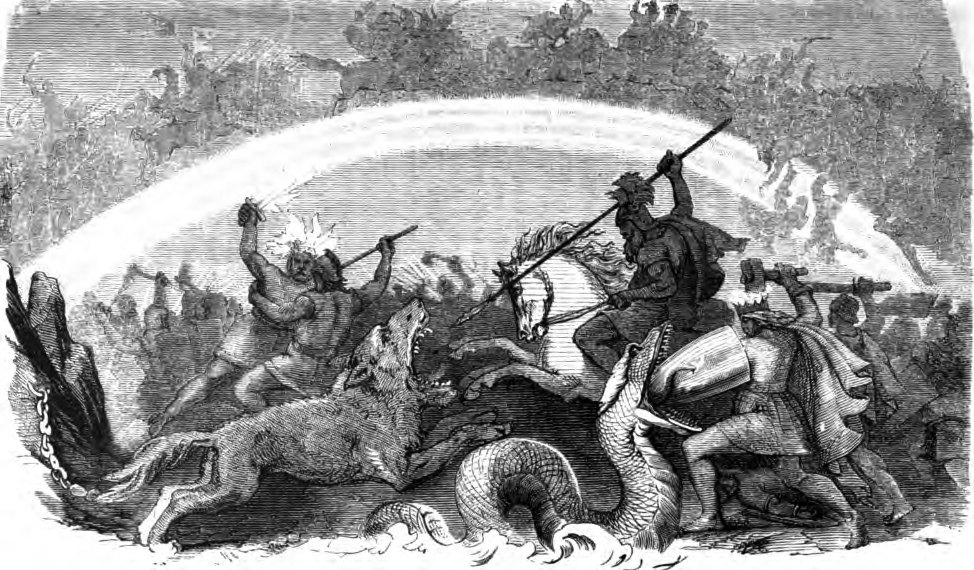
A hundred rastir in every direction, one name, one enemy: that is all the Poetic Edda says about the place where Ragnarök is fought. A single stanza calls the field Vígríðr. A second poem knows an island called Óskópnir instead, Völuspá names no place at all, and only Snorri Sturluson puts every army on the same plain. This article follows the place itself, and asks how much of the “battle of Vigrid” stands in the poems and how much in Snorri’s prose.
Anyone who reads about Ragnarök meets the name almost at once: on the field of Vigrid gods and giants clash, the wolf swallows Odin, Thor falls after nine steps. It sounds like a fixed point on the mythical map. In the texts that point shrinks. The Poetic Edda mentions Vígríðr in exactly one stanza, as the answer to a quiz question. It describes no battle there, lists no fighters and does not say where the field lies.
Everything else comes from two other sources. Fáfnismál, a heroic poem, asks almost the same question and gets a different answer. And around 1220 Snorri Sturluson, in his Gylfaginning, turns the scattered verses into one continuous story in which the field becomes the mustering ground of every army. The course of the battle is told in our main article on Ragnarök, the aftermath in What comes after Ragnarök?. Here the subject is the place: the name, the measurement, the second name, and the points at which the sources do not fit together.
Vafþrúðnismál is a contest of knowledge. Odin enters the hall of the giant Vafþrúðnir under the name Gagnráðr and at first stays standing on the floor. The giant tests the stranger with four questions before he invites him to the bench and both wager their heads. The first three concern the order of the world. What is the horse called that draws up the day? Skinfaxi. The horse of night? Hrímfaxi. The river that divides the land of the giants from that of the gods? Ífing.
The fourth question leaps to the end of time. In stanza 17 the giant wants to know hvé sá völlr heitir, what the field is called on which Surtr and “the dear gods” (in svásu goð) meet in fight. Odin answers in stanza 18, repeating the question almost word for word, as this poem likes to do:
Vigrith is the field where in fight shall meet
Surt and the gracious gods;
A hundred miles each way does it measure.
And so are its boundaries set.Vafþrúðnismál 18, translated by Henry Adams Bellows (1923), public domain
In Old Norse that is six short lines: the name, the two parties, the measure hundrað rasta … á hverjan veg (“a hundred rastir each way”) and a closing sentence, sá er þeim völlr vitaðr. Then the conversation moves on. The giant is satisfied, the guest may sit, and now Odin asks the questions: about the making of the earth, the origin of the giants and, much later, his own death.
Two things stand out. First, Surtr is alone here. No wolf, no serpent, no Loki, no frost giants: in this stanza the gods’ opponent is the fire giant and nobody else. Second, the poem treats the field as common knowledge. The giant does not ask whether such a fight will happen, only what the place is called. In this poem, knowing about the end belongs to the basic learning of the wise, just like the names of the horses of day and night.
The first element is transparent. Víg means “fight, killing”, and the word occurs a second time in the same stanza: Surtr and the gods meet vígi at, “for battle”. The poet plays on the name while he gives it.
For the whole name several glosses circulate. English Wikipedia, citing two dictionaries of Norse mythology, gives “battle-surge” or “place on which battle surges”. I did not have either dictionary to hand for this article; I know the gloss only at second hand and therefore name no names. Henry Adams Bellows simply writes “the Field of Battle” in his note. That is a paraphrase, not an analysis of the word.
German popular accounts sometimes offer “battle-ride”. I have not seen a source that argues for that reading. With the material available to me it cannot be supported, and I leave it open.
The spelling varies as well. The reading edition on this site, which follows Guðni Jónsson’s text, prints Vígriðr with a short i in the stanza; editions of Gylfaginning have Vígríðr. Simrock made it “Wigrid”, Bellows “Vigrith”, others write “Vigrid”. I have not checked the manuscripts in facsimile. The point is not trivial, because the length of the vowel can decide which word one recognises in the second element.
The field is hundrað rasta across, each way. A röst (plural rastir) is a measure of distance. Cleasby and Vigfússon’s Old Norse dictionary explains it as properly “rest”, cognate with the English word, but used only in the transferred sense of a stretch of road on land. According to that entry such distances were not measured but roughly guessed, and they varied with the terrain, shorter in the mountains than in settled country. The dictionary compares the röst in order of magnitude with the geographical mile; no fixed length that could be turned into kilometres follows from that, so I do not repeat the figures that circulate online.
Translators deal with it differently. Benjamin Thorpe in 1866, according to English Wikipedia, left “a hundred rasts”, Bellows turned it into “a hundred miles”, and translations of Gylfaginning have “a hundred leagues”. Karl Simrock kept “Rasten” in German but shortened “each way” to “right and left”. Bellows notes that the figure is “a general phrase for a vast distance”. That catches the tone. In eddic verse a hundred is often simply a large round number.
The number still does some work. It turns the battlefield into a landscape of its own. Nobody can survey a field that stretches a hundred stages in every direction; it has no edge that could be seen from the middle. The fight that takes place there is no feud between two farms. It needs a ground on which the whole world can line up.
The closing sentence reinforces this. Sá er þeim völlr vitaðr means roughly “that field is appointed for them”. Simrock renders it freely as “such a battle-place awaits them”, Bellows as “And so are its boundaries set”. One stresses fate, the other the limits. Both point the same way: the ground is fixed long before anyone sets foot on it.
The second passage stands where nobody expects it, in the middle of heroic legend. Sigurd has dealt the dragon Fáfnir his death wound, and before the serpent dies the two of them talk. Sigurd asks questions of lore as if he were sitting in a giant’s hall. First he asks about the norns. Then, in stanza 14, hvé sá holmr heitir: what the holm is called on which Surtr and the Æsir will mingle “sword-liquid” (hjörlögr, a poetic term for blood).
Fáfnir answers in stanza 15: Óskópnir hann heitir. There all the gods will “play with spears”. And he adds two lines that Vafþrúðnismál lacks: Bilröst brotnar, er þeir á brú fara, ok svima í móðu marir. Bilröst breaks when they go onto the bridge, and the horses swim in the river. Bilröst is the second form of the name of the bridge Bifröst.
What Óskópnir means is unsettled. Bellows glosses it “Not-Made” in his note. Simrock in 1851 put “unvermeidlich”, “unavoidable”, in brackets after the name. English Wikipedia adds, from more recent literature I did not have to hand, “the (not yet) created” and “mismade”. Four proposals, four directions. As far as I can see, all they share is the negative prefix ó- (“un-”).
It is also unclear who crosses the bridge in Fáfnir’s answer. The text only says þeir, “they”. Bellows’s note refers it to Surtr’s followers (the bridge “which breaks beneath Surt’s followers”); other accounts, including the Bifröst article on this site, take it to be the gods on their way to the fight. Simrock’s translation sidesteps the decision. Grammar helps only so far: þeir is a masculine plural and can mean Surtr and the Æsir of the question just as well as an unnamed host. Opinions differ.
On the position of the stanzas Bellows remarks that stanzas 11–15, on the norns and the last battle, “are probably interpolated, and come from a poem similar to Vafthruthnismol”. That is the translator’s judgement of 1923, not an established fact. It does explain why a dying dragon suddenly lectures on the topography of the world’s end.
Vafþrúðnismál speaks of a völlr, a plain. Fáfnismál speaks of a holmr, a small island. Both name the same opponent, Surtr, and both plainly mean the same fight. Are these two names for one place?
Bellows assumes so: Oskopnir is “apparently another name for Vigrith”. The equation is widespread. It is not a necessary conclusion. The eddic poems come from different poets, and nothing binds them to a shared geography. One poet may have pictured the last fight on a boundless plain, another on an island in a river.
The word holm brings a meaning of its own. The formal duel is called hólmganga in Old Norse, literally “going to the holm”; the details are in our article on the holmgang. Whether the poet of Fáfnismál intended the association cannot be proved. It is close at hand, though: the last battle would then be imagined as a duel writ large, on a bounded ground nobody leaves. An island reached over a breaking bridge and a river offers no way back, which fits.
Only the finding is firm. One poem says field and Vígríðr, another says island and Óskópnir. Whoever equates them is harmonising. That is legitimate, but it should be marked as interpretation.
The chief source for the end of the world, Völuspá, knows neither Vígríðr nor Óskópnir. The seeress describes how the enemies set out and gives compass points, but no meeting place. In the stanza count of the reading edition on this site (the Codex Regius version), Hrymr drives from the east in stanza 50, shield before him; the Midgard Serpent writhes in giant rage, and the ship Naglfar comes loose. In stanza 51 a keel fares from the east, Muspell’s people come over the sea, and Loki steers. In stanza 52 Surtr fares from the south “with the bane of branches”, fire.
Then come the single combats, brief and without scenery. Odin goes against the wolf, and “Beli’s slayer”, Freyr, against Surtr (stanza 53). Víðarr drives his sword into the wolf’s heart and avenges his father (55). Thor kills the serpent and walks nine steps before he falls (56). The sun turns black, the earth sinks into the sea (57).
What is missing matters. This version of Völuspá has no fight between Týr and the hound Garmr, no duel between Heimdall and Loki, no breaking bridge and no name for the field. The hound bays before Gnipahellir in the refrain (see our article on Garmr), but the poem does not say whom he fights. The seeress sees movement from east and south and then pairs that meet. Where it happens she leaves open.
Only in Gylfaginning, the first part of the Prose Edda, does Vígríðr become a stage. Snorri Sturluson tells the downfall in chapter 51 (in the usual chapter numbering) as a connected report, and he brings the name from Vafþrúðnismál into it.
The sky splits, and the sons of Muspell ride out. Surtr rides first, burning fire before and behind him; his sword shines brighter than the sun. When they ride over Bifröst the bridge breaks, “as was said before”. Then the decisive sentence: Múspellsmegir sækja fram á þann völl, er Vígríðr heitir, Muspell’s people advance onto the field that is called Vígríðr. The Fenris wolf and the Midgard Serpent come there too, as do Loki and Hrymr with all the frost giants; Loki is followed by “all Hel’s companions”. The sons of Muspell form a battle line of their own, and it is very bright. Snorri closes the muster with the measure: Völlrinn Vígríðr er hundrað rasta víðr á hvern veg, the field Vígríðr is a hundred rastir wide each way.
On the other side Heimdall blows the Gjallarhorn and wakes the gods; they hold assembly. Odin rides to Mímir’s well for counsel. The ash Yggdrasil trembles. Then the Æsir and all the einherjar arm themselves and advance onto the field, Odin in front with golden helmet, fair mail-coat and the spear Gungnir.
Snorri ends with evidence. He quotes a long run of Völuspá stanzas and closes with the words Hér segir enn svá, “here it says further”, and the Vígríðr stanza from Vafþrúðnismál. He thus shows his source for the name himself. As far as the text reveals, Snorri knew no more about the field than we do: name, opponents, a hundred rastir. The rest is his arrangement.
Snorri’s share shows most clearly when the fights are laid side by side.
Snorri rearranges the approach routes too. In Völuspá Muspell’s people come by ship, and Loki steers. In Snorri they ride over the bridge, Hrymr steers Naglfar, and Loki leads Hel’s following. According to our articles on Surtr and Muspelheim, Lokasenna knows a third way: Muspell’s sons ride across Myrkviðr, the Dark Wood. Ship, forest, bridge: three poems, three approaches, and Snorri lets only one of them lead onto the field.
For the gods’ army, by contrast, there is support in verse. Grímnismál says in stanza 23 that eight hundred einherjar go out at once through each of the 540 doors of Valhalla “when they go to fight the wolf”. This poem does not say where they go either. But it confirms that Snorri did not invent the presence of the fallen on the battlefield.
None of the sources says where the field lies. The Gylfaginning chapter contains no sentence placing Vígríðr before Asgard, in Midgard or by the sea, and the poems are silent as well. Maps of the “nine worlds” that mark the field are modern inventions.
The tradition does know a second völlr very well: Iðavöllr. There the Æsir meet in the earliest time and build altars and temples (Völuspá 7), and there they gather again after the downfall and find the golden gaming pieces in the grass (Völuspá 60 and 61). Snorri says in chapter 53 that Víðarr and Váli then live “on Iðavöllr, where Asgard was before”; already in chapter 14 he places it “in the middle of the stronghold” (í miðri borginni). Iðavöllr is the place of the beginning and of the new start, and it is expressly linked with Asgard.
Vígríðr does not appear again after the battle. No text equates the two fields, and none says what becomes of the battleground. That the tradition has one field for war and another for peace is an observation on the texts. Whether the poets intended the contrast cannot be clearly shown.
Vafþrúðnismál stands in the Codex Regius, usually dated to about 1270. The second manuscript, the fragment AM 748 I a 4to, contains the poem only from stanza 20 onward, according to Bellows. As poem text, stanza 18 therefore survives only in the Codex Regius, and additionally as a quotation in Snorri’s Gylfaginning. For Óskópnir there is Fáfnismál in the same Codex Regius. On the manuscripts see our article on the Edda.
Nobody knows for certain how old the stanzas are. Vafþrúðnismál is often placed in the tenth century; that cannot be proved. Only the order of the witnesses is certain: Snorri knew the stanza around 1220, and the surviving poem manuscript is some fifty years younger. There is no archaeological evidence for the field, and there cannot be. The picture stones and crosses that are connected with Ragnarök show figures, not a named place.
What is Vígríðr? The field on which, according to Vafþrúðnismál 18, Surtr and the gods fight at the end of time. Snorri makes it the scene of the whole battle of Ragnarök in Gylfaginning.
How big is the field? A hundred rastir each way. The röst is an estimated travel measure with no fixed length; what is meant is a vastness nobody can take in.
What is Óskópnir? The name of a small island on which, according to Fáfnismál 15, Surtr and the Æsir fight. Many equate it with Vígríðr; the meaning of the name is disputed.
Does Vígríðr occur in Völuspá? No. Völuspá describes the fights but names no place. The name stands in Vafþrúðnismál and in Snorri, who quotes the stanza.
What happens to the field after the battle? No source says. The surviving gods meet on Iðavöllr, the field of the earliest time; Vígríðr is not mentioned again.
Ragnarök · What comes after Ragnarök · Vafþrúðnismál – Odin's Head-Wager with the Wisest Giant · Surtr – the Fire Giant Who Burns the World: Edda, Cave Finds and Iceland's Volcanoes · Bifröst – the rainbow bridge.
Much of what is told today about Sigurd the dragon-slayer goes back to one small vellum book in Copenhagen. It holds …
Read more →Almost everything we think we know about the Norse order of the world hangs on a single poem of some sixty stanzas. It …
Read more →Valhalla (Old Norse Valhǫll, “hall of the slain”) is Odin's enormous hall in Asgard, where a chosen share of those …
Read more →Valkyries are the female figures of Norse mythology who decide, on Odin's behalf, which warriors fall in battle – and …
Read more →