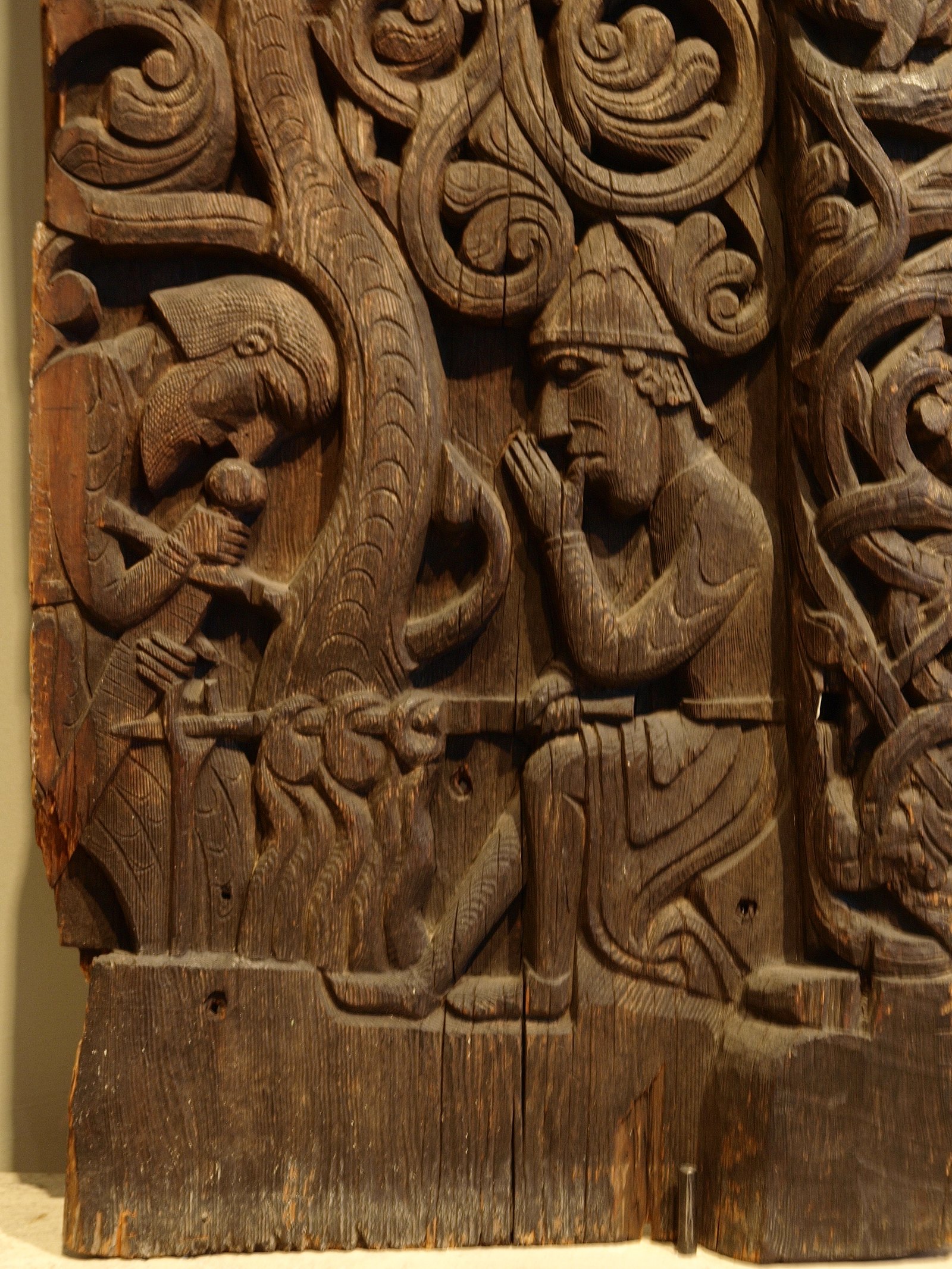
Much of what is told today about Sigurd the dragon-slayer goes back to one small vellum book in Copenhagen. It holds the Völsunga saga, the story of a family from its ancestor Sigi down to the death of its last descendants. The author is unknown, and so is the place where he worked. What is known is what he built his book from: heroic poems, some of which now survive only as an echo in his prose. This article treats the saga as a work – manuscript, date, sources, structure, editions – and points to the existing articles for the individual characters.
The Völsunga saga is neither a heroic lay nor a verse epic. It is a prose narrative in Old Norse that gathers up material which had previously circulated as separate poems. Scholars class it among the legendary sagas (Old Norse fornaldarsögur), the sagas set in a legendary age before the settlement of Iceland.
Two things give it its standing. It is the only medieval narrative from the North that offers the whole story in one sweep: from Sigi, whom the text calls a son of Odin, through Völsung, Sigmund and Sigurd to Gudrun's children. And it knows the content of poems that are missing from the main manuscript of the Poetic Edda because leaves were lost there.
The stories of the individual figures have their own articles on this site: Sinfjötli, Andvari, Fáfnir, Brynhild, Atli. This one is about the book itself.
The saga survives in exactly one medieval manuscript. Its shelfmark is NKS 1824 b 4to (“Ny kongelig Samling”, New Royal Collection) and it is kept in the Royal Library in Copenhagen. The manuscript database of the Copenhagen project “Stories for all time” (fasnl.net) dates it to 1380–1420 and gives Iceland as its origin; the literature usually says “about 1400”.
The record describes a small parchment book with pages roughly 15 to 17 centimetres high and 10 to 13 wide. It has suffered from damp, the first leaf worst of all, so the opening of the saga is damaged. Initials and rubrics are red, and in two places someone drew animals in the margin. The scribe is unknown. According to the database, which cites a work of 1906–08, Magnus Olsen concluded from the spelling that a second hand contributed a few pages.
The contents matter most. The Völsunga saga fills leaves 1 to 51. On the very page where it ends, Ragnars saga loðbrókar, the saga of Ragnar Lodbrok, begins and runs to leaf 79. The book closes with Krákumál, a poem on Ragnar's death, which is incomplete and breaks off in stanza 22.
A seventeenth-century marginal note names one Magnús Björnsson as owner. It then belonged to Bishop Brynjólfur Sveinsson, who had Þórarinn Eiríksson take it to King Frederik III of Denmark. Brynjólfur is the same bishop who sent the Codex Regius of the Poetic Edda to Copenhagen. All other manuscripts of the saga are later paper copies. In 1880 Anton Edzardi called them “without value of their own” for the text, because they depend on the vellum; that is the state of research in 1880.
The manuscript is not the original. Reference works place the saga itself in the second half of the thirteenth century; other articles on this site give the years around 1260 to 1270, which I have not checked against the scholarly literature. There is no fixed date. The dating follows from the sources: the author took over a chapter from Þiðreks saga, a Norwegian compilation of stories about Dietrich of Bern that is usually placed in the middle of the thirteenth century. In its surviving form the Völsunga saga cannot be earlier than that. A good hundred years lie between composition and the surviving copy.
On the place of composition the accounts differ. According to the summary of the entry in Kindlers Literatur Lexikon (Ilse Bauer and Klaus Böldl, cited here via German Wikipedia), Norway has been considered, because the following Ragnars saga makes its hero an ancestor of the Norwegian royal house; King Hákon IV (1204–1263) has been named as a possible patron. Against this, the same source says, stand the lack of any evidence for such a commission and the style, so that more points to Iceland. This cannot be settled; the Icelandic origin of the surviving manuscript proves nothing about where the saga was first written.
Nothing is recorded about the author.
His chief source was the heroic poems that also stand in the Codex Regius. Over long stretches the saga turns these poems into prose, from the Helgi lays to Hamðismál at the end. The otter's ransom follows Reginsmál, the talk with the dying dragon follows Fáfnismál, the valkyrie's rune lore follows Sigrdrífumál, the fall of the Gjúkungs follows the two Atli poems.
In several places the author lets the verse stand. He introduces it with formulas such as “sem kveðit er” (as is sung), “sem hér segir” (as is said here) or “sem skáldit kvað” (as the poet said). Once he names his poem: “Svá segir í Sigurðarkviðu” – so it says in the Lay of Sigurd. After Atli's death he notes that Völsungs and Gjúkungs were the boldest and mightiest of people, “ok svá finnst í öllum fornkvæðum”, and so it is found in all the old poems. He knew he was drawing on poetry, and the quotations serve him as evidence for the prose.
Two prose works come in as well. According to the overviews consulted, the author also used Snorri's Edda. And he took the description of Sigurd – a shield with a dragon on it, brown hair in great locks, shoulders as broad as two men's, a sword seven spans long – from Þiðreks saga. Edzardi calls the borrowing literal; a note in the translation by William Morris and Eiríkr Magnússon says that the chapter is nearly word for word the same as chapter 166 of the “Wilkinasaga”, as Þiðreks saga was then called after a Stockholm edition of 1715. The chapter stands out in style too. It speaks of “kurteisi” and “hæverska”, courtly manners, and halts the action for a portrait of the kind chivalric romances love.
Edzardi summed up the method in 1880: the author used his sources “now more freely, now more faithfully” and departed from them deliberately where he had to reconcile conflicting accounts. The saga is thus a redaction that makes one continuous family history out of poems of different kinds.
In the middle of the Sigurd section of the Codex Regius a gathering of eight leaves is missing. The text breaks off in Sigrdrífumál and resumes only with the end of a Sigurd poem that is therefore called “Brot af Sigurðarkviðu”, Fragment of a Lay of Sigurd. What stood in between is lost.
The Völsunga saga tells exactly this stretch in prose: Sigurd's stay with Heimir, the meeting with Brynhild, Gudrun's dream, the drink of forgetfulness, the wooing on Gunnar's behalf and the ride through the fire, the queens' quarrel at the river. Edzardi assigned chapters 23 to 29 to the gap. He counts as the source archive on this site does, which divides the saga into 42 sections. Other editions number differently: in Jesse Byock's translation the description of Sigurd is chapter 23, not 22.
This stretch contains a few stanzas preserved nowhere else; English Wikipedia counts four. Two describe the ride through the flames: the fire rages, the earth shakes, the blaze reaches the sky, hardly anyone dares the ride, until Sigurd urges Grani on with his sword and the fire dies down before the prince. Another belongs to the queens' quarrel. The last shows Sigurd leaving after his talk with Brynhild, his mail-coat bursting at the sides with grief. This is the stanza the author expressly assigns to “Sigurðarkviða”.
How much is lost can only be estimated. According to the Wikipedia article on the lacuna, the translator Henry Adams Bellows held that the lost Sigurd poem must have had more than 250 stanzas. That is an estimate, not a finding. What is certain is that the saga gives the content, not the wording. Anyone who tries to recover lost stanzas from its prose is working with a hypothesis.
The saga can be divided into five parts, as English Wikipedia also does.
The first part belongs to the ancestors. Sigi kills a thrall out of envy, is outlawed and wins a kingdom. His son Rerir stays childless until an apple helps; Rerir's son Völsung builds a hall around a tree. Then come Sigmund and his twin sister Signý, the treachery of her husband Siggeir, the revenge and the wolf-skins. No poetic source survives for these opening chapters. One passage suggests that verse existed: when Sigmund and Sinfjötli saw their way out of the burial mound with the sword, the saga quotes a half-stanza with the formula “sem kveðit er”. The section on Helgi joins up with the Helgi lays; see Helgi and Sigrún.
The second part tells Sigurd's youth: birth at the court of King Hjálprek, the foster-father Regin, the horse Grani, the sword Gram, vengeance for his father, the dragon, the valkyrie on the mountain. The third takes Sigurd to the Gjúkungs south of the Rhine, into marriage with Gudrun and the deception of Brynhild; it ends with Sigurd murdered in his bed and Brynhild dead on the pyre. The fourth belongs to Gudrun and Atli: the forced marriage, the invitation to the brothers, Gunnar in the snake-pit, Gudrun's revenge on Atli. The fifth is short. Gudrun tries to drown herself, is carried ashore and marries King Jónakr. Her daughter Svanhild is married to Jörmunrek, slandered and trampled by horses. The brothers Hamðir and Sörli ride out for revenge and are stoned, because iron will not bite on them.
Besides the family tree, one figure holds the parts together: Odin. He stands in the first sentence as Sigi's father and escorts the outlaw to the ships. A tall, old, one-eyed man with a hat pulled low drives the sword into the trunk in Völsung's hall, the sword only Sigmund can draw. The same man, now in a blue cloak and carrying a spear, meets Sigmund in his last battle, and the sword breaks on the spear. An old man with a long beard helps Sigurd choose the horse Grani; here the text adds “Óðinn hafði hann hittan”, it was Odin he had met. On the voyage to avenge his father, a man steps from a cliff into the ship, calling himself Hnikar, Feng and Fjölnir, and the storm drops. Before the dragon fight an old man with a long beard again gives advice: dig several pits.
He comes once more at the close. When Hamðir and Sörli fight on unharmed in Jörmunrek's hall, a tall, old man with one eye appears and advises stoning them. A note in the Morris and Magnússon edition says that Odin ends the tale as he began it. Mostly the text leaves him unnamed. Whether all these appearances already stood in the poems, or whether the saga author strengthened the god as an ordering figure, cannot be decided for the chapters without a surviving source.
Most of the action lies south of Scandinavia. Sigi and his descendants rule “Húnaland”, Siggeir rules Gautland. Gjúki has his kingdom “fyrir sunnan Rín”, south of the Rhine; the queens quarrel while bathing in the Rhine; and Sigurd rides from the dragon's lair “suðr til Frakklands”, south to the land of the Franks. The company that fetches Gudrun back from King Hálf's hall after Sigurd's death includes Lombards, Franks and Saxons. The dragon, we are told, is called Fáfnir by the “Væringar”, and Sigurd's name goes through every tongue “fyrir norðan Grikklands haf”, north of the Greek sea.
“Now so it is, that whoso heareth these tidings sayeth, that no such an one as was Sigurd was left behind him in the world, nor ever was such a man brought forth because of all the worth of him, nor may his name ever minish by eld in the Dutch Tongue nor in all the Northern Lands, while the world standeth fast.”Völsunga saga, section 32 in the numbering of the source archive (chapter 33 in the translators' count); translated by Eiríkr Magnússon and William Morris (first published 1870; wording as in the 1888 edition). Old Norse: “hans nafn mun aldri fyrnast í þýðverskri tungu ok á Norðrlöndum, meðan heimrinn stendr”.
“Dutch Tongue” renders “þýðversk tunga”, the German language. A thirteenth-century author knew that Sigurd's story was also told in German. He saw his material as shared property, not a Nordic speciality.
Behind some of the names stand people of the Migration Period. Gunnar is linked with the Burgundian king whose realm on the Rhine fell in the 430s, Atli with Attila the Hun, Jörmunrek with the Gothic king Ermanaric, on whom see the article on the Ostrogoths. These men lived in different generations; legend made them brothers-in-law and contemporaries. No historical model for Sigurd himself is secure. The saga is a source not for the fifth century but for how the thirteenth imagined the past.
The same material exists in three major versions, all from the thirteenth century: the Middle High German Nibelungenlied of about 1200, the Norwegian Þiðreks saga based on Low German informants, and the Völsunga saga together with the Eddic poems. Sigurd is Siegfried, Gunnar is Gunther, Gudrun corresponds to Kriemhild, Atli to Etzel.
The differences go to the core. In the saga Sigurd is stabbed in his bed; in the Nibelungenlied Siegfried dies in the forest at a spring. In the saga Gudrun avenges her brothers on Atli; in the Nibelungenlied Kriemhild avenges her husband on her brothers. The early history of the Völsungs and the Svanhild ending belong to the Norse version.
For a long time the Norse version counted as the more original and the Nibelungenlied as a courtly reworking. English Wikipedia sums up the state of research by saying that this assumption is now considered too simple. The saga itself drew on the South, as the chapter from Þiðreks saga shows, and it is younger than the Nibelungenlied. None of the three is as a whole the source of the others; each is its own treatment of older tradition.
In the middle of the wooing of Brynhild comes a sentence that has no consequence for the Sigurd plot. Brynhild says to her foster-father Heimir: “Dóttur okkar Sigurðar, Áslaugu, skal hér upp fæða með þér” – the daughter she has with Sigurd, Áslaug, is to be brought up with him. The sequel stands in the saga that follows on the same manuscript page: there Áslaug becomes the wife of Ragnar Lodbrok, and through Ragnar's sons the family tree leads to the kings of the North.
In 1880 Edzardi, with earlier scholars, held that both sagas were by one author and that the Völsunga saga was written as a kind of prehistory to Ragnars saga. He based this on style, on the transitional chapter and on a testimony in another saga. How recent research judges the relationship in detail I was not able to read in full. The manuscript evidence is firm: whoever copied the book around 1400 understood both texts as the connected history of one family that begins with Odin.
According to Edzardi's list the saga was first printed in 1737 in Björner's collection “Nordiska Kämpadater”. Friedrich Heinrich von der Hagen edited the text in 1814 and followed it with a German translation at Breslau in 1815. Rafn included the saga in the first volume of his “Fornaldar sögur Nordrlanda” in 1829, Bugge re-edited it in 1865, Wilken in 1877. In 1880 Edzardi issued von der Hagen's translation in a completely revised second edition, together with Ragnars saga; it is in the public domain and available at Projekt Gutenberg-DE. A more recent German edition is “Nordische Nibelungen” (1993), edited by Ulf Diederichs with Paul Herrmann's translation.
In English the saga appeared in London in 1870: “Völsunga Saga: The Story of the Volsungs and Niblungs, with certain Songs from the Elder Edda”, translated by Eiríkr Magnússon and William Morris. The source archive reproduces the text of the London edition of 1888 (Walter Scott, with an introduction by H. Halliday Sparling), which has 43 chapters. One of them, Gudrun's lament over Sigurd, carries the addition “as it is told in ancient Songs” and is absent from the Old Norse text in the source archive; it was evidently inserted from the Poetic Edda, and an appendix gives further Eddic poems.
Later English translations include those by Margaret Schlauch (1930), R. G. Finch (1965, with the Old Norse text), Jesse Byock (1990), Kaaren Grimstad (from the manuscript, 2000, second edition 2005) and Jackson Crawford (2017). The source archive sets the Old Norse text, the Morris and Magnússon translation and a German working translation side by side.
Richard Wagner read the saga in von der Hagen's translation. According to the Viking Site of the University of California, Los Angeles, he wrote in a letter of 1851 that he could not get the book from the Dresden booksellers and finally found it in the Royal Library. The page states that the “Ring of the Nibelung” draws more heavily on the saga and the Eddic poems than on the Nibelungenlied.
William Morris followed the translation with a verse epic of his own, “The Story of Sigurd the Volsung and the Fall of the Niblungs”. J. R. R. Tolkien wrote two poems in Old Norse metre that appeared posthumously in 2009 as “The Legend of Sigurd and Gudrún”. More in the article on Tolkien and the North.
What does “Völsunga saga” mean? “Saga of the Völsungs”. The Völsungs are the line of King Völsung, who by the saga's reckoning is Odin's great-grandson. The sequence runs: Sigi, Rerir, Völsung, then Sigmund and his sons Sinfjötli, Helgi and Sigurd.
How old is the saga? It is placed in the second half of the thirteenth century. The only medieval manuscript was written around 1400. The poems it draws on are older; how much older is disputed for each poem separately.
Who wrote it? That is not known. Iceland is considered the more likely place of origin; Norway has been suggested.
Is the saga the same as the Edda? No. The Poetic Edda is a collection of poems; the saga is a prose narrative that retells many of those poems and quotes individual stanzas. For the stretch missing from the Codex Regius the saga is the most important witness.
Which translation can I read freely? The English translation by Morris and Magnússon (first published 1870) and von der Hagen's German one in Edzardi's revision (1880) are in the public domain. Both are archaic in tone; for study, read a recent edition alongside them.
Sigurd the dragon-slayer · Sinfjötli and the wolf-skins · Andvari's cursed gold · Fafnir – the Dragon · Brynhild.
Almost everything we think we know about the Norse order of the world hangs on a single poem of some sixty stanzas. It …
Read more →Valhalla (Old Norse Valhǫll, “hall of the slain”) is Odin's enormous hall in Asgard, where a chosen share of those …
Read more →Valkyries are the female figures of Norse mythology who decide, on Odin's behalf, which warriors fall in battle – and …
Read more →The Æsir–Vanir war is the first war in the world according to Norse mythology: Odin's gods, the Æsir, fight the second …
Read more →