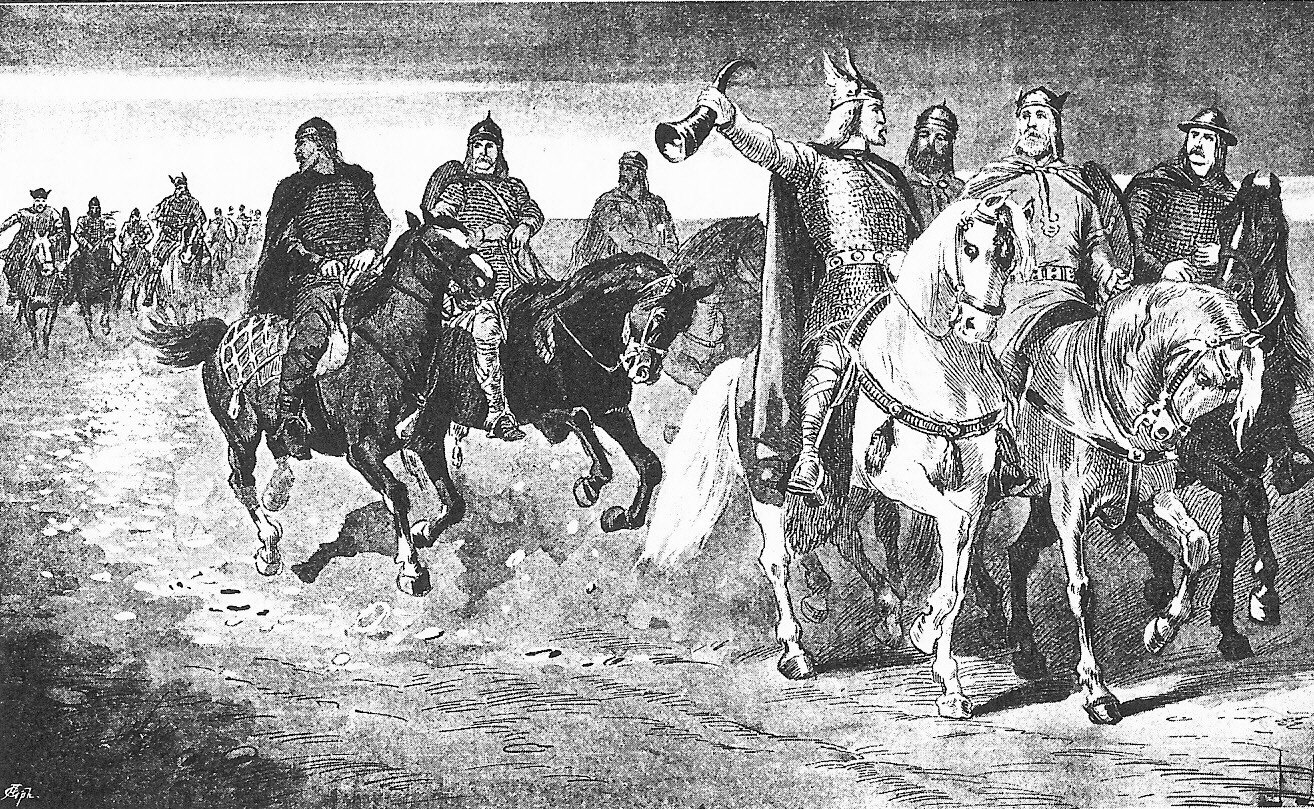
A Danish king scatters gold on a road so that his pursuers dismount to pick it up. A champion sits motionless in the hall while a bear fights for him outside. A half-sister marches on her own brother with sorcery. Hrólfs saga kraka tells all of this, but it is a young text, and none of its copies is older than the seventeenth century. Its subject matter, by contrast, already appears in the Old English Beowulf, in Saxo Grammaticus, in a small Danish chronicle and in Snorri Sturluson. This article sorts the witnesses by age and shows what the saga made of the old material.
When Snorri Sturluson sets out in the thirteenth century to explain why poets call gold "Kraki's seed", he introduces the man in one sentence: "Konungr einn í Danmörk er nefndr Hrólfr kraki", a king in Denmark is called Hrólfr kraki. He was, Snorri says, the most outstanding of the kings of old in generosity, valour and approachability. His audience knew the figure.
Hrólfr kraki, usually Hrolf Kraki in English, belongs to the Skjöldungs, the legendary Danish royal line seated at Lejre on Zealand. Tradition places him long before the Viking Age; English Wikipedia, relying on the internal chronology of the texts, gives the early sixth century. No contemporary record of him exists. What we have is poetry and history writing from later centuries, and at the very end of the chain the saga that bears his name.
Hrólfs saga kraka ok kappa hans, "the saga of Hrólf kraki and his champions", is a legendary saga (fornaldarsaga): an Icelandic prose tale set before the settlement of Iceland, with trolls, sorcery and shape-changing. Its closest well-known relative is the Völsunga saga.
For the transmission I rely on English Wikipedia, which cites Jesse Byock's 1998 translation. By that count forty-four manuscripts survive, the oldest from the seventeenth century; the catalogue "Stories for All Time" (fasnl.net), which includes young copies, lists about 60 shelfmarks. The surviving version is dated to around 1400; a precursor may go back to the thirteenth century. More than a thousand years separate the story's setting from the oldest copy. Desmond Slay published the scholarly edition and a study of the manuscripts in 1960; the online text at heimskringla.no follows the reading edition by Guðni Jónsson and Bjarni Vilhjálmsson.
The saga is built from separate tales, þættir in Old Norse. That edition heads them Fróða þáttr (chapters 1–5), Helga þáttr (6–17), Svipdags þáttr (18–23) and Böðvars þáttr (from chapter 24); I could not see the later divisions. Chapter numbering varies: Jesse Byock's translation counts more tightly and has the Uppsala journey as early as chapter 28. The title hero moves to the centre late: the first parts belong to his ancestors, the middle ones to his champions.
It begins with a killing among kin. King Halfdan is slain by Fróði. His sons Helgi and Hróarr escape, find shelter with a man called Vífill on an island, later avenge their father and kill Fróði.
The names are older than the saga. In Beowulf the same figures are Healfdene, Halga and Hroðgar. An Eddic poem presupposes the story too: in Gróttasöngr, the mill song of the giantesses Fenja and Menja, stanza 22 (numbering of our source archive) says that "Yrsa's son" will come and that she will call him "burr ok bróðir", son and brother.
The saga tells it like this. Helgi woos Ólöf, a queen in Saxony. She humiliates him, has his head shaved and has him smeared with tar. Helgi comes back, tricks her and forces her into his bed. Ólöf bears a daughter, names her Yrsa after her dog and lets her grow up herding. Years later Helgi meets the girl without knowing who she is and marries her. Ólöf keeps silent, as revenge. Hrólfr is born of the marriage. Only then does Yrsa learn the truth. She leaves Helgi and later becomes the wife of the Swedish king Aðils at Uppsala. Helgi goes after her and falls fighting Aðils.
The incest was not invented by the saga writer. It stands in every branch of the tradition; only the circumstances change. In the Lejre chronicle and in Saxo the mother is Thore or Thora and no queen; in Saxo, according to the summaries, Helgi is said to have killed himself out of shame. In Snorri's Ynglinga saga Queen Álof reveals the kinship when Hrólfr is three years old. The unwitting union of father and daughter evidently belonged to this figure as firmly as sibling incest belongs to the birth of Sinfjötli.
The longest part of the saga belongs not to the king but to his most famous champion. Böðvarr, nicknamed bjarki ("little bear"), comes from Norway. His father Björn is the son of a king Hringr, whose second, much younger wife Hvít comes to court from the far north, from Finnmörk. She desires her stepson and is refused. She strikes him with a wolfskin glove and decrees "at hann skyldi verða at einum híðbirni ólmum ok grimmum", that he shall become a bear of the winter lair, wild and fierce (chapter 25 in the heimskringla.no edition). According to the summaries Björn is from then on a bear by day and a man by night.
His lover Bera, whose name means "she-bear", stands by him. Before the king's hunters kill him, Björn foretells three sons: "Sá, sem fyrst kemr til, sonr okkar, skal Þórir heita, annarr Elg-Fróði, þriði Böðvarr." Elg-Fróði is an elk from the waist down, Þórir has a hound's feet. Only Böðvarr looks human. He avenges his father on Hvít and travels by way of Gautland to Denmark.
Björn, Bera, Bjarki: the names speak for themselves. For the background see our articles on the bear in the North, the berserks and the úlfheðnar.
At Hleiðargarðr, as the saga calls Hrólf's seat, Böðvarr finds a frightened lad called Höttr whom the retainers torment, and takes him under his protection. At Yule a beast haunts the court, already for the second year. Böðvarr kills it in the night and makes Höttr drink its blood. The boy becomes strong and brave. The two prop the carcass up, and in the morning Höttr pretends before the king to kill it. Hrólfr rewards him with a gold-hilted sword and a new name: Hjalti, from hjalt, the hilt.
What the beast looked like is told in a half-sentence that has made it into the title of a scholarly article: "ok flýgr þat jafnan", and it is always flying. In the Bjarkarímur, an Icelandic rhymed poem on the same material, Bjarki instead kills a wolf and Hjalti a bear, according to Oscar Olson (1916).
The high point of Hrólf's career is the journey to his stepfather Aðils at Uppsala. Snorri tells the same story some two hundred years earlier in Skáldskaparmál (chapters 53–54 in the numbering of our source archive).
In Snorri, Aðils is at odds with a king Áli; they fight on the ice of the lake Væni, identified with Vänern. Hrólfr sends his twelve berserks, among them Böðvarr bjarki and Hjalti hugprúði. Áli falls. The champions demand three pounds of gold each and three treasures for their king: the helmet Hildigöltr, the mail-coat Finnsleif and the gold ring Svíagríss. Aðils refuses everything. Hrólfr then goes to Uppsala himself with his twelve.
His mother Yrsa receives him. Aðils' men stoke the fire until the guests' clothes burn and ask mockingly whether it is true that Hrólfr and his berserks flee neither fire nor iron. Hrólfr throws his shield on the blaze, leaps over it and speaks in verse: "Flýra sá eld, er yfir hleypr", he does not flee the fire who leaps over it. Yrsa gives her son a horn full of gold and the ring, and they ride off.
"Then Hrólfr kraki took the gold out of the horn with his right hand and sowed it all along the road. When the Swedes saw that, they leapt from their saddles, and each took what he could get. […] King Aðils rode up to the ring, reached for it with the point of his spear and let it slide up to the socket. Then Hrólfr kraki turned round and saw him stooping. Then he said: 'Bent like a swine have I now the one who is mightiest among the Swedes.'"Snorri Sturluson, Skáldskaparmál, ch. 54 (numbering of Guðni Jónsson's edition), abridged; my own translation from the Old Norse
"Af þessi sök er gull kallat sáð Kraka eða Fýrisvalla", Snorri concludes: for this reason gold is called the seed of Kraki or of Fýrisvellir, the plain by the river Fýri at Uppsala. Eyvindr skáldaspillir speaks of "fræ Fýrisvalla", the seed of Fýrisvellir, which the warriors wore on their arms in King Hákon's lifetime. Þjóðólfr calls gold "Kraka barr", Kraki's barley. Such circumlocutions are kennings. If a skald could use the phrase, his audience already knew the story of the sown gold.
The saga is fuller. According to the summary Hrólfr sets out with 120 men and twelve champions. On the way a farmer called Hrani advises him to send most of them home; Hrani is Odin in disguise. At Uppsala come traps and the trial by fire; Aðils escapes through a hollow tree trunk in the hall, and a troll in boar shape is killed by Hrólf's dog Gramr. The gold is sown here too, and Hrólfr also deals the stooping Swede a blow.
The nickname belongs to the same cycle. In Snorri a poor boy called Vöggr steps before the young, slightly built king and says that at home he had heard Hrólfr at Hleiðra was the greatest man in the North, "en nú sitr hér í hásæti kraki einn lítill", and now a little pole sits here in the high seat. Hrólfr accepts the taunt as a naming. Because a naming calls for a gift and the boy has none, the king gives one himself: a gold ring. Vöggr vows to kill whoever kills Hrólfr. The king laughs: "Litlu verðr Vöggr feginn", Vöggr is glad of little.
Skuld, Hrólf's half-sister, is in the saga the daughter of Helgi and an elf-woman (see our article on the elves). She is married to Hjörvarðr, one of her brother's under-kings, and sets him against Hrólfr. With seiðr, the sorcery of Norse tradition, she conceals her army. At Yule it moves up to Hleiðargarðr, its weapons hidden in wagons.
A huge bear fights before Hrólf's men and rages among the attackers. Böðvarr, however, is missing. Hjalti finds him sitting motionless in the hall, upbraids him and fetches him to the field. At that moment the bear is gone. Böðvarr tells his friend that he has helped the king less by this than he thinks. The battle turns. Skuld makes her fallen rise again; Hrólfr and all his champions die.
The saga does not explain what happens. It does not say that Böðvarr "turns into" anything. His body sits still, and something of him fights outside in the shape his father wore under compulsion. Related ideas are treated in our articles on the fylgja and on Kveldúlfr.
Böðvar's brothers Elg-Fróði and Þórir then arrive with a Swedish army sent by Yrsa under Vöggr's command and kill Skuld. Hrólfr is given a mound, and his sword Sköfnungr goes into it with him.
The oldest Scandinavian prose witnesses are Danish and Latin. The Chronicon Lethrense, the "Chronicle of the Kings of Lejre", is a short text by an unknown author. Scholars place it in the second half of the twelfth century, the dates given being "around 1170" and the early 1190s. It survives, among other places, as part of the Annals of Lund.
The chronicle knows Haldan and his sons Helghe and Ro. Helghe fathers Yrse on the farmer's daughter Thore and, unknowingly, Rolf on Yrse. Rolf Krage is killed on Zealand by his brother-in-law Hartwar, husband of his sister Skulda; a single survivor called Wigg kills the victor, who was thus king for one morning only.
Saxo Grammaticus tells the story around 1200, in far more detail, in Book 2 of the Gesta Danorum. His names are Ro, Helgo, Urse, Roluo, Athislus, Hiartuar and Skulde. Here too gold is scattered on the flight from Uppsala; He explains the nickname as a tree trunk climbed like a ladder. Roluo falls at Lejre, and Wigg avenges him. Saxo knows a bear too, but according to Olson in a different place: Biarco kills it and Hialto drinks its blood, the counterpart of the saga's beast scene. English Wikipedia says that Bjarki also fights as a spirit bear in Saxo's last battle. As far as I know Biarco merely sleeps there until Hialto wakes him, and the fighting bear is peculiar to the Icelandic saga; I could not check this against Saxo's text. All these statements about Saxo come from summaries.
Much of Saxo's battle narrative is a poem. In 298 Latin hexameters beginning "Ocius evigilet", Hialto calls the sleepers to arms. Saxo is rendering an Old Norse lay, Bjarkamál, of which only a few lines survive in the original, in Skáldskaparmál and Heimskringla. On the morning of the battle of Stiklestad in 1030 the skald Þormóðr Kolbrúnarskáld is said to have recited it at King Olaf's request. One surviving line runs "Vekka yðr at víni", I do not wake you to wine. Whether it was really heard that morning cannot be shown.
In Iceland the saga was preceded by Skjöldunga saga, a history of the Danish Skjöldungs. It is dated to about 1180–1200 and lost in its original form; it is known chiefly through a Latin paraphrase by the Icelander Arngrímur Jónsson. There Helgo and Roas rule jointly, the Saxon queen is Olava, Yrsa marries Adillus, and Rolfo falls to Hiørvardus and Skullda. Its Saxon queen puts this version closer to the later saga than to the Danish Latin writers.
Snorri used the material twice: in Skáldskaparmál and in Ynglinga saga, the first part of Heimskringla. Skaldic verses presuppose the sown gold. At the end of the twelfth century the material is written down in Denmark and Iceland. In the thirteenth Snorri tells it briefly and without sorcery. Around 1400 comes the saga with its elk-man, Odin in farmer's clothes and an army of the walking dead. The younger the version, the more marvels. Anyone who reads the saga as evidence for Viking Age belief must therefore ask of each motif whether an older witness knows it.
The oldest witness is not Scandinavian. The first half of the Old English Beowulf is set at the court of the Danish king Hroðgar in the hall Heorot. The names match the Norse ones: Healfdene is Halfdan, Hroðgar is Hróarr, Halga is Helgi, the Scyldingas are the Skjöldungs, Eadgils is Aðils, Heoroweard is Hjörvarðr, and Hroðulf is Hrólfr. According to English Wikipedia (citing Tom Shippey) the identification is the consensus view.
In Beowulf Hroðulf is marginal. He sits beside his uncle Hroðgar in the hall (lines 1011–1017 and 1162–1165 in the numbering cited there), and the poet remarks that at that time the two were still true to each other. Many read this as a hint that Hroðulf will later displace Hroðgar's sons. The poem Widsith says, from line 45 on, that Hroðwulf and Hroðgar, nephew and uncle, kept peace together longest after breaking Ingeld's attack.
So the core figures are no invention of late medieval Iceland. But the roles have shifted. In England Hroðgar is the great king and Hroðulf the nephew in his shadow; in the North Hróarr is pale and Hrólfr has all the fame. More in our articles on the Geats and the Danes.
A hero comes from the land of the Geats to the Danish royal court and kills a monster that haunts the hall. That fits Beowulf and Böðvarr Bjarki alike. English Wikipedia sums up the camps: some hold that the two were originally the same figure; others assume only a distant kinship, perhaps through a common source. In 1910 Friedrich Panzer assigned both to the folktale type of the "Bear's Son".
The texts themselves speak against a simple equation. Beowulf wrestles with a man-like being and tears off its arm; Böðvarr kills a flying beast. Beowulf becomes king and dies fighting a dragon; Böðvarr remains a retainer and falls with his lord. The blood-drinking has no counterpart in Beowulf, and the saga is centuries younger than the English poem. Direct dependence cannot be demonstrated. The cautious statement holds: both texts draw on a cycle of stories about the court of the Skjöldungs. J. R. R. Tolkien worked through the hero's bear nature in a fairy-tale version of his own, published in 2014 as "Sellic Spell".
Saga, Saxo, chronicle and Snorri agree on one point: the seat of these kings is Lejre, Hleiðargarðr in the saga and Hleiðra in Snorri. At Gammel Lejre on Zealand a team led by Tom Christensen of Roskilde Museum has excavated several large halls since the 1980s, with post settings indicating buildings 50 to 60 metres long; the site was in use from about 550 to 1000. Details are in our article on the Lejre figurine.
The excavations prove a place of the powerful in exactly the period where tradition puts its Skjöldungs. They prove no Hrólfr, no Hroðgar and no Heorot. No find carries a name.
When was Hrólfs saga kraka written? The surviving version is dated to around 1400; a precursor may belong to the thirteenth century. The oldest manuscript dates only from the seventeenth century.
Did Hrolf Kraki really exist? That cannot be clearly demonstrated. There is no contemporary source. The name Hroðulf in Beowulf and Widsith shows an old tradition, not a datable life.
What does the nickname Kraki mean? Roughly "pole" or "thin trunk". According to Snorri the boy Vöggr used it to mock the slender young king, who accepted the name and rewarded the mocker with a gold ring.
Is Bödvar Bjarki a berserk? Snorri counts him among Hrólf's twelve berserks; the saga's title speaks of kappar, champions. His mark is not battle frenzy but the bear that fights for him while he himself sits still.
What does the saga have to do with Beowulf? Both are set at the court of the Danish Skjöldungs and share the names of the royal family. Whether the Geatish hero of one text goes back to the same root as that of the other is disputed.
The Lejre figurine and the site of Gammel Lejre · Saxo Grammaticus and the Gesta Danorum · The bear in the North · Berserks: checking the sources · The Geats, Beowulf's people · The Danes in the early sources · Gamla Uppsala and the royal mounds · The Völsunga saga · Kveldúlfr, the evening wolf · Gróttasöngr, the mill song
The silver figurine from Lejre · Saxo Grammaticus · The Bear in the North · Berserkers · Gamla Uppsala: the royal mounds.
Hrungnir is the strongest of the giants in Norse mythology, a being with a head, heart and shield of stone, whom Thor …
Read more →A god tears the head off a black ox, rows further out than the boat's owner likes, and moments later has the creature …
Read more →A ship that no god can budge, a giantess on a wolf bridled with vipers, sparks from the rollers and a trembling earth …
Read more →Idun (Old Norse Iðunn) is the Norse goddess who keeps the gods young: according to Snorri Sturluson she guards apples …
Read more →