A god tears the head off a black ox, rows further out than the boat's owner likes, and moments later has the creature that encircles the world on his hook. It is one of the best-known scenes in Norse mythology. In the Eddic poem Hymiskviða, though, it fills only four of 39 stanzas. Around it runs a story about beer, a missing brewing cauldron, a frost-bearded giant and a god called Týr who suddenly has a giant for a father. This article walks through the poem in order, sets Snorri's prose version beside it, asks what the skalds of the ninth and tenth centuries knew and how firmly the four famous carvings can be identified – and what can be said about the ending: does the serpent die, or does it get away?
Hymiskviða, "the lay of Hymir", survives complete in two medieval manuscripts. The better known is the Codex Regius of the Poetic Edda (GKS 2365 4to), which our source archive places "around 1270"; according to the editor Edward Pettit the poem stands there on folios 13v to 15r. The second is the fragment AM 748 I a 4to, folios 5v to 6v. Pettit notes that the two versions differ little in content but sit in different places: in AM 748 the poem follows Grímnismál and precedes Völundarkviða.
The name "Hymiskviða" appears only in AM 748. The Codex Regius heads the poem Þórr dró Miðgarðsorm, "Thor hauled up the Midgard serpent". One manuscript puts the fishing at the centre, the other the giant.
The metre is fornyrðislag, the narrative measure of Eddic verse, built from alliterating pairs of short lines. The usual count is 39 stanzas, mostly of four long lines; Henry Adams Bellows divides the text differently in places, so stanza numbers can be one off between editions. The numbers used here follow the Old Norse text of Guðni Jónsson as printed in our parallel-text reading edition of Hymiskviða.
The poem opens with thirst. The gods have been hunting and want to drink. They "shake twigs" and look at the hlaut – a casting of lots, perhaps with sacrificial blood – and the result points to Ægir, the giant of the sea. Already the first stanza is hard. Karl Simrock took the phrase örkost hvera to mean that Ægir lacked a brewing cauldron; Bellows read "rich fare"; recent summaries say Ægir had cauldrons in plenty, just none big enough for everyone at once.
Thor, here called "Yggr's child", that is Odin's son, stares Ægir in the eye and demands that he host the Æsir often from now on. The giant plots revenge and sets a condition he thinks cannot be met: let Sif's husband first fetch him the cauldron in which he can brew for them all. The gods can find none. Then Týr gives a piece of advice "to Hlórriði alone" – Hlórriði being a name for Thor. East of the Élivágar, at the edge of heaven, lives the "very wise" Hymir, and he owns a cauldron one röst deep. A röst is an old measure of distance; the point is its vast size. When Thor asks whether the "liquid-boiler" can be had, Týr answers briefly: only by cunning.
In this poem, then, the fishing trip is an episode inside a procurement journey. At its end waits the feast at Ægir's hall that goes off the rails in Lokasenna.
Thor and Týr travel for a day from Asgard to a certain Egill, who takes charge of the "horn-proud" goats. Pettit thinks him "probably a giant". In Hymir's hall the poem turns into a family scene. The "son" meets his grandmother, whom he finds loathsome: she has nine hundred heads. A second woman comes forward "all golden" and "bright-browed" and brings her son beer. She warns that her husband is often ill-tempered with guests and hides them beneath the cauldrons.
The "hard-minded" giant returns late from the hunt, ice rattles as he steps into the hall, and his "cheek-forest", his beard, is frozen. His wife announces the son and with him a companion: the "friend of men", called Véurr. Véurr, roughly "protector", is a name for Thor; Völuspá, Pettit notes, similarly calls him "Midgard's Véurr". The giant looks towards the gable where the guests sit behind a pillar. Under his gaze the pillar splits, the beam breaks, eight cauldrons crash down, and only one, "hard-hammered", stays whole.
For supper Hymir has three bulls slaughtered. Thor eats two of them by himself. The giant remarks that tomorrow the three of them will have to live on what they catch.
Thor says he is willing to row if the giant gives him bait. Hymir sends him to the herd. In the wood Thor finds an "all-black" ox and breaks off what the poem calls the "high homestead of the two horns" – its head. The animal has no name in the poem.
Out on the water the "lord of goats" asks the giant to take the boat further. Hymir has little wish to. With one hook he pulls up two whales at once, while Thor in the stern "with cunning" readies his line. Then come the three stanzas that made the poem famous. In Henry Adams Bellows's translation of 1923:
The warder of men, the worm's destroyer,
Fixed on his hook the head of the ox;
There gaped at the bait the foe of the gods,
The girdler of all the earth beneath.
The venomous serpent swiftly up
To the boat did Thor, the bold one, pull;
With his hammer the loathly hill of the hair
Of the brother of Fenrir he smote from above.
The monsters roared, and the rocks resounded,
And all the earth so old was shaken;
Then sank the fish in the sea forthwith. Hymiskviða, stanzas 22–24 (Old Norse numbering), trans. Henry Adams Bellows, The Poetic Edda (1923)
The Old Norse is more precise in three places than a verse translation can show. In stanza 22 Thor is orms einbani, "the serpent's sole slayer" – a title that may look ahead to the final battle or may imply a killing on the spot. The serpent is umgjörð allra landa, "girdle of all lands", and ulfs hnitbróðir, which Pettit explains as "brother of the wolf" (Fenrir) or "battle-brother". And the head on which the hammer falls is the "high mountain of the hair".
Stanza 24 has only three lines. Our reading edition notes that a missing line is assumed here. What happens next the poem tells in six words: sökkðisk síðan sá fiskr í mar, "then that fish sank into the sea". No knife, no severed line, not a word on whether the creature is dead. On the way back the giant is "joyless" and silent.
Ashore, Hymir offers Thor a choice: carry the whales to the farm or make the boat fast. Thor grips the stem, lifts the boat with its bilge-water, oars and bailer, and carries it to the farm together with the "surf-swine", the whales. No one is strong, the giant insists, who cannot break his cup. Thor, sitting, hurls it through stone pillars; it is brought back to Hymir unharmed. The giant's "fair mistress" gives away the trick: the giant's skull is harder than any goblet. Thor rises to one knee and strikes with all his divine strength. Hymir's "helmet-stump" stays whole; the cup cracks.
The giant laments his loss and sets the last condition: the guests may have the cauldron if they can get it out of the house. Týr tries twice and it does not move. Then "Móði's father" seizes the rim, steps down through the floor of the hall as he does so, lifts the cauldron on to his head, and its rings clatter at his heels. In Hymiskviða this motif belongs to the cauldron, not the boat. Thor putting his feet through the bottom of the boat while fishing is found only in Snorri – and, as we shall see, on stone.
Soon Thor looks back and sees Hymir coming after them from the caves in the east with a "many-headed host". He sets the cauldron down, swings Mjöllnir and kills all the "lava-whales", as the poem calls the giants. Pettit compares this threefold test – boat, cup, cauldron – with the contests at Útgarða-Loki's court.
Stanzas 37 and 38 read as if blown in from another story. One of Thor's goats lies half dead on the ground, lame in the leg, and "the cunning Loki" is to blame. The poet turns directly to his audience: you have heard what recompense Thor had from the "lava-dweller" – both his children. Pettit calls this address to the listeners unusual; Ursula Dronke regards the two stanzas as intrusive.
Snorri tells a related story in Gylfaginning 44. Thor lodges with a farmer, slaughters his goats, revives them in the morning, and one limps because a bone has been split. In compensation Thor receives the children Þjálfi and Röskva. There the host is neither a giant nor called Egill, and Loki is not at fault. Hymiskviða evidently knows another version in which the children's father is a giant – perhaps, as Pettit cautiously suggests, the Egill of stanza 7.
The final stanza brings Thor and the cauldron to the assembly of the gods. From now on they shall drink ale at Ægir's, and – this is the last word of the poem – every hörmeitið. Simrock rendered it "every flax harvest", Bellows "at the autumn-time", and Pettit takes it as a kenning for winter. When exactly the gods feast remains open.
In stanza 5 Týr says "my father" in so many words, and in stanza 11 Hymir's wife greets "the son". Pettit states it plainly: only in Hymiskviða is Týr the son of a giant. Snorri, in Skáldskaparmál, calls him a son of Odin. Nor does Týr appear anywhere else as Thor's travelling companion; that part usually falls to Loki.
None of the proposed solutions has won out. One proposal emends "father" to "grandfather" – our reading edition credits it to Finnur Jónsson, which is not checked here against his edition. Others do not read týr as a name here at all but as the ordinary word for "god" – the companion would then be an unnamed god, and one suggestion reported by Pettit is Loki, whose giant ancestry is well known. That cannot be proved. The third possibility is the simplest: Norse mythology had no binding list of gods, and the poem preserves a tradition that Snorri did not know or did not need. More on the god himself in our article on Týr.
Eddic poems mostly tell their stories straight. Hymiskviða does not. According to Pettit, no other Eddic poem has so much in common with skaldic verse: many kennings – compound circumlocutions –, unusual word order and numerous words found only here. Thor alone goes by more than a dozen designations: Sif's husband, Hlórriði, Véurr, lord of goats, Móði's father, "he who makes the giantess weep", "breaker of the rock-Danes". The boat is a "roller-steed", the cauldron an "ale-ship". (These renderings are my own from the Old Norse.)
Two things need to be kept apart. The material is old: carvings and skaldic verse attest the fishing trip long before the Edda manuscripts. The poem in its surviving form, by contrast, is considered young. Pettit sums up that date and place of composition are uncertain and that scholars incline to the twelfth century or the first half of the thirteenth. The cauldron quest is also attested independently; Pettit names the First Grammatical Treatise, some later kennings and the prose attached to Lokasenna.
Snorri Sturluson gives the fishing trip in Gylfaginning, chapter 48 – in Pettit's judgement the fullest surviving account, and one that "shows no clear use" of Hymiskviða.
Then comes a sentence which shows that Snorri knew more than one version. Some people say, he reports, that the hammer struck off the serpent's head on the bottom; the narrator, however, holds it to be true that the Midgard serpent still lives and lies in the encircling sea. Snorri needs a living serpent for Ragnarök, where Thor and the serpent kill each other. See also our article on Jörmungandr.
Skaldic stanzas are the oldest verbal evidence for the story, with one reservation: they survive only because Snorri took them into his handbook as examples in the thirteenth century. Pettit names four poets:
There is also a fragment that Snorri quotes in Skáldskaparmál under the name of Ölvir hnúfa: the "girdle of all lands" and the "son of Earth" grew furious. Whether that means the fishing trip or the final battle the verse does not say. Pettit does not mention it; it is checked here only through a secondary source.
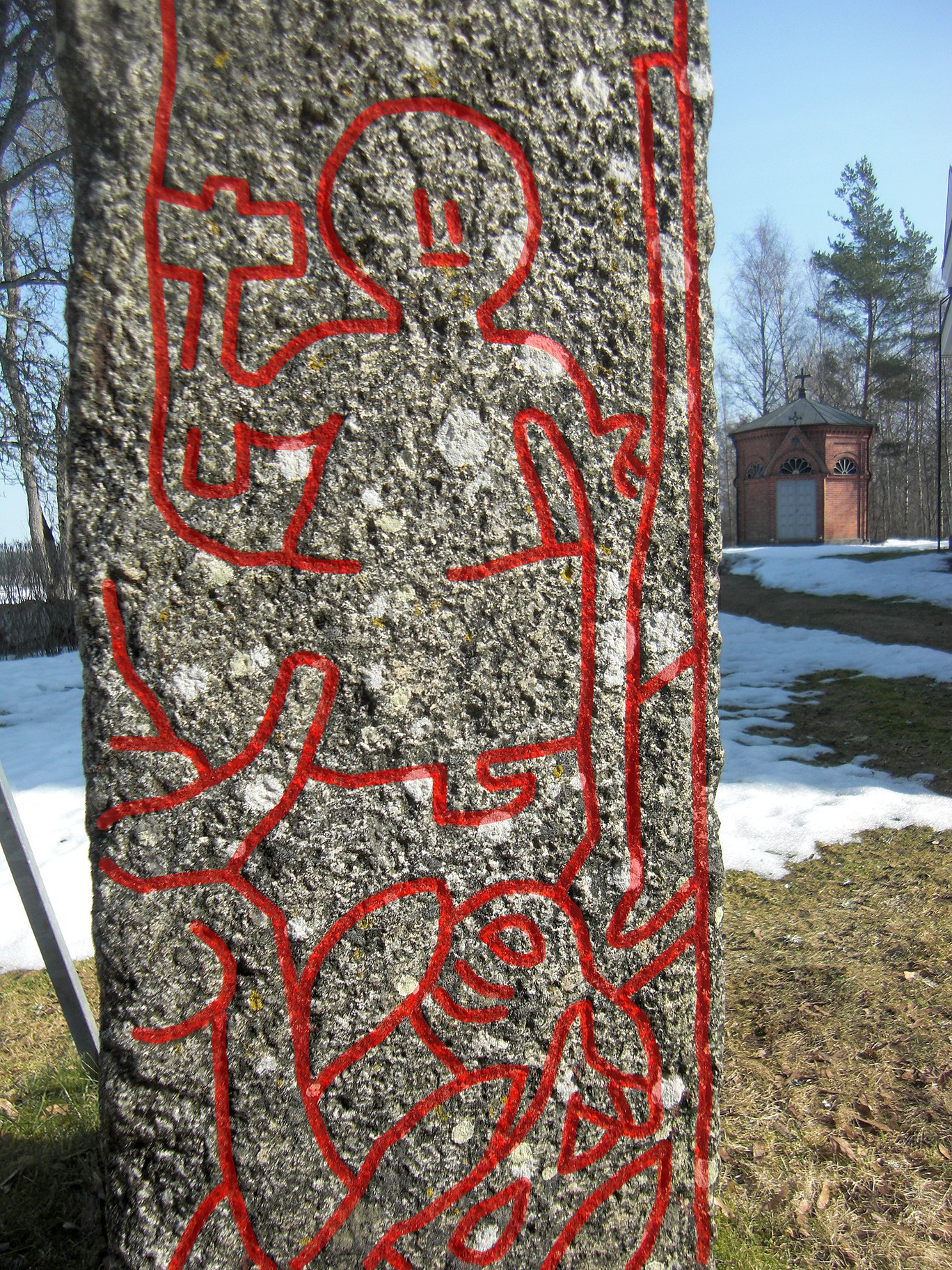
Four carvings are regularly linked with the fishing trip. None carries a caption naming "Thor" or "Hymir". Every identification rests on comparison with the texts.
Altuna (U 1161), Uppland. According to the English Wikipedia the granite stone was found in 1918 in the wall of a chapel; the runic database Rundata gives Altuna church as the find-spot, the Viking Age as the date and Pr 3 as the style, which points to the eleventh century. The inscription says that Véfastr, Folkaðr and Guðvarr (reading uncertain) had the stone raised for their father Holmfastr and for Arnfastr; father and son were both burned. Balli and Freysteinn name themselves as carvers, and Hlífsteinn is named with them. The picture face shows a single figure in a boat, a line with a bait, a serpentine creature below – and a foot sticking through the bottom of the boat. That detail matches Snorri's prose, written down some two centuries later, so the identification is regarded as very secure. Hymir is missing.
Hørdum, Thy (Denmark). According to the Danish encyclopedia lex.dk the stone came to light in excavations before the present church tower was built (1955) – the English Wikipedia says 1954 – and now stands in the church porch; it is dated broadly to the Viking Age. It shows two figures in a boat, a line, and again a foot below the hull. According to the English Wikipedia the figure at the back holds an implement read as a tool for cutting the line; the bait has not survived.
Gosforth, Cumbria (England). The slab in Gosforth church known as the "Fishing Stone" is, according to the English Wikipedia, attributed to the same sculptor as the cross in the churchyard, dated there to the first half of the tenth century; neither point is checked here against the specialist literature. It shows two men in a boat; according to Pettit whales appear to surround the bait, and one figure – presumably Hymir – is about to cut the line with an axe.
Ardre VIII, Gotland. The Gotland picture stone is placed in the eighth to tenth century. According to the English Wikipedia, Preben Meulengracht Sørensen read a sequence: a man enters a house in which an ox stands, two men leave, one carrying something on his shoulder, and two men fish with a spear. If that is right, the story was complete in outline centuries before Snorri. Of the four witnesses this is the least secure.
The sources give three answers. In Bragi and in Snorri, Hymir cuts the line and the serpent lives. In Úlfr Uggason and Gamli it dies. Hymiskviða does not commit itself: Thor hits the head, the earth shakes, the fish sinks.
According to the summary I have seen, Meulengracht Sørensen read the fishing trip as youthful recklessness on Thor's part: the story stresses the order and balance of the cosmos, in which the serpent too has its place – it holds the inhabited world, Midgard, together. Which variant is the original cannot be established.
Hymiskviða has comic traits: the god who eats his host out of house and home, the cup that breaks only on its owner's skull, the cauldron worn as a hat. Pettit sets the poem beside Þrymskviða, which likewise ends with Thor killing giants with his hammer. The comedy gains weight, he notes, because the audience knew Thor would fall against this very serpent.
Comparative approaches stand alongside. As possible ancient roots Pettit mentions parallels with Indra and Vṛtra or Apollo and Python and the serpent's resemblance to the ouroboros and Leviathan. These are interpretations, not findings. How much of Hymiskviða is inherited and how much was shaped by a poet of the twelfth or thirteenth century remains open.
What is Hymiskviða about? Thor and Týr fetch a huge brewing cauldron from the giant Hymir so that Ægir can brew ale for the gods. Along the way Thor fishes for the Midgard serpent with an ox head.
How old is Hymiskviða? The manuscripts date from the late thirteenth century and after. According to Pettit, scholars tend to place the poem itself in the twelfth or early thirteenth century. The story is attested much earlier.
Why does Týr call the giant Hymir his father? That is unresolved. Proposals include emending the text to "grandfather", reading týr as "god", and assuming a separate tradition that departs from Snorri's "son of Odin".
Which stone shows Thor's fishing trip most securely? The Altuna stone in Uppland and the Hørdum stone, because both show the foot pushed through the bottom of the boat. Ardre VIII is the least certain.
Where can I read the poem? On this site the Old Norse stands beside Bellows's translation in the reading edition; the source archive adds Simrock's German.
Jörmungandr – the World Serpent · Thor · Týr – the god who gave his hand · Ægir's feast & the Lokasenna · Þrymskviða: how Thor got his hammer back dressed as a bride.
A ship that no god can budge, a giantess on a wolf bridled with vipers, sparks from the rollers and a trembling earth …
Read more →Idun (Old Norse Iðunn) is the Norse goddess who keeps the gods young: according to Snorri Sturluson she guards apples …
Read more →The Sagas of Icelanders (Íslendingasögur), often called the family sagas, are around forty anonymous prose narratives …
Read more →Jörmungandr, the Midgard Serpent, is the gigantic sea serpent of Norse mythology that lies in the world ocean, coils …
Read more →