Towards the end of the tenth century an Icelandic chieftain builds a hall, has scenes of the gods set on its walls and roof, and holds a wedding in it. A skald stands up and recites a poem about what the guests can see above them. Nothing is left of the pictures. Of the poem we have about a dozen stanzas and half-stanzas, scattered through Snorri's handbook of poetic diction. This article goes through the surviving verses one by one and separates what the poem says from what Snorri and the saga add.
The occasion is recorded in chapter 29 of Laxdæla saga. Óláfr Höskuldsson, nicknamed “pái” (the Peacock) for his splendid appearance, had a new hall built on his farm Hjarðarholt in the west of Iceland. The saga calls the building an eldhús, literally a “fire-house”: the room with the long hearth where people sat, ate and feasted. In Keneva Kunz's English translation the hall was larger and grander than anything men had seen before. Stories from tradition were depicted on its walls and roof.
In this hall Óláfr celebrated the wedding of his daughter Þuríðr to a man named Geirmundr. One of the guests was the skald Úlfr Uggason. He recited a poem that praised Óláfr and dealt with the stories shown in the hall. The saga calls it Húsdrápa and notes that Óláfr rewarded the poet well. That is all it says. It does not quote a single line.
Hús means “house”. A drápa is the most ambitious form of skaldic praise poem, and its hallmark is a refrain that returns at intervals. “House-poem” or “praise poem on the house” is therefore a fair rendering of the title. Óláfr the Peacock was married to Þorgerðr, a daughter of the skald Egill Skallagrímsson.
Little is known about the poet. He lived in Iceland in the late tenth century. According to the English Wikipedia, which cites Landnámabók, his wife was called Járngerðr. Njáls saga mentions him twice. In chapter 60 he loses a lawsuit and is challenged to a duel by Gunnarr of Hlíðarendi. In chapter 102 the skald Þorvaldr veili tries to recruit him for an attack on the missionary Þangbrandr. Úlfr refuses and answers with a single stanza, a so-called lausavísa. I have seen both passages only through that summary, not in the saga text.
What survives of his work, then, is Húsdrápa and that one loose stanza. Whatever else he composed is lost. The Þangbrandr episode does show that Úlfr lived through the years in which Icelanders quarrelled over the new faith, and that he stayed out of the quarrel.
The figures differ. Many accounts, and older articles on this site, say “around 985”. Richard North, who edited and translated the poem for an anthology, places it in the early 990s. As far as I can see, the saga gives no year in the modern sense. Every closer date is calculated from the sequence of events in the saga, and Laxdæla saga itself was not written until the thirteenth century.
The frame is firm. The poem addresses a man called Áleifr, it assumes that the heathen stories of the gods are familiar, and it was composed before Iceland adopted Christianity, an event usually placed in 999 or 1000. A date such as “around 985” should be read as an approximation, not as a transmitted fact.
No manuscript preserves Húsdrápa as a continuous poem. Everything we have stands in Skáldskaparmál, the part of the Prose Edda in which Snorri Sturluson, writing in the thirteenth century, explains the circumlocutions of the skalds. Snorri quotes because he needs evidence. He asks, for instance, how Odin should be referred to. A string of half-stanzas by various poets follows, each containing a name for Odin. One of them is by Úlfr.
The verses are therefore spread across the whole book. In our source archive, which gives the Old Norse text after Guðni Jónsson's edition, quotations from Úlfr stand under the kennings for Odin (three half-stanzas), for poetry, for Thor, for Freyr and for Loki, and also under the kennings for man, under weapons, and in the word lists for “poetry” and “earth”. Snorri quotes one half-stanza twice, once for a word meaning warrior and once for the word frón, land.
In the archive text that makes eleven quotations, counting the repeated one once. One of them has eight lines in two halves, each with its own subject; counted separately they give twelve. Both figures circulate: the English Wikipedia speaks of twelve stanzas and half-stanzas, William P. Reaves of eleven verses. I have not consulted the numbering of the standard Skaldic Project edition. Only the Heimdall and Loki stanza survives as eight lines on a single subject. The order in which editions print the poem was worked out by modern editors. No manuscript supplies it. Nor is the attribution undisputed everywhere: according to Anthony Faulkes, the half-stanza about the frightened giant on the fishing trip is assigned to Bragi in manuscripts R and W and to Úlfr in manuscript U, while T lacks it. Faulkes thinks it more likely to belong to Húsdrápa. I know this only at second hand.
Twice Snorri names the title himself. Under the kennings for Baldr he writes that Úlfr composed “a long passage” in Húsdrápa on the story of Baldr. Under Heimdall he says Úlfr composed “for a long while” on the god's dispute with Loki. Snorri clearly knew far more of the text than he quotes.
One half-stanza, cited under the kennings for poetry, reads like the beginning of a poem. The poet offers “cheerful Áleifr” the “wave of the fjord of the mind” and wishes to address him with “Grímnir's gift”. Grímnir is a name of Odin, Odin's gift is the mead of poetry, and the liquid that flows from within the poet is the poem. Áleifr is an older form of the name Óláfr. The name in the verse fits the saga's account but does not prove it, for the name was common.
Two quotations end on the same line: Hlaut innan svá minnum. This is the refrain, Old Norse stef. It stands once at the end of the Thor scene and once in the Baldr scene. The line is terse and hard to translate. Innan means “within”, minni “memory, things handed down”. It is mostly taken to mean something like “thus it was furnished within with memorable things”, referring to the hall and its pictures. The working translation in our source archive has “Within it has thus been adorned with memorial images”. The exact syntax cannot be established with certainty, particularly since the refrain may once have been longer than this single line reveals.
Another quotation sounds like an ending. “There the river comes to the sea,” says the poet, and he has delivered his praise poem. A river reaching the sea is an obvious image for the close of a poem. Snorri, however, cites the lines only because they contain two words for poetry, mærð and lof.
The one stanza preserved in full stands under the kennings for Loki. In substance it says: the famous defender of the land of the gods, ready in counsel, contends at Singasteinn with the exceedingly sly son of Fárbauti. The spirited son of eight mothers and one is first to win the beautiful “sea-kidney”. In between, the poet slips in a remark on his own business: he makes it known in the strands of his praise poem.
The son of Fárbauti is Loki. The son of nine mothers is Heimdall, and Snorri comments on the stanza in so many words that it mentions Heimdall being the son of nine mothers. The phrase “defender of the land of the gods” uses rein, properly a strip of land, and is often referred to the bridge Bifröst, which Heimdall guards.
Everything else stands in Snorri's prose, not in the stanza. In his Heimdall chapter he calls the god “visitor of Vágasker and Singasteinn” and adds that on that occasion he contended with Loki for the Brísingamen; Húsdrápa, he says, mentions that both were in the shape of seals. On Snorri's testimony the seals were in the poem, but in a part he does not quote. The necklace is named by him, not by Úlfr. In the surviving stanza the object is called hafnýra, “sea-kidney”.
What that means has occupied scholars for a long time. I know the following positions from the English Wikipedia article “Singasteinn”, not from the works themselves. Birger Pering was the first, in 1941, to set out the interpretation as a birthstone. In 1983 Audrey Meaney connected the “sea-kidney” with drift seeds, kidney-shaped seeds of tropical plants that wash up on northern coasts and were used as amulets in childbirth. Franz Rolf Schröder read hafnýra in 1967 as a kenning for “island”, and in 1976 Kurt Schier built on this the view that Singasteinn is the place of the fight and not its object. Wilhelm Heizmann regards “Vágasker” as Snorri's own, unclear explanation of the name. It has also been proposed to emend singasteini to signasteini, “magic stone”.
Even the wording varies. Our archive text opens the stanza with Ráðgenginn; the Skaldic Project edition, as quoted on Wikipedia, reads Ráðgegninn. The story behind it is unknown. Why the two fight, how the quarrel ends and what the seal shape is for, no surviving source tells us.
The fishing verses begin in the middle of the action. In one half-stanza the “thick-grown one”, the giant, says he sees great danger in the heavy, mighty haul of the “user of goats”. That is Thor, whose wagon is drawn by goats. The next shows the monster: the “stiff cord of the earth”, the Midgard Serpent, stares over the gunwale at the “tester of hosts”, sharp-eyed, and blows poison.
Then two blows fall. The mighty slayer of giants lets his fist crash against his opponent's ear; “that was a grievous hurt”, the poet interjects. And the “Víðgymnir of Vimur's ford” strikes the “ground of hearing”, the head, off the gleaming serpent by the waves. The refrain follows these lines. Snorri explains the last kenning: Thor is here called “giant of Vimur's ford”, Vimur being the river he waded on his way to Geirröðr.
In Úlfr's version, then, the serpent loses its head. That is worth noting because other versions end differently. In Snorri's prose the giant Hymir cuts the fishing line and the serpent escapes. How Hymiskviða and the picture stones show the scene is compared in our article on that Eddic poem. The surviving verses of Húsdrápa give the giant no name.
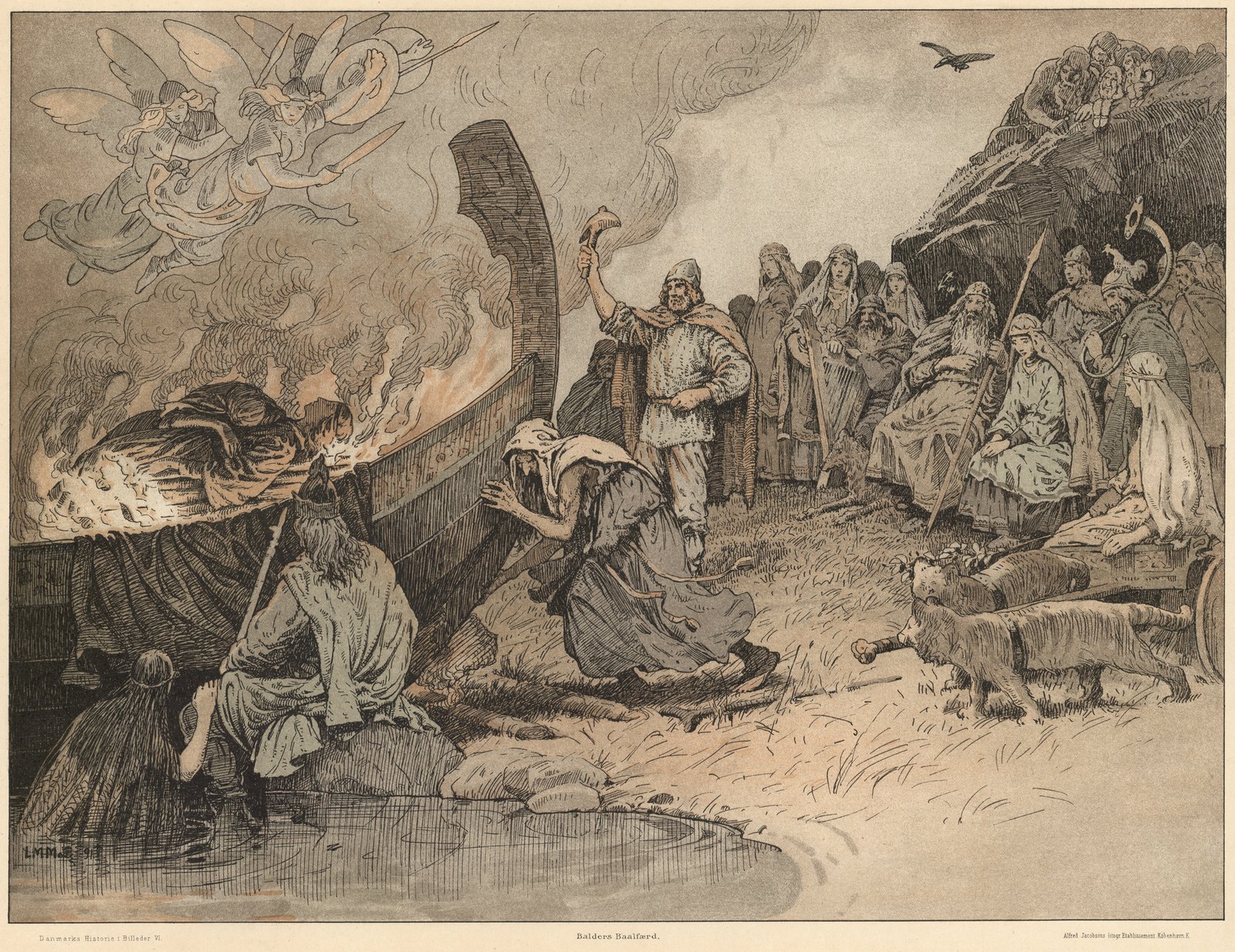
Five half-stanzas belong to the funeral procession for Odin's son. Four of them describe arrivals, a procession of the kind that suits a long stretch of wall. Freyr rides first on the boar with golden bristles and leads the hosts. Heimdall comes on horseback. Odin rides to the “very wide” pyre of his son, and again the poet speaks up: words of praise glide over his lips.
Kostigr ríðr at kesti, / kynfróðs, þeim er goð hlóðu, / Hrafnfreistaðar, hesti / Heimdallr, at mög fallinn.
Úlfr Uggason, Húsdrápa, quoted in Skáldskaparmál (kennings for Odin); Old Norse text after Guðni Jónsson, own translation
“The excellent Heimdall rides his horse to the pyre which the gods piled up for the fallen son of the wise Tester of Ravens.”
The “Tester of Ravens” is Odin; his fallen son is Baldr. Another half-stanza names Odin's following: “There, I think, valkyries and ravens follow the wise victory-tree.” How the remaining words of these lines fit together is considered difficult; they concern a drink and a holy sacrifice. The refrain comes next. The verb hykk, “I think, I believe”, stands out. It is how someone speaks who looks at a picture and interprets what he sees. The valkyries and Odin's ravens have articles of their own.
The fifth half-stanza concerns the ship. The very mighty “Hildr of the mountains” – Hildr is a valkyrie name, and a Hildr of the mountains is a giantess – makes the “sea-Sleipnir” lumber forward, that is, sets the ship moving. Odin's warriors, described by way of the “helmet-fires”, swords, fell her mount. Snorri tells the same scene with names in Gylfaginning: there the giantess is called Hyrrokkin and the ship Hringhorni. Neither name occurs in Úlfr's verses. The whole story is treated in the article on Baldr's death.
Set Snorri's prose beside the verses and verbal agreements appear. In the fishing story of Gylfaginning 48 the serpent “stared” up from below “and blew poison” (starði … ok blés eitrinu); Úlfr has starði … ok blés eitri. Snorri goes on to say that some people claim Thor struck off the serpent's head “by the waves” (við hrönnunum); Úlfr has við hrönnum. And in Snorri Thor plants his fist “by the ear” of the giant (við eyra), exactly as in the verse.
At this point Snorri keeps his distance. He has his narrator say that the truth is probably that the Midgard Serpent still lives and lies in the encircling sea. The “people” who claim otherwise are very likely poets such as Úlfr. Here one can watch Snorri handle a source that does not fit his overall picture: he reports it and disagrees.
The funeral in Gylfaginning 49 is similar. Odin arrives with Frigg, the valkyries and his ravens; Heimdall rides; the berserks can hold the giantess's mount only by throwing it to the ground. That matches the half-stanzas. One difference remains. In Snorri, Freyr drives a chariot drawn by the boar. In Úlfr he rides the boar. More on this in the article on Gullinbursti. After the Freyr quotation Snorri adds that the boar is also called Slíðrugtanni.
The suspicion that Snorri drew much of his prose on the fishing trip and the funeral from Húsdrápa is an obvious one, and it has been argued, for example by William P. Reaves on a private website. It cannot be proved, because most of the poem is missing. Only this much is certain: Snorri had “long passages” in front of him, and we have splinters.
This site and many reference works speak of carvings. Translations of the saga passage do not agree. The English Wikipedia article on Húsdrápa refers to carved panels but renders the older translation by Muriel Press (1899) as legends “painted” round the hall, and the article on Úlfr speaks of paintings on walls and ceiling. Despite several attempts I could not consult the Old Norse wording in a text edition, so I leave the question open.
Either is conceivable, and so is both at once: shallow relief finished in colour. Which technique was used at Hjarðarholt cannot be read from the surviving verses. They name no tool, no colour and no timber. I know of no remains of the hall or its pictures. For an impression of what Norse carvers could do, see the article on Viking Age woodcarving.
Húsdrápa is regularly compared with two older poems that also describe mythological pictures: Ragnarsdrápa by Bragi Boddason and Haustlöng by Þjóðólfr of Hvinir. Both deal with pictures on a shield given to the poet. Scholars call the genre the picture poem or, borrowing a term from ancient rhetoric, ekphrasis: poetry that puts a work of art into words.
Úlfr's poem differs in its object. It concerns a room in which many people sat and could see the pictures at the same time, not a portable gift. The wedding guests could compare the verses with what was depicted. That may explain why the poet narrates so little and names so much: who rides, on what, to where. Everyone knew the story.
The metre is dróttkvætt, the “court metre” of the skalds, with short lines, alliteration and internal rhyme. The Heimdall stanza above lets you hear it: Kostigr and kesti alliterate and chime, as do hesti and Heimdallr. How the circumlocutions are built is explained in our article on kennings.
The value of Húsdrápa as a source lies in its age and its kind. Snorri wrote a good two centuries after the conversion of Iceland. Úlfr composed while the stories of the gods were still living tradition, and for listeners who knew them. Where his verses attest a scene that Snorri later tells in prose, Snorri did not invent that scene.
There are several limits. That the poem describes pictures is stated by the saga, which is more than two hundred years younger than the feast. In the verses themselves the supporting evidence is the refrain with its “within”, the tentative “I think”, and the sequence of figures without narrated connection. These are good indications, not proof. Nor do we know which other scenes were on the walls. Three can be made out because Snorri happened to need examples from them.
The pictures therefore cannot be reconstructed from the verses. Whether Heimdall and Loki were shown as seals or as men, whether the serpent ran along the edge of a wall, how large the figures were: the stanzas are silent. Comparison is possible only with surviving works that carry narrative content, such as the Gotland picture stones or the Överhogdal tapestries, and there too the reading of individual scenes is often disputed.
What does “Húsdrápa” mean? “House-poem” or “praise poem on the house”. Hús is the house, drápa the skaldic praise poem with a refrain. The house is the new hall of Óláfr the Peacock at Hjarðarholt.
How much of Húsdrápa survives? Eleven or twelve stanzas and half-stanzas, depending on the count, all of them quotations in Snorri's Skáldskaparmál. Only the Heimdall and Loki stanza has eight lines on a single subject. Nobody knows how long the poem was.
Which myths does it contain? Three can be recognised: the contest between Heimdall and Loki at Singasteinn, Thor's fishing for the Midgard Serpent, and the arrival of the gods at Baldr's pyre, together with the giantess who moves the ship.
Is the Brísingamen in the poem? Not in the surviving stanza. There the object is called “sea-kidney” (hafnýra). That Freyja's necklace was at stake is Snorri's statement. Whether he is right is disputed.
Where can I read the stanzas in the original? The source archive for Skáldskaparmál gives them in Old Norse at the points where Snorri quotes them, each with a working translation marked as such. A scholarly edition is provided by the Skaldic Project.
Haustlǫng: the shield poem · The death of Baldr · Hyrrokkin – the wolf-riding giantess · Brisingamen – Freyja's Necklace in Edda, Skaldic Verse and Viking Graves · Hymiskviða: Thor fishes for the serpent.
A god tears the head off a black ox, rows further out than the boat's owner likes, and moments later has the creature …
Read more →A goddess wakes a giantess in the middle of the night to squeeze a family tree out of her. Her mount is a boar with …
Read more →A ship that no god can budge, a giantess on a wolf bridled with vipers, sparks from the rollers and a trembling earth …
Read more →Idun (Old Norse Iðunn) is the Norse goddess who keeps the gods young: according to Snorri Sturluson she guards apples …
Read more →