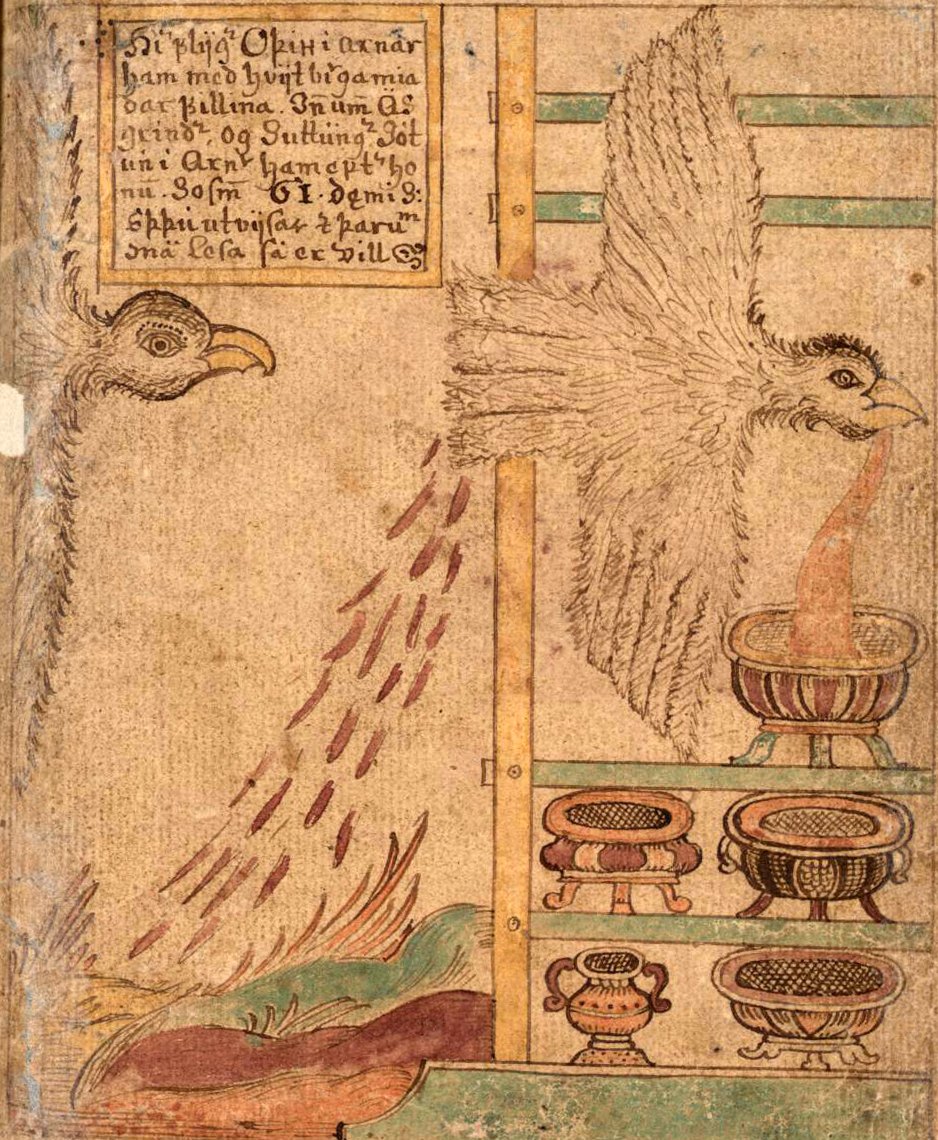
A man skilled in magic, from the island of Hlésey, visits the gods, is given the seat next to Bragi and asks questions all evening. That is how the longest part of Snorri's Edda opens. What starts as table talk turns into a reference book: how do you paraphrase Odin, the sea, gold, a king? Between the lists stand some of the best-known Norse tales – and hundreds of verses by earlier poets, many of which survive nowhere else.
The title means “the language of poetry”. The work is the middle and largest part of Snorri's Edda, the handbook attributed to the Icelander Snorri Sturluson. Before it comes Gylfaginning with its connected account of the gods; after it Háttatal, a model poem on verse forms. Skáldskaparmál supplies the vocabulary.
The first chapter sets a scene. A man named Ægir, “or Hlér”, lives on the island of Hlésey and is very skilled in magic. He travels to Asgard, where the Æsir receive him well, though with a good many illusions. In the evening Odin has swords carried into the hall, so bright that no other light is needed. Twelve Æsir take the high seats as judges: Thor, Njörðr, Freyr, Týr, Heimdallr, Bragi, Víðarr, Váli, Ullr, Hœnir, Forseti and Loki. Odin himself and Baldr are missing from this list. Next to Ægir sits Bragi, and the two fall into conversation.
The set-up recalls Gylfaginning, where a stranger also questions the gods. But Ægir is no king in disguise, and the conversation does not last. According to Anthony Faulkes, editor of the standard edition of 1998, the speakers are rarely named after the opening chapters; in the section on heiti the dialogue is a mere formality and is finally abandoned, with no closing scene of the kind Gylfaginning has.
Before any teaching begins, Bragi tells stories. The first concerns three Æsir on a journey – Odin, Loki and Hœnir – an ox that will not cook in the earth oven, and an eagle who turns out to be the giant Þjazi. Loki strikes at him with a pole, sticks fast to it and buys his freedom by promising to deliver Iðunn and her apples. The Æsir turn grey and old, Loki has to fetch her back in falcon shape, and Þjazi scorches his feathers in a fire lit at the wall of Asgard.
Then comes the compensation for Þjazi's daughter Skaði. She may choose a husband but sees only the feet, and picks Njörðr instead of Baldr. Bragi goes on to Þjazi's father Ölvaldi, whose sons shared their inheritance by mouthfuls of gold. That, he says, is why gold is called the “speech” or “word” of these giants, and so it is hidden “in runes or in poetry”. Ægir finds that “well hidden”.
The second long tale answers his question about where poetry comes from. Æsir and Vanir seal their peace by spitting into a vessel, and from the spittle the wise Kvasir is made. The dwarfs Fjalarr and Galarr kill him and mix his blood with honey into a mead that turns whoever drinks it into a poet or a scholar. By way of the giant Suttungr the drink ends up with his daughter Gunnlöð. Odin, calling himself Bölverkr, creeps through the rock as a serpent, sleeps with her for three nights, empties the vessels Óðrerir, Boðn and Són and escapes as an eagle. What he spits out in Asgard belongs to the Æsir and to those who can compose. What escapes him backwards during the flight is called “the poetasters' share” (skáldfífla hlutr).
After the mead, Ægir asks how many kinds of poetry there are. Bragi answers: two, mál ok hættir, language and verse forms. Language has three modes. You call a thing by its name; you use a substitute name (fornafn); or you form a kenning, a paraphrase of more than one element. Bragi's examples are names of Odin such as “Victory-Týr” or “Týr of the hanged”: the god-name Týr stands for any god, and only the addition shows who is meant. How kennings are built and solved is covered in our article on kennings; the subject here is the book that collects them.
Immediately afterwards the text leaves the gods' hall. Nobody asks, nobody answers; an author addresses his readers. In this site's source archive the passage is chapter 8.
“Now it is to be said to young skalds who are desirous of acquiring the diction of poetry, or of increasing their store of words with old names, or, on the other hand, are eager to understand what is obscurely sung, that they must master this book for their instruction and pastime. These sagas are not to be so forgotten or disproved as to take away from poetry old periphrases which great skalds have been pleased with. But christian men should not believe in heathen gods, nor in the truth of these sagas, otherwise than is explained in the beginning of this book …”Skáldskaparmál, ch. 8 in this site's source archive (“Orðum beint til ungra skálda”); translation by Rasmus B. Anderson, The Younger Edda (1880)
These sentences state a purpose (learning, and understanding old poems), a defence (the myths must stay, because the poetic language does not work without them) and a limit: none of it is to be believed. The reference to “the beginning of this book” points to the Prologue of the Edda, which explains the Æsir as men from Asia. How strongly that Christian framing colours the content is discussed in How Christian is the Edda?
In the Old Norse text of the archive the chapter ends here. Anderson's translation runs on: it equates Priam, Hector and Achilles with figures of Norse myth and reads Ragnarök as the Trojan War. Editors call this addition the Eptirmáli, “afterword”; Faulkes prints it as part of the text. Whether it comes from Snorri himself I leave open.
The real work starts in chapter 9. “Now the examples shall be heard,” it says, “of how the chief poets have composed according to these names and kennings.” The first quotation is by Arnórr jarlaskáld and shows that Odin is called “All-father”. So it continues: a question (“How shall Thor be referred to?”), a list of paraphrases, then half-stanzas as evidence, each with the poet's name.
The order is deliberate. Odin is followed by poetry itself, then Thor and twelve further gods down to Loki. Later come four goddesses, then sky, earth, sea, sun, wind, fire, winter and summer, and finally man and woman. For the sky the list gives “Ymir's skull” and “toil” or “burden of the dwarfs”. The evidence is a half-stanza by Arnórr in which the sun turns black, the earth sinks into the dark sea and “Austri's toil bursts”. Austri is one of the four dwarfs who hold up the sky.
Some entries are brief but valuable. Under Baldr we read only that Úlfr Uggason composed at length about him in Húsdrápa. Under Heimdallr we learn that he contended with Loki for the Brísingamen, that both were in the shape of seals, and that a sword is called “Heimdallr's head”, about which there was a poem named Heimdallargaldr. That poem is lost; only Gylfaginning quotes two lines from it.
In the middle of the catalogue of gods the text inserts two tales, to explain where the kennings just listed come from. The first is Thor's duel with Hrungnir. Odin provokes the giant into a race, and Hrungnir ends up drunk in Asgard, boasting that he will carry Valhalla off to Jötunheimar. Hrungnir has a heart of stone with three points and a whetstone for a weapon; beside him stands a giant of clay, Mökkurkálfi, who has been given a mare's heart. Hammer and whetstone meet in mid-air, and a splinter lodges in Thor's head.
The seeress Gróa chants spells to loosen the stone. Thor wants to please her and tells her that he carried her husband Aurvandill out of the north in a basket and threw a frozen toe into the sky as a star. In her joy Gróa forgets her spells. A closing note says that Þjóðólfr of Hvinir composed about this story in Haustlöng.
The second tale takes Thor to Geirröðr, this time without hammer, belt of strength and iron gloves, because Loki has lured him into a trap. The giantess Gríðr lends him replacements and her staff. In the swollen river Vimur Thor speaks a stanza, saves himself by grasping a rowan bush and later breaks the backs of the giant's daughters. As its source the text names Þórsdrápa by Eilífr Goðrúnarson.
No heading gets more room than gold. The list in chapter 40 includes “Ægir's fire”, “needles of Glasir”, “Sif's hair”, “Fulla's headband”, “Freyja's tears”, “otter-payment”, “seed of Fýrisvellir” and “Hölgi's mound-roof”. Almost every one of these kennings then receives its story.
“Ægir's fire” is explained by a return visit. Three months after the feast in Asgard, Ægir invites the Æsir to his own hall; instead of lamps he has glowing gold carried onto the floor. At this banquet Loki quarrels with all the gods and kills the servant Fimafengr – the matter of Lokasenna, traced in our article on Ægir's feast. A technical term appears here too: nýgervingar, “new formations”, by which younger poets extended the old patterns from sea to lake, from lake to river, from river to brook.
“Sif's hair” leads to the dwarfs' wager. Loki cuts off the hair of Sif and has to provide a replacement of gold. The sons of Ívaldi make the hair, the ship Skíðblaðnir and the spear Gungnir. Loki then stakes his head that the brother of the dwarf Brokkr cannot make anything as good. Despite a biting fly, a boar with golden bristles, the ring Draupnir and the hammer, its handle rather short, come out of the forge. The gods judge the hammer the best piece. Loki saves his head by objecting that the neck was not part of the bet, and has his lips sewn together (see Sindri and Brokkr).
The “otter-payment” is the beginning of the Nibelung legend. Loki kills an otter who was a son of the farmer Hreiðmarr; the Æsir must fill the skin with gold and cover it. Loki extorts the gold from the dwarf Andvari, together with a ring on which the dwarf lays a curse. One whisker remains uncovered, so Odin gives up the ring as well. From there the text continues in summary, from Fáfnir and Sigurðr to the death of Hamðir and Sörli. The full version of the same matter is Völsunga saga.
“Fróði's flour” goes back to the mill Grotti. King Fróði, in whose time the text places the peace of Augustus and the birth of Christ, has the bondwomen Fenja and Menja grind gold, peace and prosperity and allows them no rest. They grind out an army against him. The sea-king Mýsingr kills Fróði and has them grind salt until his ship sinks – since then the sea has been salt. (See Grottasöngr.) “Kraki's seed”, lastly, recalls the Danish king Hrólfr kraki, who scatters gold on the plain of Fýrisvellir while fleeing the Swedish king Aðils, so that the pursuers dismount to gather it; the later Hrólfs saga kraka tells this at greater length.
Among the kennings for battle and weapons stands one last tale. Battle is called “the Hjaðnings' weather”, weapons “the Hjaðnings' fire”. King Heðinn has carried off Hildr, daughter of King Högni. The father pursues him to Orkney, to the island of Háey. Hildr brings an offer of settlement and adds that Heðinn is ready to fight. Högni has already drawn his sword Dáinsleif, which must kill a man every time it is bared. They fight all day; in the night Hildr wakes the fallen by magic, and in the morning everything begins again. So the Hjaðnings are to go on until Ragnarök. The text names Bragi's Ragnarsdrápa as its source.
That this handbook was written for Christian poets is shown plainly by chapter 65. “How shall Christ be referred to?” – as creator of heaven and earth, king of the angels and of the sun, ruler of Jerusalem, the Jordan and Greece. Old poets, the text adds, referred to him by Urðr's well and by Rome. The evidence is a half-stanza by Eilífr Goðrúnarson, the poet of Þórsdrápa, which says that Christ sits “in the south at Urðr's well”.
The following chapter on kings adds that “king of men” may be said of Christ but also of any earthly ruler; which one is meant has to be worked out from the context.
The last third deals with ókend heiti, “unparaphrased terms”: single poetic words. Poetry is called bragr, hróðr, óðr, mærð, lof. The evidence is a small scene. Bragi the Old is driving through a forest late in the evening when a troll-woman addresses him in verse and lists what she is called. He answers in kind: “Skald they call me”, Odin's thought-smith, bearer of Yggr's ale, skilled smith of song.
Words follow for gods, sky, earth, animals, sea, fire, times, kings, men, women and parts of the body. In between stand memory verses from older name lists, which the text calls Þorgrímsþula and Kálfsvísa, and stanzas from “Alsvinnsmál”, which are also found in the eddic poem Alvíssmál. The words for kings are explained by a legend: Hálfdan the Old had eighteen sons, and their names – Þengill, Ræsir, Gramr, Gylfi, Hilmir, Jöfurr, Tyggi, Skyli, Harri – are said to have become words for “prince”.
The close is formed by composing in ambiguities, ofljóst. According to the text the word lið can mean joint, ship, troop, help and ale. Such words can be placed so that the listener first assumes the wrong meaning. With that remark the text in the archive stops, without Ægir and Bragi appearing again.
Faulkes, in the summary of his introduction available to me, counts more than seventy earlier poets. His edition numbers the verse quotations from 1 to 517; numbers 412 to 517 belong to appended name lists. The text of our archive, which leaves out the long poem extracts, counts up to 345. Most quotations are half-stanzas of four lines.
In the archive text certain names recur again and again: Bragi the Old, Þjóðólfr of Hvinir, Úlfr Uggason, Eyvindr skáldaspillir, Einarr skálaglamm, Arnórr jarlaskáld, Hallfreðr, Óttarr svarti, Kormákr, Refr and Einarr Skúlason. Egill Skalla-Grímsson and Sighvatr appear as well, and twice the poet is a king: Haraldr Sigurðarson, once with a half-stanza about a voyage off Sicily. A certain Snæbjörn calls the sea “Amlóði's mill” in one verse, as the text itself explains.
Many of these poems exist only as splinters in this book. Húsdrápa, Haustlöng and Ragnarsdrápa are known from stanzas that a handbook quotes as word evidence and that editors later reassembled into poems.
There is no original. The four main manuscripts of Snorri's Edda carry the sigla R, T, W and U: Codex Regius GKS 2367 4to, from the early fourteenth century (the datings range from “c. 1300” to “1300–1325”); Codex Trajectinus (Utrecht, Ms. 1374), a paper copy of about 1595 to 1600 from a lost older exemplar; Codex Wormianus AM 242 fol., of about 1350; and Codex Upsaliensis DG 11, of about 1300 to 1325. There are also fragments, which Faulkes calls A, B and C (AM 748 I b 4to, AM 757 a 4to, AM 748 II 4to). This is not the Codex Regius of the eddic poems.
In Skáldskaparmál in particular the witnesses diverge. According to Faulkes, R is taken to represent Snorri's work most accurately; T and C are close to it. W offers a heavily revised second part, A and B contain revised versions of various parts. U, by the same account, differs throughout, omits passages and places the two Thor tales directly after Bragi's stories. The long poem extracts are missing from some of the manuscripts. Grottasöngr, for instance, is given in full only by R and T according to Faulkes, and it is uncertain whether Snorri intended such extracts to be included.
Even the title is not fixed. According to Faulkes, “Skáldskaparmál” appears as a heading in no early manuscript; the word occurs in the opening rubric of U, which announces “Skáldskapar mál and terms for many things”. The chapter numbering is just as recent: our archive counts 89 chapters, Faulkes's edition 75.
Older editions separate Bragi's tales as “Bragaræður”, “Bragi's speeches”. Faulkes traces this to the Arnamagnæan edition (1848–1887), which attached these sections to Gylfaginning as chapters 55 to 58. Simrock and Anderson, whose translations stand in the archive, also set Bragi's tales apart; Anderson calls them “Brage's Talk”, and his extracts from “Skaldskaparmal” begin only with Hrungnir. Faulkes, by contrast, counts the four sections as part of Skáldskaparmál.
No manuscript transmits a date. Faulkes assumes that Háttatal was written soon after Snorri's first visit to Norway (1218–1220), and that the lack of organisation in Skáldskaparmál suggests it was unfinished at Snorri's death in 1241. The abrupt ending fits that view without proving it.
For the narratives Faulkes names various sources and parallels: a largely lost Skjöldunga saga for Hrólfr kraki and perhaps for the Hjaðnings; the eddic poems Hymiskviða and Lokasenna for Ægir's feast. The story of the mead also appears, in a different form, in Hávamál (stanzas 104–110). For Þjazi, Hrungnir and Geirröðr the text itself names the skaldic poems. Where those poems survive, the prose can be measured against them. The verses are older than the book; the prose between them is the work of a Christian scholar of the thirteenth century who wanted to explain old poetry.
What does Skáldskaparmál mean? “The language of poetry”. Skáldskapr is the art of the skalds, mál means speech or language.
Who speaks in Skáldskaparmál? At the start Ægir, who asks, and Bragi, who answers. Later the names disappear.
Which myths are found only here? Within Snorri's Edda, the theft of Iðunn, the origin of the mead of poetry, Thor's fights with Hrungnir and Geirröðr and the wager over the dwarfs' treasures stand only in this part. Some of the material is also known from skaldic and eddic poems.
What is the difference between a kenning and a heiti? A kenning paraphrases with at least two elements, such as “Ægir's fire” for gold. A heiti is a single poetic word, such as bragr for poetry.
Is there a public-domain English translation? Rasmus B. Anderson's Younger Edda of 1880 renders the tales but not the catalogues with their skaldic verses. Our source archive therefore adds a clearly marked working translation in many places.
Kennings: the riddle language of the skalds · Gylfaginning · The Edda: two books, one name · Snorri Sturluson · Bragi · Húsdrápa · Haustlöng · Grottasöngr · Codex Regius · Kvasir and the mead of poetry
The Edda · Kennings · Gylfaginning: the Tricking of Gylfi · Haustlǫng: the shield poem · Thjazi & the theft of Idun.
Almost everything we think we know about Odin, Thor and the end of the world runs through a single figure: an Icelandic …
Read more →A son wakes his dead mother, receives nine protective charms from her, and then stands before a hall ringed with fire …
Read more →Thjálfi and Röskva (Old Norse Þjálfi and Rǫskva) are a brother and sister from a poor farmhouse who become servants of …
Read more →A giant in eagle shape, a god blackmailed into treachery, a goddess turned into a nut, and immortals going grey for the …
Read more →