A man called Þorleifr gives a poet a shield with gods and giants on it. The poet thanks him the way skalds do, in stanzas that retell the pictures. Twenty of them survive because Snorri Sturluson copied them, a good three hundred years later, into his handbook of poetic language as model examples. They count as the oldest witness to the abduction of Iðunn and to Thor's duel with the giant Hrungnir. This article sets out what the stanzas say, how their circumlocutions are read, and what the usual date and attribution actually rest on.
Haustlǫng opens with a question. How, the poet asks, is he to repay the gift? The gift is a shield, and the giver is named in the very first stanza: Þorleifr. Then the speaker says what he sees. In Rasmus B. Anderson's English version of 1880: “On the splendidly made shield I see the unsafe journey of three gods and Thjasse.”
That sentence describes how the whole poem is built. The skald – the word for the court poets of the North, who composed in strict metres for rulers and their retinues – does not tell myths for their own sake. He describes pictures on an object and turns the description into a poem of thanks. Scholars call this a picture poem or, where the object is a shield, a shield poem. What makes Haustlǫng valuable is its age. If the usual dating holds, this is a voice from around 900, from pagan Norway, long before the Icelandic manuscripts.
Two myths survive. Stanzas 1–13 tell how the giant Þjazi, in the shape of an eagle, forces Loki to hand over the goddess Iðunn. Stanzas 14–20 describe Thor's drive to his duel with Hrungnir. This one is about the poem: its maker, its form, its language, and how far it can be trusted as a source.
No manuscript preserves Haustlǫng as a poem in its own right. Everything we have is quotation in Skáldskaparmál (“The Language of Poetry”), the second main part of the Edda that Snorri Sturluson wrote around 1220 to 1225. Snorri cites the stanzas in two blocks, and in reverse order: first the Hrungnir section, then, under the circumlocutions for Iðunn, the Þjazi section. Richard North, who edited the poem in 1997, gives the passages as verses 65–71 and 92–104 of Skáldskaparmál. The numbering 1–13 and 14–20 used today follows the opening of the poem instead: the stanza with the introductory question was presumably the first.
Snorri names poet and title in both places. After the Hrungnir story he writes that Þjóðólfr hvinverski composed “after this tale” “in Haustlǫng”; the Iðunn entry has almost the same sentence. Title and attribution therefore come from Snorri's prose, not from the stanzas. He also quotes two half-stanzas a second time on their own, as evidence for particular words: one in the section on expressions for the sky, one in the list of terms for the gods. All these passages can be read in our source archive for Skáldskaparmál (chapters 24–25, 30, 31 and 68 in Guðni Jónsson's edition).
At the two main passages the Old Norse text in our archive gives only Snorri's reference to the poem, not the long runs of stanzas; Anderson's English translation includes them. Which manuscripts of Snorri's Edda carry the two blocks I was not able to check against a critical edition for this article, so I leave that open.
Þjóðólfr ór Hvini, also Þjóðólfr inn hvinverski, was by Icelandic tradition a Norwegian skald of the late ninth and early tenth century. His byname is referred to Hvinir, identified with Kvinesdal in southern Norway. Heimskringla, Snorri's history of the Norwegian kings, links him with Harald Fairhair calls him a great friend of the king and makes him foster-father to Harald's son Guðrøðr ljómi (Haralds saga hárfagra, ch. 26). These are thirteenth-century statements about a man said to have lived three hundred years earlier. No contemporary record of him exists.
Two major works are ascribed to him. One is Ynglingatal, an enumeration of the Ynglingar, the kings of Uppsala, said to have been composed for a chieftain from Vestfold named Rǫgnvaldr heiðumhæri and used by Snorri as the backbone of his Ynglinga saga. The other is Haustlǫng. That medieval attributions do not always hold is shown by a third poem: according to the English Wikipedia, Snorri also ascribes Hrafnsmál to him, which scholars rather give to Þorbjǫrn hornklofi, another poet of Harald's circle. I have come across no such objection to Haustlǫng; North, too, names Þjóðólfr as the poet without reservation.
Who was the man who gave the shield away? The poem offers only the name. North considers him “probably” Þorleifr inn spaki (“the Wise”) Hǫrðu-Kárason, known to tradition as an adviser of Harald Fairhair and a powerful man in Hordaland. From that identification, and from Þjóðólfr's association with Harald, comes the usual date of about 900.
It is worth seeing what this date hangs on. No charter, no runestone and no find fixes Haustlǫng in time. The chain runs like this: Snorri ascribes the stanzas to Þjóðólfr; the kings' sagas place Þjóðólfr at Harald's court; Þorleifr can be matched with a contemporary of Harald. Each link is plausible, none is independently attested. Language and style, which suit early skaldic verse, are added to that.
Haustlǫng means literally “the autumn-long one”. The title is not a word from the stanzas; it stands in Snorri. North takes it as short for haustlǫng drápa, an “autumn-long praise poem” – a drápa being a longer, formal poem with a refrain. What “autumn-long” is meant to convey nobody knows for certain. The common explanation is that the poet worked on it for an autumn; North thinks of about a month in early autumn, the German Wikipedia of autumn and winter. These are readings of a name, not reports about how the poem came to be.
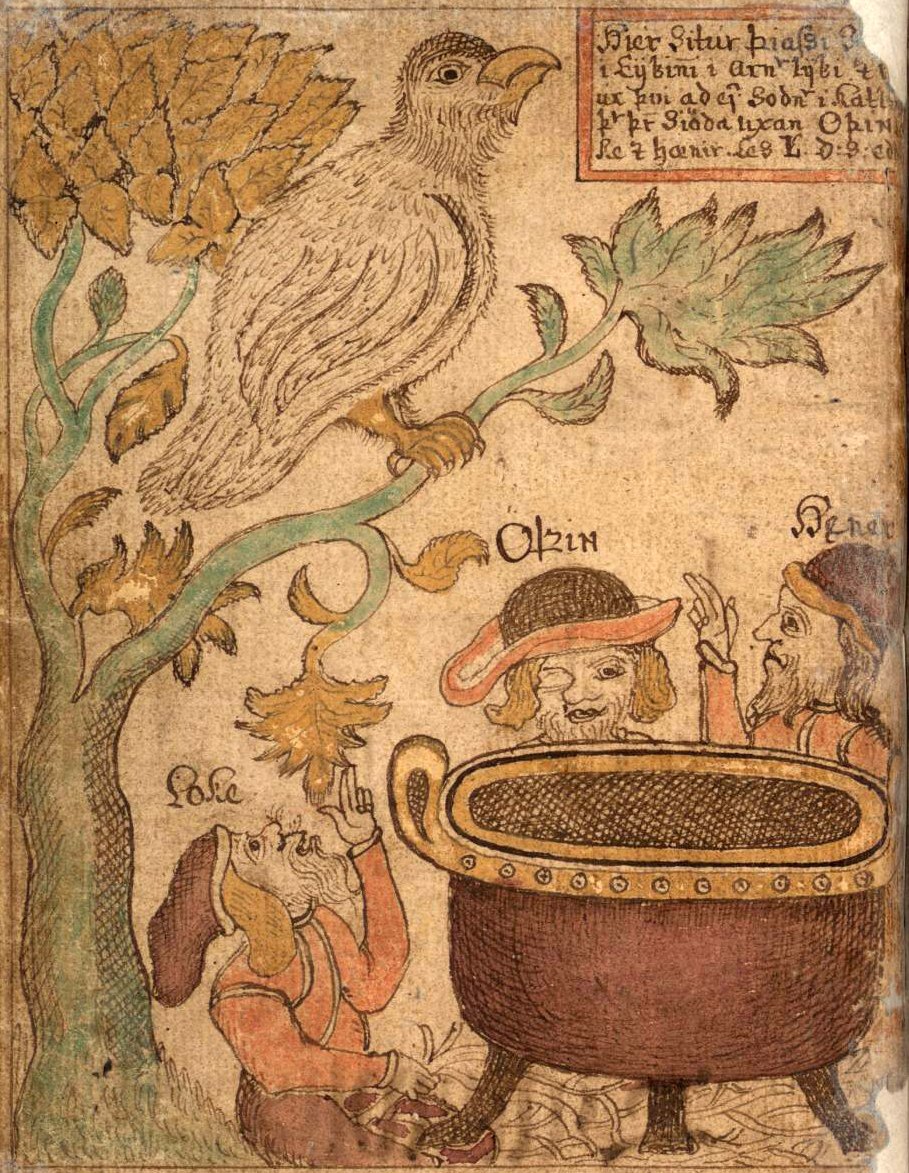
Stanzas 2 to 13 follow the action in short steps. Þjazi flies in his old eagle shape to where the gods are preparing their food. The ox will not be divided. One of the half-stanzas Snorri quotes separately captures exactly this moment: Tormiðlaðr var tívum tálhreinn meðal beina – hard for the gods to share out was the beast between the bones – and the “helmeted teacher of the gods” asks what is to blame. The teacher in the helmet is Odin. The word for the ox is disputed. The text in our archive reads tálhreinn; North emends to taðlhreinn and translates “dung-reindeer”. A single line is enough to show that the wording of these stanzas is something editors establish.
The eagle answers from the tree and demands his share. In Anderson's rendering it falls to Hœnir to blow the fire; North refers the kenning (“raven-god's friend”) to Loki instead. Odin tells Loki to divide the ox, and the giant eats greedily. Loki strikes at him with a pole – and sticks fast. The eagle carries him off until Loki has to sue for peace. The price: he is to fetch the woman who knows the ellilyf ása, the “old-age medicine of the Æsir”. Loki brings her to the courts of the giants. The giants are pleased; in Anderson's version Iðunn comes to them “from the south”. The gods, however, turn grey and old. At this point the poet calls them the kin of Ingvi-Freyr.
Then they find Loki, bind him and threaten him. He sets off in a falcon's skin, the giant after him as an eagle. Stanza 13 ends at the fire: the gods shave shafts, the shafts burn, the giant is scorched. The poem says nothing of a nut into which Loki turns the goddess, and the word apple does not occur in the surviving stanzas. What happens after the fire – Þjazi's death, the compensation for his daughter Skaði – is not there either. Skaði is present all the same, because Þjazi is once described through her: North translates the kenning as “the ski-goddess's foster-father”.
The second sequence starts afresh. Its seven stanzas show almost a single event: Thor's approach and the blow. The half-stanza Snorri cites among the sky expressions sets the tone: Ók at ísarnleiki Jarðar sunr, en dunði – móðr svall Meila blóða – mána vegr und hánum. Literally: to the iron-game drove the son of Earth, and it thundered – wrath swelled in Meili's brother – the moon's way beneath him. The iron-game is battle, the son of Jǫrð (“Earth”) and brother of Meili is Thor, the moon's way is the sky.
The heavens stand in flames, hail beats the ground, and the earth – “Svǫlnir's widow”, that is, Odin's lover and Thor's mother – threatens to split as the goats pull the chariot. Mountains shake, rocks break. Hrungnir sees his killer coming. Then the shield flies under the giant's soles. Why? The poem says only that the powers (bǫnd) willed it so, and the dísir, female spirits of fate or battle. Anderson wrote “valkyries” in 1880; North has “war-spirits”.
The hammer strikes and the giant falls on his shield. At the same moment a piece of his whetstone drives into Thor's head and stays there. The last stanza speaks of a woman who is to loosen the stone with chanted spells. North sees in her kenning a possible allusion to Gróa; Anderson simply writes “Orvandel's wife”. Whether the cure succeeds in the poem is read differently by the two translations. I leave that open, because I have not seen the full Old Norse wording of this stanza. In Snorri it fails. Only there does Thor also tell Gróa of his way across the Élivágar; they do not occur in the surviving stanzas.
Both sequences close with the same two lines. A refrain of this kind, Old Norse stef, belongs to the form of the drápa. Here is the stanza that ends the Iðunn section:
Hófu skjótt en skófu
skǫpt ginnregin brinna,
en sonr biðils sviðnar
(sveipr varð í fǫr) Greipar.
Þats of fátt á fjalla
Finns ilja brú minni:
baugs þák bifum fáða
bifkleif at Þorleifi.
The holy gods soon built a fire –
They shaved off kindlings –
And the giant was scorched.
This is said in memory
Of the dwarf's heel-bridge.
A shield adorned with splendid lines
From Thorleif I received.Þjóðólfr of Hvinir, Haustlǫng, stanza 13; Old Norse text after Richard North's edition; English by Rasmus B. Anderson, The Younger Edda, 1880
Anderson's Victorian version is free. Closer to the words, the stanza says: quickly the shafts began to burn, the high powers had shaved them, and the son of Greip's suitor is scorched – his journey took a sudden turn. That is painted on my bridge of the mountain-Finn's foot-soles; I received the picture-painted cliff of the shield-rim from Þorleifr. The “son of Greip's suitor” is the giant: Greip is a giantess's name, her suitor a giant, his son Þjazi. The “mountain-Finn” is a giant too (Anderson made him a dwarf), and the “bridge of his foot-soles” is the shield, because in the second myth Hrungnir stands on his shield. The poet thus names the shield he is describing with an image taken from the story shown on that shield. The last two lines return in stanza 20.
The metre can be read off these eight lines as well. Haustlǫng is in dróttkvætt, the “court metre”: short lines linked in pairs by alliteration (skjótt – skófu – skǫpt), with internal rhymes inside the line (bif-kleif – Þor-leif-i). For bifum fáða I follow North, who thinks of stories or pictures with which the shield is “coloured”.
A kenning is a circumlocution of two or more parts that names a thing or person through a relationship; how the technique works as a whole is explained in our article on kennings. Haustlǫng is a textbook case, because it almost never calls its main figures by name. The following examples I have seen in North's edition or in the quotations in our archive.
Thor is Jarðar sunr, son of Earth, Meila blóði, Meili's brother, Ullar mágr, Ullr's kinsman by marriage (usually taken as stepfather), Baldrs barmi, Baldr's brother, and Einriði, the lone rider. I give the kennings in their base form; in the verse they are inflected and often split (Meila blóða, Ullar … mági, Baldrs of barmi, Einriða). Without knowing these family ties a listener cannot tell who is meant.
Loki is Fárbauta mǫgr, son of Fárbauti (in the verse Fárbauta mǫg), ulfs faðir, the wolf's father, Hœnis vinr, Hœnir's friend, and farmr Sigynjar arma, the “burden of Sigyn's arms”. Once his byname Loptr appears. According to North, “son of Fárbauti” occurs elsewhere only in stanza 2 of Húsdrápa; more on Loki's parents can be found in the article on Fárbauti and Laufey. Also notable is Brísings … girðiþjófr, in North “the thief of the gods' Brísing-girdle”, which Anderson renders as “Brisingamen's thief”. Haustlǫng thus takes a story about Loki stealing that piece of jewellery as known, without telling it.
Þjazi appears as faðir Mǫrnar, father of Mǫrn, and as áttrunnr Hymis, a scion of Hymir's kin – both mean simply “giant”, Hymir standing here for the giants in general. The ox is an okbjǫrn, a “yoke-bear”. The sky is the moon's way, the earth Svǫlnir's widow. And the shield has further names besides the sole-bridge; stanza 20 has Geitis garði, in North the “fortress of King Geitir”, a sea-king.
Snorri tells both myths in prose and places the stanzas after them as evidence. His sentence “after this tale Þjóðólfr composed” turns the relationship round: for us the poem is the older source and Snorri's prose the younger interpretation.
In the Iðunn myth only Snorri has the apples, the nut into which Loki turns the goddess, and the ending with Þjazi's death inside the walls of Asgard. The poem has the old-age medicine, the falcon flight and the fire. In the Hrungnir myth the stanzas lack the prelude with Odin's horse race, the drinking bout, the clay giant Mǫkkurkálfi and Thor's companion Þjálfi. In Snorri, Hrungnir steps onto his shield because Þjálfi lies to him; in the poem the powers and the dísir will it. Citing an article by John Lindow (1996), the English Wikipedia notes that Þjóðólfr puts the weight on Thor's journey, with its noise and flames, while Snorri also develops Hrungnir's journey and the events leading up to the duel.
It does not follow that Snorri invented the missing parts. He may have known other poems or oral tales, and a shield poem need not say everything its audience knew. Only the direction is certain: what stands in Haustlǫng is attested for the time before the conversion, provided the date holds. What stands only in Snorri is attested for the thirteenth century. How Snorri handles his sources in the narrative part of the Edda is the subject of the article on Gylfaginning.
Haustlǫng does not stand alone. Older is the Ragnarsdrápa of Bragi Boddason, which likewise describes a painted shield received as a gift and likewise survives only as quotations in Snorri. According to the English Wikipedia, Lee M. Hollander argued in 1947 that Þjóðólfr modelled his poem on Bragi's and that Haustlǫng probably once had two further picture scenes. North, too, reckons with lost sequences. The refrain supports this: it closes two sequences and may have articulated a longer whole. It cannot be proved.
A third poem of the kind is the Húsdrápa of the skald Úlfr Uggason. According to Laxdœla saga, Úlfr recited it at a wedding feast when Óláfr Hǫskuldsson, called the Peacock, had finished his new hall; it described the legendary scenes on its walls. Scattered stanzas survive on Thor's fishing trip, Baldr's funeral and an obscure scene that Snorri understood as a contest between Loki and Heimdallr over the Brísingamen.
Did Þorleifr's shield exist? The poem says so, and the genre presupposes it. Archaeologically, no shield with narrative mythological pictures survives. What finds tell us about paint and construction is covered in the article on the Viking shield. That myths were told in pictures in the North is shown by other monuments, such as the Gotland picture stones. How the scenes were arranged on the shield – in fields, as a frieze or in some other way – we do not know. North notes that one word in stanza 12 (“I heard”) might imply that the pursuit was not depicted at all.
For the history of religion Haustlǫng is a piece of luck, with three reservations. The first is transmission. More than three centuries of oral tradition lie between composition and the oldest written record. The strict form of dróttkvætt makes unnoticed changes harder than in free prose, but does not prevent them. The text is corrupt in several places. In North's edition one line of the first stanza is marked as a gap, and editors intervene with emendations, as with the “dung-reindeer”.
The second is selection. We know the poem only as far as Snorri needed it. He was looking for examples of poetic expressions and for evidence of two tales. The third is interpretation. Many kennings are ambiguous, and older translations differ from newer ones, sometimes sharply. In 1880 Anderson turned the Skaði kenning into “Skade's foster-son”; North reads “the ski-goddess's foster-father”.
A great deal remains nonetheless. The outlines of both myths, the trio of Odin, Loki and Hœnir, Loki as father of the wolf and husband of Sigyn, Thor as son of Earth with goat-drawn chariot and hammer, Earth as Odin's lover – the poem takes all of this for granted. That makes it one of the most important pieces of evidence that Snorri's myths are not inventions of the thirteenth century.
What does Haustlǫng mean? Literally “the autumn-long one”. The title is usually explained by the poet having worked on the poem for an autumn. Only the name is attested, in Snorri, not its explanation.
Who composed Haustlǫng? Snorri ascribes it to Þjóðólfr of Hvinir, a Norwegian skald whom tradition places at the court of Harald Fairhair. The attribution is not disputed in the literature known to me.
How many stanzas survive? Twenty: thirteen on Þjazi, Loki and Iðunn, seven on Thor and Hrungnir. Snorri quotes two half-stanzas a second time on their own.
Where can Haustlǫng be read? In any complete edition of Skáldskaparmál that prints the stanzas. Scholarly editions with translation are by Richard North (1997) and the Skaldic Project; Anderson's old English rendering is in our source archive.
Is Iðunn named in Haustlǫng? Yes, in stanza 10, with the name spread over two lines (Ið- … -unnr). Otherwise she is described indirectly, for example as the woman who knows the old-age medicine of the Æsir or as the “playmate of the Æsir”.
Þjazi: the giant in eagle shape · Iðunn and the remedy against old age · Hrungnir: Thor's duel · Learning to read kennings · Bragi and Ragnarsdrápa · The Viking shield · Skaði · Fárbauti and Laufey · Darraðarljóð · The Edda at a glance
Thjazi & the theft of Idun · Idun & the apples of youth · Thor versus Hrungnir · Kennings · Bragi – god of poetry.
A poem that opens by advising you to look around when you enter a house, to see where the enemies are sitting. It …
Read more →A king's daughter promised to a husband she does not want picks a hero for herself. He wins her in war and dies at her …
Read more →Hermod (Old Norse Hermóðr) is the god who, after Baldr has been killed, rides Odin's eight-legged stallion Sleipnir for …
Read more →A young woman sails alone by night to an island, walks between burning grave mounds and wakes her dead father to claim …
Read more →