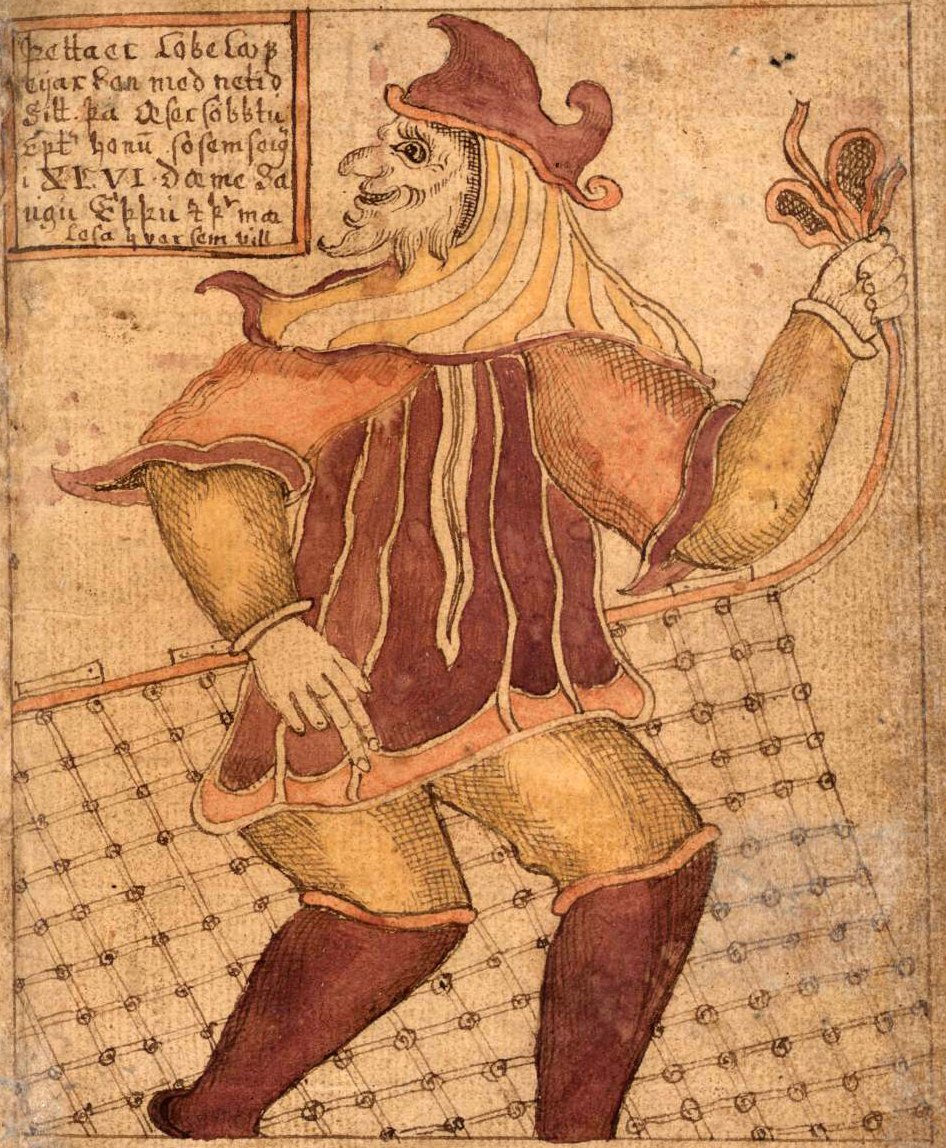
There is not a single story about Loki's parents. No poem tells how they met, no scene shows them with their son, no find depicts them. What survives is names: one sentence in Snorri Sturluson, two skaldic stanzas from the tenth century, three lines in the Poetic Edda and a late tale from the fourteenth century. This article lays out the evidence piece by piece, explains the readings of the names, including the well-known lightning-and-leaves theory, and shows where scholarship can only guess.
The fullest statement on Loki's descent stands in Gylfaginning, the narrative core of the Edda written by the Icelander Snorri Sturluson in the thirteenth century. In Guðni Jónsson's edition it is chapter 33; other editions and translations count differently, so the same passage is sometimes cited as chapter 34. The Old Norse is brief: Sá er nefndr Loki eða Loftr, sonr Fárbauta jötuns. Móðir hans heitir Laufey eða Nál. Bræðr hans eru þeir Býleistr ok Helblindi. Literally: he is called Loki or Loptr, son of the giant Fárbauti. His mother is called Laufey or Nál. His brothers are Býleistr and Helblindi.
“There is yet one who is numbered among the asas, but whom some call the backbiter of the asas. He is the originator of deceit, and the disgrace of all gods and men. His name is Loke, or Lopt. His father is the giant Farbaute, but his mother’s name is Laufey, or Nal. His brothers are Byleist and Helblinde.”Snorri Sturluson, Gylfaginning, ch. 33 (Guðni Jónsson’s numbering), trans. Rasmus B. Anderson, The Younger Edda (1880)
Three things stand out. First, only the father is given a kind: he is a jötunn, a giant. The mother is not classified at all. Second, the mother has two names joined by a plain “or”, and Snorri does not explain why. Third, the passage opens by saying that Loki is “numbered among” the Æsir, although his father is a giant. That is all. Snorri moves straight on to Loki's character, his wife Sigyn and, in the next chapter, the children he has with the giantess Angrboða.
Snorri did not invent the father's name. Two skalds, court poets whose stanzas are transmitted under their names, already use it in the tenth century. We know both stanzas only because Snorri quotes them in Skáldskaparmál, his handbook of poetic language.
The first comes from Húsdrápa by the Icelander Úlfr Uggason, composed towards the end of the tenth century. It describes the contest between Heimdall and Loki at a place called Singasteinn: frægr við firnaslægjan / Fárbauta mög vári. The famous defender of the gods contends with the “exceedingly sly son of Fárbauti”. Snorri cites the stanza as an example of how to refer to Loki in verse.
The second is in Haustlǫng by the Norwegian Þjóðólfr of Hvinir, dated to the beginning of the tenth century. In the stanza about the ox meal, where the giant Thjazi in eagle shape demands his share, the “lord of the earth” tells “Fárbauti's son” to divide the ox quickly. In Rasmus B. Anderson's public-domain English rendering this is the fifth eight-line unit from the start of the poem, that is, stanza 5. I have not seen the Old Norse wording of this stanza.
Úlfr uses the poetic word mögr, “son, offspring”, rather than everyday sonr, as the quoted wording shows. Whether Þjóðólfr uses the same word I could not check against the original. The finding matters: the father's name belongs to the oldest layer we can reach. It is attested a good two to three centuries before Snorri wrote, provided the usual dating of the poems holds.
The mythological poems of the Poetic Edda show the opposite picture. As far as I have checked the texts, the name Fárbauti does not occur there. Loki is named after his mother instead.
Þrymskviða does so twice, each time in a speech introduction. Stanza 18 in the Old Norse text used on this site reads Þá kvað þat Loki / Laufeyjar sonr, “Then spoke Loki, Laufey's son”, and he cuts Thor short when Thor refuses to put on the bridal dress. Stanza 20 repeats the formula before Loki offers to come along as the maid. In Lokasenna Loki uses the name of himself. In stanza 52 he tells the giant's daughter Skaði that she spoke more gently “to Laufey's son” when she invited him to her bed.
Snorri adopts the form as a fixed byname. In Gylfaginning “Loki Laufeyjarson” appears in the story of the wall of Asgard (ch. 42), when the gods look for someone to blame, and twice in the account of Baldr's death (ch. 49): once when Loki is displeased that nothing harms Baldr, and again at the end, where the giantess Þökk, the only one who will not weep, is supposed to have been Loki Laufeyjarson. In Skáldskaparmál the story of Sif's shorn hair opens with the same name (ch. 43 in Guðni Jónsson's numbering). There “Laufeyjarson” is simply Loki's full name.
The distribution is striking. The two skalds say “Fárbauti's son”, the Eddic poems say “Laufey's son”, and Snorri's prose knows both but uses only the mother's name when telling stories. About Laufey herself we learn nothing. She never appears, and in these texts her name exists only in the genitive, attached to her son.
Skáldskaparmál contains a section telling poets which kennings, multi-part paraphrases, may stand for Loki. It starts with kinship: one may call him son Fárbauta ok Laufeyjar, Nálar, bróður Býleists ok Helblinda, son of Fárbauti and of Laufey, of Nál, brother of Býleistr and Helblindi. Only then come the better-known ones, such as father of the wolf or the bound god.
In Guðni Jónsson's edition this is chapter 23; in Anthony Faulkes's English translation the passage is cited as chapter 16. The full section with translation is in our source archive for Skáldskaparmál.
Whether Snorri had older stanzas, now lost, for the names of the mother and the brothers, or drew them from poems we still have, cannot be established. “Brother of Býleistr” is attested in Eddic verse; for Helblindi as Loki's brother I know of no witness outside Snorri's Edda.
One source alone turns the names into people with traits. Sörla þáttr, a short tale preserved in the Icelandic compilation Flateyjarbók from the late fourteenth century, where it forms part of the great saga of Olaf Tryggvason, opens its Loki plot like this: Maðr hét Fárbauti. Hann var karl einn ok átti sér kerlingu þá, er Laufey er nefnd. Hún var bæði mjó ok auðþreiflig; því var hún Nál kölluð.
A man was called Fárbauti; he was an ordinary fellow and had a wife named Laufey. She was slender and, as the English translations take the second adjective, slight; for that reason she was called Nál, “Needle”. The couple have one child, Loki, small of build, sharp-tongued from early on and cunning. He goes to Odin in Asgard and becomes his man. Later, on Odin's orders, he steals Freyja's necklace Brísingamen.
The passage is vivid and has to be read with caution. The giant has become a karl, a common man, and the enigmatic mother a kerling, a woman of the common people. Loki appears as a retainer at Odin's court. The text is regarded as post-classical and as a composite of older material; it ends with men of the Christian king Olaf breaking a heathen curse. The explanation of Nál looks like a folk etymology, a reason made up afterwards for a name no longer understood. According to English Wikipedia, the American scholar John Lindow considers the claim suspect because of the late date. For the question of what was told about Loki's parents in the Viking Age, Sörla þáttr is of little use. It shows what people in late fourteenth-century Iceland made of the names.
The father's name is transparent. It combines fár, glossed in the dictionaries as “hostility, danger, misfortune”, with a derivative of bauta, “to strike”. The handbooks differ only in shading: “dangerous striker” in Jan de Vries (1962), “anger striker” in John Lindow (2002) and “sudden-striker” in Andy Orchard (1997). I take these three renderings from English Wikipedia, not from the books themselves.
Such a name fits other speaking names among the giants; Angrboða, for one, is the “bringer of grief”. Whether it is more than that, the remnant of a lost myth or the label of a natural force, is the real point of dispute.
With the mother, even the word formation is uncertain. The first element is generally connected with lauf, “leaves, foliage”. The second looks like ey, “island”, which gives the common translation “leaf-island”. According to English Wikipedia, Lindow calls that a strange name, and it is: a woman called “island”?
Two ways out are offered. One takes -ey not as the island word but as an ending found in women's names such as Bjargey or Þórey. The other posits a hypothetical form *lauf-awiaz, “the leafy”, reconstructed and not attested, and understands it as a tree goddess. English Wikipedia attributes both proposals to Jan de Vries (1962); for the link with lauf it cites de Vries and Rudolf Simek (1996). There is also an older and quite different reading: the Edda translator Hugo Gering is said to have taken Laufey as “member of a distinguished clan”. That, too, I know only from the summary, which cites de Vries.
That the name has to do with leaves is the majority view, not a proof. And even if it is right, nothing follows about the figure herself.
The second name is clear as a word: nál means “needle”. What it is doing here is not clear. In Gylfaginning Snorri sets it beside Laufey with “or”; in Skáldskaparmál it follows in the genitive as an apposition. Nál does not occur in the Eddic poems I went through for this article. Outside Snorri's Edda only Sörla þáttr has the name, and its explanation, thin as a needle, is late.
According to a footnote in English Wikipedia, Simek doubts that Nál and Laufey are the same figure and considers a link with the realm of the dead, as in the ship Naglfar. The footnote is not clearly worded; I take it to refer to Nál. I have not read Simek's argument myself. Gering is even said to have understood Nál as “killer”. So there are at least three readings: a byname of Laufey, a separate figure merged with her, or a word whose original sense Snorri himself no longer knew. Two attestations cannot settle it.
The best-known interpretation of the family comes from the Swedish linguist Axel Kock. In his “Etymologisch-mythologische Untersuchungen”, published in 1899 in the journal Indogermanische Forschungen, he proposed reading the names as an image from nature. Fárbauti, the dangerous striker, is lightning. It hits dry leaves (Laufey) or needles (Nál), and fire results: Loki. I have not read the paper; I report the theory as English Wikipedia presents it, citing Kock and Simek.
The appeal is obvious. One image explains three puzzling names and even accounts for the mother's double name, since leaves and needles are two kinds of tinder. Popular accounts therefore often repeat it without saying that it is a hypothesis.
Several things speak against it. It presupposes that Loki is a fire being by origin. That equation is itself disputed; our portrait of Loki sets out the other derivations of his name. No source says that Fárbauti is lightning, and none tells of a begetting by lightning strike. Whether nál could denote the needles of a tree in Old Norse, as the theory requires, I have not been able to check. And it remains open what the brothers Býleistr and Helblindi would be doing in this picture.
Kock's proposal is thus neither refuted nor proven. There is no narrative to test it against.
Old Norse usually names people after the father: Thor is Odin's son, so is Baldr, and the sagas are full of names in -son and -dóttir preceded by the father's name. “Laufeyjarson” is a matronymic. That Loki of all figures bears one has occupied scholars repeatedly, and no explanation has prevailed. Matronymics are still possible in Iceland today; I have not verified medieval examples for this article.
One suggestion, which English Wikipedia traces to Lindow, runs as follows: if the mother were a goddess and the father a giant, the matronymic would stress Loki's tie to the gods and explain why Snorri calls him “numbered among the Æsir”. In support it is said that Laufey is listed among the goddesses in one of the þulur, versified name lists transmitted in manuscripts of Snorri's Edda. That could not be confirmed. The list of goddesses in those name lists, which I checked in English translation, has Frigg, Freyja, Sigyn and more than twenty other names, but not Laufey. Wikipedia points instead to a different list of poetic terms for women, which I was not able to consult.
A second observation can be made on the texts themselves, and it is mine, not taken from the literature: each name stands where it carries the alliteration. Old Norse verse links its half-lines by matching initial sounds. In Þrymskviða Loki alliterates with Laufeyjar, in Lokasenna léttari with Laufeyjar. In Húsdrápa frægr, firnaslægjan and Fárbauta alliterate. A poet naming Loki in an L-line has a ready formula in “Laufey's son”. That explains the choice in a given line, not the existence of the matronymic, and not why Snorri prefers it in prose as well.
One often reads that Laufey is a giantess, and just as often that she is a goddess. Neither stands in any narrative source. Snorri expressly calls Fárbauti a jötunn and omits the label for Laufey. That may be deliberate or accidental. The list of goddesses I was able to check does not include her.
For Loki's place among the gods the sources offer a different reason, one that needs no Laufey. In stanza 9 of Lokasenna Loki reminds Odin that they once mixed their blood. Blood-brotherhood, not descent, wins him his seat in the hall there.
Anyone who enters Laufey in a family tree as a giantess or as a goddess makes a decision the tradition does not support.
The evidence for Loki's brothers is thinner still. In poetry Býleistr occurs only as part of a paraphrase for Loki. In Völuspá a ship sails from the east at the end of the world, Loki steers, and with the wolf goes “Býleistr's brother” (stanza 51 in the usual numbering). In Hyndluljóð, stanza 40, a monster descends “from Býleistr's brother”. Both times Loki is meant; Býleistr himself never acts.
The interpretations of the name collected by de Vries, according to English Wikipedia, mostly start from bylr, “storm wind”. Lindow calls the meaning uncertain.
Helblindi is usually translated “Hel-blind” (so Orchard, per English Wikipedia). Notably, the same name stands among Odin's bynames in Snorri: in chapter 20 of Gylfaginning he quotes the list of names from Grímnismál, and Helblindi appears there between Uðr and Hár. In the Old Norse reading text of Grímnismál on this site (stanza 46) the form at this point is “Herblindi”, while Simrock's German translation has “Helblindi”. I have not checked which manuscripts the forms go back to. Whether Loki's brother and the Odin name have anything to do with each other cannot be established.
No source states outright that the two brothers are sons of Fárbauti and Laufey. It is a natural inference from the word “brothers”. According to English Wikipedia, Simek regards their role in the myths around Loki's family as largely unclear.
Set side by side, the evidence shows what is missing. There is no account of Loki's birth or childhood apart from Sörla þáttr. No one reports where Fárbauti lives, whether he is still alive or how he stands towards the gods. He is absent from the battles of the last days, in which his son leads the other side. Laufey does not mourn her bound son as Sigyn does; her grandchildren Fenrir, the Midgard Serpent and Hel never meet her. The parents play no part in the story of Loki's punishment either.
Evidence outside the texts is lacking too. I know of no runestone, picture stone or place name connected with Fárbauti or Laufey, and no source mentions worship. Archaeology has nothing on either.
Two explanations are conceivable, and they do not exclude each other. Either there were stories that are lost; Lokasenna, after all, alludes to several tales unknown from elsewhere. Or the parents were from the start little more than names that anchor Loki genealogically, as Old Norse poetry does with many figures. In favour of the second, even the oldest attestations use the names only to paraphrase the son.
Many people today know the name Laufey from the cinema. In the Marvel film “Thor” (2011) Laufey is the king of the frost giants, and Loki turns out to be his son. Compared with the medieval texts this is reversed: there Laufey is the mother, the father is called Fárbauti, and Loki is not Thor's brother. The Old Norse name itself shows the gender. “Laufeyjar” is a feminine genitive, and Snorri writes móðir hans, “his mother”.
Comics and films are not source editions. Confusion arises only when the film version drifts back into retellings of the mythology.
Who are Loki's parents? According to Snorri's Gylfaginning, the giant Fárbauti and a woman named Laufey, also called Nál. The Edda transmits nothing beyond the names.
What do the names Fárbauti and Laufey mean? Fárbauti is mostly translated “dangerous striker”. Laufey is probably related to lauf, “leaves”; whether the second part means “island” or is a name ending remains disputed. Nál means “needle”.
Is Laufey a giantess or a goddess? That is open. Snorri calls only the father a giant. That a name list places Laufey among the goddesses could not be confirmed, and no story says so.
Why is Loki called “Laufeyjarson” and not “Fárbautason”? The sources give no reason. It has been suggested that the matronymic stresses Loki's tie to the gods. In verse, “Laufeyjar” also suits alliteration on L. The skalds of the tenth century, by contrast, call him “Fárbauti's son”.
Does Loki have siblings? Snorri names two brothers, Býleistr and Helblindi. No story survives about either; Býleistr appears only in the paraphrase “Býleistr's brother” for Loki.
Loki: helper and destroyer · Angrboða and Loki's children · Sigyn · Lokasenna · Þrymskviða · Haustlǫng · Gylfaginning · The giants · Kennings · Loki's punishment
Loki · Angrboða – mother of monsters · Sigyn – the Goddess at Loki’s Side: Sources, Sons, Name and Legacy · Lokasenna – the flyting of the gods · Þrymskviða: Thor as the bride.
Fenrir (also Fenrisúlfr, the "Fenris wolf") is the monstrous wolf of Norse mythology: a son of Loki and the giantess …
Read more →Before the gods fall, the cold comes. That is how Snorri Sturluson tells it around 1220: three winters in a row, snow …
Read more →A dog barks in front of a cave, and a fetter is going to break. That is all Völuspá says about Garmr, but it says it …
Read more →What does the strongest god do when his hammer has been taken from him? He sets out anyway. The journey to Geirröd …
Read more →