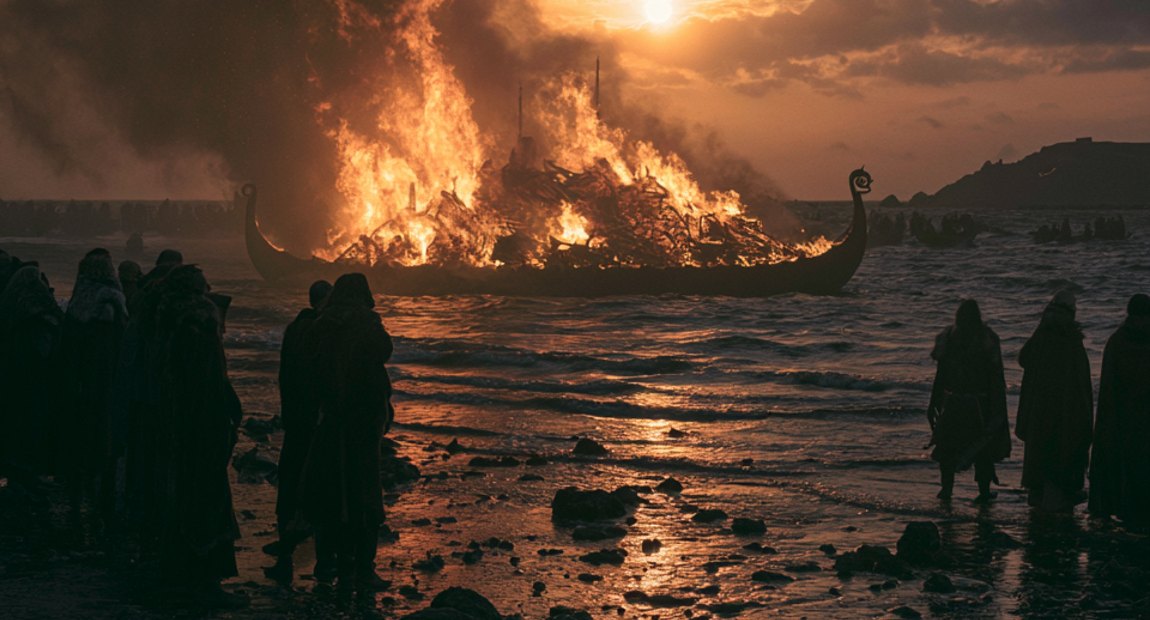
When the world ends, a ship comes across the flood, built from the untrimmed nails of the dead. That is how Snorri Sturluson tells it in the thirteenth century, and he attaches an oddly practical warning: anyone who lets a person die with uncut nails is supplying timber, so to speak, for the ship of doom. The older poem Völuspá mentions Naglfar in just two words, and even there the questions begin. Who steers, the giant Hrymr or Loki? Where does the ship come from? Does the name even mean "nail-ship"? This article sets the passages side by side, sorts out the scholarship on the name, and compares the mythical vessel with the ships that actually lay in Viking-Age graves, held together by thousands of iron rivets.
Naglfar, also spelled Naglfari in Old Norse, is the ship that carries the enemies of the gods to the final battle at Ragnarök. Ragnarök (roughly "the fate of the gods") is the Eddic end of the world, in which gods and giants fight and the earth sinks into the sea before rising again. Naglfar is a minor player in that story, but no other ship in the mythology is made of such a disturbing material.
Our knowledge rests on very few passages. The poem Völuspá ("the prophecy of the seeress"), preserved above all in the Codex Regius from the second half of the thirteenth century, mentions the ship in two words: "Naglfar losnar", Naglfar is loosed. Everything else, the material of dead men's nails, the warning to the living and the giant Hrymr at the helm, comes from Gylfaginning, the first narrative part of the Prose Edda by Snorri Sturluson, written around 1220. Add one more sentence in Gylfaginning and an entry in a name list, and that is the whole record.
In Völuspá the seeress describes the end of the world in a rapid sequence of images. In the standard numbering of Gustav Neckel's edition these are stanzas 50 and 51; Karl Simrock's German translation of 1851 counts one stanza fewer and numbers them 49 and 50. Stanza 50 opens with "Hrýmr ekr austan, hefiz lind fyrir": Hrymr comes (literally "drives") from the east and lifts his shield, literally his linden-wood, before him. The World Serpent Jörmungandr writhes in giant-fury and lashes the waves, an eagle screams and tears at corpses. Then the half-line "Naglfar losnar".
Stanza 51 begins: "Kióll ferr austan", a keel, that is a ship, travels from the east. "Muspell's people" come over the sea, "en Loki stýrir", and Loki steers. With them go "the sons of the monster" (fífl, a word for giants and ogres), all with the wolf, and "the brother of Býleiptr", a roundabout name for Loki himself. Muspell stands for fire and the south; in Snorri it becomes the fire world Muspelheim, home of Surtr.
Here lies the problem every later reading faces. Völuspá does not say that the keel of stanza 51 is Naglfar. Nor does it put Hrymr on board Naglfar. Hrymr "drives" (aka, a verb often used of travelling by wagon), Naglfar is loosed with no one named on board, and Loki steers a ship carrying Muspell's people. Whether these are three views of the same scene, or two ships plus a giant arriving by other means, the text leaves open.
One detail in stanza 50 matters later in the debate about the name. Directly before "Naglfar losnar" the eagle tears the dead, and the Old Norse uses a form of nár, "corpse". Simrock renders the line "Leichen zerreißt er", "corpses he tears". Whether the poet was playing on the echo between nár and Naglfar cannot be proven.
In Gylfaginning Snorri has the figure Hár ("the High One") explain the end of the world to the questioning king Gangleri. Chapter numbering varies: many translations count this as chapter 51, while Bruce Lincoln cites it as chapter 55. The sequence is clear. Earth and mountains quake, trees are torn from the ground, "all fetters and bonds break and snap". The Fenris wolf gets loose. The sea surges over the land because the Midgard Serpent writhes in giant-fury and pushes ashore. Then: "Þá verðr ok þat, at Naglfar losnar, skip þat, er svá heitir", then this also happens, that Naglfar is loosed, the ship of that name.
What follows is the explanation that made the ship famous. It is made of the nails of dead men, and therefore it is worth a warning: whoever dies with uncut nails adds a great deal of material to the ship, which gods and men would rather see finished late. Snorri then returns to the action. Naglfar floats on this flood, and "Hrymr heitir jötunn, er stýrir Naglfari", Hrymr is the name of the giant who steers Naglfar.
A little later the enemies of the gods gather on the plain of Vígríðr, which Snorri says measures a hundred rasts (an old measure of distance) in every direction. Loki and Hrymr are there; with Hrymr come "all the frost giants" (hrímþursar), and Loki is followed by "all the people of Hel". The sons of Muspell form a host of their own, shining brightly; they ride over the bridge Bifröst, which breaks beneath them. So the ship belongs with Hrymr and the giants, Loki leads the dead of Hel, and the sons of Muspell ride.
A second passage in Gylfaginning completes the picture. Talking about the magic ship Skíðblaðnir, which belongs to the god Freyr and can be folded up like a cloth, Hár says Skíðblaðnir is the best ship and made with the greatest skill, "en Naglfar er mest skip. Þat á Múspell", but Naglfar is the largest ship, and Muspell owns it. (More on Freyr's ship under Treasures of the Edda.) Here the ship belongs to Muspell; in the Ragnarök chapter Hrymr steers it and the sons of Muspell ride. Snorri is not entirely consistent either.
In many retellings Loki steers Naglfar; in others Hrymr does. Both go back to the sources, but no single source says both. Völuspá names Loki as helmsman of a keel carrying Muspell's people. Snorri names Hrymr as helmsman of Naglfar. He quotes the Völuspá stanzas himself, yet quietly rearranges rather than resolving the contradiction.
Two explanations are possible, both guesses. Snorri may have read the stanzas so that Hrymr and Naglfar belong together because they share a stanza, while the keel in stanza 51 is a second ship. Or he knew another tradition that is now lost. Which versions of the poems and what oral knowledge Snorri used in detail cannot be established with certainty.
Hrymr himself remains a pale figure. He appears nowhere outside these two contexts. His name is usually linked to words for frailty or decrepitude, but that too is not secure. In Snorri he leads the frost giants (more under Giants); Loki's role at the end of the world is covered in the article on Loki.
For Naglfar itself the finding is sober. Only Snorri's prose names a helmsman, and that helmsman is Hrymr. The idea that Loki steers Naglfar is a widespread modern merger that equates the keel of stanza 51 with the Naglfar of stanza 50. Possible, but interpretation.
In Neckel's edition both stanzas say "austan", from the east. Henry Adams Bellows, however, renders stanza 51 in 1923 as "O'er the sea from the north there sails a ship / With the people of Hel", that is, from the north and with Hel's people instead of Muspell's. Lee M. Hollander's 1928 translation also brings the ship from the north, again with hosts from Hel.
These are not readings one can look up in the manuscript but interventions by editors and translators. Hel, the realm of the dead, is imagined in the north, Muspell in the south. Smoothing the text shifts both direction and people; the manuscript does not offer that smoothing. For Naglfar this means that statements such as "Naglfar comes from the north, out of Hel" rest on an emended, that is corrected, version of the text. For the realm of the dead see Hel and Helheim.
Þat er gert af nöglum dauðra manna, ok er þat fyrir því varnanar vert, ef maðr deyr með óskornum nöglum, at sá maðr eykr mikit efni til skipsins Naglfars, er goðin ok menn vildi seint, at gert yrði.
"It is made of the nails of dead men, and so it is worth a warning: if a man dies with uncut nails, that man adds much material to the ship Naglfar, which gods and men would wish to be finished late."Snorri Sturluson, Gylfaginning (ch. 51 in common numbering); Old Norse text as given on voluspa.org, read via a retrieval tool; English translation my own
At first glance the name is transparent. Old Norse nagl means "fingernail or toenail", far means "journey, vessel, ship". Naglfar would be the "nail-ship", and Snorri's explanation with the nails of the dead would follow naturally. That very neatness is what makes scholars suspicious.
The Swedish linguist Adolf Noreen proposed in the late nineteenth century that the first element does not belong to nagl at all but to a word family for "corpse, death" that includes Old Norse nár, Gothic naus "dead man" and Greek nékys "corpse". Naglfar would originally have been the "ship of the dead", and the nails a later explanation, a folk etymology: people reinterpreted a name that had become opaque and supplied a story to fit. Jan de Vries adopted this view in his "Altgermanische Religionsgeschichte". Rudolf Simek writes in his Dictionary of Northern Mythology that the interpretation as "nail ship" from nagli "nail" is surely a folk etymology, and presents the ship of the dead as more likely.
Sigmund Feist (1909) and Albert Morley Sturtevant (1951) raised linguistic objections; Sturtevant pointed out that nár appears in compounds as ná-, never as nagl-. The historian of religions Bruce Lincoln followed him in a 1977 article on the treatment of hair and nails among the Indo-Europeans and wrote that there is no reason whatever to contend that nagl- does not have its usual meaning of "nail".
The question remains open. "Ship of the dead" fits the content, and the nail story sounds like an afterthought; but the sound history does not work out smoothly. A third idea appears in popular accounts and also on this site, in the article on Ragnarök: alongside nagl ("fingernail") there is nagli ("nail, peg" of metal or wood). A "nail-ship" might then simply be a nailed ship. In the scholarly literature I could consult, this is not put forward as a worked-out etymology; it remains a possibility.
Lincoln also sets Snorri's warning beside a passage from the Vīdēvdād, a text of the Zoroastrian tradition in Avestan. There it is said that harmful creatures arise from carelessly discarded hair and nails. Lincoln regards the section on nails as a later addition but the underlying formula as old. From this he concludes that the idea that improperly disposed hair and nails threaten the order of the cosmos might go back to a shared Indo-European past.
The image of the nail-ship itself Lincoln considers a distinctly Germanic development. For the claim that belief in a nail-ship is well attested throughout Scandinavia he refers to Axel Olrik's book on Ragnarök (German edition 1922) and to a 1912 article by Kaarle Krohn. He does not cite specific Scandinavian folk traditions in the article itself; his examples of more recent nail customs come from nineteenth-century German collections. Whether that is independent tradition or an echo of learned Edda reading cannot be established with certainty.
Jacob Grimm read the motif differently in his "Deutsche Mythologie": a ship made of such tiny material shows above all how long it will take until the end of the world. Snorri, by contrast, stresses delay: the fewer nails go into the ship, the later it will be finished.
Anyone checking the index of an Edda edition meets a second bearer of almost the same name. In Gylfaginning Snorri tells of the giantess Nótt, Night personified, who has three husbands in turn. The first is called Naglfari, and with him she has a son named Auðr. Nothing in the text links this figure to the ship. Simek suspects that Snorri invented the name; why remains unclear.
In addition, the manuscripts of the Prose Edda call the ship itself sometimes Naglfar, sometimes Naglfari. In the name lists known as þulur at the end of Skáldskaparmál, the part of the Prose Edda devoted to poetic diction, Naglfari appears among the words for "ship". These lists are probably a later addition to Snorri's work and are not found in every manuscript. They show only that the name was available to poets as a word for "ship".
Does Naglfar exist outside books? The runestone of Tullstorp in Scania is sometimes mentioned, catalogued as DR 271 and dated to around the year 1000. Its inscription says that Kleppir (or Glippir) and Ása raised these monuments in memory of Ulfr. It shows a ship with animal heads at both ends, unlike any known Viking ship, and beside it a large four-legged beast with a mane and pointed ears.
Some read the scene as Ragnarök: the beast as Fenrir, the ship as Naglfar. The beast can just as well be understood as a picture of the dead man's name, for Ulfr means "wolf". There is no caption explaining the image. Reading it as Naglfar is an interesting hypothesis, nothing more. I know of no secure Viking-Age image of Naglfar.
Naglfar is a ship of the dead. The Viking Age knew real ships for the dead, and the two invite comparison as long as they are not confused. Ship graves are well documented; the article on boat burial gives an overview.
The Oseberg ship in Vestfold was buried in a mound in 834, according to tree-ring dating of the grave chamber, with two women and rich furnishings. The Gokstad ship, also in Vestfold, went into the ground around 900 to 905: a seagoing vessel of about 23 metres with a man in a wooden burial chamber. Both are clinker-built: the planks overlap like roof tiles and are joined with iron rivets. A large ship needed thousands of them. More on the technique in the articles on Viking shipbuilding and longships.
At Ladby on Funen the ship's timber has gone. What survives is the impression in the soil and the iron: the Viking Museum at Ladby speaks of more than 2,000 nails and bolts that held the hull together, plus an anchor and anchor chain at the bow. The ship was about 22 metres long and some three metres wide, and the burial is placed around 925. Eleven horses and several dogs lay in the grave.
A ship of the dead made of nails, and real ships of the dead of which only the nails remain: the comparison is appealing, but modern. No source links Naglfar with ship burials, and no grave find can be read as evidence for the idea of Naglfar. The mythical ship does not take the dead into the otherworld; it brings them back out of it, to fight the gods. The contrast with Baldr's funeral ship Hringhorni, on which the dead god is burned, is clearer within the mythology itself than any link to archaeology.
Snorri's sentence is often retold as if it described a Viking-Age funeral custom: people cut the nails of the dead to delay Ragnarök. That is not what the text says. Snorri phrases a warning, not a report of a practice. He says it is worth warning that a dead person with uncut nails supplies material.
Archaeologically such a custom cannot be demonstrated. Nails rarely survive, never in cremations, and even on well-preserved bodies one could hardly tell when they were cut.
The origin of the sentence is open as well. Snorri wrote as a Christian some two hundred years after Iceland's conversion. The warning may preserve an old popular belief that he picked up. It may equally be an explanation he spun out of the name Naglfar himself. What can actually be said about the treatment of the dead is covered in the articles on honouring the dead and on the revenants known as draugar.
Since the nineteenth century Naglfar has been a subject for illustrators. The artist Louis Moe, for instance, gave the ship its own plate in his picture cycle "Ragnarok" (1929). Such images supply a shape and crew that the sources do not describe.
In music a Swedish band carries the name: Naglfar, founded in Umeå in 1992, first under the name Uninterred, is a melodic black metal group whose first album "Vittra" appeared in 1995.
Games and novels have taken up the ship as well. In "The Witcher 3: Wild Hunt" (2015) Naglfar is the ship on which the Wild Hunt travels between worlds. In the "Legion" expansion of "World of Warcraft" (2016) the ship features in a dungeon where players fight a mistress of the dead named Helya. Rick Riordan made Naglfar's voyage the core of the plot of his young-adult novel "The Ship of the Dead" (2017). These are new creations, not sources.
Read as a whole, Snorri's chapter shows Naglfar as part of a series of releases. First all fetters break, then the Fenris wolf gets loose, then the sea rises, then Naglfar is loosed. The ship, like the wolf and Loki, is something bound that comes free at the end. The gods keep their enemies bound, and Ragnarök begins when the bonds fail.
The warning fits this. Anyone who trims a dead person's nails helps, according to Snorri, to push the end back, and gods and men alike wish the ship to be finished late. The warning gives every human being a tiny share in the end of the world, and Naglfar probably owes its fame to that turn towards the everyday. What comes afterwards, the new earth and the return of some gods, is described in After Ragnarök; what comes before, the long winter, under Fimbulwinter.
What is Naglfar? A ship in Norse mythology that comes loose at Ragnarök and carries the enemies of the gods to the final battle. Snorri says it is built from the nails of the dead.
Who steers Naglfar? According to Snorri's Gylfaginning, the giant Hrymr. Völuspá names Loki as helmsman of a ship with Muspell's people but does not say that this ship is Naglfar.
Why should the dead have their nails trimmed? Snorri warns that whoever dies with uncut nails supplies material for Naglfar, which gods and men want finished as late as possible. Whether this custom actually existed is not attested.
What does the name Naglfar mean? The obvious literal reading is "nail-ship". Some scholars, including de Vries and Simek, regard that as a folk etymology and interpret the name as "ship of the dead"; others, such as Lincoln, defend the meaning "nail".
Are there archaeological finds connected with Naglfar? No. Ship graves such as Oseberg, Gokstad and Ladby attest real burials in ships but have no demonstrable link to Naglfar. Reading the ship image on the Tullstorp runestone as Naglfar is a hypothesis.

Ragnarök · Loki · Surtr – the Fire Giant Who Burns the World: Edda, Cave Finds and Iceland's Volcanoes · Boat burial – the burning ship · Fimbulwinter.
The nine worlds of Norse mythology are firmly attested – but only as a number. The seeress of the Völuspá says she …
Read more →It begins with petty theft and ends with eleven people dead under a burning roof. In between lie fifty years, two dozen …
Read more →Odin, Thor, Yggdrasil, Ragnarök: few ancient worldviews fascinate as many people today as that of the Norse. Yet …
Read more →Above the gods stands fate – and it has many shapes. This large overview reaches far beyond the three famous Norns: to …
Read more →