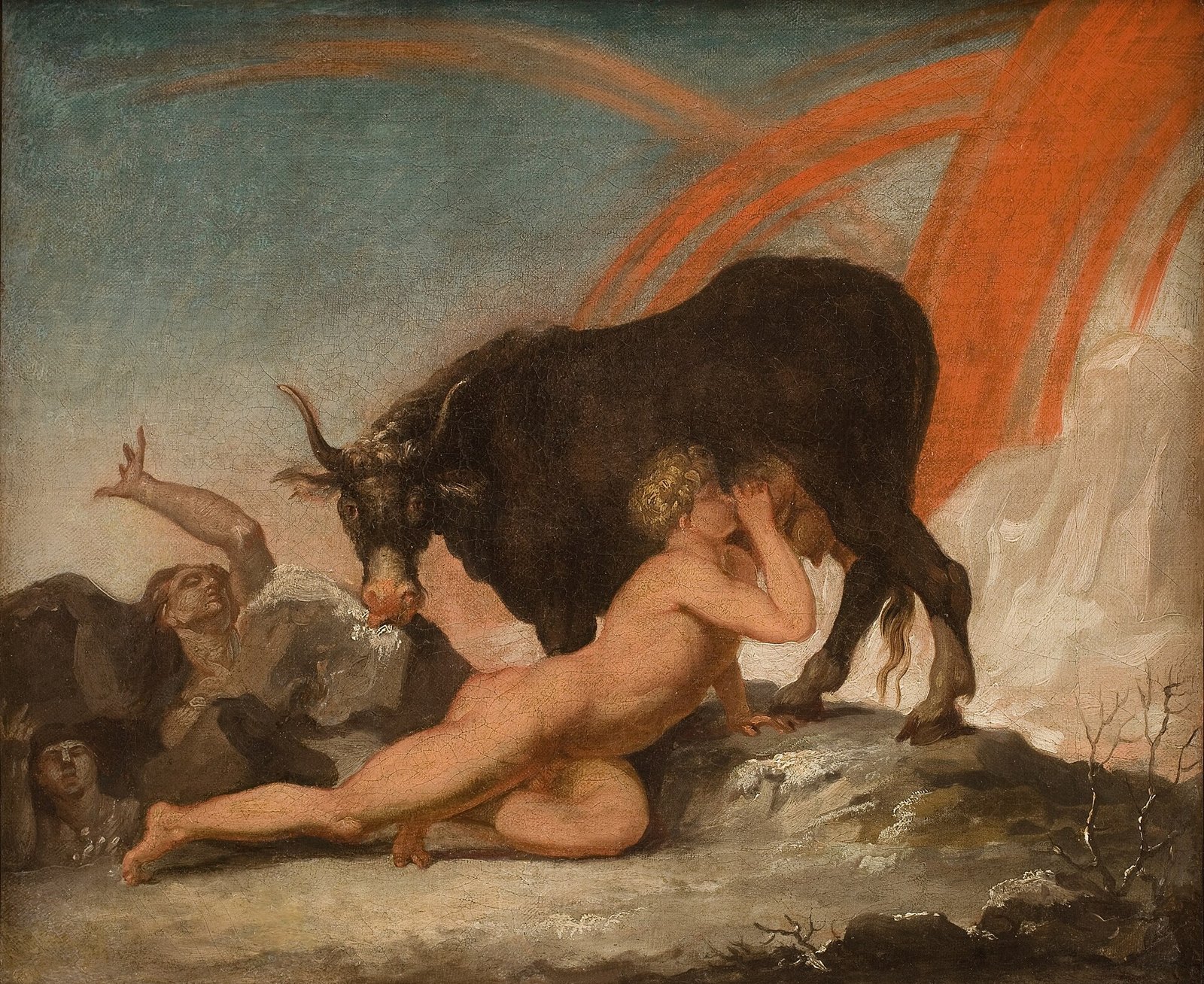
The name stands in four passages of Old Norse literature, and each time it means something slightly different. In one eddic poem, venom drips from Élivágar and grows into the forefather of the giants. In Snorri Sturluson's account the waters harden into the ice that fills the primeval gap. In a second poem a giant lives beyond them “at the end of the sky”, and in a fourth passage Thor wades across with a man in a basket on his back. This article sets the four passages side by side, tests the familiar list of “eleven rivers”, and shows what is in the texts and what later retellings have stitched together.
Look up Élivágar and you soon meet a tidy story: eleven rivers rise in the spring Hvergelmir in Niflheim, are collectively called Élivágar, carry venom, freeze in the gap Ginnungagap and supply the matter from which the primeval giant Ymir is formed. Many reference works put it that way, as did older articles on this site. The story is not wrong, but it is assembled from pieces that lie in different places in the sources.
The name is attested in four passages, two in poems of the Poetic Edda and two in the prose of Snorri's Edda:
I know of no further attestations; whether the name turns up in a skaldic stanza outside these texts I have not checked. None of the accounts I consulted mentions images or runic inscriptions referring to Élivágar. All we know therefore comes from texts written down in thirteenth-century Iceland.
Élivágar is a plural. The passages themselves show it: ór Élivágum (“out of Élivágar”) in Vafþrúðnismál, fyr austan Élivága (“east of Élivágar”) in Hymiskviða, yfir Élivága (“across Élivágar”) in Skáldskaparmál. The second element is the plural of vágr, a word for moving water that can mean “wave”, “sea” or “bay” depending on context.
The first element is connected with él, a shower of snow or hail, a short, violent squall. Edward Pettit, whose dual-language edition of the Poetic Edda appeared in 2023, leaves every option open in his note: “(Snow/Hail-)Storm Waves/Seas/Bays”. Henry Adams Bellows wrote “Stormy Waves” in 1923; John Lindow heads his handbook entry “Hailstorm-waves”.
An older, shorter gloss sits alongside these. Cleasby and Vigfússon's Icelandic-English dictionary lists eli-vágar simply as “the Ice-waves”, a mythological name from the Edda, and “ice waves” is still widely repeated. “Storm waves” is closer to the language, since él denotes the squall, not the ice. That the two end up fitting together is Snorri's doing: in his telling Élivágar really do turn to ice.
Vafþrúðnismál is a contest of knowledge between Odin and the giant Vafþrúðnir. In stanza 30 Odin asks where Aurgelmir first came from “among the sons of giants”. The answer is the oldest surviving statement about Élivágar. In normalised Old Norse: Ór Élivágum / stukku eitrdropar, / svá óx, unz varð jötunn. Literally: out of Élivágar sprang venom-drops; so it grew until a giant came of it.
“Down from Elivagar did venom drop,
Vafþrúðnismál, stanza 31, translated by Henry Adams Bellows (The Poetic Edda, 1923)
And waxed till a giant it was;
And thence arose our giants' race,
And thus so fierce are we found.”
The poem says no more than that. No Niflheim, no Hvergelmir, no ice, no heat from the south. There is water with a name, there is eitr, and there is a being that grows out of drops. The giant is called Aurgelmir here; that Ymir is meant is stated outright only by Snorri, although the poem itself speaks elsewhere of Ymir's flesh and Ymir's kin.
One detail of transmission matters for how we weigh the stanza. The poem survives complete in the Codex Regius of the Poetic Edda and, from stanza 20 onward, in the fragment AM 748 I a 4to. According to Pettit's apparatus the closing lines of stanza 31 are missing in both manuscripts. The statement that all the giants' kindreds came from there and that this is why they are always so fierce is known only because Snorri quotes the stanza in Gylfaginning; editors supply the lines from him. Bellows said as much in his note in 1923. The last two lines of the translation above therefore rest on Snorri alone.
Karl Simrock's classic German Poetic Edda closes the stanza differently, with two lines about sparks from the southern world giving life to the ice. They are in no Old Norse text of the stanza; Simrock evidently composed them from Snorri's prose.
The fullest passage is in Gylfaginning, the narrative core of the Edda that Snorri Sturluson wrote in the early thirteenth century. Gangleri asks how things stood before there were kindreds and mankind. Hárr answers in one long sentence, which I translate from the Old Norse text in our source archive:
“The rivers that are called Élivágar – when they had come so far from their source that the venomous flow that went with them hardened like the slag that runs out of the fire, then it turned to ice. And when that ice came to a halt and flowed no longer, rime formed over it, and the drizzle that rose from the venom froze to rime, and the rime grew, layer upon layer, all the way into Ginnungagap.”
Three things stand out. First, the comparison: sindr is the slag left over from smithing and smelting iron. Snorri explains an event before all time with an image from the workshop: liquid, then sluggish, then hard. Second, the wording: what the rivers carry is called eitrkvika, the drops from which life arises a moment later are kvikudropar, and the coming to life is kviknaði. All three words contain the same stem, which in Old Norse also means “alive”. Whether Snorri intended the echo cannot be proved; it is striking.
Third, and this is the key point for this article: Snorri says the rivers had come far “from their source”. He does not say here what that source is called.
The next sentences build the famous opposition. The part of Ginnungagap that faces north fills with the weight of ice and rime, with drizzle and gusts of wind. The southern part grows lighter from the sparks flying out of Muspellsheim. Where the rime meets the warm breath it melts and drips, and from the drops, “by the power of the one who sent the heat”, a being in human shape arises: Ymir, whom the frost giants call Aurgelmir. As evidence Snorri then quotes first a stanza of the “Short Völuspá” and after it the stanza from Vafþrúðnismál. Shortly afterwards the primeval cow Auðhumla comes out of the same dripping rime.
The poem gives Snorri venom-drops and a growing giant. He adds the process that turns flowing water into drops: hardening, riming, thawing. The heat from the south, absent from the poem, is the second force he needs for that.
The river list is not in chapter 5 but one chapter earlier. There Jafnhárr says that Niflheim was made many ages before the earth; in its midst lies the spring Hvergelmir, and from it fall the rivers named as follows: Svöl, Gunnþrá, Fjörm, Fimbulþul, Slíðr ok Hríð, Sylgr ok Ylgr, Víð, Leiftr. Gjöll er næst Helgrindum – Gjöll is nearest the gates of Hel.
That makes eleven names. Count in older translations and you get twelve: both Rasmus B. Anderson (1880) and Simrock write “Fimbul, Thul”, turning one river into two. The Old Norse text in our archive has Fimbulþul as a single word, and that is how the name appears in the river list of Grímnismál as well. Nor is the number eleven Snorri's. He does not count; he only names. “Eleven rivers” is a tally made by readers.
Something else is not there: a statement that these eleven rivers are Élivágar. Chapter 4 names Hvergelmir and the rivers but not the word Élivágar. Chapter 5 names Élivágar and their “source” but neither Hvergelmir nor any of the eleven names. The identification is an obvious one: the passages are adjacent and both deal with cold waters in the north. Pettit accordingly takes Élivágar as a collective name for various primeval rivers in Gylfaginning. It remains an inference by the reader, not a sentence of Snorri's.
Snorri did not invent the eleven names. They stand in Grímnismál, in a quite different setting. Stanza 26 tells of the stag Eikþyrnir, who stands on Odin's hall; from his antlers it drips into Hvergelmir, and “from there all waters take their course”. Stanzas 27 and 28 then list river names – 37 by my count, with Víð occurring twice.
Set Snorri's list beside them and every one of his eleven names can be found. Svöl, Gunnþró (Gunnþrá in Snorri), Fjörm and Fimbulþul stand together in stanza 27. Slíð and Hríð, Sylgr and Ylgr, Víð, Gjöll and Leiftr stand at the end of stanza 28, in the group of which the poem says that they flow “near to men” and “down from here to Hel”. Seven of the eleven primeval rivers are thus, in the poem, rivers on the way to the realm of the dead. Snorri's remark that Gjöll is nearest the gates of Hel fits that.
The word Élivágar does not occur in Grímnismál. And the poem arranges things differently from Snorri's creation account: for him Hvergelmir is older than the earth, whereas in the poem the spring is fed from the antlers of a stag standing on Valhalla – in a finished world. Snorri knows this version too. In chapter 39 of Gylfaginning he retells it and gives a second list of 25 river names, in which Svöl, Gunnþró, Fjörm, Fimbulþul and Víð appear again. He let the contradiction stand. For the eleven names this means that they are a selection from a mnemonic list of river names which Snorri moved to the beginning of the world.
Some of the names have a life of their own. In the Baldr story the gold-thatched bridge that Hermóðr rides across spans the river Gjöll (see The road to Hel). Slíðr is named in stanza 36 of Völuspá: a river that falls from the east through “venom-dales” and carries swords. An oath is sworn on the water of Leiptr in the second lay of Helgi (see Helgi and Sigrún).
In Hymiskviða Élivágar have nothing to do with creation. The gods need a brewing cauldron for the feast at Ægir's, and Týr knows where one stands: Býr fyr austan Élivága / hundvíss Hymir / at himins enda. Bellows translates: “There dwells to the east of Elivagar / Hymir the wise at the end of heaven.”
Here Élivágar are a place in the gods' present. They lie between Asgard and the edge of the world, and a giant lives beyond them. On the direction Pettit remarks drily that giants generally live in the east, and at “the end of the sky” he thinks a folk-etymological link between Hymir and himinn (“sky, heaven”) likely. How Thor and Týr get across the water the poem does not tell. It says only that they travelled far from Asgard that day until they came to a certain Egill, with whom the goats stayed.
In its surviving form Hymiskviða is considered late; according to Pettit scholars lean towards the twelfth or early thirteenth century. Whether the idea of a boundary water is older than that of venomous streams at the beginning of the world, or the reverse, cannot be deduced from two poems of uncertain age.
The fourth passage is in Skáldskaparmál, the part of Snorri's Edda devoted to poetic diction, at the end of the tale of Thor's duel with Hrungnir (chapter 25 in the Old Norse text of our source archive; other editions number differently). After the fight a piece of whetstone is lodged in Thor's head. The seeress Gróa, wife of Aurvandill “the Bold”, chants spells over it until the stone begins to loosen. Thor wants to please her and tells her that he has waded norðan yfir Élivága, from the north across Élivágar, carrying Aurvandill in a basket on his back out of Jötunheim. One toe stuck out of the basket and froze; he broke it off, threw it into the sky and made of it the star called “Aurvandill's Toe”. Gróa is so glad that she forgets her spells, and the stone is still there.
The passage tells us three things about Élivágar. They can be waded, at least by Thor. They are cold enough to freeze a toe off. And they lie between Jötunheim and the world of the gods – this time in the north. Thor wading rivers is a fixed motif: according to Grímnismál 29 he wades Körmt, Örmt and the two Kerlaugar every day on his way to the court at the ash.
Snorri adds that Þjóðólfr of Hvinir composed on this story in Haustlǫng. According to the translations, the last surviving stanza alludes to a woman who is to loosen the stone with chanted spells; whether the poem also names Élivágar I have not checked. Gróa herself appears once more in the late poem Grógaldr (see Svipdagsmál).
Laid side by side, the four passages fit together only loosely. In Vafþrúðnismál and in Snorri's creation account Élivágar belong to the beginning of time. In Hymiskviða and the Aurvandill tale they are a body of water that exists now and can be crossed. In Gylfaginning they have frozen solid before there was an earth; in Skáldskaparmál, by the same author, Thor wades through them. Hymiskviða puts Hymir's home in the east, Skáldskaparmál has Thor come from the north.
There is no need to smooth this out. Mythic geography is not a map, and east and north in these texts are above all the directions in which the alien lies. “One river or many” is likewise a modern reader's question. The form is always plural. Gylfaginning 5 speaks expressly of rivers. Hymiskviða and Skáldskaparmál treat Élivágar as a single obstacle, which is unremarkable for a name meaning “waves” or “bays”. Anyone who pictures an icy sea at the rim of the world contradicts none of the four texts.
Vafþrúðnismál itself offers a comparison. In stanza 16 it names another boundary river: Ífing divides the ground between the sons of giants and the gods, flows open for ever, and never has ice on it. According to Pettit the river is otherwise unknown. The same poem thus knows a boundary river that never freezes and primeval waters that drip venom, and does not equate them. Whether the Élivágar of Hymiskviða and Ífing mark the same border, no source says.
The most striking word attached to Élivágar is eitr: corrosive, deadly venom. The same word stands in Völuspá, where eitrdropar fall through the roof-vents of the hall on the Corpse Shore and the river Slíðr runs through eitrdalar, venom-dales. Venom, cold and the road to the dead belong together in this imagery.
Where the venom in the primeval streams comes from, no text says. Retellings sometimes claim that it comes from the serpents which, according to Snorri, live in Hvergelmir with Níðhöggr (see The serpents beneath Yggdrasil). That is a modern conjecture. Snorri mentions the serpents when describing the world tree, not in the creation account, and nowhere makes the connection.
Another reading takes the venom less literally and treats eitrkvika as an image of numbing, icy cold. I know it only at second hand and therefore name no names. It cannot be proved, and it does not explain why Snorri expressly compares the venom to slag from a fire.
Two readings carry most accounts. The first sees in Élivágar the primal water of the cosmogony, the story of how the world began: a substance that exists before earth and sky and from which the first living being emerges. The second reading sees a border, either between gods and giants or between the human world and what lies beyond. The first reading rests on Vafþrúðnismál and Gylfaginning, the second on Hymiskviða and Skáldskaparmál.
The two can be combined without forcing the texts: the water the giants come from is also the water they live behind. As the thought of a medieval poet, though, that link is not attested; it arises only when the four passages are read together.
A third interpretation is older and now a footnote. In his note on the stanza Bellows records that Mogk suggested the river may have been the Milky Way. Bellows gives no reasons, and nothing in the texts points to the sky – except Aurvandill's toe. The idea remains speculation.
What are Élivágar? Icy, venom-bearing primeval waters of Norse mythology. In Vafþrúðnismál the first giant grows from their drops; in Snorri they harden into the ice and rime that fill the north of Ginnungagap.
What does the name mean? It is explained from él (“shower of snow or hail”) and vágar (“waves”), so roughly “storm waves”. The older gloss “ice waves” is less exact.
What are the eleven rivers called? Svöl, Gunnþrá, Fjörm, Fimbulþul, Slíðr, Hríð, Sylgr, Ylgr, Víð, Leiptr (Leiftr) and Gjöll. Snorri names them as rivers from Hvergelmir; that together they are Élivágar is an inference from the next chapter.
Where do Élivágar lie? The texts disagree. Hymiskviða places Hymir's home east of them at the end of the sky; in Skáldskaparmál Thor crosses from the north. Both mean the edge of the gods' world facing the giants.
Was there a cult or any image of Élivágar? None is known. The name occurs only in texts recorded in thirteenth-century Iceland.
Ymir, the primeval giant · Ginnungagap: the primeval gap · Niflheim · Muspelheim · Gylfaginning: Snorri's “Beguiling of Gylfi” · Vafþrúðnismál · Hymiskviða · Grímnismál · Hrungnir and the whetstone · Jötunheim
Ymir: the Primordial Giant Whose Body Became the World · Ginnungagap – the yawning void at the beginning of the world · Niflheim – the Mist World of the North: what Snorri says, what the poems say, and why Niflheim is not Hel · Muspelheim, the Fire Realm of the South: Surtr, the Sons of Muspell and a Mysterious Word for the End of the World · Gylfaginning: the book that presents its gods as an illusion.
Eyvindr Finnsson, called skáldaspillir, lived in the tenth century and composed two of the best-known Norwegian skaldic …
Read more →Fáfnir is the most famous dragon in Norse tradition – and he was not born one. In the Eddic poems he is a son of …
Read more →There is not a single story about Loki's parents. No poem tells how they met, no scene shows them with their son, no …
Read more →Fenrir (also Fenrisúlfr, the "Fenris wolf") is the monstrous wolf of Norse mythology: a son of Loki and the giantess …
Read more →