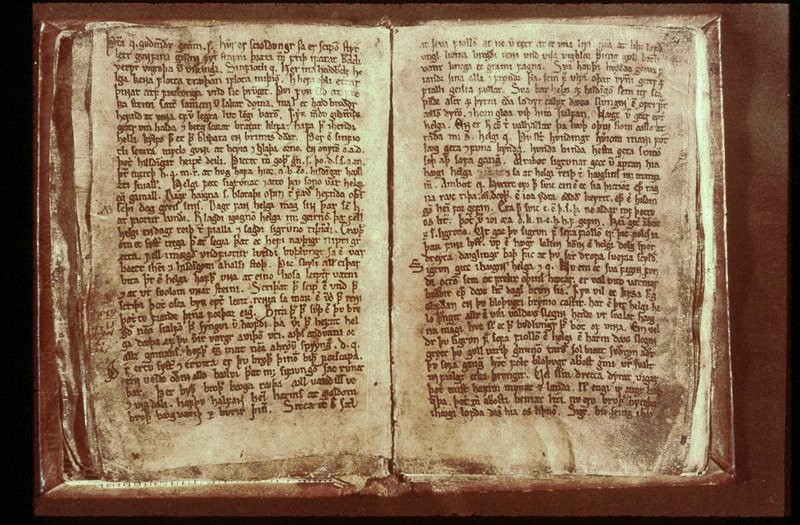
Everything the Edda tells us about Odin, Thor and Ragnarök was written down by Christians, two to three centuries after Iceland accepted the new faith. That is not a footnote. It is the basic problem behind any study of Norse mythology: are we reading the beliefs of the Viking Age, or what learned thirteenth-century Icelanders made of them? This article looks at when and in what setting the Prose Edda and the Poetic Edda came into being, examines the passages where Christian influence has been suspected, sets the counter-arguments beside them and places the main scholarly positions. There is no simple answer. There are, however, good grounds for a nuanced one.
People who ask "How Christian is the Edda?" usually mean two different things. The first concerns transmission, and it has a clear answer. The Prose Edda was written around 1220 by Snorri Sturluson, a Christian Icelandic chieftain, politician and scholar. The Poetic Edda survives mainly in a single manuscript, the Codex Regius, compiled by an unknown Icelandic scribe in the 1270s. Both are products of a Christian culture of writing; there are no pagan manuscripts anywhere in the North.
The second question is harder: how much of the content was shaped by Christian ideas, or even invented under their influence? The extremes – untouched paganism on one side, a mythology assembled from Bible and sermon on the other – are hardly held by anyone today. Most specialists reckon with old material that was passed on, selected, arranged and, in places, visibly recoloured in the Christian period. Exactly where those places are, and how deep the colouring goes, is the real point of contention.
What "Edda" means is explained in our article on the Edda.
Iceland was settled from about 870, mostly from Norway. Around the year 1000 – some historians prefer 999 – the Althing, the assembly of free men, adopted Christianity. The main source is Ari Þorgilsson's "Íslendingabók", written around 1122–1133. Ari tells how the pagan lawspeaker Þorgeirr lay under his cloak for a day and a night and then announced that all Icelanders would be baptised. Private sacrifice, the exposure of infants and the eating of horse meat remained permitted for a time.
The change was a political compromise and did not wipe out the old knowledge overnight. Those baptised around 1000 knew the gods from practice; their grandchildren from stories and skaldic poetry. How the conversion unfolded elsewhere in the North is described in our piece on the Christianisation of the Germanic peoples; the Norwegian side is embodied by Olaf Tryggvason, who put pressure on Iceland.
Writing in the vernacular began in Iceland only in the early twelfth century, starting with laws, genealogies and church texts. Literacy came with the Church and was taught at the sees of Skálholt and Hólar and at farms with schools such as Oddi and Haukadalur. Anyone writing about the old gods in the thirteenth century had learned Latin and knew the Bible, saints' lives and medieval world chronicles. That is the setting of both Eddas.
Snorri Sturluson, born in 1178 or 1179 and killed at Reykholt in 1241, grew up at Oddi in the household of Jón Loftsson, the most powerful man in Iceland at the time and a grandson of the Norwegian king Magnus Barefoot. Oddi was a centre of learning. Snorri became lawspeaker, travelled to the Norwegian court in 1218–1220 and then wrote the Prose Edda. It cannot be dated more precisely than "around 1220–1225". More on his life is in our portrait of Snorri Sturluson.
The Prose Edda is a textbook for poets. It comprises the Prologue, Gylfaginning ("The Deluding of Gylfi"), Skáldskaparmál ("The Language of Poetry") with hundreds of kennings, and Háttatal, a praise poem in which Snorri demonstrates around a hundred verse forms. To explain the circumlocutions he had to tell the myths behind them, which he does in prose, quoting stanzas from older poems – many known from the Codex Regius, some surviving only in his work.
The Poetic Edda is a modern label for a group of anonymous poems. Its core is the Codex Regius, shelfmark GKS 2365 4to, a small parchment manuscript that today has 45 leaves; eight are missing, in the middle of the heroic poems about Sigurd. The manuscript is dated to the 1270s. Bishop Brynjólfur Sveinsson acquired it in 1643 and sent it to the Danish king in 1662; it returned to Reykjavík in 1971. Völuspá also survives in Hauksbók, compiled for the lawman Haukr Erlendsson in the early fourteenth century.
No manuscript tells us when the poems themselves were composed. Datings for Völuspá range from about 900 to 1150. Edward Pettit notes in his dual-language edition (2023) that where, when and by whom Völuspá was composed is uncertain, though Iceland around the conversion of 999/1000 has often been favoured. He suggests a rough latest date of about 1065, because the skald Arnórr Þórðarson appears to echo a Völuspá stanza in his Þorfinnsdrápa. For parts of Hávamál, Pettit points to lines that already resonate around 960 in the work of the skald Eyvindr skáldaspillir.
The most openly Christian part of the Prose Edda is its Prologue. It begins not with Ymir but with biblical creation: God makes heaven and earth, then Adam and Eve; the Flood follows. Afterwards many people lost knowledge of the true God, yet reasoned from the order of nature that some ruler must stand above everything. The Æsir become humans, descendants of the Trojan king Priam. Thor appears as Tror; Odin is a wise ruler who leads his people north from the region of Troy, founds dynasties and is eventually worshipped there as a god. The text derives the name "Æsir" from "Asia".
This approach is called euhemerism, after the Greek Euhemerus, who around 300 BC explained gods as deified kings. Christian scholars had long applied the method to Jupiter and Saturn, and Saxo Grammaticus likewise turned Odin into a human sorcerer around 1200.
What was the author after? The British scholar Anthony Faulkes argued in his 1983 essay "Pagan Sympathy" that the learned framework also served to forestall criticism from the Church: if the old gods are described as mistaken but rational humans, their stories can be told without glorifying them. The Prologue is therefore Christian learning about pagan gods – not evidence that the myths themselves are Christian. Whether every part of it is Snorri's own work is not settled.
Gylfaginning also has a frame that creates distance. The Swedish king Gylfi travels in disguise as Gangleri to learn the secret of the Æsir's power. But they see him coming and receive him with an optical illusion, Old Norse sjónhverfing. In a splendid hall sit three figures, one above the other: Hár ("High"), Jafnhár ("Just-as-High") and Þriði ("Third"). They answer his questions about creation, the gods and the end of the world. At the close there is a crash, the hall has vanished, and Gylfi stands on open ground.
The frame can be read as protection: the whole account is marked as trickery, so a Christian reader could enjoy the stories without believing them. Hilda Ellis Davidson suggested this in 1964. The three enthroned figures have led some scholars, Anne Holtsmark among them, to think of a parody of the Trinity.
In content, the most Christian-sounding passage is chapter three. The All-Father lives through all ages, created heaven and earth and gave man an imperishable soul; the righteous will dwell with him in Gimlé or Vingólf, the wicked go to Hel and on to Niflhel. Creator god, immortal soul, reward and punishment after death: that combination is familiar from Christian teaching, not from the older poems. Rudolf Simek and, before him, Lee M. Hollander described Snorri's Gimlé as shaped by the image of the Heavenly Jerusalem. Yet Gylfaginning also tells stories no Christian needed to invent, such as Týr losing his hand to the Fenris wolf. Snorri arranges and interprets, but he does not invent on a grand scale.
Völuspá, the Prophecy of the Seeress, is the main battlefield of the debate, and our article on the poem devotes a section of its own to the controversy. After the great fire a green earth rises from the sea, Baldr returns, and the seeress sees a hall fairer than the sun, thatched with gold, at Gimlé, where faithful hosts will live and rejoice for ever. That stanza appears in both manuscripts.
In Hauksbók it is followed by a half-stanza that is missing from the Codex Regius. In the original it reads:
Þa kemr hinn riki at regin domi / oflugr ofan sa er ollv ræðr.
"Then comes the mighty one to the judgement of the gods, the strong one, from above, he who rules over all."Völuspá 65 (Hauksbók, AM 544 4to, stanza 57 there; wording after the diplomatic transcription), our own translation
Who is this mighty one? For many readers he is Christ coming to the Last Judgement. Pettit's commentary lists several possibilities: Christ himself, or Heimdall, Odin or Baldr as figures who might prefigure Christ. Scholars disagree about whether the half-stanza is a late Christian addition; it is striking that it appears only in the younger manuscript. Regindómr is ambiguous too: regin means "the gods" but can also simply intensify, and Pettit adds a question mark to his rendering "divine judgement".
There are further echoes. Pettit points to parallels with Revelation 21:8 (Völuspá 37–38) and with Mark 13:24–26 in the darkened sun and falling stars. In "The Nordic Apocalypse" (2013), edited by Terry Gunnell and Annette Lassen, Gro Steinsland and Karl G. Johansson compare Völuspá with the Sibylline prophecies, apocryphal oracles popular in the Middle Ages, and Kees Samplonius traces Surtr to the Christian black fire of hell and considers deriving the name Loki from Lucifer. The same volume, however, also contains John McKinnell's survey of heathenism in Völuspá; elsewhere McKinnell characterises the poet as influenced by Christianity without being a Christian.
Against a Christian derivation of the poem as a whole stands the fact that its framework has no biblical counterpart: the world tree Yggdrasil, the Norns, the war between Æsir and Vanir, the dwarves, the wolf that swallows the sun, gods who die. The final stanza also fits a pious ending poorly: in the Codex Regius, after the vision of the renewed world, the dark dragon Níðhǫggr flies in with corpses in his feathers. The ending stays restless.
No god of the Edda is compared with Christ as often as Baldr. From 1881 the Norwegian philologist Sophus Bugge argued in his "Studier over de nordiske Gude- og Heltesagns Oprindelse" that the Baldr myth arose under Christian and classical influence: the beautiful, innocent son of the highest god, killed through treachery, mourned by all creation, returning in a new world. For the blind Höðr he pointed to the legend of the blind Longinus, who pierced Christ's side. Often cited too is the Old English "Dream of the Rood", in which all creation weeps for the crucified Christ – in Snorri, all things are asked to weep Baldr out of the underworld.
The other side has a strong witness. Around 985 the Icelandic skald Úlfr Uggason performed Húsdrápa, a praise poem on the carved images in the new hall of Óláfr pái. The images showed, among other things, Baldr's funeral pyre with Odin, Freyr, Heimdall, the valkyries and the giantess who pushes the ship into the sea. That was before the decision at the Althing. The stanzas survive only in Snorri's Skáldskaparmál, but the strict skaldic metre makes later alteration comparatively difficult. Snorri's funeral scene therefore rests on old foundations.
The American Scandinavianist John Lindow proposed a different key in "Murder and Vengeance among the Gods" (1997): Baldr's death as a story of killing and revenge within a family. That explains features that fit no Christ story, such as the avenger begotten specially for the task. Most likely both are true: an old myth retold by Christian Icelanders who gave it colours from the Passion.
The second great Christ parallel is found in Hávamál, in the stanzas known as the Rúnatal. In stanza 138 Odin says he hung for nine nights on the windswept tree, wounded by a spear and given to Odin, "myself to myself". Without bread or drink he peered down, took up the runes and fell back screaming. Bugge saw in this the crucified Christ, whom the Norsemen had met in England and Ireland: the tree – a common medieval name for the cross – the spear of Longinus, the thirst, the cry.
The objections are just as solid. Christ does not sacrifice himself to himself, and he does not hang on the cross to gain secret knowledge. Hanging belongs to Odin's cult: around 1075 Adam of Bremen reports men and animals hanging from trees in the sacred grove at Uppsala, and Odin bears names such as "god of the hanged". Pettit calls the myth "almost certainly heathen" despite its apparent correspondences to the Crucifixion, because skaldic kennings presuppose it and Hávamál otherwise contains no Christian teaching at all. He concedes that a late Christian antiquarian might have remoulded individual parts.
An end of the world with fire, a darkened sun and a judgement sounds like Christian apocalypse. The Old High German "Muspilli" makes the comparison almost unavoidable: a Bavarian poem on the soul and the Last Judgement, added in the ninth century to the margins of a manuscript once presented to Louis the German. In it Elijah fights the Antichrist, his blood drips onto the earth, and the world burns. The word muspilli occurs once there; the Old Saxon "Heliand" has mudspelli, also at the end of the world. In the Edda, Múspell is a fiery realm whose sons march against the gods at Ragnarök; Snorri turns it into Muspelheim.
The word is a genuine bridge – but nobody knows which way it runs. More than twenty etymologies have been proposed: a Christian coinage that travelled north from Old Saxon, or an older Germanic word for world destruction. Gustav Neckel compared Elijah with Freyr, who falls against Surtr; later Germanists derived the imagery from the Bible and the Church Fathers. The question is open.
The differences are clear. In the Christian end time a god who does not die sits in judgement. At Ragnarök the gods themselves die: Odin is swallowed by the wolf, Thor dies from the serpent's venom. What comes after is covered in After Ragnarök.
To test whether the myths were thirteenth-century inventions, we need older evidence. The most important is the poetry of the skalds, the court poets. Around 900 the Norwegian Þjóðólfr of Hvinir described the images on a shield in Haustlǫng: Þjazi abducting Iðunn, Thor fighting Hrungnir. Towards the end of the tenth century Eilífr Goðrúnarson composed Þórsdrápa. These stanzas, too, survive only in thirteenth-century manuscripts, mostly in Snorri; their dating is the result of scholarship, not documentary record.
Then there are images in stone. Thor's fishing for the Midgard Serpent appears on picture stones and rune stones, for example at Altuna (Sweden) and Hørdum (Denmark). The Gosforth Cross in Cumbria, a Christian stone cross from the first half of the tenth century, shows beside the crucifixion scenes associated with Ragnarök: a bound Loki, Víðarr tearing open the wolf's jaws, a horn-blower. More on this in our article on stone crosses. These stones attest not pure paganism but coexistence: Christian carvers apparently found Norse end-time scenes fitting for telling of Christ's victory. What counts is that the motifs are attested three centuries before the Codex Regius.
Small finds speak too. According to the survey by the archaeologist Jörn Staecker (1999), 121 Thor's hammers from 86 sites in northern Europe were known at the time. Single hammer pendants appear from the late ninth century and cluster in Denmark and southern Sweden in the tenth, before or alongside the cross pendants that became common there mainly in the eleventh. Whether they were a deliberate response to the cross is disputed, and Staecker warns against overplaying the opposition.
The debate falls roughly into three phases. Well into the nineteenth century the Edda was read as a window onto an ancient Germanic religion. Then Bugge's "Studier" (1881–1889) derived numerous myths from Christian and classical material. The reaction was fierce. Karl Müllenhoff reproached him for not being a scholar of legend; the weightiest objection came from the Icelander Finnur Jónsson: the myths of the eddic poems were already known to ninth-century skalds, too early for an origin in the British Isles. Bugge's individual derivations have mostly not survived, but his basic question has.
In the twentieth century a middle way prevailed. Sigurður Nordal dated Völuspá in 1923 to the period of upheaval around 1000 and read it as the work of a pagan who knew Christianity. Later, attention turned to the writers themselves. Margaret Clunies Ross explored in "Prolonged Echoes" (1994/1998) how Icelanders thought with the myths after the conversion. Faulkes read Snorri's frame as a learned construction, and Lars Lönnroth described the "natural religion" of the Prologue.
Recent scholarship follows two strands. One looks for Christian learned sources, as "The Nordic Apocalypse" shows. The other stresses orality: Gísli Sigurðsson asks what it means to take Völuspá seriously as a product of oral tradition, and Terry Gunnell has gathered evidence that eddic poems were performed. The two strands are not mutually exclusive. Anyone who assumes a poem lived orally must expect it to have changed with its audience, and from 1000 onwards that audience was Christian. For readers this means: test Snorri's systems against older poems, and treat stanzas found only in a younger manuscript, such as Völuspá 65, with particular caution.
Was the Edda written by Christians? Yes. The Prose Edda was composed by Snorri Sturluson, a Christian Icelander, around 1220–1225. The Codex Regius of the Poetic Edda was written by an unknown scribe in the 1270s. Many poems are older and were first transmitted orally.
Which passages are considered Christian-influenced? Most clearly Snorri's Prologue with creation, the Flood and Trojan descent, the third chapter of Gylfaginning on the All-Father and Gimlé, and the half-stanza about the "mighty one from above" in the Hauksbók Völuspá. Baldr's death, Odin's hanging on the tree and details of Ragnarök are disputed.
Is Baldr modelled on Jesus? That thesis was made famous by Sophus Bugge in 1881. Against it stands Húsdrápa (around 985), which describes Baldr's funeral before Iceland's conversion.
Is there evidence for the myths from before the conversion? Yes, though no complete texts: skaldic poems such as Haustlǫng and Húsdrápa, picture stones, the Gosforth Cross and Thor's hammer pendants.
The Edda: Poetic and Prose Edda at a glance · Völuspá: the Prophecy of the Seeress · Snorri Sturluson · Baldr · Rúnatal: Odin's self-sacrifice on the tree · Hávamál · Ragnarök · Stone crosses · Christianisation of the Germanic peoples · Saxo Grammaticus

The Edda · Völuspá – the Seeress's Prophecy · Snorri Sturluson · Baldr · The Christianisation of the Germanic Peoples.
The Wild Hunt is a European folklore motif: a roaring host of the dead – riders, horses and hounds – that sweeps across …
Read more →Yggdrasil is the world tree of Norse mythology: a vast ash that holds up the nine worlds and links them together. No …
Read more →Ymir is the primordial giant of Norse mythology: the first living being, born from dripping venom-ice in the yawning …
Read more →A sea-giant brews ale for the gods, gold replaces the hearth fire, and in the middle of a sacred peace Loki kills a …
Read more →