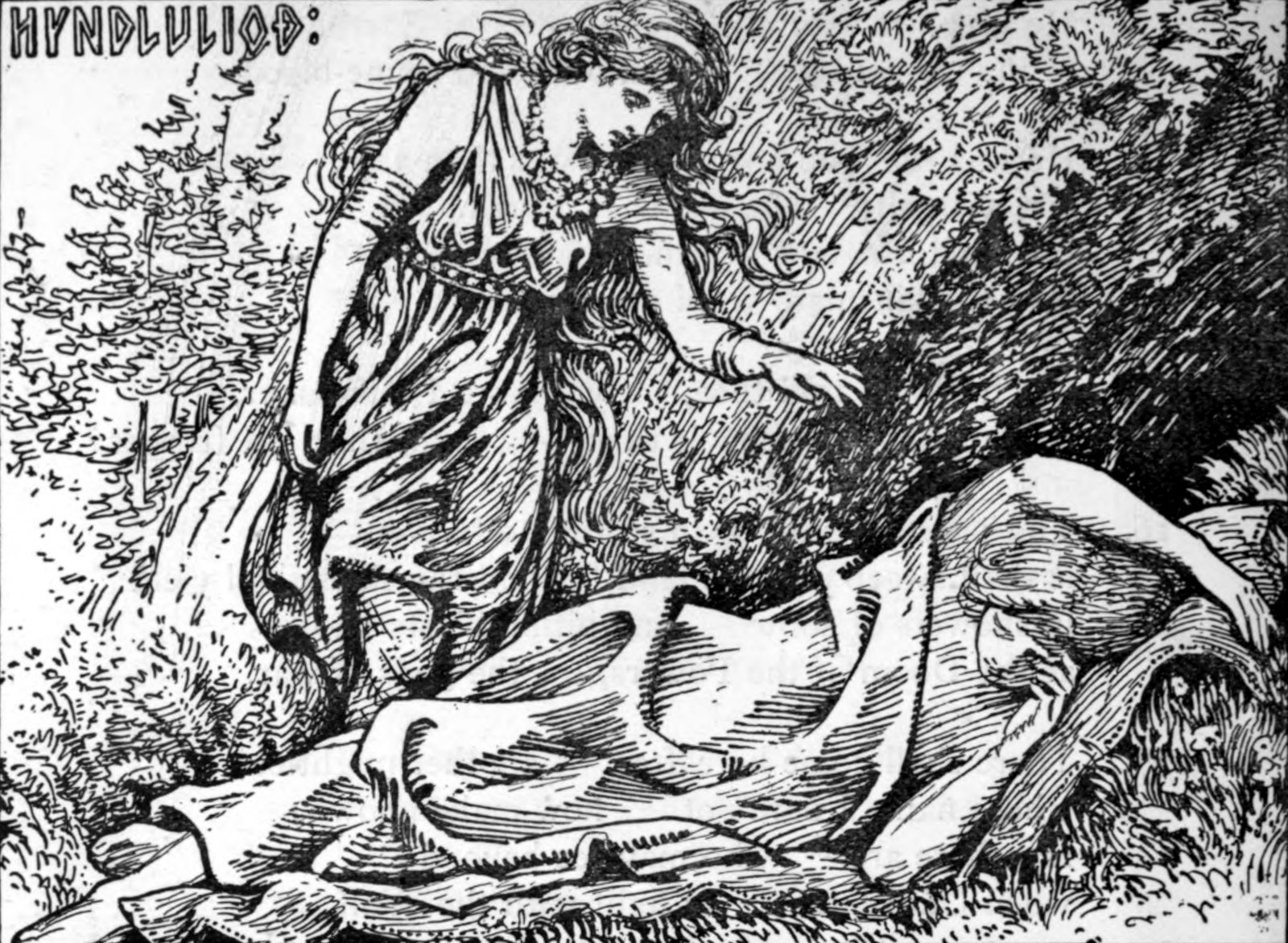
A goddess wakes a giantess in the middle of the night to squeeze a family tree out of her. Her mount is a boar with golden bristles, and in truth a young man who has staked his father's inheritance on a wager. Hyndluljóð, the "Lay of Hyndla", combines divine comedy, a list of ancestors and an inserted poem about the end of the world. It survives in a single manuscript. This article walks through the poem stanza by stanza and separates what the text says from what editors and interpreters have added.
Calling Hyndluljóð an "Eddic poem" means using a label supplied by editors. The poem is absent from the Codex Regius, the main manuscript of the Poetic Edda. It is found only in Flateyjarbók, the "Book of Flatey" (shelfmark GKS 1005 fol.), an Icelandic compilation that consists chiefly of sagas of the Norwegian kings. The book was being written in 1387 and was finished in 1394 or very soon afterwards. It was commissioned by Jón Hákonarson; the scribes were the priests Jón Þórðarson and Magnús Þórhallsson. The codex has 225 vellum leaves.
Hyndluljóð stands right at the front: Edward Pettit, in his dual-language edition of 2023, gives folios 2v–3r. If the usual dating holds (see below), some two hundred years separate the poem from its only written copy. There is no second witness to compare. Where the text is corrupt, editors can only conjecture, and that is why editions differ so noticeably in wording, stanza order and numbering.
Around the middle of the seventeenth century Bishop Brynjólfur Sveinsson obtained it from Jón Finnsson on the island of Flatey (sources differ on the year), and in 1656 he presented it to King Frederik III of Denmark. It returned to Iceland in 1971 and is kept by the Árni Magnússon Institute.
The poem opens with a wake-up call. "Vaki mær meyja, vaki mín vina" – wake, maid of maids, wake, my friend: this is how Freyja addresses the giantess Hyndla, her "sister who lives in the cave" (st. 1). It is the "dusk of dusks", she says, and the two of them should ride to Valhalla, to the holy place. Pettit renders the name Hyndla as "Little Bitch".
Freyja goes on flattering. For two stanzas she praises Odin as a giver: Hermóðr received helmet and mail-coat from him, Sigmundr a sword; to some he grants victory, to others wealth, fair winds to sailors and poetry to skalds (st. 2–3). She even offers to win Thor's goodwill for Hyndla, although Thor, as the stanza drily remarks, has little liking for giants' brides (st. 4).
Hyndla is to take one of her wolves from the stall and let it run beside Freyja's boar (st. 5). According to Pettit's note, wolves are the typical mounts of giantesses. The second half of the stanza is already a rebuff: the boar is too slow for the gods' road, and the speaker has no wish to burden her fine steed. Karl Simrock and Pettit give these lines to Hyndla; Henry Adams Bellows puts the whole stanza in Freyja's mouth.
Hyndla is not fooled. "False you are, Freyja," she says in stanza 6, and gives the reason: the goddess has her verr – the word means "man" and also "husband" – with her on the road of the slain, "Óttarr the young, Innsteinn's son". Freyja denies it. Her mount, she says, is the boar Hildisvíni, glowing with golden bristles, made for her by two skilful dwarfs, Dáinn and Nabbi (st. 7).
The text does not keep up this lie for long. As early as stanza 9 Freyja speaks openly of Óttarr and his wager, and at the end she demands the memory-ale expressly for her "guest". Nowhere does the poem state in so many words that Óttarr was "turned into a boar"; that follows from these stanzas taken together and is the generally accepted reading.
One point matters for anyone interested in the animals of Norse mythology: Hildisvíni is a different animal from Gullinbursti, the boar of the god Freyr. The confusion has a basis in the wording. Stanza 7 reads "göltr glóar gullinbursti, Hildisvíni" – "the boar glows, the golden-bristled one, Hildisvíni". Here "gullinbursti" is a description, and the name follows it. Freyr's boar, in Snorri's account, comes from the forge of the dwarf Brokkr and his brother; Freyja's boar was made by Dáinn and Nabbi. What boars meant in the North more generally is covered in The boar in the North.
Stanza 9 names the occasion. Óttarr "the young" and a man called Angantýr have laid a wager in "Vala malm", foreign metal, meaning gold. At stake is the föðurleifð, the paternal inheritance that the young man ought to have "after his kinsmen". Stanza 45 supplies the deadline: on the third morning Óttarr and Angantýr will recount their lineages.
The poem tells us nothing else about Angantýr. Pettit's note regards him as probably Óttarr's elder brother; the text itself does not prove it. Why Freyja helps, on the other hand, is stated outright, and it is the stanza historians of religion quote most often:
For me a shrine of stones he made,—
And now to glass the rock has grown;—
Oft with the blood of beasts was it red;
In the goddesses ever did Ottar trust.Hyndluljóð, stanza 10, translated by Henry Adams Bellows (The Poetic Edda, 1923), public domain
Bellows's "shrine" stands for hörgr, a place of sacrifice or altar built of piled stones: "Hörg hann mér gerði hlaðinn steinum" – a hörgr he made for me, piled with stones. The original is more specific than "beasts": Óttarr reddened it "with fresh blood of cattle", and he always believed in the ásynjur, the goddesses. Pettit explains the glass by the heat of sacrificial fires. How much real cult practice lies behind the stanza is an open question. It belongs to a poem that was probably composed in Christian times, and it shows how people then imagined a devout pagan. It is not an eyewitness report.
Freyja asks about the great kindreds: who belongs to the Skjöldungar, the Skilfingar, the Öðlingar, the Ylfingar, who is born of freeholders and who of chieftains (st. 11)? Hyndla answers first with the paternal line: Óttarr is born of Innsteinn, Innsteinn of Álfr the Old, Álfr of Úlfr, Úlfr of Sæfari, Sæfari of Svanr the Red (st. 12). Next comes the father's mother, the "priestess" (gyðja) Hlédís, daughter of a Fróði and a Fríund (st. 13).
Then the list widens. Hálfdan, "highest of the Skjöldungar", kills Sigtryggr, marries Almveig and has eighteen sons with her; from them come the Skjöldungar, Skilfingar, Öðlingar and Ynglingar (st. 14–16). Many stanzas of the pedigree close with the same refrain: "allt er þat ætt þín, Óttarr heimski" – all this is your kin, Óttarr, you fool. Bellows has "Ottar, thou fool". A second refrain drives the recital on: "Viltu enn lengra?" – do you want still more?
Some degrees of kinship are given precisely ("the mother's father of your mother", st. 19), elsewhere there are bare names. Some lines are evidently out of place, and editors have rearranged, merged and split them. The source itself wavers: in stanza 11 Freyja asks about the Ylfingar, in stanza 16 Hyndla answers with the Ynglingar.
The longer Hyndla speaks, the more familiar the names become. Stanza 23 lists twelve names (our reading edition puts the first four in square brackets), and stanza 24 then says that the sons of Arngrímr and Eyfura were born "east in Bolm", berserks who went "like fire over land and sea" – among them an Angantýr and a Tyrfingr. The same kindred appears in the saga of the cursed sword Tyrfing, which we treat under Hervör; there, admittedly, Tyrfing is the sword and not a brother.
After that comes the most famous heroic legend of the North. Jörmunrekr is named, the kinsman by marriage of Sigurðr "who slew Fáfnir" (st. 25). Behind him stands the Gothic king Ermanaric of the fourth century – very old material in a young poem. Völsungr, Hjördís and Eylimi follow (st. 26), then Gunnarr and Högni, "Gjúki's heirs", their sister Guðrún and the half-brother Gutþormr, who "was not of Gjúki's kin" (st. 27). The connections can be followed in our articles on Sigurd and the Völsunga saga.
The series ends with Haraldr hilditönn, "War-Tooth", a legendary Danish king, with his mother Auðr the Deep-Minded and her father Ívarr (st. 28). "Those were men consecrated to the gods," says Hyndla. The purpose is plain: Óttarr's descent is to be tied to everything of rank in the world of legend. As genealogy it is hardly credible.
At stanza 29 the subject changes abruptly. Heroic ancestors give way to gods: eleven Æsir were counted when Baldr sank down "at the mound of death", and Váli avenged his brother. Freyr and Gerðr follow, the giants Þjazi and Skaði, Loki's offspring, an image of storms and two dark promises. None of this concerns Óttarr any longer. Many scholars therefore regard stanzas 29 to 44 as a separate poem that found its way into Hyndluljóð.
Snorri Sturluson supplies a name for it. In Gylfaginning (chapter 5 in the numbering of our source archive) he tells of the origin of the primeval giant Ymir and adds: "svá sem segir í Völuspá inni skömmu" – as it says in the Short Völuspá. He then quotes one stanza: all seeresses come from Viðólfr, all wizards from Vilmeiðr, the seiðberendr from Svarthöfði, all giants from Ymir. The same stanza stands in Hyndluljóð as number 33.
Two things follow. First, Snorri knew this stanza around 1220, so it is older than Flateyjarbók. Second, what the title refers to remains open. Either Snorri knew the whole poem by that name, or he knew an independent poem that was later inserted into Hyndluljóð. Pettit mentions both possibilities. The English Wikipedia, citing Judy Quinn's essay of 2002, states that the refrains have led to the suggestion that both titles were names for the same poem. Bellows, in 1923, considered the whole to be two pieces clumsily joined.
Where Snorri has seiðberendr, "bearers of seiðr", Flateyjarbók writes skilberendr, a word attested nowhere else and one that disturbs the alliteration. Many editors therefore print Snorri's form. The insertion shares its theme and tone with the great Völuspá, including a questioning refrain – there "Vituð ér enn, eða hvat?", here "viltu enn lengra?". It is not an excerpt from that poem; no stanza is the same.
Three passages of the insertion are quoted especially often. The first concerns one who was born "in days of old", "greatly strengthened, of the race of gods": nine giant maidens bore him at the edge of the earth (st. 35). Stanza 37 names them: Gjálp, Greip, Eistla, Eyrgjafa, Úlfrún, Angeyja, Imðr, Atla and Járnsaxa. He was made strong with the might of the earth, with the ice-cold sea and with sónardreyri (st. 38), which Bellows renders as "the blood of swine" and Pettit as the blood of the sacrificial boar. The poem gives no name. That Heimdall is meant is an inference editors draw from other sources; the details are in our article on Heimdall's nine mothers.
The second passage concerns Loki. Stanza 40 says that he begot "the wolf" with Angrboða and conceived Sleipnir by Svaðilfari. Stanza 41 tells something found nowhere else: Loki ate of a heart that had been burnt with linden wood; he found, half singed, a woman's hugsteinn – literally "mind-stone", a circumlocution for the heart. From this Loptr, as Loki is called here, became pregnant "by the evil woman", and from that comes every flagð on earth, every ogress. Whose heart it was and why it was burnt, the stanza does not say. Pettit sets stanza 23 of Lokasenna beside it, where Odin taunts Loki with having borne children as a woman beneath the earth.
The third passage is a picture of weather: the sea rises in storms against heaven itself, flows over the lands, "the air gives way", snows and sharp winds come (st. 42). Pettit reads this as a compact portrait of the winter that heralds Ragnarök. The last line is uncertain: depending on the edition, it is "the rain" (regn) or "the powers" (rögn), that is, the gods, that come to an end.
The last two stanzas of the insertion belong together. Stanza 43 speaks of one "born greater than all", strengthened with the might of the earth, the richest of rulers, kin to all peoples. Pettit thinks this, too, probably refers to Heimdall. Then: "Þá kemr annarr enn máttkari, þó þori ek eigi þann at nefna" – then comes another, mightier still, yet I dare not name him. Few now see further ahead, the stanza says, than the day when Odin meets the wolf.
Who is this unnamed figure? Pettit considers a reference to Christ possible and points to a related stanza of Völuspá that stands only in the Hauksbók version: "Then the mighty one comes to the judgment of the gods, the strong one from above, who rules over all." That, Pettit says, could suggest a date after the Conversion; many scholars, he notes, favour the twelfth century. The stanza itself withholds the name, and Pettit observes that it may be a late addition, since the poem runs on smoothly without it. More on the topic in How Christian is the Edda?
After stanza 44 the frame returns. Freyja demands: "Ber þú minnisöl mínum gesti" – bring my guest the memory-ale, so that on the third morning he can repeat every word of this speech (st. 45). Minnisöl is a drink that strengthens memory. Whether a real custom or a poetic motif stands behind it cannot be decided from this one passage.
Hyndla wants to sleep and turns abusive. Freyja runs about outside at night "as Heiðrún goes among the he-goats"; many have already slipped under her shift (st. 46–47). In our reading edition the form of address is "Óðs vina", friend of Óðr, who is Freyja's husband. That is an editorial emendation; Pettit prints eðlvina, a word of uncertain meaning, and Bellows translates "my noble one". The accusation itself is familiar from Lokasenna, where Loki says something similar of Freyja.
Freyja answers with force: she will strike fire around the íviðja, the "wood-dweller", so that Hyndla cannot get away (st. 48). Hyndla sees fire burning and the earth ablaze and gives in, though with a curse: let the beer be brought to Óttarr "mixed with venom", to an evil fate (st. 49). The curse shall have no effect, Óttarr shall drink "precious draughts", and she asks all the gods to help him (st. 50).
There the poem breaks off. Whether Óttarr succeeds on the third morning we are not told. Some of the speaker attributions in these closing stanzas are also regarded as uncertain, and according to Pettit many scholars regard the second half of stanza 48 and the last two lines of stanza 49 as mistaken repetitions.
The paternal line of stanza 12 has a foothold outside the poem. According to Pettit, Hálfs saga ok Hálfsrekka, a legendary saga of the fourteenth century, names in chapter 10 an Innsteinn as the elder son of an Álfr; Flateyjarbók itself is said to give the line from Svanr to Álfr elsewhere. That shows the names were anchored in tradition. It does not prove a historical Óttarr.
Pettit mentions two possibilities: Óttarr may be pure invention, or the poem may allude to Óttarr birtingr, a Norwegian of humble birth who married Ingiríðr Rögnvaldsdóttir, widow of King Haraldr gilli, and was killed in 1146. This cannot be clearly demonstrated; Pettit names no originator for the suggestion.
No firm date of composition exists. Pettit calls time and place uncertain; many scholars place the poem in the twelfth century. The English Wikipedia, relying on Stefán Einarsson, speaks of the second half of the twelfth century or later. The metre is fornyrðislag, the ordinary narrative metre of Eddic poetry. Opinions on the purpose diverge. One reading comes from the history of religion: Jens Peter Schjødt, in a sentence of 2016 quoted by Pettit, sees Óttarr as a future king who receives knowledge from the giantess in a kind of initiation. Gro Steinsland discussed the poem in 1991 in connection with the "sacred marriage"; I know her study only from Pettit's reading list.
Anyone looking for a stanza first needs the right numbering. This article counts continuously to 50, as do our reading edition and Pettit; the "Short Völuspá" is then stanzas 29–44. Bellows arrives at 51 stanzas and rearranges within the insertion. Guðni Jónsson's edition, which our source archive follows, removes the insertion and treats it as a separate work; there the memory-ale is stanza 29.
The older translations read well but are loose in places. Simrock has "house" for hörgr and "sunbeams" for sónardreyri. In stanza 13 the original names the father's mother; Simrock gets that right, Bellows turns it into "thy mother". Such differences are normal for a poem preserved in one manuscript. They are a reminder not to treat any single translation as the text.
In our workshop in Alsdorf the poem serves mainly as the evidence for what Freyja's boar is called – and what it is not called.
What does the title Hyndluljóð mean? "Lay (or song) of Hyndla". Hyndla is the giantess who speaks most of the poem; Edward Pettit renders her name as "Little Bitch".
Where is the poem preserved? Only in Flateyjarbók, an Icelandic manuscript from the end of the fourteenth century. In addition, Snorri quotes a single stanza in Gylfaginning.
What is "Völuspá in skamma"? It is the name Snorri gives as the source of a stanza that stands in Hyndluljóð. Scholars mostly use it for stanzas 29–44, a section on gods, giants, Loki's offspring and the end of the world. Many scholars assume it was once an independent poem; that is not proven.
Is Óttarr Freyja's lover? Hyndla says so and calls him Freyja's verr, "man". Freyja rejects this and explains her help by Óttarr's sacrifices. The text leaves both statements side by side.
How old is Hyndluljóð? That cannot be said with certainty. The twelfth century is often suggested; the manuscript dates from 1387 to 1394. Some of the material, such as the legend of Jörmunrekr, is far older than the poem.
Freyja · Gullinbursti · Heimdall's nine mothers · Völuspá · Codex Regius · Baldrs draumar · Angrboða · Hervör and Tyrfing · Giants · The völva
Freyja · Gullinbursti · Heimdall's Nine Mothers – A Birth at the Edge of the World Between Evidence and Interpretation · Loki · Heimdall – the White God, Watchman of Bifröst and Keeper of the Gjallarhorn.
A ship that no god can budge, a giantess on a wolf bridled with vipers, sparks from the rollers and a trembling earth …
Read more →Idun (Old Norse Iðunn) is the Norse goddess who keeps the gods young: according to Snorri Sturluson she guards apples …
Read more →The Sagas of Icelanders (Íslendingasögur), often called the family sagas, are around forty anonymous prose narratives …
Read more →Jörmungandr, the Midgard Serpent, is the gigantic sea serpent of Norse mythology that lies in the world ocean, coils …
Read more →