An eight-legged horse, two ravens, a squirrel carrying messages, a goat that yields mead: Norse mythology is full of animals with names of their own. This overview sorts them into groups and gives, for each one, the place where it actually stands – poem and stanza, or chapter in Snorri. Almost every animal has an article of its own on this site.
Most of the mythical animals stand in two texts. One is the Eddic poem Grímnismál, in which Odin, tortured between two fires, lists the furnishings of the divine world for a king's son. The other is Gylfaginning, the first main part of Snorri's Edda, written around 1220–1225 according to our source archive. Snorri Sturluson quotes stanza after stanza from Grímnismál and tells in prose what the poem only hints at.
That shapes every statement about these animals. Grímnismál is a memory poem: it gives names, seldom stories. How Sleipnir was born, why one of Thor's goats limps, what the fetter for the Fenris wolf was made of – all of that comes from Snorri, a thirteenth-century Christian Icelander writing a handbook for poets. Völuspá adds the animals of the world's end, and a few other poems contribute single references.
Stanza numbers follow the bilingual reading editions on this website (Old Norse after Guðni Jónsson's edition). Other editions count differently in places, Völuspá above all. Gylfaginning chapters refer to the 54-chapter division of our source archive.
Cult, finds and pictorial evidence are the subject of the article on sacred animals in the North. The question here is only which animal stands in which text and what is said there.
Sleipnir. Grímnismál names him in a list of the best of each kind: Yggdrasil of trees, Skíðblaðnir of ships, Sleipnir of horses (st. 44). The eight legs are in Snorri, twice: in the list of the Æsir's horses (Sleipnir is the best, he is Odin's, he has eight feet; Gylfaginning 15) and in the story of his birth (Gylfaginning 42). There Loki, in the shape of a mare, lures the stallion Svaðilfari away from building the gods' stronghold and later bears a foal – grey, eight-legged, the best horse among gods and men. Hyndluljóð knows the parentage too: Loki conceived Sleipnir by Svaðilfari (st. 40). In Gylfaginning the horse is ridden by Hermóðr on the road to Hel to ransom Baldr (ch. 49); in Skáldskaparmál Odin rides him to the giant Hrungnir and wagers his head on him (ch. 24 in our archive). See Sleipnir.
Huginn and Muninn. Grímnismál 20: the two fly over the earth every day; Odin fears Huginn may not come back, but worries more about Muninn. The stanza does not say they are ravens – that word comes from Snorri. In Gylfaginning 38 they sit on Odin's shoulders and tell him in his ear whatever they have seen and heard; he sends them out at dawn, and people call him the raven god (Hrafnaguð). Both names also stand in the list of raven names in Skáldskaparmál (ch. 75), together with two stanzas by the skald Einarr Skúlason in which “Huginn” and “Muninn” simply mean “raven”. See Hugin and Munin.
Geri and Freki. Grímnismál 19: the battle-seasoned Father of Hosts feeds Geri and Freki, while he himself lives on wine alone. Here too Snorri supplies the species: Odin gives the food on his table to “two wolves that he owns” (Gylfaginning 38). In the texts read for this article they are table companions, not actors. See Geri and Freki.
Sæhrímnir. The stanza (Grímnismál 18) packs three names into one sentence: Andhrímnir has Sæhrímnir boiled in Eldhrímnir, “the best of meat” – and few know what the einherjar live on. What kind of animal Sæhrímnir is, the stanza does not say. Snorri commits himself: it is a boar whose flesh is enough for any number of men; it is boiled every day and whole again by evening (Gylfaginning 38). Andhrímnir is his cook, Eldhrímnir the cauldron. See Sæhrímnir and the einherjar.
Heiðrún. The goat stands on the hall and bites from the branches of the tree Læraðr; she is to fill the vat with bright mead, and that drink never runs out (Grímnismál 25). Snorri specifies that the mead runs from her udders and fills a vessel each day that is enough for all the einherjar (Gylfaginning 39). Hyndluljóð knows the name too (st. 46–47). See Heiðrún.
Eikþyrnir. The twin stanza (Grímnismál 26) sets a stag beside the goat, feeding on the same tree. From his antlers it drips into Hvergelmir, and from there all waters take their course. Snorri repeats this in Gylfaginning 39. Neither he nor the poem states outright that Læraðr is Yggdrasil; the equation is an interpretation. See Eikþyrnir.
The names are in Snorri: Thor has two he-goats, Tanngnjóstr and Tanngrisnir, and a chariot they draw, which is why he is called Öku-Þórr, “Driving-Thor” (Gylfaginning 21). The poems read for this article know the team but give no names. In Þrymskviða the goats are driven home and harnessed; mountains break and the earth burns as Odin's son drives to Jötunheim (st. 21). Hymiskviða twice calls Thor “lord of goats” (hafra dróttinn, st. 20 and 31) and has him stable the splendidly horned animals with a certain Egill (st. 7).
The best-known story is in Gylfaginning 44. Thor slaughters both goats in the evening, has them cooked and invites the farmer's family. The bones are to be thrown onto the hides. The farmer's son Þjálfi splits a thigh bone to get at the marrow. In the morning Thor hallows the hides with the hammer Mjöllnir and the goats stand up – one of them lame in a hind leg. Hymiskviða also knows the lame goat (st. 37) but blames Loki; Simrock bracketed those stanzas as a probable later addition. More under Tanngrisnir and Tanngnjóstr.
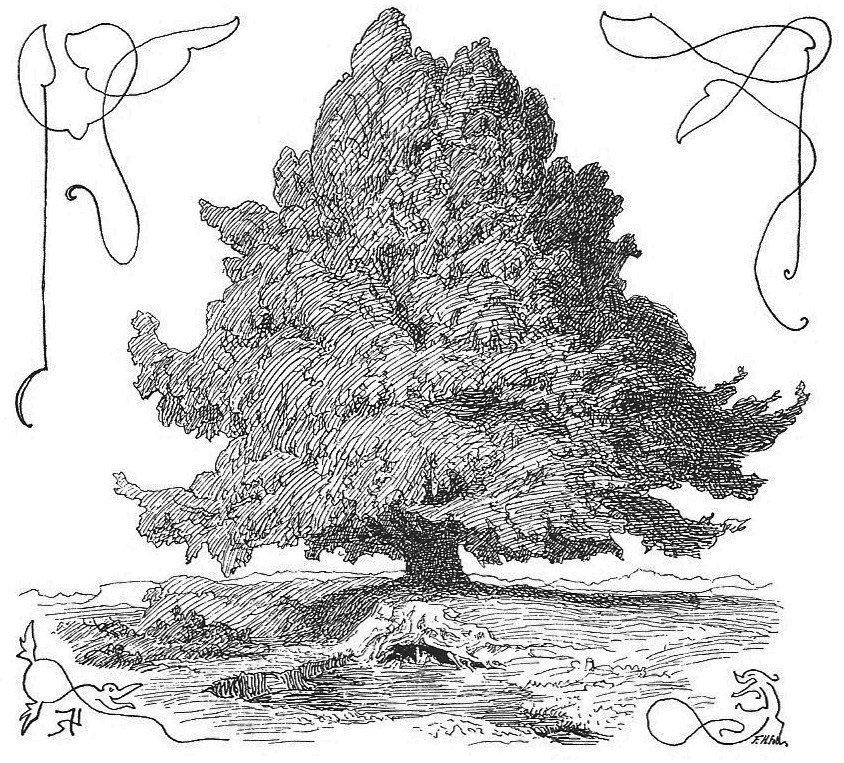
Nowhere do the animals crowd as closely as on the ash Yggdrasil. Grímnismál gives them four stanzas (32–35); Snorri sums up:
“On one of the boughs of the ash sits an eagle, who knows many things. Between his eyes sits a hawk that is called Vedfolner. A squirrel, by name Ratatosk, springs up and down the tree, and carries words of envy between the eagle and Nidhug. Four stags leap about in the branches of the ash and bite the leaves.”Snorri's Edda, Gylfaginning 16, translated by Rasmus B. Anderson (1880)
The eagle and Veðrfölnir. The eagle in the crown has no name in either source. Grímnismál mentions him only indirectly: Ratatoskr carries “the eagle's words” downwards (st. 32). The hawk between his eyes is known, in the texts used here, from Snorri alone (Gylfaginning 16). See The eagle and Veðrfölnir.
Ratatoskr. Grímnismál 32 names the squirrel and its task: to fetch the eagle's words from above and tell them to Níðhöggr below. That they are spiteful words (öfundarorð) is Snorri's addition. See Ratatoskr.
The four stags. Dáinn, Dvalinn, Duneyrr and Duraþrór gnaw the shoots with necks bent back (Grímnismál 33; Gylfaginning 16). Two of these names are also dwarf names: Dáinn and Dvalinn stand in the list of dwarfs that Snorri quotes from Völuspá in Gylfaginning 14, and a dwarf Dáinn makes the boar Hildisvíni in Hyndluljóð. What the doubling means cannot be established. More: The four stags.
Níðhöggr and the serpents. Níðhöggr gnaws from below (Grímnismál 35). The stanza before lists further serpents under the ash – Góinn and Móinn, Grábakr and Grafvölluðr, Ófnir and Sváfnir – that shall for ever wear away the tree's twigs (st. 34). Snorri says that so many serpents lie in Hvergelmir with Níðhöggr that no tongue can count them (Gylfaginning 16; for the gnawing at the root, ch. 15). In Völuspá he has a darker part: where oath-breakers and murderers wade through heavy streams, he sucks the corpses of the dead (st. 39), and in the poem's final stanza he comes flying as a “dark dragon” from Niðafjöll, bearing corpses in his feathers (st. 66). See Níðhöggr and The serpents beneath Yggdrasil.
Odin sums up the picture himself in Grímnismál 35: the ash suffers more than men know – the stag bites above, the side rots, Níðhöggr gnaws below. Snorri adds two more birds at the end of Gylfaginning 16: two birds feed in Urðr's well; they are called swans, and from them comes the whole kind of birds that bears the name. For swans in another role see swan maidens.
Gullinbursti. Freyr's boar has the fullest origin story. In Skáldskaparmál (ch. 43 in our source archive) the dwarf Sindri lays a pig's hide in the forge, his brother Brokkr works the bellows, a fly bites his hand as he blows – and out comes a boar with bristles of gold, which Brokkr gives to Freyr; the chapter does not use the name. At Baldr's funeral Freyr drives a chariot drawn by the boar “called Gullinbursti or Slíðrugtanni” (Gylfaginning 49). Skáldskaparmál 14 calls Freyr the boar's owner and repeats the second name. See Gullinbursti.
Hildisvíni. The name stands in a single stanza. In Hyndluljóð Freyja speaks of the boar that glows, “Gullinbursti, Hildisvíni”, made for her by two dwarfs, Dáinn and Nabbi (st. 7). Simrock translates “golden-bristled” as a quality of Freyja's boar Hildisvíni; read both as names, and her mount shares a name with Freyr's boar. The wording does not settle it. That the boar conceals Freyja's protégé Óttarr, whom Hyndla names as Freyja's companion in st. 6 and addresses from st. 12 on, is the usual reading of the poem; the stanzas read do not say so outright. In Skáldskaparmál Hildisvín is a helmet, not an animal (ch. 54). See also The boar in the North.
Freyja's cats. Two sentences in Snorri carry the whole motif. Gylfaginning 24: when Freyja travels, she drives two cats and sits in a chariot. Gylfaginning 49: to Baldr's funeral Freyja “drove her cats”. A list of kennings adds that she may be called “owner of the tomcats” (eigandi … fressa, Skáldskaparmál 28). The animals have no names anywhere; colour, breed and size go unmentioned. The team does not appear in the Eddic poems read for this article. More under The cat in the North.
Auðhumla. From the thawing rime a cow comes into being; four streams of milk run from her udders and feed the primeval giant Ymir. She herself licks salty rime-stones, and within three days a man emerges from them: hair on the first evening, a head on the second, the whole man on the third. His name is Búri, and he is Odin's grandfather (Gylfaginning 6). The cow is absent from the poems read for this article; whether Snorri retells a lost poem cannot be shown. See Auðhumla and Bestla and Bölþorn.
Árvakr and Alsviðr. These two horses draw the sun; under their shoulders the gods have placed “iron coolness” (ísarnkol; Grímnismál 37). Snorri explains the word in his own way: the gods set two bellows under the horses' shoulders to cool them, “and in some lore that is called ísarnkol” (Gylfaginning 11). A second pair belongs to day and night: Skinfaxi draws the day, Hrímfaxi the night, and the dew falls from his bit every morning (Vafþrúðnismál 12 and 14; Gylfaginning 10). Grímnismál 30 also lists ten horses of the Æsir, among them Gulltoppr, whom Snorri assigns to Heimdall (Gylfaginning 27 and 49).
Hræsvelgr. At the end of the sky sits a giant in eagle's shape; from his wings the wind comes over all men (Vafþrúðnismál 37). Snorri quotes the stanza in Gylfaginning 18 and places the giant at the northern end of the sky. Strictly speaking, then, Hræsvelgr is not an animal but a giant in animal form.
Fenrir. According to Gylfaginning 34, Loki has three children with the giantess Angrboða: the Fenris wolf, Jörmungandr and Hel. Hyndluljóð confirms the parentage of the wolf (st. 40). In the same chapter the Æsir have dwarfs make the fetter Gleipnir – from the sound of a cat's footfall, the beard of women, the roots of mountains, the sinews of bears, the breath of fish and the spittle of birds. The wolf will be bound only if someone lays a hand in his mouth; Týr does so and loses it (Gylfaginning 25 and 34). A sword props the bound wolf's jaws apart, and his slaver becomes the river Ván. At the world's end he breaks free, goes about with gaping mouth – upper jaw against the sky, lower jaw against the earth – and swallows Odin; Víðarr kills him (Gylfaginning 51). Völuspá puts it more briefly: Odin goes “to fight with the wolf” (st. 53). In Grímnismál the einherjar march out “when they go to fight the wolf” (st. 23). In full: Fenrir.
Jörmungandr. Odin throws the serpent into the deep sea that surrounds all lands; there it grows until it lies around all lands and bites its own tail (Gylfaginning 34). Thor meets it three times. In the hall of the giant Útgarða-Loki he is asked to lift a grey cat from the floor and gets only one paw off the ground – afterwards he learns that the cat was the Midgard Serpent (Gylfaginning 46–47). On the fishing trip with Hymir he baits it with an ox's head, hauls the “venom-gleaming serpent” up to the gunwale and strikes its head with his hammer (Hymiskviða 22–23). In Snorri, Hymir cuts the line, Thor throws the hammer after it, and the narrator believes the serpent still lives (Gylfaginning 48). At the world's end he kills it, walks nine paces and falls dead from its venom (Gylfaginning 51). Völuspá has the name too: Jörmungandr writhes in giant rage and lashes the waves (st. 50). See Jörmungandr.
Garmr. In Grímnismál's list of the best, Garmr is foremost “of hounds” (st. 44). Völuspá turns him into a refrain that comes four times in our reading edition (st. 44, 49, 54, 58): Garmr bays loudly before Gnipahellir, the fetter will break and “the freki” run free. Freki is a poetic word for a wolf (Skáldskaparmál 71; likewise the Cleasby–Vigfússon dictionary). Whether the refrain means a hound and a wolf, or one beast twice, the wording leaves open. Snorri keeps the two apart: for him Garmr is a dog, bound before Gnipahellir, “the greatest monster”; he fights Týr, and each kills the other (Gylfaginning 51). More under Garmr.
Sköll and Hati. Grímnismál 39: Sköll is the wolf that follows the “bright-faced deity”; the other, Hati, son of Hróðvitnir, runs before the “bright bride of heaven”. The stanza does not mention the moon. It is Snorri who assigns the parts: Sköll pursues the sun, Hati runs ahead of her and means to seize the moon (Gylfaginning 12). In the same chapter he names a third wolf, Mánagarmr, mightiest of the brood of the old giantess in the Iron Wood, who will swallow the moon. For this Snorri quotes Völuspá 40, which speaks of “Fenrir's kin” and a “snatcher of the heavenly body”. In Gylfaginning 51 “the wolf” then swallows the sun and “the other wolf” takes the moon – no names given. And in Vafþrúðnismál it is Fenrir who gets the sun (st. 46). The sources do not agree on who devours which light. See Sköll and Hati.
The three cocks. Völuspá 42–43: in the “gallows wood”, among the giants, crows a fair-red cock called Fjalarr; among the Æsir crows Gullinkambi and wakes the heroes at the Father of Hosts'; beneath the earth a soot-red cock crows in the halls of Hel. These cocks do not occur in the Gylfaginning of our source archive. See Gullinkambi.
Two eagles frame the downfall. As the ship Naglfar comes loose, an eagle screams (Völuspá 50). When the earth rises from the sea a second time, an eagle flies over it, one “that hunts fish on the fell” (st. 59).
Set poem and prose side by side and a pattern appears. Grímnismál supplies the frame: a name, a place, an activity. Snorri supplies the species where it is missing (ravens, wolves, boar), the explanation where the poem is dark (bellows for “iron coolness”), and the character where the poem stays neutral (Ratatoskr's spiteful words).
No verdict on authenticity follows from that. Snorri may have known older tradition now lost; he may equally have ordered, smoothed and added. Usually neither can be proved. Only the layering is certain: what stands in Snorri alone is attested for the thirteenth century, not automatically for the Viking Age. That covers Auðhumla, Veðrfölnir, the names of the goats, Freyja's cats, Sleipnir's eight legs and Mánagarmr – measured against the poems read for this article. Skaldic stanzas can shift the picture in individual cases; the raven names are an example.
Which animals belong to Odin? The horse Sleipnir (Grímnismál 44; Gylfaginning 15 and 42), the ravens Huginn and Muninn (Grímnismál 20; Gylfaginning 38) and the wolves Geri and Freki (Grímnismál 19; Gylfaginning 38). Only Snorri states outright that they are ravens and wolves.
How many animals live on Yggdrasil? Named are a squirrel, four stags, Níðhöggr and six further serpents (Grímnismál 32–35), plus a hawk in Snorri. The eagle is nameless. There is no fixed total: Snorri speaks of countless serpents and of two swans in Urðr's well (Gylfaginning 16).
Does Thor have a horse? Not in the texts read here. Grímnismál lists the horses of the Æsir, and Snorri notes expressly that Thor walks to the place of judgement and wades through rivers (Grímnismál 29–30; Gylfaginning 15). His vehicle is the goat-drawn chariot.
Is Garmr the same as Fenrir? That cannot be decided with certainty. The refrain of Völuspá names Garmr and, in the same breath, a “freki”, a wolf. Snorri treats Garmr as a separate dog who fights Týr, while Fenrir swallows Odin (Gylfaginning 51).
Which animals survive Ragnarök? After the downfall Völuspá mentions an eagle hunting fish above the newly risen earth (st. 59) and, in the final stanza, the flying Níðhöggr (st. 66). The texts read here say nothing about the fate of Sleipnir or the ravens. More under Ragnarök.
Animals of the North · Grímnismál: Odin between the fires · Gylfaginning: the Tricking of Gylfi · Yggdrasil – the world tree · Sleipnir – Odin's steed.
They howled like wolves, wore the pelts of predators and were reckoned the most dangerous fighters of the North: the …
Read more →Utgard-Loki is the giant king of Útgarðr who humiliates Thor with illusions in Snorri Sturluson's Gylfaginning …
Read more →In the late tenth century an Icelander composes a praise-poem for the most powerful man in Norway and calls it "Lack of …
Read more →A hundred rastir in every direction, one name, one enemy: that is all the Poetic Edda says about the place where …
Read more →