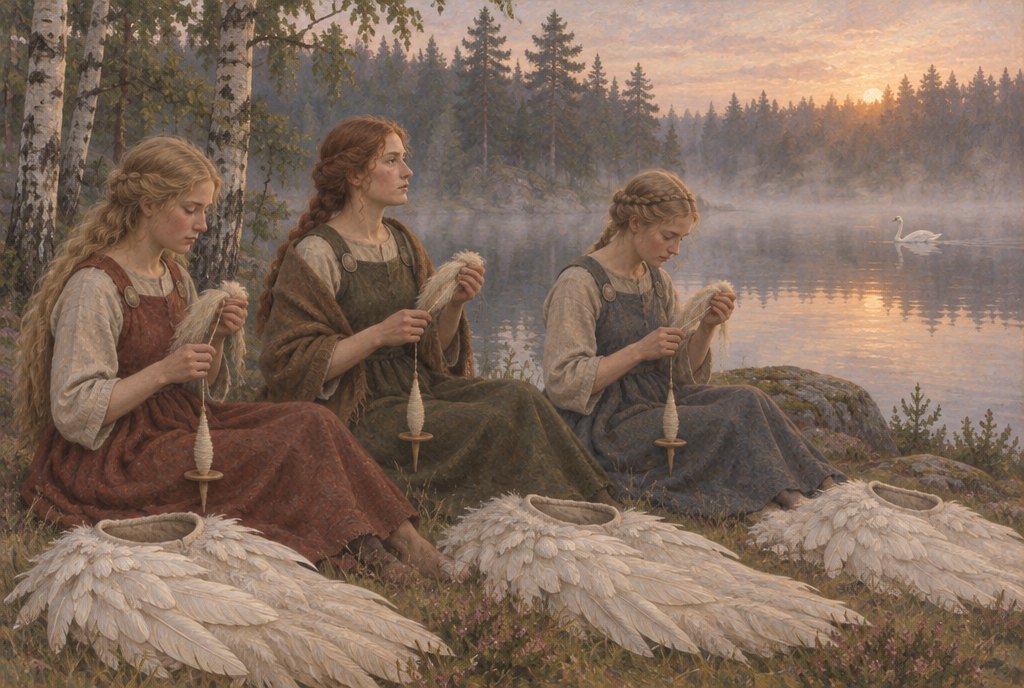
A man surprises women bathing, takes one woman's feather dress and so forces her into marriage; years later she finds the dress and flies away. That is the swan maiden of the fairy tale. The Old Norse texts tell it differently. They have swan-skins but no theft, and at the decisive point the word “valkyrie” stands in a single sentence of prose. We go through the evidence piece by piece – Völundarkviða, Helreið Brynhildar, the Kára tradition and the Nibelungenlied – and keep verse, scribal addition, late saga and modern interpretation apart.
Völundarkviða, the Eddic lay of Völund the smith, does not open with verse in the manuscript but with a short piece of prose. It introduces King Níðuðr in Sweden and then three brothers, sons of a “king of the Finns”: Slagfiðr, Egill and Völundr. They travel on skis, hunt, and build themselves a house in Úlfdalir, the Wolf Dales. There is a lake there called Úlfsjár, “Wolf Lake”.
Then come the sentences that concern us. Early one morning the brothers find three women on the shore, spinning linen. Beside them lie their álftarhamir – literally “swan-skins” or “swan-shapes”. The next sentence has three words: Þat váru valkyrjur, “those were valkyries”. Two of them are daughters of a King Hlöðvér, namely Hlaðguðr svanhvít (“Swan-white”) and Hervör alvitr; the third is Ölrún, daughter of Kjárr of Valland. The brothers take the women home. Egill gets Ölrún, Slagfiðr gets Svanhvít, Völundr gets Alvitr. They live together for seven winters. Then the women fly off “to seek out battles” (at vitja víga) and do not come back. Egill and Slagfiðr go after them. Völundr stays.
That is all the prose says. What happens to Völund next is told in our article on Völund the smith. Here we stay with the women.
The stanzas are more sparing than the introduction. Stanza 1 has “maids from the south” fly through Myrkviðr, the dark forest; they sit down to rest on the shore, “southern women” (drósir suðrænar), and spin costly linen. Stanza 2 pairs them off: one takes Egill in her arms, the second “was Svanhvít, she wore swan-feathers” (svanfjaðrar dró), the third puts her arms round Völund's white neck. Stanza 3 gives the time span: seven winters, longing in the eighth, and in the ninth need parts them. The maidens yearn for the dark wood, örlög drýgja, “to work fate” or “to fulfil their destiny”. In stanza 4 the hunters come home and find the halls empty; Egill heads east after Ölrún, Slagfiðr south after Svanhvít. Stanza 5 shows Völund alone, forging rings and waiting. The Old Norse with Bellows's translation is in our reading edition of Völundarkviða.
In the verse, then: the women fly. One is called Swan-white and wears swan feathers. A later stanza (no. 15 in the numbering of our source archive) gives the names: Hlaðguðr and Hervör, daughters of Hlöðvér, and Ölrún, daughter of Kjárr. What is not in the verse: the word valkyrie, the Wolf Lake, the skins laid aside on the shore, the king of the Finns.
The word alvitr, which stands next to “young” in stanzas 1, 3 and 10, is uncertain. The prose turns it into a byname of Hervör. Simrock's German translation treats it as a personal name, Bellows renders it “fair and young” in stanza 1 and “all-wise maid” further on. The English Wikipedia article on the poem glosses it as “foreign beings”. The readings differ, and I do not commit to one.
Only the prose claims that the three women are valkyries. The translator Henry Adams Bellows said so plainly in his notes of 1923: the poem gives the statement little support, and he suspected that whoever wrote the prose “was mistaken in his mythology”. Bellows thought the identification might predate the story's arrival in the North, or might be an attempt to attach a southern tradition to familiar northern figures. He left it open.
Two things speak for the prose all the same. According to the introduction the women fly off to seek battles, which suits valkyries and corresponds to the ambiguous formula about fate in the verse. And women “from the south” are valkyries elsewhere in Eddic heroic poetry: in the second Helgi lay Helgi addresses the valkyrie Sigrún as “sun-bright, southern” (sólbjört, suðræn, stanza 45 in our source archive); that valkyries can also be called dísir is shown in our article on the dísir. Against it: no other source knows valkyries who spin flax for seven years and keep house with hunters in the forest. For valkyries elsewhere see our article on the valkyries.
On transmission: the poem survives complete only in the Codex Regius, an Icelandic manuscript of about 1270. The beginning of the prose introduction is also preserved in the fragment AM 748 I 4to. Bellows counted the poem among the oldest of the collection on linguistic grounds. When the prose was added cannot be established; it is no younger than the manuscript.
Read Völundarkviða with the fairy tale in mind and you supply a scene unasked: the brothers take the skins away. The text does not say so. The prose says only that the skins lay beside the women and that the brothers took the women home. Nothing is said about taking, hiding or force. In stanza 2 it is the women who act: they take the men in their arms.
The ending does not follow the fairy tale either. There the wife finds her hidden dress and escapes. Here an inner restlessness drives the women away – longing in the eighth winter, “need” in the ninth. They evidently had their skins all along. And where the fairy tale follows the husband on his quest, the poem drops the two searching brothers at once and stays with the one who waits.
Whether an older version knew the theft is a guess that can be neither proved nor refuted. Völundarkviða attests women with swan-skins who enter a marriage with humans for a limited time. It does not attest the theft of the garment.
Álftarhamir is usually translated “swan-garments” or “swan-shirts”. But Old Norse hamr means first of all “skin”, “covering”, “shape”. Whoever slips into a hamr is not dressing up but changing form. Our article on fylgja and hamingja explains the term more fully.
Bird-skins of this kind occur several times in Norse tradition, among gods and giants. In Þrymskviða Thor asks the goddess Freyja for her fjaðrhamr, her feather-skin; Loki flies to the land of the giants in it, and the poem remarks twice that the feather-skin whirred. In Snorri's Skáldskaparmál Loki borrows Freyja's valshamr, the falcon-skin, to fetch Iðunn back, and the giant Þjazi pursues him in an arnarhamr, an eagle-skin. Frigg too owns a falcon-skin, according to Snorri.
The swan-skins thus belong to a familiar idea. Two things set them apart. The falcon and eagle skins are lent and used for a particular flight, whereas the swan-skins belong permanently to their wearers. And the swan is rare in this role. For the others see our overview of the animals of Norse mythology.
The second Eddic passage stands in a quite different setting. In Helreið Brynhildar, “Brynhild's Hel-ride”, the dead Brynhild travels to the realm of the dead on a wagon, is stopped by a giantess and justifies her life. In doing so she says one thing about her youth:
“The monarch bold the swan-robes bore
Of the sisters eight beneath an oak;
Twelve winters I was, if know thou wilt,
When oaths I yielded the king so young.”Helreið Brynhildar, stanza 6 in Bellows's numbering (stanza 8 in the Old Norse text after Guðni Jónsson); translation Henry Adams Bellows, 1923
The original reads hami vára … átta systra: “our skins, of the eight sisters”. Two details matter. First, the text says only hamir, skins. The stanza does not mention swans. Bellows's “swan-robes” is already interpretation, based on Völundarkviða; Simrock was more cautious and wrote “Fluggewande”, flying garments. Second, the translators count differently: Bellows has eight sisters in all, Simrock makes it Brynhild and eight sisters, that is nine. The wording allows both.
Who is the king? The poem does not name him here. The stanza immediately next to it, which is missing in Simrock and Bellows, speaks of Agnarr, brother of Auða; Brynhild then gives him victory against Odin's will, for which Odin casts her into sleep. The passage is therefore often understood to mean that Agnarr had the skins seized and so bound the women to himself. That would make it the only instance of a garment theft in the Edda – though without a bath, without a marriage, and with an oath as the outcome. The stanza is so brief that this reading remains an interpretation. The full text is in our source archive, Brynhild's whole story in the article on Brynhild.
The third Norse witness is the most vivid and also the youngest. At the end of the second lay of Helgi Hundingsbani there is a prose note: Helgi and Sigrún, it is said, were born again; he was then called Helgi Haddingjaskati and she Kára, daughter of Hálfdan, “as is told in the Káruljóð, and she was a valkyrie”. That Lay of Kára is lost. The note says nothing about a swan. More on this in the article on Helgi and Sigrún and in the source text.
The swan appears only in Hrómundar saga Gripssonar. There the opponent of the hero Hrómundr is called only “Helgi the Bold” (Helgi inn frækni); he fights for two kings from Sweden, both named Hadding. The saga does not say that he is Helgi Haddingjaskati; that is an inference scholars draw from the names. Above the fighting flies Helgi's mistress Kára, a sorceress, in the shape of a swan. Her singing and spells make the enemy forget to defend themselves. Then the accident happens: Helgi swings his sword so high that he cuts off the swan's leg. Kára drops down dead, and Hrómundr cleaves Helgi's helmet and skull. Older printed editions call the woman “Lára”; the translator Nora Kershaw explains this as a misreading, the manuscripts having “Cara”.
The scene needs careful handling. According to Þorgils saga ok Hafliða a saga about Hrómundr was recited at a wedding at Reykjahólar as early as 1119; that version does not survive. What survives is Griplur, a set of rhymed narrative verses (rímur) placed, depending on the authority, in the first half of the fourteenth century or around 1400, and a prose saga that exists only in paper manuscripts from the seventeenth century onward and is widely held to have been reconstructed from such rímur. I rely on Nora Kershaw's English translation of the saga and her introduction; I have not read Griplur or the Old Norse wording. That the scene preserves remnants of the lost Káruljóð is plausible but unproven. Kára's swan shape is therefore securely attested only from the late Middle Ages onward.
The classic theft of clothing is not found in the North but in a Middle High German epic. In the twenty-fifth âventiure of the Nibelungenlied the Burgundians ride to the court of King Etzel and reach the Danube in flood. Hagen looks for a ferryman and comes upon water-women bathing in a spring to cool themselves. He takes their clothes. In the English prose translation I read, the women “floated before him on the flood” like birds.
A bargain follows. One of them, Hadburg, promises him a prophecy if he gives the clothes back, and foretells a fortunate journey with great honours. No sooner are the clothes returned than the other, Siegelind, says that her aunt has lied. None of them will come home except the king's chaplain. Hagen tests this in his own way: during the crossing he throws the chaplain overboard. The man reaches the bank and turns back. Hagen now knows that the women told the truth.
The text does not call these women swan maidens and describes no feather dresses; the translation speaks of “wise women” and mermaids. A footnote by the translator nevertheless takes them to be probable swan maidens whose clothes give Hagen power over them, and cites Jacob Grimm for it. That is interpretation, not the wording of the poem. Three features of the motif remain: the bath, the stolen clothes used as leverage, and the comparison with birds, together with a knowledge of the future. For the historical background see our article on the Burgundians.
Folktale scholarship classifies tales by the index of Aarne, Thompson and Uther, ATU for short. The swan maiden belongs chiefly to type 400, “The Man on a Quest for His Lost Wife”. As a single motif she has the number D361.1 in Stith Thompson's motif index; taking the clothes of a bathing girl is listed there under K1335 as well. Both motifs are also listed there for type 313.
In the Grimms' Children's and Household Tales, “The Drummer” (KHM 193) is assigned to this type; I take that from the Wikipedia survey and have not consulted the type index itself. Johann Karl August Musäus had already given the material a literary treatment in 1784 in “Der geraubte Schleier” (“The Stolen Veil”). Jacob Grimm connected the swan maidens with the valkyries in his “Deutsche Mythologie”; how far such bridges between fairy tale and myth hold is examined in our article on the Brothers Grimm and the old gods.
Scandinavian folk tradition of the modern period knows marriage to a woman from the other world without feathers too. The huldra follows a young man to his farm and loses her cow's tail at the wedding.
The swan maiden is not Norse, or at least not only Norse. According to the Wikipedia survey of the motif, which I could not check against specialist literature, the oldest record of the fully formed narrative is held to be a Chinese one of the fourth century, transmitted in the “Sou shen ji” of Gan Bao, who died in 336. A Japanese version is traced back to a provincial gazetteer of the eighth century. The story is found from Scandinavia to Manchuria and in the Americas.
Several proposals exist about its origin, none of them secure. The older assumption of an Indian source is regarded as outdated. In 1961 A. T. Hatto asked in the very title of an essay whether the swan maiden is a folk-tale of north Eurasian origin. According to the summary I have seen – I have not read the essay itself – he connected the motif with the migratory water birds of northern latitudes. The reasoning is easy to follow: swans, geese and cranes come and go with the seasons, as she does.
For Völundarkviða in particular Bellows pointed south. The name Hlöðvér, he noted, is the northern form of Ludwig, Kjárr of Valland also appears in Atlakviða, and the poem itself mentions the Rhine (stanza 14 in our source archive). He therefore considered the swan-maiden story too to be of German rather than Scandinavian origin. That is a judgement of 1923. But the Franks Casket also shows that the Wayland story was known in England long before it was written down in Iceland.
Valkyrie. This interpretation stands in the sources themselves, in the prose to Völundarkviða and in the note about Kára. It is medieval, not a modern invention. Whether it is old remains open. The verse supports it only weakly, and the clearest scene – Kára above the battle – comes from late tradition.
Fylgja. In the sagas the fylgja is a personal follower-spirit that appears as an animal or as a woman. A woman in animal shape who protects a warrior recalls this, and for Kára the comparison suggests itself. The two should not be equated: the animal fylgja mirrors the nature of its person and often shows itself in dreams, while Kára is an independent figure with a father, a name and a love story. I know of no study that convincingly shows swan maidens to be fylgjur.
Shamanism. In the prose the brothers are sons of a king of the Finns, they ski, and the women fly in bird shape – from this a Sámi or Siberian background is readily inferred. For the Eddic poem the argument carries little weight: the king of the Finns appears only in the prose, and Bellows took him for a later addition. Finns, as he notes, were thought to have magic powers; the scribe may have supplied the brothers' descent for exactly that reason. It is a hypothesis, not a fact.
What is a swan maiden? A woman who takes the shape of a swan by means of a feather skin. In the fairy tale a man takes the skin away and marries her; when she finds it again she leaves him. In the Norse sources the theft is mostly absent.
What are the swan maidens of the Edda called? The prose to Völundarkviða names Hlaðguðr svanhvít, Hervör alvitr and Ölrún. The first two are daughters of a King Hlöðvér; Ölrún is the daughter of Kjárr of Valland.
Are swan maidens valkyries? The Eddic prose equates them twice: for the three women of Völundarkviða and for Kára. The stanzas themselves do not say so. The equation is medieval; how old it is remains uncertain.
Who was Kára? According to a prose note in the Edda, the reborn Sigrún, lover of Helgi Haddingjaskati and a valkyrie. In Hrómundar saga Gripssonar a Kára flies above the battle as a swan until her lover Helgi accidentally strikes her with his sword and she drops down dead.
Is there archaeological evidence for swan maidens? I know of no find that can be read that way without doubt. Picture stones and the Franks Casket show scenes from the Wayland legend; whether the swan women are meant as well cannot be established with certainty.
Völund the smith · Valkyries · Brynhild · Helgi and Sigrún · Fylgja and hamingja · Huldra and skogsrå · Freyja and her feather cloak · The Brothers Grimm and the old gods · Franks Casket · Animals of Norse mythology
Voelund the Smith · The Valkyries · Brynhild · Helgi and Sigrún – The Valkyrie Who Met the Dead in the Mound · Fylgja & Hamingja.
Sigurd is the greatest hero of the North: the Volsung who kills the dragon Fáfnir with the sword Gram, wakes Brynhild …
Read more →Sindri (called Eitri in some editions) and Brokkr are the dwarf brothers who, according to Snorri Sturluson's …
Read more →A boy kneads a venomous snake into the bread dough and does not flinch. A few years later he is stuck with his father …
Read more →Almost everything we think we know about Odin, Thor and the end of the world runs through a single figure: an Icelandic …
Read more →