A boy kneads a venomous snake into the bread dough and does not flinch. A few years later he is stuck with his father inside a wolf-skin neither of them can take off, and kills eleven men on his own. Sinfjötli is the darkest figure of the Völsung legend: conceived by brother and sister, raised for a single act of revenge, poisoned in the end by his stepmother. This article follows the story through the Old Norse text, chapter by chapter, and separates what the saga says from what later readers have added – the “werewolf”, the warrior initiation, Odin in the boat.
Sinfjötli (Old Norse Sinfjǫtli) belongs to the Völsungs, the legendary family that traces itself back to Odin and whose most famous member is the dragon-slayer Sigurd. Sinfjötli is Sigurd's elder half-brother. They share a father, Sigmund, but never meet in the legend: Sinfjötli dies before Sigurd is born.
In the Völsunga saga his story forms a self-contained block. It is about a blood feud that takes a generation to settle, and about a woman, Signý, who gives up everything for it, her children included. The wolf-skin episode, the reason he is usually mentioned today, takes up only a few lines, and what they say is stranger than most retellings.
The fullest version is in the Völsunga saga, an Icelandic prose narrative of the thirteenth century that retells older heroic poems. Its main manuscript, NKS 1824 b 4to, is dated to around 1400. I quote from the Old Norse text in our source archive (after heimskringla.no); the chapter numbers used here, 5 to 10, follow that edition and the English translation by William Morris and Eiríkr Magnússon.
The second witness is a short prose passage in the Codex Regius of the Poetic Edda (c. 1270): Frá dauða Sinfjötla, “Of Sinfjötli's Death”. The third is the Helgi poems in the same manuscript, where Sinfjötli is the spokesman in an exchange of insults. The fourth is Snorri's Skáldskaparmál, with a skaldic stanza that calls poison “the drink of the Völsungs”. Two voices come from outside Iceland: the Old English epic Beowulf, which knows a Fitela at Sigemund's side, and the memorial poem Eiríksmál, in which Sinfjötli sits in Valhalla.
These witnesses are not independent. The saga used the Eddic poems; the Codex Regius prose and the saga chapter on the poisoning agree almost word for word in places. For the years in the forest – conception, tests, wolf-skins – the saga stands alone. It quotes just two lines of verse at that point. Henry Adams Bellows concluded in the notes to his Edda translation that an old poem on this material had probably been lost.
King Siggeir of Gautland has married Signý, daughter of King Völsung. He invites his father-in-law and brothers-in-law and attacks them. Völsung falls; his ten sons are captured. Signý asks for a delay: instead of killing her brothers at once, Siggeir should have them set in stocks in the forest, a heavy beam across their feet.
What follows is the saga's first wolf scene (chapter 5). For nine nights running an old she-wolf comes out of the forest at midnight and eats one brother each time. Before the tenth night Signý has honey smeared on Sigmund's face and put in his mouth. The wolf licks his face and pushes her tongue into his mouth; he bites down and holds on until the tongue tears out at the root and she dies. The saga adds that “some men say” this she-wolf was Siggeir's mother, who had taken that shape through sorcery.
The narrator reports the transformation as hearsay. Even so, the tone is set: in this story people can be wolves, and at first the wolf is on the enemy's side. Our article on the wolf in the North looks at the animal's double role.
Sigmund hides in an earth-house in the forest and Signý supplies him in secret. Signý wants vengeance for her father and looks for a helper for her brother. Chapter 6 tells how she sends her elder son by Siggeir to Sigmund when the boy is ten winters old. Sigmund hands him a sack of meal and tells him to bake bread. The boy does not dare touch the sack because something alive is moving in the meal. Sigmund tells his sister the lad is no use to him. Her answer is brief: then kill him, he need not live any longer. A year later the younger son goes the same way.
Chapter 7 reports the next step without a word of comment. A woman skilled in sorcery, a seiðkona, visits Signý, and the two exchange appearances. The sorceress lies with the king; Signý goes to the forest, poses as a stranger who has lost her way and asks her brother for shelter. He finds the woman fair, and they share a bed for three nights. Signý goes home, changes back, and bears a son: Sinfjötli. For the magic in the background, see seiðr.
Signý explains herself only at the very end, in her last speech: Sinfjötli has such fighting spirit because he is “both son's son and daughter's son of King Völsung”. The saga thinks in terms of descent. Two children with Siggeir's blood failed; a child who is Völsung on both sides passes. As she had done with his half-brothers, she sews his sleeve to his arm through skin and flesh, then pulls the tunic off so that the skin comes away with it. The half-brothers had cried out. Sinfjötli only says that a Völsung would think little of such pain.
Then comes the meal test. When Sigmund returns with firewood, the bread is baked. Asked whether he found anything in the meal, the boy says he suspected something alive in it and simply kneaded it in. Sigmund laughs and forbids him to eat the bread: it was the most venomous of snakes. The narrator spells out the difference between the two. Sigmund could eat poison and take no harm. Sinfjötli could bear poison only on his skin, not in food or drink. The aside prepares his death.
Sigmund still thinks the boy too young and sets out to harden him (chapter 8). Summer after summer they range through the forests and kill men for plunder. Sigmund takes Sinfjötli for a son of Siggeir, with his father's malice and the Völsungs' drive, and not much attached to his kin, since he keeps urging Sigmund to kill Siggeir.
One day they find a house. Two men wearing thick gold rings lie asleep in it, and above them hang úlfahamir, wolf-skins. In my translation: “They had fallen under an evil spell, for wolf-skins hung in the house above them. Every tenth day they could come out of the skins. They were kings' sons.” Sigmund and Sinfjötli put the skins on and cannot get out again. The nature that went with the skins passes to them; they howl with a wolf's voice, and both understand that voice.
They agree that each is to take on up to seven men alone, but no more; whoever is hard pressed gives the wolf's howl. Sigmund meets seven men and howls. Sinfjötli comes and kills them all. Then Sinfjötli meets eleven men, does not call, and kills them alone. Badly wounded, he rests under an oak. When Sigmund arrives, the boy taunts him: Sigmund needed help for seven, while he, a child in years beside him, asked for none against eleven. Sigmund springs at him so hard that he falls, and bites him in the front of the throat.
That day they cannot get out of the skins. Sigmund carries the wounded boy home on his back, sits over him and wishes the wolf-skins to the trolls. Then he sees two weasels. One bites the other in the throat, runs into the wood, fetches a leaf and lays it on the wound; the injured animal jumps up healed. Sigmund steps outside and sees a raven flying towards him with such a leaf, which it brings him. He draws it over Sinfjötli's wound, and the boy stands up as if he had never been hurt. When the time comes they take the skins off, burn them, and pray that they may harm no one again.
The word “werewolf” does not occur in the episode. The saga speaks of hamr, plural hamir. The word means skin, pelt, outward shape, and it also appears in Signý's request to the sorceress: she wants the two of them to exchange hamir. Shape, in this way of thinking, is something you put on and take off like a garment. With the skin you change your nature, but not all of your wits: inside the wolf-skins Sigmund and Sinfjötli make agreements, count opponents and quarrel over honour.
The condition itself is called ósköp, ill fate or a curse. Who cursed the two kings' sons, and why, we are not told. What becomes of them is left open; the saga does not say they are killed, although some summaries put it that way.
One small point concerns the interval. The original has “it tíunda hvert dægr”. Translations usually render this as “every tenth day”, as Morris and Magnússon do. According to the dictionary entry I consulted, however, dægr (also dœgr) denotes a twelve-hour period, a half-day, which would halve the interval. I have seen no commentary on the passage and leave the question open.
And the raven. The bird counts as Odin's, and Odin intervenes in the Völsung legend more than once. That the raven is the god's messenger is an obvious reading. The text mentions a raven and a leaf, nothing more. On Odin's birds see Hugin and Munin.
Once Sinfjötli is grown, Sigmund considers him proven. One evening the two hide by the ale casks in the forecourt of Siggeir's hall. Two small children of the royal couple are playing with gold rings in the hall; a ring rolls out into the forecourt, a child runs after it, sees two big, grim men in helmets and bright mail-coats, and tells his father.
Signý leads the children out and advises the men to kill them, because they have betrayed them. Sigmund refuses. Sinfjötli does not hesitate; he kills both and throws them into the hall at Siggeir's feet. The saga passes no judgement; it leaves that to a later opponent of Sinfjötli's.
The two are overpowered. Siggeir chooses a slow death: he has a mound of stone and turf raised, with a great stone slab set on edge in the middle, so that the prisoners sit apart and can only hear each other. Before the mound is closed Signý throws a bundle of straw in to Sinfjötli. Inside it is pork, and inside the pork is Sigmund's sword. Sinfjötli drives the point over the top of the slab, Sigmund grips it, and together they saw through the stone. Here the saga quotes its only verse on this material: with might Sigmund and Sinfjötli cut the great slab with the sword.
They set fire to the hall. When Siggeir asks who has done this, Sigmund answers: “Here are we two, I and Sinfjötli, my sister's son,” and the king should know that not all the Völsungs are dead. He offers Signý the chance to come out. She declines and says what Sigmund had not known until then: she came to him in the forest in the shape of a seeress, and Sinfjötli is their son. She has done so much for this revenge that she cannot go on living. She will now die willingly with the man she married unwillingly. She kisses brother and son and walks into the fire.
Sigmund wins back his father's kingdom and marries Borghild; their sons are Helgi and Hámundr. When Helgi goes to war at fifteen, Sinfjötli is sent with him. Before the battle against Höðbroddr an opponent calls from the shore to ask who leads the fleet, and Sinfjötli answers. The result is a senna, a formal exchange of abuse. In Helgakviða Hundingsbana I the opponent is Guðmundr; in the saga (chapter 9) he is called Granmarr.
The accusations are crude; the pattern is described in our article on Helgi and Sigrún. What matters for Sinfjötli is what the other man knows about him: that he has eaten “wolves' food”, has been the slayer of his brothers, and lay out in the woods as Siggeir's stepson, “used to wolf-howling” (stanzas 36 and 41 in our archive's numbering, 38 and 43 in Bellows). Sinfjötli for his part boasts of having fathered nine wolves on his opponent. The poem thus assumes that the forest years and the dead siblings are common knowledge – as a disgrace, not as a heroic deed. Helgi ends the quarrel: fighting would become them better than such talk.
Bellows considered the poem one of the latest in the Edda, hardly earlier than the second quarter of the eleventh century, and thought the flyting might derive from an older poem.
Sinfjötli courts a woman whom Borghild's brother also wants, and kills him in the fight that follows (chapter 10). Borghild demands that he leave the kingdom. Sigmund refuses and offers her compensation, although he has never before paid for a man he or his had killed. She has to accept, and holds the funeral feast for her brother.
There she brings Sinfjötli a horn three times. At the first he says the drink is cloudy. Sigmund takes the horn and empties it. At the second he calls the drink treacherous; again his father drinks. At the third she challenges him to drink if he has the courage of the Völsungs. Sinfjötli says: “There is poison in the drink.” Sigmund answers: “Lát grön sía, sonr” – let your moustache strain it, son. The saga adds that the king was very drunk by then. Sinfjötli drinks and falls dead.
The Eddic prose is briefer and set differently. There Sigmund is king in “Frakkland”, the land of the Franks, Borghild's realm lies in Denmark, and Sinfjötli is the eldest of three sons. The name of Borghild's brother is missing; the Old Norse text has a gap at that point. Simrock's German translation supplies “Borgar” – on what basis I could not check – while Bellows leaves the gap. The remark about drunkenness is absent from the Edda.
That the story of the poison-proof Sigmund is old is supported by a stanza Snorri attributes to the skald Bragi, who is usually placed in the ninth century. It paraphrases the Midgard Serpent as the eel of “the Völsungs' drink”, meaning poison. Such a kenning only works if the audience knows the legend.
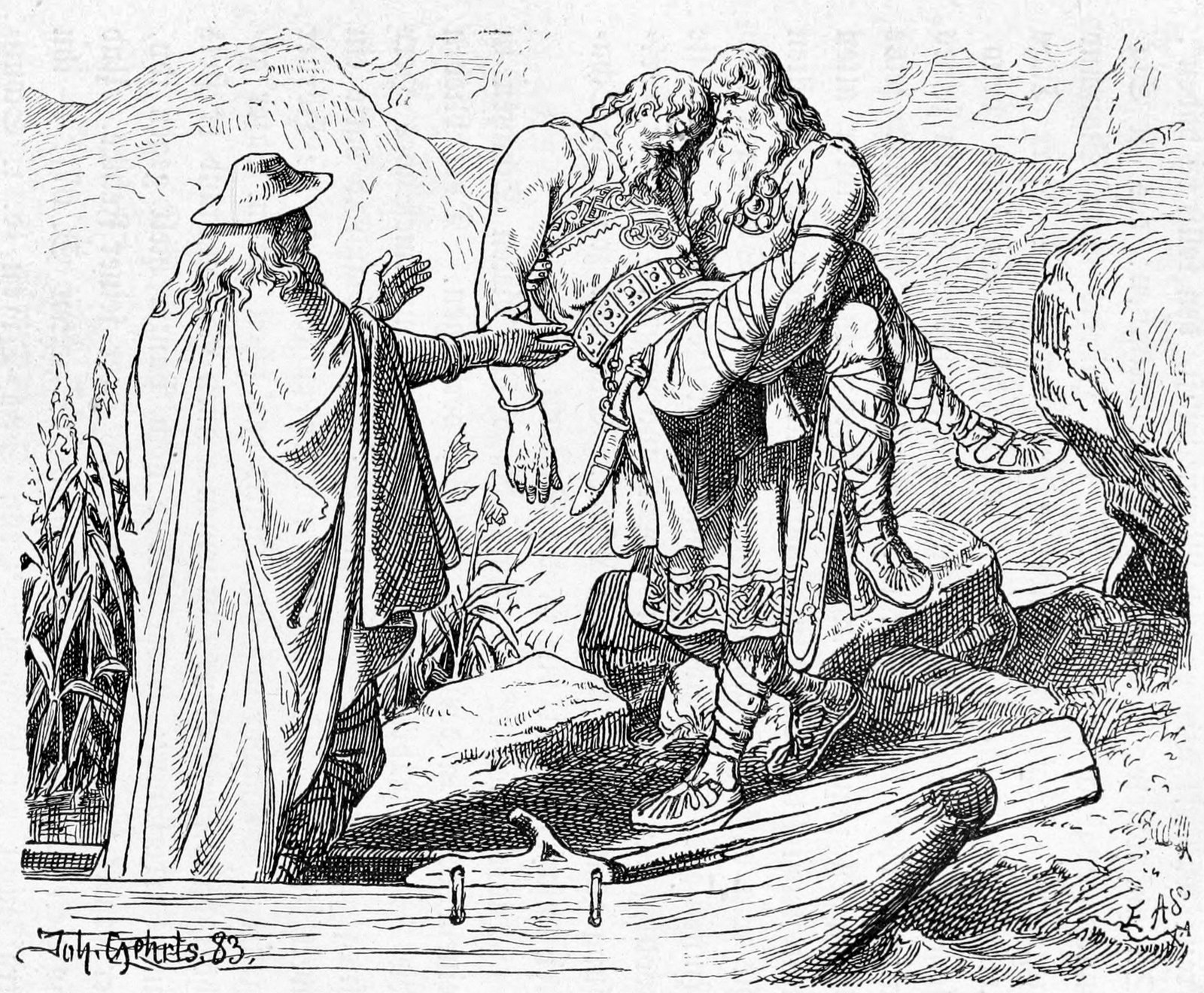
Sigmund takes the dead man in his arms and carries him away until he reaches a fjord.
“Sigmund bore him a long way in his arms, and came to a narrow and long fjord, and there was a little boat and a man in it. He offered to take Sigmund across the fjord. But when Sigmund had borne the corpse out into the boat, then the craft was full. The man told Sigmund to go round the inner end of the fjord. Then the man pushed the boat off, and disappeared.”Poetic Edda, Frá dauða Sinfjötla (prose), translated by Henry Adams Bellows (1923)
What is missing is a name. The Edda calls the man karl, “old man” or simply “fellow”; the saga says only “a man in a small boat”. Neither text says he is Odin. The identification is well founded, since Odin appears repeatedly in the Völsung legend as a nameless stranger. It remains an interpretation. Sigmund goes home and drives out Borghild, who dies soon afterwards.
In Beowulf, after Grendel's defeat, a song is sung of Sigemund the “Wælsing” (lines 875–900). The song says that Sigemund and Fitela, “ēam his nefan”, uncle and nephew, killed many giants (lines 879–884). Fitela is the Old English counterpart of the second element in Sinfjötli's name. The dragon fight, which the North gives to Sigurd, belongs in Beowulf to Sigemund himself; Fitela is expressly absent: “ne wæs him Fitela mid” (line 889).
The pair Sigmund and Sinfjötli were known outside Scandinavia, in a manuscript usually dated to around the year 1000. And the English poet calls Fitela a nephew, not a son. Whether he did not know the incest story or passed over it cannot be decided. In the saga, too, Sigmund himself speaks of his “sister's son” until Signý's last speech.
Eiríksmál, a poem on the death of Eric Bloodaxe (killed in 954), survives as a fragment in the kings' saga compilation Fagrskinna. In it Odin has Valhalla made ready for a newcomer and sends two heroes out to receive him: Sigmund and Sinfjötli. The line begins: “Sigmundr ok Sinfjötli, rísið snarliga” – rise quickly. More in our articles on Eric and on the einherjar. If the usual dating holds, Sinfjötli counted in the tenth century as a hero who deserved a place at Odin's side – a different picture from that of the flyting.
Aðalheiður Guðmundsdóttir has surveyed the werewolf motif in Icelandic literature (Journal of English and Germanic Philology, 2007). According to the opening of her article, which I was able to consult, the motif occurs in fourteen native sources, among them the Völsunga saga and Helgakviða Hundingsbana I – in a country that had no wolves.
It is often linked to the úlfheðnar, the warriors in wolf-pelts, and read as the reflection of a warrior initiation: a boy who lives in the forest as a “wolf” under an older man's guidance, robbing and killing, before he returns to society. The reading is widespread; I have not checked a specific scholarly statement. Against the text it has limits. The saga names neither úlfheðnar nor berserks, it speaks of a curse, and the two men burn the skins so that they can harm no one else.
Closer to hand is the native idea of shape-changing. In Egils saga the poet's grandfather is called Kveldúlfr, “Evening-Wolf”, and is said to be hamrammr, shape-strong; more on that in the article on Egill Skallagrímsson and under fylgja and hamingja. The difference: Kveldúlfr changes by his own disposition, Sinfjötli through a borrowed skin.
Who are Sinfjötli's parents? Sigmund and his sister Signý, both children of King Völsung. Signý came to her brother in another woman's shape; Sigmund learned only at her death that Sinfjötli was his son.
How long did Sigmund and Sinfjötli remain wolves? The saga gives no total. The skins could be taken off every tenth day, and the Old Norse word may also mean half-days.
What does Sinfjötli die of? A poisoned drink that his stepmother Borghild hands him at the funeral feast for her brother. Sinfjötli had killed that brother in a dispute over a woman.
Is Fitela in Beowulf the same figure? Very probably: the name matches the second part of Sinfjötli, and Fitela stands at Sigemund's side. The epic calls him a nephew, though, and tells of neither wolf-skins nor poison.
Does Sinfjötli appear in Wagner? Not according to the summaries I consulted. In “Die Walküre” the siblings Siegmund and Sieglinde are Siegfried's parents; the sibling motif has moved to Sigurd's counterpart.
Sigurd the dragon-slayer · Helgi and Sigrún – The Valkyrie Who Met the Dead in the Mound · The Ulfheðnar · The Wolf in the North · Berserkers.
Almost everything we think we know about Odin, Thor and the end of the world runs through a single figure: an Icelandic …
Read more →A son wakes his dead mother, receives nine protective charms from her, and then stands before a hall ringed with fire …
Read more →Thjálfi and Röskva (Old Norse Þjálfi and Rǫskva) are a brother and sister from a poor farmhouse who become servants of …
Read more →A giant in eagle shape, a god blackmailed into treachery, a goddess turned into a nut, and immortals going grey for the …
Read more →