Half a stanza, one sentence and a poet's circumlocution: that is the whole record of Odin's mother. Old Norse tradition left nothing more about Bestla, and less still about her father Bölþorn. A good deal nevertheless hangs on these few words. They tell us that the highest god of the Æsir descends from giants on his mother's side, that he learned nine spell-songs from an uncle nobody names, and that the main manuscript may spell the grandfather differently from Snorri. This article takes the evidence piece by piece and says in each case what the text states and what later readers have added.
A search for Bestla is over quickly. She appears in three places: in stanza 140 of Hávamál, in chapter 6 of Gylfaginning, and in a skaldic half-stanza that Snorri Sturluson quotes in his handbook of poetic diction. Bölþorn is named in the first two. There is no narrative in which Bestla acts or speaks. No poem describes her marriage to Borr, her death, or a conversation with her son.
The three attestations come from three different kinds of text: a mythological poem, a learned prose work of the thirteenth century and a praise poem of the tenth. That they agree in substance is the strongest argument that Bestla is not one author's invention.
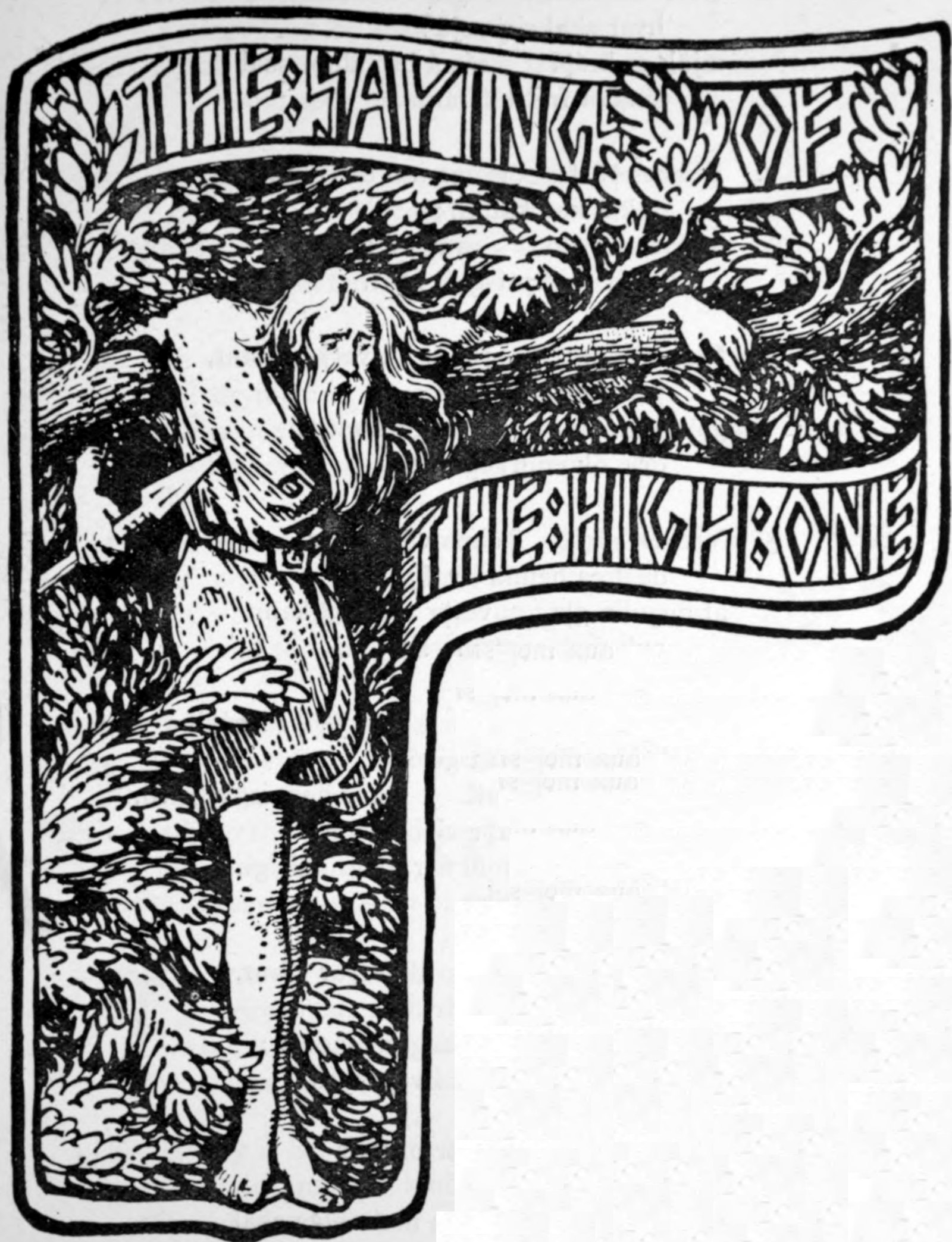
Hávamál, "The Sayings of the High One", is a collection of gnomic verse and Odin poetry. Our article on the sayings of Hávamál gives an overview of the whole. Stanzas 138 to 141 form a small block of their own. Odin tells how he hung for nine nights on the windy tree, wounded with a spear and given to himself, how he looked down without bread or horn and took up the runes. Our stanza follows at once. In the normalised text we reproduce in our source archive it reads: Fimbulljóð níu nam ek af inum frægja syni Bölþorns, Bestlu föður, ok ek drykk of gat ins dýra mjaðar, ausinn Óðreri.
Nine mighty songs I got from the son
Of Bolthorn, Bestla's father;
And a drink I got of the goodly mead
Poured out from Othrörir.Hávamál, stanza 140 (141 in Bellows), translated by Henry Adams Bellows
More literally: "Nine mighty songs I took from the famous son of Bölþorn, Bestla's father, and I got a drink of the precious mead, poured from Óðrerir." Two details deserve a comparison with the older translations. Bellows drops the adjective frægr, "famous", altogether. Karl Simrock, in the standard nineteenth-century German version, renders it as "wise" and so interprets where he should translate. Both versions stand next to the original in our source archive.
The stanza has two halves and reports two gifts: songs and mead. The songs are spells. A few stanzas later Odin begins to list such songs. The list opens in stanza 146 with Ljóð ek þau kann, "I know those songs", and runs to the eighteenth song in stanza 163. Whether the uncle's nine belong among these eighteen the text does not say. Our article on the Rúnatal shows how the whole section is built.
Famous as it is, the stanza leaves a great deal open. It does not say who the "famous son" is. It does not say where Odin met him, or whether learning the songs belongs to the hanging on the tree or is a separate event. And, a point easily missed, it never says that Bestla is Odin's mother.
That this man is Odin's mother's brother follows only when Snorri's genealogy or the skaldic stanza is laid beside it. The inference is legitimate, but it remains an inference from several sources.
Even the stanza's position is not secure. According to the summary of his notes that I could consult, Bellows regarded it as a later insertion at this point and its meaning as obscure; the wording of his footnote was not retrievable for me. The subject does change abruptly: stanza 139 concerns runes, 140 songs and mead, 141 growing and thriving, 142 runes again. Whether a poet strung together different traditions about how Odin won his knowledge, or a copyist slipped a stanza in, cannot be established.
Every reference work gives the name as "Bölþorn". In the stanza itself the form is less certain than the usual reading texts suggest. Edward Pettit's dual-language edition of the Poetic Edda (2023), which is based on the main manuscript, the Codex Regius, prints the genitive Bǫlþórs in stanza 140. That implies a nominative Bölþórr. English Wikipedia likewise records that the shorter form stands in Hávamál and the form in -þorn in Gylfaginning. English Wikipedia spells the short form "Bölþor". I have not seen an image of the manuscript page; I report what the edition prints.
Many editions, including the normalised text used in our archive, put "Bölþorns" here and so bring the stanza into line with Snorri. "Bölþorn" can be understood: böl means "misfortune, evil", þorn "thorn", together something like "evil-thorn". According to the Wikipedia article the shorter form yields no clear sense.
Nobody knows which form is older. A scribe may have left out a letter. Equally, Snorri or his source may have turned a name that had become opaque into one that speaks. This article uses "Bölþorn" because the name is known in that form, not because it is the better attested.
Pettit's apparatus records one more thing at this point. Before the word fǫður the letters syn or syni have been erased in the manuscript. The scribe had evidently written "son" a second time and removed it, which need be no more than a slip.
English Wikipedia calls Bölþorn Bestla's father or, in some sources, her grandfather; its article on Bestla says, citing John Lindow (2002, p. 77), that Hávamál 140 makes him the grandfather. How does that come about? One possible explanation, which I have not checked in the specialist literature, lies in the form föður: for the word "father" it can be accusative, dative or genitive. Read Bestlu föður as a genitive and it goes with "Bölþorns": Bölþorn is Bestla's father and his son is her brother. Read it as a dative and it goes with syni: the famous son would then himself be Bestla's father, Bölþorn her grandfather, and the teacher of the nine songs Odin's maternal grandfather.
Gylfaginning settles the matter for Snorri, since there Bestla is Bölþorn's daughter. Simrock and Bellows translate accordingly, as does Edward Pettit ("of Bǫlþórr, father of Bestla").
The second attestation is a single sentence. Snorri Sturluson relates in Gylfaginning how the primeval giant Ymir and the cow Auðhumla arise from the melting rime. The cow licks salty rime-stones and in three days frees a man, Búri. Then comes: Hann gat son þann, er Borr hét, hann fekk þeirar konu, er Bestla hét, dóttir Bölþorns jötuns, ok fengu þau þrjá sonu. He begot a son called Borr; Borr took a wife called Bestla, daughter of the giant Bölþorn, and they had three sons. The first is called Óðinn, the second Vili, the third Vé.
The sentence supplies three pieces of information the stanza withholds. Bölþorn is expressly called jötunn, a giant. Bestla is his daughter. And she is the mother of the three brothers who, in the next chapter, kill Ymir and build the world from his body. Our articles on Ginnungagap and the Élivágar describe the sequence.
Snorri does not say where he found this genealogy. He knew Hávamál. Völuspá, which he also uses, speaks in stanza 4 only of Burs synir, "Bur's sons", who lifted up the land; it names no mother. Whether Snorri took the link between Borr and Bestla from a lost poem, from oral tradition or from his own combination cannot be decided. The third attestation speaks against free invention.
A word on Borr. He is sometimes described as a giant himself. Gylfaginning does not say so. There he is the son of Búri, and Búri is described as a handsome, tall and mighty man, assigned to no kindred at all. In Snorri the gods' giant ancestry comes through Bestla alone.
Skalds, the court poets of the North, seldom call gods by name. They paraphrase them with kennings, two-part figures the listener has to resolve. In Skáldskaparmál Snorri gives examples of such designations for Odin, and one of them runs: Því at fjölkostigr flestu flestr ræðr við son Bestlu, tekit hefk morðs til mærðar, mæringr en þú færa. It is introduced with nothing more than "So said Einarr".
This is Einarr Helgason, nicknamed skálaglamm, an Icelander at the court of the Norwegian jarl Hákon. Editors assign the half-stanza to his praise poem Vellekla, which is dated to about 980. Its number there depends on the edition, because Vellekla survives only in quotations and its order has to be reconstructed; German Wikipedia gives stanza 4, which I have not checked against an edition. The syntax is intricate and the translation uncertain in detail.
For our question only the kenning matters. Sonr Bestlu can be nobody but Odin, and that is exactly why Snorri cites the passage. If a poet of the tenth century trusts his audience to understand this paraphrase unaided, then Bestla was known as Odin's mother a good two hundred years before Snorri. This is the evidence that supports the genealogy of Gylfaginning from outside.
Right beside it Snorri quotes two further paraphrases from the same family. Þorvaldr blönduskáld calls Odin burar Bors, Búra arfa, "son of Borr, heir of Búri". And in a stanza ascribed to Egill Skallagrímsson Odin is bróður Vílis, "brother of Vílir", and also Míms vinr, "Mímr's friend". Father, grandfather, brother and mother are thus each attested in skaldic verse as well. Bölþorn is not. I found no kenning that calls Odin his grandson in the material I was able to consult.
Who is the famous son of Bölþorn? The sources are silent. Scholars have long suggested that he is Mímir. According to the surveys I could consult, Henry Adams Bellows mentions the suggestion in the note to his translation of the stanza (1923). Who made it first I have not checked in the works themselves.
The argument is circumstantial. In the tradition Mímir is the figure from whom Odin draws knowledge: from his well, for which he gives an eye, and from his severed head, which gives him counsel. In the Egill stanza just mentioned Odin is "Mímr's friend". That makes him an obvious candidate.
A good deal stands against it. No source calls Mímir a son of Bölþorn or a brother of Bestla. Ynglinga saga counts him among the Æsir, who send him as a hostage to the Vanir. The identification can be neither refuted nor proved. It may stand as a hypothesis; in a family tree it belongs only with a question mark.
Why does Odin learn from his mother's brother, of all people? Scholars point to a relationship that anthropology calls the avunculate, from Latin avunculus, "mother's brother". It means a special, often educational, bond between a man and his sister's sons.
The best-known ancient witness for Germanic peoples is Tacitus, more than a millennium before the Icelandic manuscripts. In chapter 20 of the Germania, in the two online texts I was able to consult, he writes: Sororum filiis idem apud avunculum, qui ad patrem honor. Sisters' sons enjoy the same regard with their mother's brother as with their father. Some, Tacitus goes on, consider this tie of blood even more sacred and binding and prefer such kinsmen when they take hostages. A man's heirs, however, are his own children.
The English Wikipedia article on Bölþorn places the stanza in this context. It also cites a medieval Icelandic proverb that men turn out most like their maternal uncles, and with it John Lindow's remark (2002, p. 77 as cited there) that of all the gods Odin turned out most like a giant. I have not read this in Lindow himself.
The comparison has limits. Tacitus describes a social habit among human beings, Hávamál a mythical acquisition of knowledge. Nor is the avunculate proof of descent reckoned through the mother's line; Tacitus himself names a man's own children as his heirs in the same chapter. In the North kinship was counted on both parents' sides, as our article on kin and family shows. The mother's brother as teacher is a plausible background for the stanza, not a proven one.
The stanza's pattern does not stand alone. What Odin owns in knowledge and poetry he fetches, in the poems, strikingly often from giants. In Hávamál 104 and 105 he tells how he sought out "the old giant" Suttungr and how Gunnlöð, on a golden seat, gave him a drink of the precious mead. The wording is the same as in our stanza: drykk ins dýra mjaðar. Whether stanza 140 means the same event or a second drink remains open. According to Snorri the name Óðrerir denotes one of the vessels of the mead of poetry, whose earlier history is told in our article on Kvasir.
In Vafþrúðnismál Odin visits a giant to match wits with him and addresses him in stanza 30 as inn fróði jötunn, "the wise giant". Giants in this poetry are older than the gods and therefore know more about the beginnings. More on this in our article on the giants.
The closing stanza of Hávamál calls the High One's sayings allþörf ýta sonum, óþörf jötna sonum, "most useful to the sons of men, useless to the sons of giants". The poem in which Odin receives his mightiest songs from a giant's son ends by turning its back on the giants.
Snorri's genealogy has a consequence he does not spell out. In chapter 7 of Gylfaginning "Borr's sons" kill the giant Ymir, and the whole race of frost-giants drowns in his blood except one, Bergelmir, who escapes with his household. If Bestla is a giantess, the three brothers strike down a being of their mother's kindred, and the grandfather must have perished in the flood as well. John Lindow therefore reads the killing of Ymir, as English Wikipedia reports him, as violence within the family, the killing or denial of the maternal side.
Snorri nowhere says how Bölþorn is related to Ymir, and he does not work out when the famous uncle is supposed to have taught his songs if only Bergelmir survived. More probably pieces of different origin stand side by side here that were never joined into a seamless chronicle.
The comparison with Loki is instructive. In his case Snorri expressly calls the father, Fárbauti, a giant, while the mother's standing remains open; the details are in our article on Fárbauti and Laufey. With Odin it is the other way round: the father belongs to Búri's line, the mother is a giant's daughter. In this mythology the line between gods and giants does not run along descent.
With Bölþorn matters are comparatively simple, provided the longer form is taken as the basis: "evil-thorn". About the figure himself the name says nothing.
Bestla is harder. There is no certain translation. The reference works I could consult through summaries list several proposals. According to German Wikipedia, Jan de Vries cites the meanings "beloved", "bast (giver)" and "bark"; English Wikipedia speaks of "wife" and of "bark" or "bast". According to English Wikipedia, which cites de Vries, two reconstructions lie behind these. One posits an earlier form *Bastilōn and thinks of bast or bark; According to German Wikipedia, Franz Rolf Schröder saw a yew goddess in Bestla in 1941. The other starts from *Banstillōn and connects the name with an Old Frisian word for "marriage, union", which would amount to "wife". Both articles report Rudolf Simek's conclusion from the name's obscurity that it appears to be very old.
None of these proposals has prevailed, and each rests on a reconstructed form that is attested in no text.
A further thesis builds on the bark etymology. According to the Wikipedia articles on Bestla (the English one cites Lindow), Waltraud Hunke proposed seeing in Bestla the bark of the world tree, and so the tree itself as the one who bore Odin. Its appeal lies in the sequence of stanzas: immediately before Bestla is named, Odin hangs on a tree of which nobody knows from what roots it grows.
German Wikipedia, referring to Jan de Vries and Rudolf Simek, calls the proposal too far-reaching. The reading relies on one of several possible etymologies. Gylfaginning calls Bestla the daughter of a giant and says nothing of a tree. And the neighbourhood of the stanzas may, as shown above, be the result of later arrangement. I have not read Hunke's study itself.
Firmest of all is that Odin counted as Bestla's son in the tenth century; the kenning of a poet known by name attests it. Well established too is that an Odin stanza linked Bestla with a Bölþorn or Bölþórr and with the gaining of spell-songs. That Bölþorn is a giant and Bestla his daughter is stated by Snorri alone, though no other source contradicts him.
Everything else is interpretation: the uncle as Mímir, the mother's brother as educator after Germanic custom, Bestla as a tree or yew goddess, the killing of Ymir as the killing of kin. None of these can be tested against a text that says more than the texts we have.
Behind the entry "Bestla" in a list of gods there stand, then, half a stanza, one sentence and a paraphrase of two words. That is enough to establish Odin's descent from the giants' side. It is not enough for a portrait.
Who is Bestla? According to Snorri's Gylfaginning she is the daughter of the giant Bölþorn, the wife of Borr and the mother of Odin, Vili and Vé. The skald Einarr calls Odin "Bestla's son" in the tenth century. No stories of her own survive.
What does the name Bölþorn mean? In its longer form it can be understood as "evil-thorn". In the Hávamál stanza Edward Pettit's edition prints, after the manuscript, the shorter form Bǫlþórs, whose sense is unclear. Which form is original cannot be decided.
From whom did Odin learn the nine spell-songs? From "the famous son of Bölþorn", on the usual reading his mother's brother. The name is missing. Mímir is often proposed; that is not attested.
Is Odin half giant? By Snorri's genealogy his mother is a giant's daughter. The sources draw no conclusion from this; they count Odin among the Æsir throughout. Descent and belonging are two different things in this mythology.
Does Bestla appear in Völuspá? No. Völuspá speaks in stanza 4 only of "Bur's sons", who lift up the land, and names no mother.
Odin: the Allfather in the sources · Rúnatal: Odin's self-sacrifice in Hávamál 138–145 · Mímir: well, head and counsel · Ymir and the world made from a giant's body · Auðhumla, the primeval cow · The giants of Norse mythology · Fárbauti and Laufey: Loki's parents · Vellekla: Einarr's praise poem for Jarl Hákon · Gunnlöð and the mead of poetry · Kin and family in the North
Odin · The Rúnatal – the spell-songs of the Hávamál · Mímir – the counselling head · Ymir: the Primordial Giant Whose Body Became the World · Audhumla – the Primeval Cow Who Fed Ymir and Licked the First God Out of the Ice.
Brísingamen is the necklace of the goddess Freyja and the most famous piece of jewellery in Norse mythology. The name …
Read more →A valkyrie punished by Odin with a sleep-thorn. A hero who rides through the flames. A betrayal that ends in blood …
Read more →We like to picture Valkyries as noble riders who escort the fallen to Valhalla. The Darraðarljóð shows them quite …
Read more →A singer loses his seat at his lord’s table, and what he makes of it has survived for more than a thousand years in a …
Read more →