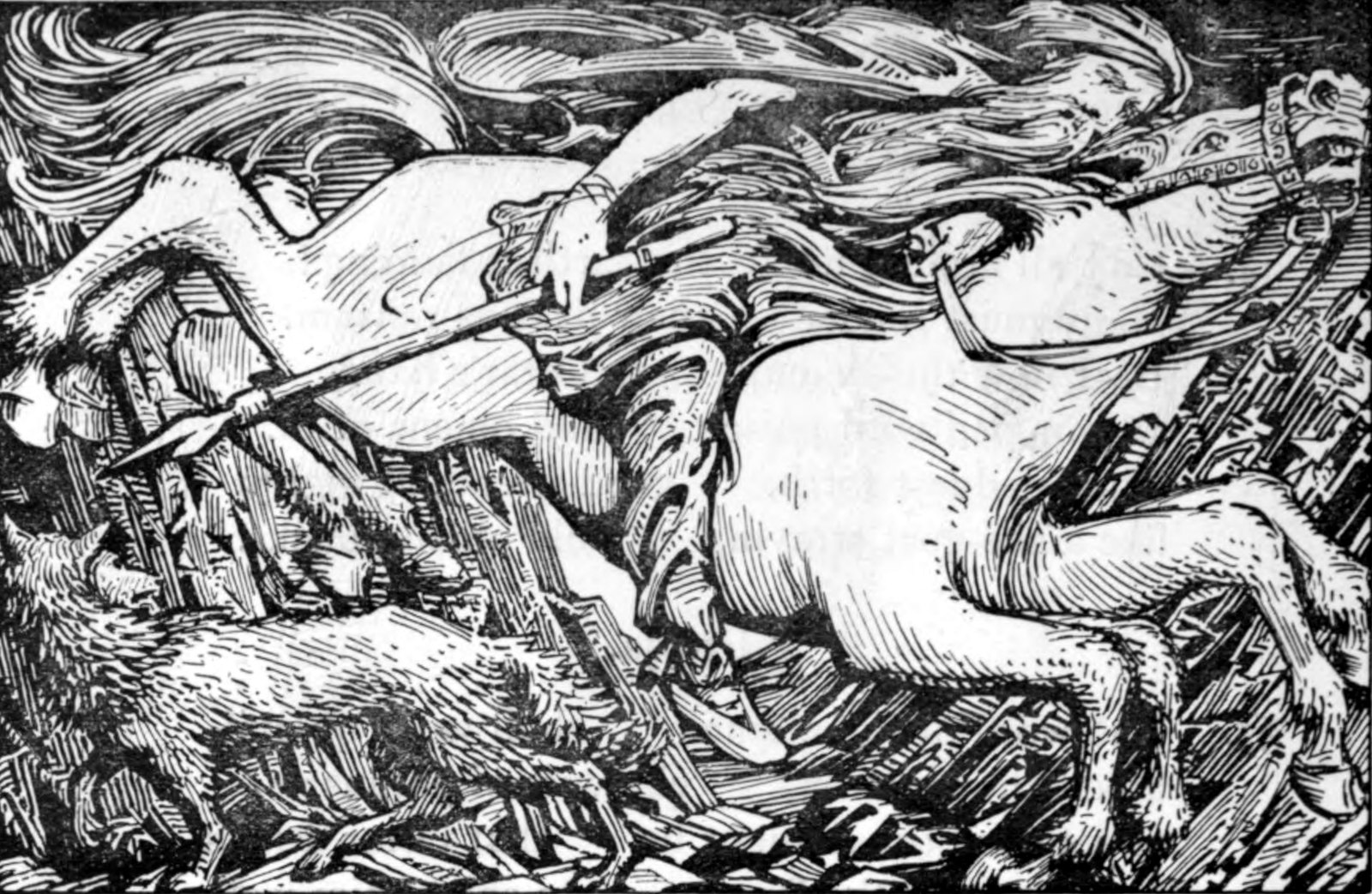
A god saddles his horse, rides into the world of the dead and sings a dead woman out of her grave, because he wants to know what his son's dreams mean. That is the whole plot of Baldrs draumar, and it takes just fourteen stanzas. A good deal hangs on this small poem all the same: a scene of necromancy, a nameless hound with a bloody breast, a riddle nobody has solved with certainty, and a transmission that depends on one vellum manuscript. This article walks through the poem stanza by stanza and separates what the text says from what editors, translators and retellers have added.
Baldrs draumar, “Baldr's Dreams”, is among the shortest mythological poems of the eddic tradition. It has fourteen stanzas in fornyrðislag, the metre of short alliterating lines also used by Völuspá and Þrymskviða. The first four stanzas narrate; the other ten are an exchange between Odin, hiding behind an assumed name, and a dead seeress, a völva.
The poem does not tell how Baldr dies; it only announces the death. The full story with Frigg's oaths and the mistletoe is Snorri Sturluson's and is retold in our article on Baldr's death; for the god himself see Baldr. This article is about the poem. I quote the Old Norse from Guðni Jónsson's edition as printed in the bilingual reading edition and the source archive on this site.
The main collection of eddic poems, the Codex Regius, does not contain Baldrs draumar. The poem survives in a second, much smaller manuscript with the shelfmark AM 748 I a 4to. It is dated to the beginning of the fourteenth century and is a fragment: six leaves remain. According to the overview I consulted they hold Grímnismál, Hymiskviða and Baldrs draumar complete, parts of Skírnismál, Hárbarðsljóð and Vafþrúðnismál, and the opening of the prose to Völundarkviða. It is kept, on the same authority, in the Arnamagnæan collection in Copenhagen.
Every other poem in the fragment is also known from the Codex Regius. Baldrs draumar is not. AM 748 I a 4to is the only medieval manuscript that preserves it. Edward Pettit, in his dual-language edition of 2023, gives the exact place: folios 1v–2r, between Hárbarðsljóð and the poem about Skírnir.
So where the scribe slipped or left something out, no second vellum can expose the error. Every correction is an editor's conjecture. In stanza 11 that matters a great deal.
Karl Simrock headed his German translation of 1851 “Vegtamskvidha”, “the lay of Vegtamr”, after the alias Odin uses in stanza 6. That title comes from later paper manuscripts, not from the vellum; Henry Adams Bellows says so in the introduction to his 1923 translation and keeps “Baldrs Draumar” himself.
The first stanza opens with an assembly: Senn váru æsir allir á þingi ok ásynjur allar á máli – all the Æsir were at the thing, all the goddesses in talk. The “mighty gods” debate hví væri Baldri ballir draumar, why Baldr had baleful dreams. What Baldr dreamed the poem never says.
Snorri is no more specific. Chapter 49 of Gylfaginning says only that Baldr dreamed “great and perilous dreams about his life” (drauma stóra ok hættliga um líf sitt). In Snorri the gods then take counsel and Frigg collects oaths from all things; the chapter has no ride by Odin to the underworld, and the name Vegtamr does not occur in the Gylfaginning text of our archive. In the poem the council is followed at once by one god setting out alone. More on dreams in the sagas.
The opening stanza has a twin. Stanza 14 of Þrymskviða begins with the same six short lines and departs only in the last pair, where the gods discuss how to recover Thor's hammer. (Bellows numbers that stanza 13; the figure depends on the edition.) Bellows reports that the editor Vigfússon guessed from this likeness that one poet made both poems. Pettit says only that the basis of the correspondence is uncertain. None of this can be proved.
Stanza 2 belongs to Odin alone. He rises, lays the saddle on Sleipnir and rides “down from there to Niflhel” (niðr þaðan niflheljar til). Simrock's German puts “Nifelheim” here. The Old Norse says Niflhel, roughly “Mist-Hel”. The word also occurs in Vafþrúðnismál, where the giant speaks of nine worlds “below Niflhel”, and in Snorri, who writes in Gylfaginning 3 that wicked men go to Hel and from there to Niflhel, down in the ninth world. Niflheim, the cold primeval world of Snorri's creation account, is a different word.
On the way Odin meets a dog, more exactly a hvelpr, a whelp or young dog, “that came from Hel”. It is bloody on the breast and barks or howls for a long time at “the father of magic song” – galdrs föður is a paraphrase for Odin. The dog has no name. Bellows, in his note, identifies it with Garmr, the hound of the Völuspá refrain, without reservation; Pettit also compares the Greek Kerberos and suggests the blood is that of dead people the dog devoured for trying to leave Hel. These are interpretations. In the poem the dog only barks; it neither stops Odin nor guards anything.
Simrock's version is longer here than the Old Norse. In his German the hound's jaws gape to bite and it advances on the god with yawning maw. Those two lines have no counterpart in Guðni Jónsson's text.
Odin rides on, “the earth-way thundered” (foldvegr dunði), until he reaches the high house of Hel. A second ride of this kind is told in Gylfaginning 49: Hermóðr takes the same horse and rides nine nights to the Gjöll bridge. The poem knows no river, bridge or bridge-keeper; compare the road to Hel.
Odin does not enter the hall. He rides fyrir austan dyrr, east of the door, “where he knew the völva's grave to be” (völu leiði). The seeress lies buried in the realm of the dead itself; the poem does not explain this. There Odin begins to chant a valgaldr for “the wise one”. The word is formed from valr, “the slain, the dead”, and galdr, “chanted spell” – a spell for the dead. He chants until she “rose under compulsion” and spoke “a corpse's words” (nás orð).
Here too Simrock has more than the vellum: his Odin faces north and strikes with a staff. These details are absent from Guðni Jónsson's text and from Bellows; presumably they come from the expanded version Simrock follows, which I have not checked. The passage is no evidence for a ritual.
The dead woman's first words are among the most haunting lines in the whole collection:
“What is the man, to me unknown,
That has made me travel the troublous road?
I was snowed on with snow, and smitten with rain,
And drenched with dew; long was I dead.”Baldrs draumar, st. 5, translated by Henry Adams Bellows, The Poetic Edda, 1923
The last line reads dauð var ek lengi in the original, long was I dead. This seeress does not prophesy on demand; every answer has to be forced from her. See also the völva.
Odin introduces himself under a false name: Vegtamr ek heiti, sonr em ek Valtams. The second element -tamr means “accustomed to, familiar with”. Vegtamr is thus “the way-accustomed”, a man used to wandering; Pettit renders it “Way Ready”. Valtamr would be “accustomed to the slain”. Both fit Odin, wanderer and lord of the slain. The alias hides very little.
He then proposes an exchange: segðu mér ór helju, ek mun ór heimi – tell me news from Hel, I will tell of the world. And he asks his first question: for whom are the benches strewn with rings, the fair platforms flooded with gold? He does not ask about Baldr; he asks about a hall decked out for a guest.
“Here the mead stands brewed for Baldr, the clear drink, a shield lies over it.” In the world of the dead the welcome feast is ready while the guest is still alive. The sons of the gods, as Simrock and Bellows agree in translating, are without hope. Then comes the sentence that returns three times: nauðug sagðak, nú mun ek þegja – under compulsion I spoke, now I will be silent.
Odin will not have it. His reply also returns three times: “Be not silent, völva, I will question you until all is known; I want to know further …” According to Pettit's apparatus the scribe merely abbreviated these repetitions in two places.
The second question concerns the killer: who will be Baldr's slayer and rob Odin's son of life? The answer names Höðr – and contains a word on which the translators disagree. Höðr berr hávan hróðrbaðm þinig, literally something like: Höðr bears the high “glory-tree” hither. Bellows takes it as a branch, “the far-famed branch”, that is, the weapon, which recalls the mistletoe of Völuspá. Simrock refers the word to Baldr himself: Höðr brings “the highly famed one” here. Höðr would then be sending his brother hither, to the dead, and the word þinig, “hither”, suits that. Pettit prints the form hróðrbarm, calls the word obscure and thinks the mistletoe possible. I do not decide between the readings. The word mistletoe, at any rate, does not occur in the poem, Loki does not appear as instigator, and nothing is said of Höðr's blindness. Pettit thinks the stanza may be indebted to Völuspá 31–32.
The third question concerns vengeance: who will avenge the hateful deed on Höðr and bring Baldr's slayer to the pyre? Rindr bears a son in the “western halls” (í vestrsölum) who will fight einnættr, one night old. He will not wash his hand nor comb his head before he carries Baldr's adversary to the pyre. Bellows notes that four of the stanza's five lines nearly match Völuspá 32–33; in our archive three return almost word for word. The western halls, he adds, occur in no other poem.
In printed texts the first line reads Rindr berr Vála, “Rindr bears Váli”. According to Pettit's apparatus, however, the name is not in the manuscript at all; editors have supplied it. Other texts provide it: Snorri names “Áli or Váli” as son of Odin and Rindr in Gylfaginning 30, and the stanzas of the “short Völuspá” in Hyndluljóð say that Váli proved worthy to avenge Baldr and slew his brother's killer. Völuspá, at the corresponding place (st. 32 in our archive), likewise speaks only of “Baldr's brother”. Neither poem, then, transmits the avenger's name here. More in Vidar and Vali.
The fourth question breaks the pattern. Odin asks: Hverjar ro þær meyjar, er at muni gráta ok á himin verpa halsa skautum? Who are the maidens who weep – to their hearts' content, or for their loved one, depending on the reading – and fling the “corners” of their necks to the sky? Even the literal sense is uncertain. Bellows calls the two lines “thoroughly obscure” and his own rendering, in which the maidens toss “the yards of the sails”, doubtful. Since the manuscript marks the third line as the start of a stanza, he adds, something may have been lost.
The best-known interpretation goes back, according to Bellows, to the Norwegian philologist Sophus Bugge: the maidens are the daughters of the sea-god Ægir, the waves. Pettit spells this out. The “neck's corners” may be the lower parts of women's headdresses or ships' sails; the waves would be tossing their hoods, or Baldr's funeral ship. It fits that, as Pettit notes, Odin also asks a riddle whose answer is “waves” in the riddles of Gestumblindi in Hervarar saga. But Pettit names the alternative as well: the question may be unanswerable, and that is what betrays the questioner.
There is a parallel for this second reading. In Vafþrúðnismál Odin contends in knowledge with a giant under a false name. His last question is what Odin said in his son's ear before the son mounted the pyre. Only Odin can know that, and the giant realises whom he faces. Both poems end with a question that circles Baldr's death and unmasks the disguised god.
Simrock's German goes a third way and departs clearly from the Old Norse: he asks for the name of the one woman who will not weep. That points to the giantess Þökk, who in Snorri alone refuses to weep Baldr out of Hel. In Guðni Jónsson's text the maidens weep. Whether Simrock had a different reading before him or translated interpretively, I cannot show.
The seeress does not answer the fourth question. She says instead: “You are not Vegtamr, as I thought; rather you are Odin, the old gautr.” What gautr means here is uncertain; Bellows says so of his rendering “enchanter”, and Simrock chooses “Allerschaffer” (creator of all). Guðni Jónsson's text has alda gautr in stanza 2 and aldinn gautr in stanza 13; according to Pettit's apparatus the manuscript there has allda corrected to alldin.
Odin retorts: “You are no völva and no wise woman; rather you are the mother of three giants.” The poem does not say who is meant. Pettit considers Angrboða possible, mother by Loki of Hel, Fenrir and the Midgard serpent, and mentions Loki himself, perhaps in the shape of Þökk, as another proposal. Bellows treats it as an open conjecture that the speaker is the seeress of Völuspá. The text supports none of these.
The last stanza is hers. “Ride home, Odin, and be proud” – it sounds like mockery. No one will visit her again until Loki slips loose from his bonds and the destroyers come to the doom of the gods, ragna rök. The poem thereby ties Baldr's death to the end of the world, to Ragnarök. Bellows understands her to mean that she will stay silent until then. Pettit suggests emending the transmitted er (“when”) to unz (“until”). Why Loki lies bound the stanza does not tell; see Loki's punishment.
Pettit sets Baldrs draumar closest to Völuspá and to stanzas 29–44 of Hyndluljóð, the “short Völuspá”. Baldr's death occurs in all three, but Völuspá and the short Völuspá are speeches by a single speaker. Baldrs draumar is largely a dialogue of question and answer, and in that respect closer to Hárbarðsljóð and Vafþrúðnismál.
In Völuspá, too, a seeress addresses Odin, and a recurring sentence articulates her speech: “Would you know yet more?” in Bellows's wording. In Baldrs draumar this has become a duel of refusal against insistence. Bellows reports that some even thought of the same poet. Pettit thinks stanza 11 may derive from Völuspá 32–33. What sets the poem apart from its relatives is compulsion: this dead woman has to be sung out of her grave and tries three times to end the conversation.
The manuscript dates from the early fourteenth century. How much older the poetry is, nobody knows. Bellows was confident in 1923: the poem presumably took its present form no later than the first half of the tenth century, that is, still in heathen times. He offers no proof.
A hundred years later Pettit writes soberly that the date of composition is unknown and that the poem perhaps postdates Völuspá. He separates the age of the poem from the age of its matter: parts of the story of Baldr and Höðr may be very old, because comparable features are attached to differently named figures in the Indian Mahabharata. That yields no date; the fixed point remains the vellum.
Later paper manuscripts transmit a longer version. Bellows notes that two old editions and one later one insert four stanzas from late paper manuscripts after stanza 1; the English Wikipedia speaks of about five extra stanzas. They are regarded as a late addition. Sophus Bugge, according to the summary I have seen, believed their author also composed Forspjallsljóð – a poem also called Hrafnagaldr Óðins and found only in paper manuscripts of the seventeenth century. I have not seen the wording of the extra stanzas in the original and therefore do not reproduce it.
Simrock's German translation follows the longer version. He has those four stanzas after the first, his numbers 2 to 5; since he also splits the exchange in stanza 13, he arrives at nineteen stanzas instead of fourteen. Added to this are the single lines in the stanzas on the hound, the incantation and the fourth question that are missing from Guðni Jónsson's text.
The English poet Thomas Gray wrote “The Descent of Odin. An Ode” at Cambridge in 1761, with the note “From the Norse-Tongue”; it was printed in 1768 in an edition of his poems. Gray names his source in the subtitle: Bartholin's book printed at Copenhagen (“Hafniae”) in 1689, in its Latin version according to the Thomas Gray Archive. The ode has 94 lines and opens “Uprose the King of Men with speed” – that is, with Odin's departure; the council of the gods is missing. Its last line is “Sinks the fabric of the world”.
Gray's footnotes show what an educated reader around 1760 could know: Sleipnir had eight legs, Hela presided over “Niflheimr”, and valgaldr comes from valr, dead, and galdr, incantation.
According to the English Wikipedia article, the meeting of the Wanderer and Erda in the third act of Richard Wagner's “Siegfried” is based on this poem. The same source mentions a ballet “Baldurs draumar” by the Norwegian composer Geirr Tveitt, first staged in 1938.
What is Baldrs draumar? A short eddic poem about the gods, fourteen stanzas long. Odin rides to the world of the dead and learns from a dead seeress that Höðr will kill Baldr and a son of Rindr will avenge him.
Why is the poem also called Vegtamskviða? Odin gives his name to the seeress as Vegtamr, roughly “the way-accustomed”. Later paper manuscripts and older translations such as Simrock's name the poem after that alias.
Which manuscript contains Baldrs draumar? Only AM 748 I a 4to, an Icelandic vellum fragment from the beginning of the fourteenth century. The Codex Regius does not contain the poem.
Who is the seeress? The poem gives no name. Odin abuses her as “mother of three giants”; Angrboða, Loki and the seeress of Völuspá have been proposed. None of these identifications can be proved.
What does Odin's last question mean? He asks about maidens who weep and fling something to the sky. Many read them as the waves, the daughters of Ægir; others think the question unanswerable. There is no secure solution.
Baldr's death · Baldr · Höðr · Vidar and Vali · Völuspá · Hyndluljóð · Codex Regius · Garmr · The road to Hel · The völva
The death of Baldr · Baldr · Sleipnir – Odin's steed · Víðarr & Váli – the silent avengers · The road to Hel.
Berserkers were warriors who went into a feared battle-frenzy, the berserksgangr – first attested in the late ninth …
Read more →There was no single Viking burial rite: people in the Viking-Age North either cremated their dead or laid them in the …
Read more →Half a stanza, one sentence and a poet's circumlocution: that is the whole record of Odin's mother. Old Norse tradition …
Read more →Brísingamen is the necklace of the goddess Freyja and the most famous piece of jewellery in Norse mythology. The name …
Read more →