No god in Norse mythology has a role so brief and so far-reaching as Höðr. He does essentially one thing: he shoots or hurls the sprig of mistletoe that kills his brother Baldr, and with it the decline of the gods begins. Snorri Sturluson calls him blind and strong and says the gods would rather never have to mention him. A brother only one night old avenges the deed; after the end of the world Höðr returns together with Baldr. In Saxo Grammaticus, by contrast, he is called Hotherus, sees perfectly well, plays the harp and cuts Balderus down with a sword in a rivalry over a woman. This article sets the witnesses side by side, checks what each text actually says, and labels interpretations as interpretations.
Höðr, Old Norse Hǫðr, anglicised as Hod, Hoder or Hodur, belongs to the Æsir, the family of gods around Odin. Snorri makes him Odin's son and Baldr's brother; the Eddic poems assume this kinship rather than spell it out. I know of no cult, sanctuary or place-name that can be securely tied to him. For us Höðr exists almost entirely inside one story: the death of Baldr.
That story survives in two versions. One is Icelandic, in the Eddic poems and in Snorri, where Höðr is a blind god who kills without malice. The other is Danish, in Saxo Grammaticus, where he is a mortal prince who strikes his opponent down on purpose. Both pictures deserve to be taken seriously, and they should not be blended into a single tale.
The Poetic Edda is a collection of mythological and heroic poems, preserved above all in the Codex Regius of about 1270; the Prose Edda is a handbook of poetics written by Snorri Sturluson around 1220–1230. More in the article on the Edda.
The name is generally linked to Old Norse hǫð, "battle, war", from Proto-Germanic *haþuz; related forms are Old High German hadu-, as in Hadubrand, the son in the Hildebrandslied, and Old English heaðu-. That is the view of Jan de Vries and Vladimir Orel in their etymological dictionaries. A god called "Battle" who, in Snorri, stands blind on the sidelines: whether the name preserves an older, warlike image or simply uses a common name element cannot be settled.
Add to these a few fragments in skaldic verse and a note in the Danish Chronicon Lethrense. I know of no archaeological evidence that can securely be connected with Höðr.
In the vision of the seeress in Völuspá, Baldr appears as a "bloody god", Old Norse blóðgum tívur, and beside him a plant: "stóð of vaxinn […] mjór ok mjök fagr mistilteinn", there stood, grown up, slender and very fair, the mistletoe. In the next stanza the plant becomes a weapon: "Varð af þeim meiði […] Höðr nam skjóta", from that shoot came what Höðr shot. The verb skjóta can mean "to shoot" as well as "to hurl"; no bow is mentioned.
The avenger follows at once. "Baldrs bróðir var […] sá nam Óðins sonr einnættr vega": Baldr's brother was soon born, this son of Odin fought when one night old. Einnættr means "one night old", not "one day old", as one sometimes reads. He neither washes his hands nor combs his hair until he has brought Baldr's adversary to the pyre. Völuspá does not name Váli here, and it does not name Höðr in this sentence either; it calls him Baldrs andskoti, "Baldr's opponent". Then the closing line: Frigg weeps in Fensalir, her hall, over the woe of Valhalla.
What is missing is just as striking: no blindness, no Loki as instigator, no oaths. Whether Höðr meant to kill, the poem does not say. The idea that he killed unwittingly comes from Snorri.
In Baldrs draumar Odin rides down to a dead seeress, wakes her with necromancy and questions her; the article on Baldr's death tells the ride in full. For Höðr three answers matter. Asked who will kill Baldr, she names him: "Höðr berr hávan hróðrbaðm þinig, hann mun Baldri at bana verða", Höðr carries the high tree of glory there, he will be Baldr's slayer. Asked who will take vengeance on Höðr, she answers: "Rindr berr Vála í vestrsölum", Rindr bears Váli in the western halls; this son of Odin will fight one night old, will not wash his hand nor comb his head until he brings Baldr's opponent to the pyre.
The poem speaks of a "tree of glory", not explicitly of mistletoe; the sprig is probably meant, but the text does not say so. Nor is there any word of blindness. The numbering varies: on heimskringla.no the question about the killer is stanza 8, the answer stanza 9 and Váli's birth stanza 11; other editions shift these by one.
Snorri gives Höðr a face, a curiously closed one. Gylfaginning, chapter 28, says briefly: "Hann er blindr. Ærit er hann sterkr, en vilja mundu goðin, at þenna ás þyrfti eigi at nefna." He is blind. He is very strong, but the gods would wish there were no need to name this god, for the work of his hands will long be remembered among gods and men. No dwelling, no wife, no attribute: where Snorri gives other gods a hall or a function, he gives Höðr a guilt that has not yet been told.
The deed itself comes in chapter 49. Frigg has made all things swear to spare Baldr, and the gods turn it into a game of throwing and shooting at him. Loki, disguised as a woman, learns from Frigg that west of Valhalla grows a shoot called mistletoe that seemed too young to make it swear. He pulls it up and goes to the assembly.
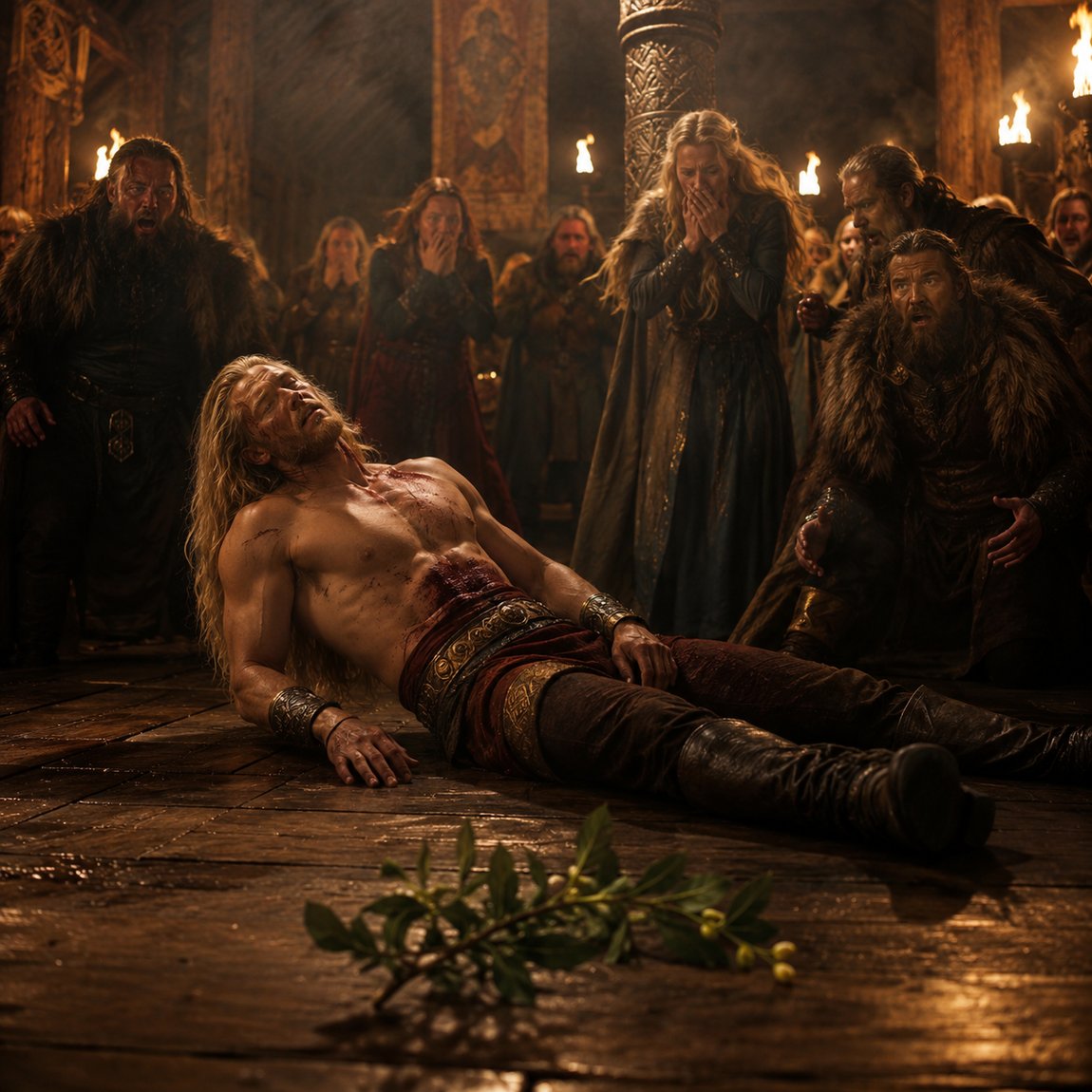
There Höðr stands outside the ring of men, "because he was blind". Loki asks why he is not shooting. Höðr answers that he cannot see where Baldr stands and has no weapon besides. Loki tells him to do as the others do and show Baldr honour; he will direct him. Höðr takes the mistletoe and shoots "at tilvísun Loka", at Loki's direction. The sprig pierces Baldr and he falls dead. Snorri calls it the greatest misfortune ever to befall gods and men.
The killer is not punished on the spot. The gods want revenge, but the place is a sanctuary, a griðastaðr, where no blood may be shed. Then come Hermóðr's ride to Hel, the burning on the ship Hringhorni, where Nanna too meets her end, and the world's weeping. Höðr drops out of the story. How he dies, Snorri does not tell in Gylfaginning.
Snorri's version divides the guilt between two figures. Höðr carries out the shot, Loki plans it. Old Norse has words for this: the handbani is the one by whose hand someone dies, the ráðbani the one by whose plan. Snorri does not use these terms for Baldr's death; that his story follows the pattern is a modern observation.
How old Loki's role is remains disputed. In Völuspá and Baldrs draumar Loki does not appear as instigator; Völuspá shows him only afterwards, bound. The one poem in which Loki claims the blame himself is Lokasenna: in stanza 28 he boasts to Frigg that he is the reason she no longer sees Baldr ride home. He does not mention Höðr. Whether Snorri preserves older tradition here or elaborated the story himself cannot be decided.
The historian of religion Jens Peter Schjødt pointed out in 1981 something easily overlooked: in Snorri's version only Frigg and Loki know that the mistletoe never swore. Blindness does not make Höðr ignorant; it makes him steerable. Loki needs someone who cannot see where he aims and therefore depends on a hand to guide him.
Why must a new son be born for Baldr to be avenged? A common answer points to the rules of feud: someone who kills a kinsman can hardly be killed by his own kin without that kin shedding its own blood a second time. John Lindow described in a study of murder and vengeance among the gods (1997) how this dilemma shapes the story.
The solution is a child begotten for this purpose alone. Váli, Odin's son by Rindr, whom Snorri counts among the goddesses and Saxo makes the daughter of a Ruthenian king, is one night old when he kills Höðr. He has no story of his own: he is born, and he avenges. Snorri introduces him briefly in chapter 30 of Gylfaginning as bold in battle and a very lucky shot, mjök happskeytr, but does not narrate the vengeance there. More on Váli and his brother Víðarr is in the article Vidar and Vali.
That Váli kills Höðr is thus attested in three forms: as a circumlocution in Völuspá ("brings Baldr's opponent to the pyre"), as prophecy in Baldrs draumar, and as a kenning in Snorri, who calls Váli among other things "foe and slayer of Höðr". No Icelandic source contains a worked-out scene with a weapon and a sequence of events.
A kenning is a poetic circumlocution, such as "horse of the sea" for a ship. In Skáldskaparmál Snorri collects such phrases as a toolkit for poets. For Höðr he lists six: the blind god (blindi áss), Baldr's slayer (Baldrs bani), shooter of the mistletoe (skjótandi mistilteins), Odin's son, Hel's companion (Heljar sinni) and Váli's foe (Vála dólgr).
"Hel's companion" assumes that Höðr dwells in the realm of the dead after his death, "Váli's foe" assumes the vengeance Snorri never narrates. He evidently knew more than he set out. Yet none of these kennings is attested in surviving skaldic poetry, so we cannot tell whether poets really used them or whether Snorri formed them from his knowledge of the story.
Conversely, the name Höðr does occur in skaldic verse in a quite different setting: in warrior kennings such as "Höðr of the mail-coat" or "Höðr of battle", where the god's name stands for a warrior in general. Some scholars see this as a hint that poets knew a combative Höðr, closer to Saxo's Hotherus; others reply that divine names were used loosely in kennings. Neither view is proof.
The most surprising turn comes at the end of Völuspá. After the fire of Ragnarök a new green earth rises from the sea, and the seeress sees:
Munu ósánir akrar vaxa,
böls mun alls batna,
Baldr mun koma;
búa þeir Höðr ok Baldr
Hrofts sigtoftir,
vé valtíva.
"Unsown the fields shall grow, all evil shall be bettered, Baldr shall come; Höðr and Baldr shall dwell in Hroptr's halls of victory, the sanctuaries of the gods of the slain."Völuspá, stanza 62 (Neckel/Kuhn numbering); Old Norse text as given on heimskringla.no, read line by line through a retrieval tool, refrain line omitted; English translation my own
Hroptr is a byname of Odin. Snorri elaborates this in chapter 53 of Gylfaginning: Baldr and Höðr come from Hel, sit down with the surviving gods and talk of old things. There is no word of resentment. The article After Ragnarök describes this new world in more detail.
Not all sources agree. In Vafþrúðnismál the giant Vafþrúðnir lists the gods of the new world: Víðarr and Váli, with Thor's sons Móði and Magni. Baldr and Höðr are missing. Whether the poem did not know of them or left them out is open, as is whether their return is old or touched by Christian images of reconciliation. A postage stamp mentioned in the Store norske leksikon shows Baldr leading the blind Höðr as an image of reconciliation. That is a modern reading.
Saxo Grammaticus treats the old gods as humans with magical powers who let themselves be worshipped; this approach is called euhemerism, after the Greek writer Euhemerus. His Hotherus is a mortal: son of King Hodbroddus, brought up by King Gevarus. He outdoes everyone at swimming and archery and plays so masterfully that he can sway the feelings of men. Gevarus's daughter Nanna loves him.
Balderus, son of Othinus, sees Nanna bathing and resolves to remove his rival. Lost in a mist, Hotherus comes upon wood-maidens who govern the fortunes of war. They warn him that Balderus is "a demigod, sprung secretly from celestial seed", as Oliver Elton translates. Gevarus knows a way: iron cannot harm Balderus, but the forest being Mimingus, a satyrus in Saxo's Latin, owns a sword that can kill him, and a bracelet that increases its owner's wealth. Hotherus lies in wait for many nights, overpowers him and receives both as ransom. Here the weapon is a sword, not a plant; why swords in saga literature so often carry their own fates is explained in the article on the Viking sword.
Nanna rejects Balderus: a god cannot marry a mortal. In a sea battle Othinus, Thor and the other gods fight for Balderus; Thor smashes every shield until Hotherus hews through the haft of his club. The gods flee and Hotherus marries Nanna. Later Balderus wins on land, but phantoms in Nanna's likeness waste him until he has to be carried in a cart. Hotherus becomes king of the Danes and the Swedes, is defeated, and withdraws, weary of life, into solitude.
There the wood-maidens reveal that Balderus draws his strength from a special food, into which three women mix venom dripping from the mouths of three snakes. Disguised as a musician Hotherus slips into the camp; he does not get the food, but he does get a belt that ensures victory. On his way back he drives his sword into Balderus's side. In a dream Proserpina, Saxo's Latin name for the mistress of the dead, appears to the wounded man, and three days later he dies.
The vengeance follows the Eddic pattern. A Finn named Rostiophus foretells to Othinus that Rinda, daughter of the king of the Ruthenians, will bear the avenger. Othinus courts her in several disguises and finally takes her by trickery and force. Their son Bous marches against Hotherus, who foresees his death and has his son Roricus named heir. Hotherus falls; Bous dies of his wounds the next day. Of a child one night old there is nothing in Saxo.
In Snorri a blind god, a plant, a guided shot, an avenger one night old; in Saxo a sighted hero, a magic sword, a war over love lasting years, a grown avenger. The frame stays the same: Baldr dies through Höðr, Odin begets an avenger with Rind, the avenger kills Höðr.
Which version preserves the older myth has long been debated. Most recent accounts see Saxo's narrative as a reshaping that he fitted into his line of kings. Beside it stands the Latin Chronicon Lethrense, the Chronicle of Lejre from the later twelfth century: according to the information available to me, Both, a son of Othen, kills Hother in battle there. I have not read that text in the original; it does suggest a Danish tradition not simply derived from Saxo.
There is no final answer: both versions were written down by Christians, and neither is a direct window onto pre-Christian religion.
Everything in this section is scholarly hypothesis, not finding.
The Christian hypothesis. The Norwegian philologist Sophus Bugge argued from 1881 in his studies on the origin of the Norse myths and hero legends that the Baldr story was shaped in essential features by Christian legends. Baldr recalls Christ, and Höðr took on features of the blind Longinus, the Roman soldier who, according to legend, pierced Jesus on the cross with a lance after being shown the direction. Longinus's blindness appears in the legend only after the tenth century, so it would have been available to Snorri. Since the blindness is found only in Snorri, the idea remains worth weighing for his version; as an explanation of the whole myth it is no longer accepted.
The instrument hypothesis. Many recent accounts read the blindness in narrative terms: a blind man needs a guiding hand, and guilt shifts from the doer to the plan. Maria Kallestrup Laursen, in a Danish study of 2008, calls him an instrument of fate rather than a god of fate. Sharon Choe examined Höðr's blindness as disability in the journal Mirator in 2021 and related it to the balance of power in thirteenth-century Iceland; I know her article only from its summary.
The comparative hypothesis. The French scholar of religion Georges Dumézil placed Höðr in an Indo-European series and compared him with Bhaga, a blind god of Vedic India, and with the blind king Dhṛtarāṣṭra in the Mahābhārata epic. Such structural comparisons are stimulating but hard to test.
Sacrifice and ritual. Völuspá calls Baldr blóðgum tívur, the "bloody god", which Simrock rendered as "the blooming sacrifice". Some scholars therefore read Baldr's death as the reflection of a ritual sacrifice in which Höðr would be the sacrificer, cleared of personal guilt by his blindness. There is no direct evidence for such a ritual. Nineteenth-century nature-myth readings that saw Baldr as light or summer and Höðr as darkness or winter are now considered outdated; the sources give them no support.
Was Höðr evil? Not in the Icelandic sources: Snorri has him act unknowingly on Loki's direction. In Saxo Hotherus kills a rival deliberately, but he is the hero, with the wood-maidens on his side.
Who killed Höðr? In the Edda, Váli, son of Odin and Rindr, when he was one night old. In Saxo he is slain in battle by Bous, also a son of Othinus and Rinda; Bous dies of his wounds the following day.
Why is Höðr blind? No source says. The blindness is attested only in Snorri. Whether it is old or emphasised by Snorri, whether it comes from Christian legend or is mainly a narrative necessity so that Loki can guide him, is a matter of interpretation.
Does Höðr return after Ragnarök? According to Völuspá and Snorri, yes: Höðr and Baldr live together in the new world. Vafþrúðnismál, however, does not list them among the survivors.
How is the name pronounced? The ð sounds like th in English "this". Common English forms are Hod, Hoder and Hodur.
Baldr · The death of Baldr · Víðarr & Váli – the silent avengers · Loki · Saxo Grammaticus.
Hringhorni is the ship of the god Baldr – in Snorri's words "the greatest of all ships" – and after his death it …
Read more →Hrungnir is the strongest of the giants in Norse mythology, a being with a head, heart and shield of stone, whom Thor …
Read more →A ship that no god can budge, a giantess on a wolf bridled with vipers, sparks from the rollers and a trembling earth …
Read more →Idun (Old Norse Iðunn) is the Norse goddess who keeps the gods young: according to Snorri Sturluson she guards apples …
Read more →