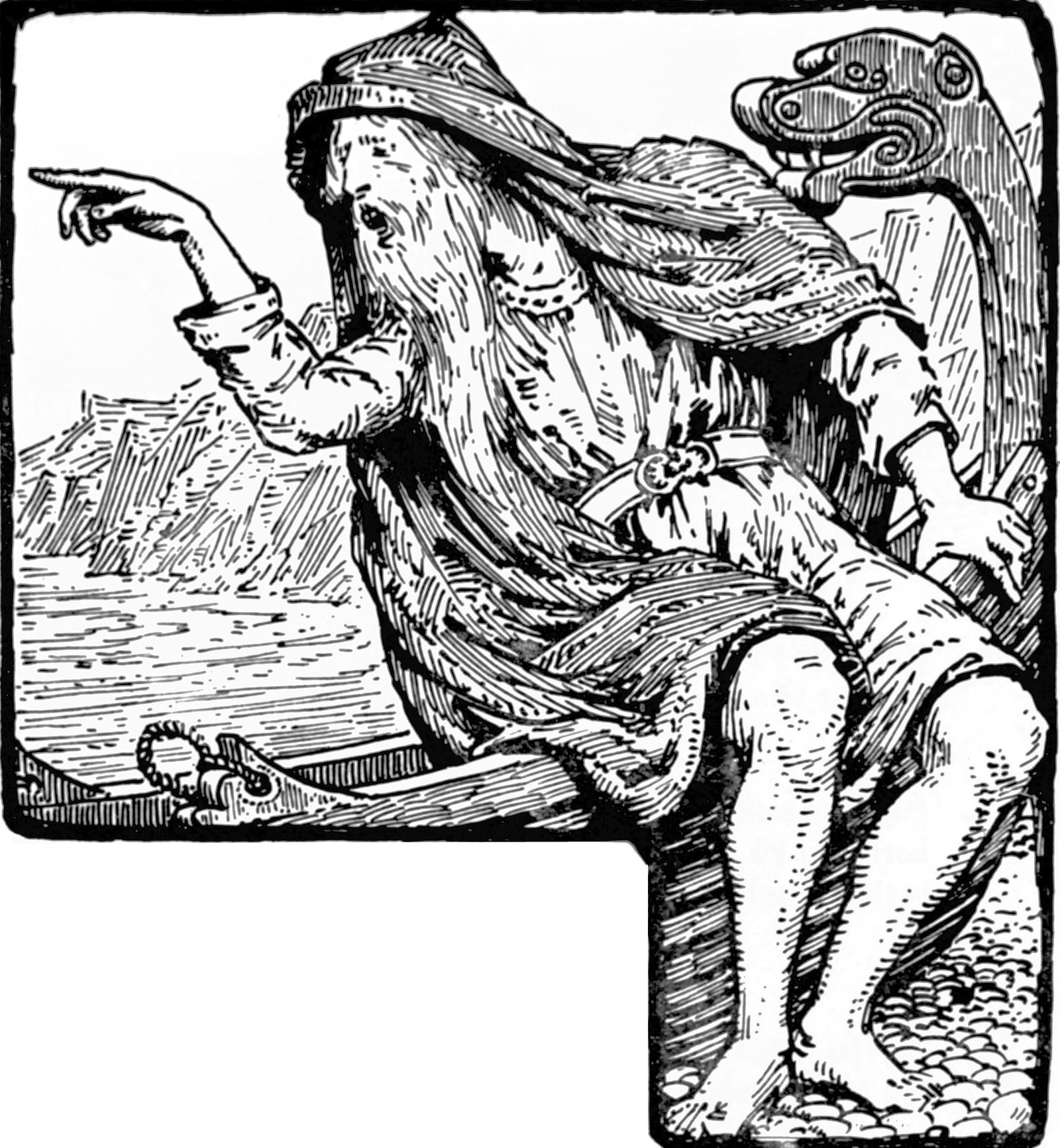
Thor comes back from the east and reaches a sound. On the far shore lies a boat, and beside it a ferryman. That is all the action Hárbarðsljóð has. The strongest of the gods asks for passage, does not get it, and is told instead that he is a beggar without breeches, a coward who hid in a giant's glove, and the god of thralls. The poem is one of the oddest pieces in the Poetic Edda: shapeless, coarse and full of allusions to stories nobody else tells. This article walks through it stanza by stanza, shows where the two manuscripts part company, and separates the wording from what later readers have put into it.
The Poetic Edda usually shows Thor winning. He fetches the brewing cauldron from the giant Hymir, he kills Thrym and his kin, and in Lokasenna he is the one who finally shuts Loki up. In Hárbarðsljóð, "the lay of Hárbarðr", he wins nothing. He does not cross the water, he gets no fight, and the other man has the last word.
A short prose sentence opens the poem: Þórr fór ór austrvegi ok kom at sundi einu. Thor travelled from the east-way and came to a sound; on the other side of the sound was the ferryman with the boat. In the mythological poems the "east-way" is where Thor fights giants. Where the sound lies, the text does not say. Then an exchange begins that is shouted across the water to the very last line. The two speakers never come closer than hailing distance.
In stanza 10 the ferryman gives his name as Hárbarðr, "Greybeard". The poem never states that Odin is hiding behind that name. It is nonetheless the usual reading today, for good reasons set out below. Stanza numbers in this article follow the reading edition in our archive, which counts sixty stanzas (Hárbarðsljóð, bilingual).
The first two lines are already a trade of blows. Thor shouts, in Henry Adams Bellows's translation: "Who is the fellow yonder, on the farther shore of the sound?" The ferryman shouts back: "What kind of a peasant is yon, that calls o'er the bay?" The original sets sveinn sveina against karl karla, roughly "lad" against "old, common man". Edward Pettit notes in his dual-language edition that each describes the other in a term that suits himself better.
Thor tries an offer first. He has a basket on his back, there is no better food, and the ferryman shall share it in the morning. At home he ate his fill of síldr ok hafra. Bellows translates "herrings and porridge", Karl Simrock "Hering und Hafermus". Pettit thinks "he-goats" is possible as well, since hafra can belong to either word, and Thor's goats, which he slaughters and brings back to life, are known from Gylfaginning. Which reading was meant cannot be decided.
The ferryman's reply is the first piece of malice in the poem. Thor boasts of his breakfast but does not know how things stand at home: his household is sad, and his mother, he thinks, is dead. Thor takes it seriously. That is the heaviest news anyone can hear, he says in stanza 5. The ferryman presses on. Thor does not look like a man who owns three good farms. He stands there barefoot, dressed like a vagrant, without even breeches.
Some retellings turn this into a fact and have Thor arrive in beggar's clothes. In the text it is a taunt from the mocker's mouth and nothing more. Whether Thor really looks like that, we are not told.
Next comes the ritual of naming. The boat belongs to one Hildólfr who lives at Ráðseyjarsund, says the ferryman, and Hildólfr has forbidden him to carry robbers and horse thieves. So Thor had better give his name. In stanza 9 Thor introduces himself with his whole family: Odin's son, Meili's brother, Magni's father, "the strong one of the gods". He does not name his mother. The other man answers in a single sentence: "Harbarth am I, and seldom I hide my name." Coming from a god who hardly ever travels under his own name, that is a neat joke.
Thor threatens to repay the mockery as soon as he is across. But he will not wade, he says; it would be a nuisance and he would get wet. Which garment or body part ögur refers to, nobody knows for certain. Simrock writes "garment", Bellows "my middle", and Pettit considers a coarser meaning. Hárbarðr stays where he is: Thor has not met a harder opponent since Hrungnir died.
With the name Hrungnir the conversation tips into a new form. Thor picks up the cue and tells in stanza 15 how he felled the giant with the head of stone. Then he asks the question that returns as a refrain from here on: Hvat vanntu þá meðan, Hárbarðr? "What, Harbarth, didst thou the while?" In the text of our archive this sentence, with small variations and the name changing, occurs nine times.
The answers could hardly differ more. Thor lists fights:
Hárbarðr answers with achievements of a different kind. He spent five winters with one Fjölvarr on an island called Algrœn, "All-green", fighting and seducing women, and he slept with seven sisters (st. 16 and 18). He lured "dark-riders" (myrkriður) away from their husbands and robbed the giant Hlébarðr of his wits after the giant had given him a gambanteinn, a magic wand (st. 20). In Valland he set princes against one another and never made peace (st. 24). In the east he met a "linen-white" girl in secret (st. 30).
That is the pattern of the poem. One protects; the other seduces, deceives and stirs up war. Thor's comments are dry. On hearing how Hlébarðr was cheated he merely says that Hárbarðr repaid good gifts with an evil mind. The reply is a proverb about the oak that takes what it scrapes off another: in such matters every man looks to himself.
Almost all of these stories are only hinted at here. According to Pettit, Fjölvarr, Algrœn and Hlébarðr are otherwise unknown, and so is the episode with the sons of Svárangr. He identifies Hlésey with the Danish island of Læsø in the Kattegat. In Þjazi's case the poem even contradicts the better-known version. In Skáldskaparmál (ch. 4 in the numbering of our source archive) it is Odin who throws the giant's eyes into the sky and makes two stars of them, as compensation to Þjazi's daughter Skaði. In Hárbarðsljóð Thor claims the deed, and the ferryman does not object. Whether an older variant shows through or the poet lets Thor brag on purpose cannot be settled.
When Thor proudly reports on the women of Hlésey, Hárbarðr twists the words in his mouth: it was shameful to strike women. Thor defends himself. She-wolves they were, hardly women. The dialogue is built very precisely at such points. Thor is constantly made to justify himself; Hárbarðr never is.
The best-known passage of the poem sits in the middle of this list. Hárbarðr speaks:
In Valland I was, and wars I raised,
Princes I angered, and peace brought never;
The noble who fall in the fight hath Othin,
And Thor hath the race of the thralls.Hárbarðsljóð, st. 24, translated by Henry Adams Bellows (1923)
The last three lines of the original read: Óðinn á jarla, þá er í val falla, en Þórr á þrælakyn. Literally: Odin owns the jarls who fall among the slain, but Thor owns the kindred of thralls. A jarl is a man of high rank, a þræll an unfree person (on the subject itself see slavery in the Viking Age). It is worth noticing that the speaker refers to Odin in the third person although, on the usual reading, he is Odin himself. That fits the disguise.
The line is often read as a piece of information about religion: the god of the warrior aristocracy on one side, the god of ordinary people on the other. The context speaks against that. The line is spoken in an exchange of insults and it is meant to hurt. Thor takes it that way. Hárbarðr would share out men unequally among the Æsir, he replies in stanza 25, if he had the power to do so. He disputes the division.
Bellows warned as early as 1923, in the introduction to his translation, against looking for deeper symbolism in the poem, such as a contrast between nobles and peasants; he called it "a vigorous piece of broad farce". Pettit explains the passage just as soberly. Odin's valkyries choose the best of the dead for Valhalla, where they live as einherjar; Thor is linked rather with free farmers, so the claim about thralls is probably one more insult. The stanza is no evidence that the unfree went to Thor after death. I know of no other source that says so.
Two of the ferryman's charges are shared with Lokasenna. The first comes in stanza 26. Thor has strength enough but no heart. Out of fear and cowardice he squeezed into a glove and did not dare to sneeze or fart in case Fjalarr heard. Snorri tells the story behind this in Gylfaginning (ch. 45 in our archive): on the way to Útgarða-Loki, Thor spends the night in what he takes for a house and what turns out in the morning to be a giant's glove. Snorri calls the giant Skrýmir; Hárbarðsljóð calls him Fjalarr.
In Lokasenna, Loki throws the same episode at Thor, and one line agrees word for word: ok þóttisk-a þú þá Þórr vera, in Bellows's rendering "and there forgot thou wast Thor" (Hárbarðsljóð 26, Lokasenna 60 in our archive's numbering). A single word links the texts as well. In stanza 13 Thor wants to pay back the kögursveinn, the "swaddled child" or runt, for his taunts. In Gylfaginning Skrýmir warns that Útgarða-Loki's men will not put up with big words from such kögursveinar. Pettit thinks it possible that Snorri had the poem in his ear.
The second charge concerns Sif. When Thor threatens him with the hammer in stanza 47, Hárbarðr changes the subject in stanza 48. Sif has a lover at home; Thor should try his strength on him, that would be more to the point. Thor believes it is a lie. In Lokasenna (st. 54) Loki claims that he himself slept with Sif. Who the lover in Hárbarðsljóð is supposed to be remains open, and no story about it survives.
How the two poems are related is unresolved. Pettit puts most of the resemblances down to the shared genre and regards direct dependence as possible but unproven. Thor's favourite insult belongs here too. Twice he calls the ferryman Hárbarðr inn ragi (st. 27 and 51). Ragr is not just any term of abuse. It is the charge of unmanliness that the law codes made punishable; Bellows translates "womanish", while Simrock softens it to "shameful one". More on this in our article on insults and níð.
Towards the end Thor gives up. He asks for the boat once more ("set Magni's father across"), is refused, and asks for the way by land. Hárbarðr describes it in stanza 56: a while to the stock, a while to the stone, then keep left as far as Verland. There Fjörgyn will meet her son Thor and show him the road to Odin's lands. So the mother who was supposedly dead in stanza 4 is alive. Pettit reads this as a tacit retraction.
Thor asks whether he will get there today. With toil and trouble, comes the answer. Thor promises to repay the refusal if they ever meet again. The last line is the ferryman's: Far þú nú, þars þik hafi allan gramir, in Bellows's words "Get hence where every evil thing shall have thee!" There is no violence. Nor does Thor learn whom he has been talking to.
The name is the first argument for Odin. In Grímnismál Odin lists his aliases, and the list ends "Gondlir and Harbarth midst gods" (st. 49 in our archive and in Pettit). Snorri takes the same run of names into Gylfaginning. The behaviour matches: disguise, false name, magic, affairs with women, warmongering. Odin appears as a boatman elsewhere too, for instance, as Pettit points out, when he carries off the dead Sinfjötli in a boat.
The rival theory is old. Early commentators such as F. W. Bergmann and Viktor Rydberg took Hárbarðr to be Loki; that is how the English Wikipedia reports it, and I have not seen the original passages. Their arguments are obvious enough: the jibes about the glove and about Sif recur in Lokasenna in Loki's mouth. Later scholars such as Finnur Jónsson and Felix Niedner rejected the identification. Pettit says cautiously that scholars have often compared Hárbarðr with Loki and sometimes identified the two, and stays with Odin.
One objection arises from the text itself. Thor calls himself Odin's son, and at the end the ferryman points him towards "Odin's lands". A father who makes his son's journey home harder and curses him at parting is unusual. The poem does not explain it.
Old Norse has two names for verbal duels. The senna is an exchange of insults; the mannjafnaðr, literally "comparison of men", sets one's own deeds against the other's. Where Hárbarðsljóð belongs is disputed, according to Pettit. Some assign it to one type, some to the other, and some divide it, with stanzas 1 to 14 as senna and 15 to 46 as mannjafnaðr. Everyone agrees that the two are closely related. English-language scholarship calls both flyting.
Pettit lists what makes a Germanic flyting: a stock setting, often a feast or a stretch of water; each party asking the other's name; boasts and insults in turn; the contrast between the hard life of the fighter and the soft life at home; an ending without blows. Related scenes occur in the Helgi poems and in the Old English Beowulf.
In 1979 Carol Clover devoted an article to the poem under the title "Hárbarðsljóð as Generic Farce". Pettit cites her for the many similarities with other Germanic flytings; I have not consulted the article itself. What the text itself shows is a game with the conventions. Hárbarðr boasts of the "soft" life, of beds and tricks instead of battles, and wins all the same.
No other mythological poem is as irregular. Pettit identifies lines in málaháttr or fornyrðislag, in ljóðaháttr and galdralag; Bellows took some of the speeches for prose. Several "stanzas" consist of a single sentence, such as Thor's "How won ye success with your women?" (st. 17). Bellows called Hárbarðsljóð "the most nearly formless of all the Eddic poems" and thought the stanza divisions largely arbitrary; he accepted Mogk's view that the author was "a first-rate psychologist, but a poor poet".
Earlier editors suspected corruption and later insertions and tried to restore a regular original. According to Pettit, recent scholarship has given that up. He considers that the text may be a dialogue for two voices, meant for performance.
The poem is complete only in the Codex Regius (R, fols. 12r to 13v), between Skírnismál and Hymiskviða. The second manuscript, the fragment AM 748 I a 4to (A) from the beginning of the fourteenth century, has lost its opening. Its text starts in the middle of stanza 19, at the word minna, and runs to the end; in A, Baldrs draumar follows. According to Pettit both manuscripts mark the speakers from stanza 20 on.
The two versions largely agree. A few differences recorded in Pettit's apparatus do change the sense:
The translations diverge even where the manuscripts agree. Stanza 50 has ef þú litum færir: Simrock understands "if you travelled in changed shape", Bellows "in the boat", Pettit "with oars". In stanza 52 Hárbarðr calls himself a féhirðir, a herdsman; Bellows puts "ferryman". Anyone quoting the poem should therefore say which edition they are using.
Accounts differ. Bellows placed the poem "in its present form" in the eleventh century, "a relatively late date", pointing among other things to the suffixed articles: forms such as sundit, váginn or bátinum, which do run through the whole text. Pettit calls the date uncertain. Snorri neither quotes nor names the poem; if the word kögursveinn in Gylfaginning is an echo, the poem existed in some form before about 1225.
Pettit cites two further traces. An episode in the Old Norse version of Oddr Snorrason's life of Óláfr Tryggvason looks like a comic inversion: a man, obviously Thor, is taken on board, talks big and boasts of having killed the last two giantesses. And Njáls saga (ch. 102) contains a verse attributed to Úlfr Uggason, the poet of Húsdrápa, which seems to allude to a contest between Hárbarðr and Thor. If it really is Úlfr's, the material was known in the late tenth century. That is not certain.
What is Hárbarðsljóð about? Thor wants to be ferried across a sound. The ferryman Hárbarðr refuses and draws him into a long exchange of boasting and mockery. In the end Thor has to go round by land.
Why does Thor not simply wade across? He says himself in stanza 13 that it would be too much trouble, and threatens to do it once more in stanza 47. A Grímnismál stanza that Gylfaginning also quotes has him wading rivers every day. The poem uses the contradiction for comedy and does not resolve it.
Does Thor realise whom he is talking to? Nothing in the text suggests it. He treats the ferryman as a stranger to the end and threatens him with revenge.
What does Hárbarðr mean? "Greybeard"; Pettit translates "Grey Beard". The name also appears in the list of Odin's names in Grímnismál.
Where can I read the poem? In Old Norse with Simrock's German in our reading edition, and with Bellows's English version in the source archive.
Lokasenna: Loki's flyting · Thor · Odin · Fjörgyn, Thor's mother · Sif · Hrungnir · Thor and Útgarða-Loki · The Codex Regius · Baldrs draumar · Insults and níð
Thor · Odin · Lokasenna – the flyting of the gods · Fjörgyn and Fjörgynn · Þrymskviða: Thor as the bride.
A man called Þorleifr gives a poet a shield with gods and giants on it. The poet thanks him the way skalds do, in …
Read more →A poem that opens by advising you to look around when you enter a house, to see where the enemies are sitting. It …
Read more →A king's daughter promised to a husband she does not want picks a hero for herself. He wins her in war and dies at her …
Read more →Hermod (Old Norse Hermóðr) is the god who, after Baldr has been killed, rides Odin's eight-legged stallion Sleipnir for …
Read more →