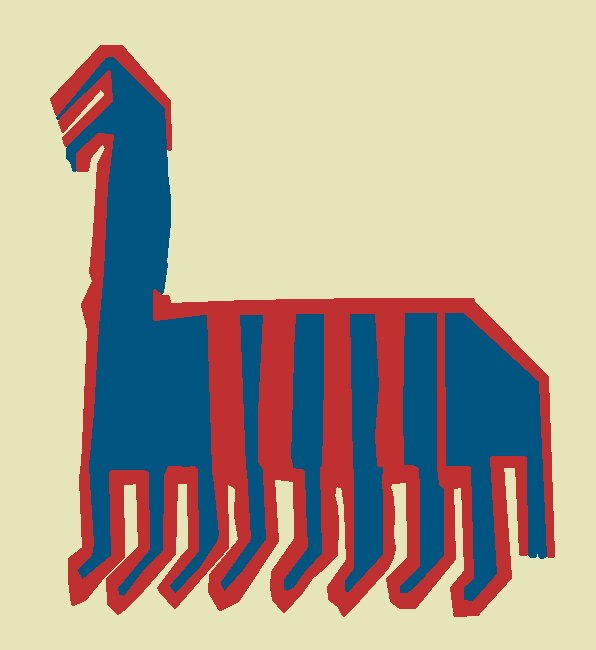
Hundreds of small people, red and blue animals, a tree, a ship, buildings topped with crosses – and nearly everything moves to the left. The Överhogdal tapestries are among the best-preserved figured textiles of medieval Scandinavia. They are often introduced as a “Viking tapestry” showing Ragnarök. The measurements point to the years around 1100, and in a little over a century scholars have put forward at least four readings that cannot all be right. This article separates what has been measured, what has been read and what is interpretation.
Överhogdal is a church village in Härjedalen, a thinly settled province in the Swedish interior. According to the archaeologist Stig Welinder, the village had no church before the fifteenth century; the present building, according to a restoration report by the county museum, was put up in 1744–1749 and rebuilt in 1849–1855. The weavings are several centuries older than any church that stood there. Where they were woven, and how they reached Överhogdal, nobody knows.
When the pieces came to light in the early twentieth century they had been sewn together into a single length. That is how Anneli Palmsköld describes them in a book review published in the cultural-history journal RIG in 1998. Only in 1929 was the length taken apart again, and the pieces were framed separately. From 1930 they hung in the county museum in Östersund; in 1995 they moved to the new building of the Jamtli museum. According to Palmsköld the parish of Överhogdal remained the owner, with the museum holding the weavings on deposit.
The accounts of the discovery differ. English Wikipedia names Jonas Holm (1895–1986) as the finder, saying he discovered the weavings in 1909 in the vestry during renovation work; in 1910 the artist Paul Jonze (1883–1973) and Ellen Widén, wife of the county governor, are said to have brought them to Östersund. If the birth year is right, Holm was a boy of about fourteen at the time. Independently attested is only Jonze's presence in 1910: the restoration report prints a photograph of the church captioned “1910. Foto: P. Jonze”.
An exhibition text based on material from Jamtli tells it differently. There Paul Jonze himself is the finder. In 1910, it says, he cycled through Jämtland and Härjedalen to record rural culture for the handicraft association Jämtslöjd and found the weavings in a shed beside the church. Palmsköld likewise speaks of a church storehouse and the year 1910, Welinder of the church and its storehouse. Vestry or shed, 1909 or 1910: the texts available to me do not settle it.
The accounts agree on what happened next. Ellen Widén took charge of the dirty cloth and had it washed. In 1911 the weavings were shown in Östersund for the first time. Later Helena Öberg gathered further fragments. One had served as a cover for a doll, one had been used in the church to polish a lamp, one lay under the pulpit stairs. After a history like that, the condition of the main pieces is close to miraculous, and the colours in particular are regarded as unusually fresh.
Scholars count five pieces and label them with Roman numerals: Ia, Ib, II and III are figured weavings in the same technique, IV is an ornamental weaving in a different one. Piece III is only a small fragment and, according to Palmsköld, too small to interpret. This explains the confusion in many short descriptions, which speak now of four parts, now of five. Both are correct, depending on whether you count the textiles or the narrative picture fields.
Survey accounts count several hundred human figures and well over a hundred animals. I give no exact numbers, because I could not check them against a specialist source. The people are small, the animals large.
At first the pictures were taken for embroidery. A closer look showed otherwise: nowhere does the wool thread pierce the fibres of the ground fabric, as a needle almost inevitably does. The figures were made during weaving. According to Palmsköld, Erik Salvén coined the Swedish word snärjväv, “snare weave”, for it. Internationally the technique is called soumak.
The principle is this. A coloured pattern thread does not simply pass between the warp threads; it is wrapped around them. The exhibition text mentioned above gives the rhythm – the pattern thread passes forward over nine or six warps and back around two or three – and says a linen pick secures the cloth after each pattern row. I have not checked these figures against a technical study. The result is a slightly raised, dense field of colour on a pale ground. As the loom, the accounts name the upright warp-weighted loom, on which stone weights keep the warp threads taut. Our article on weaving and textile craft in the Viking Age explains how that loom works.
Piece IV is a double weave. Two layers of cloth are woven at once and change places along the edges of the pattern, so that an ornament appears on both faces in reversed colours. It carries no narrative, but according to Palmsköld it belongs to the same period as the figured pieces.
The name has been disputed since the find. Altar cloths, wall hangings, tapestries – every term implies a purpose that nobody knows. In his book, published by Jamtli in 1996, Sture Wikman therefore chose the neutral word väv, weaving. “Tapestry” is the established English term and I keep it here.
The ground is of plant fibre, the pattern of wool. The exhibition text names woad for blue, madder root for red and weld for yellow as the dyes, the same three plants attested on other Nordic textile finds. More on this in our articles on the dyer's craft and the colours of the Viking Age.
A study by Skoglund, Nockert and Holst, published in Scientific Reports in 2013, corrected the older picture. The authors examined ten Scandinavian plant-fibre textiles from the Viking Age and early Middle Ages, all of them believed to be flax. Four turned out to be hemp, among them two pieces from Överhogdal; in three of the four cases hemp was mixed with flax. I know the study only through a summary, not in full. Its conclusion: hemp in the North was used for fine cloth as well as for rope and sailcloth.
At first the tapestries were considered medieval in a broad sense. Then came radiocarbon dating, which measures the age of organic material from the decay of the carbon isotope C-14.
In 1991 threads from four pieces were dated. Welinder sums up the outcome: two dates agree with the later measurements, two came out older, one in the ninth and one in the tenth century. This series is the origin of the often repeated range “800 to 1100”, and of the label “Viking Age”.
In 2005 new measurements were made, this time on one tiny linen thread from each of the five weavings. According to Welinder the results were almost entirely consistent and indicate that all five were woven within about fifty years around 1100. Welinder gives no range of years. The often repeated figure of 1040 to 1170 is known to me only from English Wikipedia, which assigns it to the 2005 test; some websites attach it to 1991.
That leaves the two early dates of 1991. Welinder lets the reader choose: either the first analysis was faulty, or some threads really were centuries older than the cloth. For the second case he offers a practical explanation. The weavers may have unravelled older fabrics and reused the old threads, because that is less work than spinning new flax. This is a hypothesis, not a finding. His verdict on the date is clear all the same: the tapestries are not Viking Age work but were made roughly two generations after the usual end date of that period.
The picture fields show animals, people, trees, boats and buildings. Among the animals, horses in dark blue and red stand out, along with birds and horned animals that Wikman reads as reindeer. People ride, walk or stand inside houses. At least one ship is shown. Almost all figures move to the left, which gives the pictures the character of a procession. Several buildings carry crosses; Palmsköld speaks of four church buildings.
Then there are trees, three by Wikman's count. One of them, on piece Ia, bears two red birds and is the motif most often reproduced. Overviews also mention a horse figure which they identify as Odin's horse Sleipnir. I have not checked this figure against an image and so only pass the identification on.
There is no frame of explanatory captions of the kind the Bayeux Tapestry has. With one exception.
Runes are woven into one of the pieces. The runic database Rundata lists the inscription under the signature Hr Peterson2006;157, formerly Hr Pipping1924;462. The transliteration is -- × (k)uþbu: the beginning is missing and the k is an uncertain reading. This is normalised as Old Norse Guðbú. The database's English translation is “the gods' dwelling”; its Swedish translation treats the word as a place name, “Gudby”. According to the database comment the inscription is woven upside down. For the date Rundata enters “Viking Age”, which reflects the state of knowledge before the 2005 measurements.
So two readings stand side by side, a concept and a name. Whether guð here means the old gods or the Christian God cannot be decided from the word alone; a Swedish television report of 2017 renders it as “God's dwelling”. Which of the pieces carries the runes does not emerge from the texts I was able to consult.
From the start the motifs were linked either with Christian contexts or with Norse mythology. Four main interpretations have grown out of that.
The mission story. In 1920 Georg Karlin read the pictures as an account of the Christianisation of Härjedalen by a missionary named Staffan, including a scene in which a Sámi sacred stone is torn down. The reading leans on the buildings with crosses. It assumes that the weavings come from the area where they were found, and that is exactly what cannot be shown.
The Sigurd legend. Agnes Branting and Andreas Lindblom saw scenes from the Völsunga saga: Sigurd the dragon-slayer, with Atli and Gudrun. The reading is not dead. In 2019 a bachelor's thesis by Staffan Mjönes at Stockholm University compared pieces Ia and Ib with the Völsunga saga, both Eddas and the Nibelungenlied and found many points of contact; according to its abstract it considers a political purpose and sees Danish and English influence in the style. The same abstract mentions a reading of piece II that links it with the Norwegian campaign of Cnut the Great in 1028. I could not establish who first proposed that reading.
The Last Judgement. In 1991 Ruth Horneij submitted the doctoral thesis Bonaderna från Överhogdal. According to the account I read, she drew on Apocalypse manuscripts of the ninth and tenth centuries and recognised Christ, the archangel Michael and the Book of Life in individual figures. Horneij sees pagan and Christian ideas of the end of the world pushed together. I did not have the thesis itself.
Ragnarök. In Fenrisulven ränner (“The Fenris Wolf Runs”, 1996) Sture Wikman interpreted the weavings as a depiction of the end of the world as told in the Völuspá. For him the tree with the birds is Yggdrasil. He reads three riders as Odin, Thor and Freyr, a V-shaped form as the collapsing sky, a bound figure as Loki beneath the serpent's venom – the scene we treat under Loki's punishment. The figure earlier scholars took for Sigurd is, for Wikman, the fire giant Surt, riding up the rainbow bridge Bifröst towards the watchman Heimdall. On piece II he sees reindeer and the survivors of the catastrophe, Baldr among them.
The poem Wikman appeals to sounds like this at the decisive point:
Yggdrasil shakes, and shiver on high
The ancient limbs, and the giant is loose;
To the head of Mim does Othin give heed,
But the kinsman of Surt shall slay him soon.Völuspá, stanza 47 (as numbered in our source archive), translated by Henry Adams Bellows, 1923
Popular accounts today present the Ragnarök reading as the dominant one, and the dating is often cited in support. That argument only works with the figures of 1991. Anyone who takes the 2005 measurements seriously arrives at a time when churches were already standing in the region.
Each of the four readings explains part of the imagery well and another part badly. Palmsköld objects that Wikman passes quickly over the four church buildings with crosses, which other scholars discuss at length. Conversely, anyone who sees the Last Judgement or a mission story has to account for the mass of animals that dominates the picture. And the Sigurd reading needs a figure that Wikman reads, just as coherently, as Surt.
The problem lies in the genre. The figures are heavily simplified, attributes are largely missing, and no text names a scene. A rider is a rider. Whether he is Odin, Sigurd or an apostle is decided by the viewer and the book the viewer happens to have in mind. There is a problem of time as well: the Völuspá was written down in the Codex Regius around 1270, the Völsunga saga later still. Explaining the pictures by these texts means reading a cloth of around 1100 through Icelandic manuscripts that are more than a century and a half younger and come from a different region. That is legitimate, since the Sigurd carvings on Swedish rock show that such stories circulated in images in the eleventh century. It remains an inference across a gap.
Finally, it is an open question whether the pieces form a single narrative at all. They were sewn together when found, but that speaks only of their late use. Mjönes treats Ia and Ib separately from II; Wikman reads them all together. The museum's exhibition text draws the sober conclusion that no single interpretation has been proven.
What the 2005 result means becomes clear from a look at the region. Towards the end of the eleventh century Östman, son of Gudfast, had a rune stone raised on Frösön that credits him with the Christianisation of Jämtland; we discuss it in our article on the Jämtlanders. According to Welinder, the churches of Mattmar and Norderön have radiocarbon dates of 1070 to 1100. In the twelfth century Härjedalen came under the bishop of Nidaros, Jämtland under the bishop of Uppsala.
At the same time the change of faith was not complete. Welinder mentions two men buried at Vivallen in the twelfth century wrapped in birch bark, a custom known from later Sámi tradition, and a cremation at Vikarsjön from the early thirteenth century that looks neither Christian nor clearly Sámi. The tapestries were therefore made in a society where baptised and unbaptised people lived side by side and where Norse and Sámi ways of life touched; more on this in our article on the Sámi in the Norse sources.
Pictures that show churches and a world tree on the same length of cloth, without forcing a choice, fit such a setting. Welinder imagines the weaving being done on a magnate's farm, in a weaving room like the one excavated at the farm of Kyrklägdan in Ås, where needles, spindle whorls, a pair of shears and six loom weights of about one kilogram each were found. He himself thinks it possible that the tapestries were not made in the province at all.
The figured textiles from the Oseberg ship burial, dated by tree rings to 834, are older. More than a hundred fragments of narrow picture bands survive there, only about 16 to 23 centimetres high, with a procession of people, horses and wagons. What the two share is the pictorial idea, a train of small figures on a long, narrow cloth. But some 250 years and a change of religion lie between them.
The Skog tapestry is often set beside Överhogdal. It is known for three figures debated under the heading “three kings or three gods”. I did not verify the details of Skog's discovery and dating for this article and therefore leave them out.
The Bayeux Tapestry is often mentioned in the same breath but is a different thing. It is embroidered, not woven, measures some 68 to 70 metres, tells a datable political event and names its scenes in Latin captions. Överhogdal has none of that. Only the period is comparable: both works belong to the late eleventh or early twelfth century.
As visual sources for Norse narrative, the Gotland picture stones are more rewarding, because some are centuries older. There too, matching scenes to myths remains interpretation.
The originals hang in Jamtli in Östersund, the regional museum of Jämtland and Härjedalen, in a room set up specially for them and designed for their preservation. To understand how they were made, Ellinor Sydberg has woven a copy. For preparation, Jamtli offers Ulla Oscarsson's book of 2010, De gåtfulla Överhogdalsbonaderna – “The Enigmatic Överhogdal Tapestries”. The title is honest.
For us in the workshop in Alsdorf, the Överhogdal animals are a lesson in reduction: a few straight and slanting lines, and still you recognise horse, bird and reindeer at once.
How old are the Överhogdal tapestries? The most recent radiocarbon measurements, from 2005, place all five weavings around 1100; the often quoted range of 1040 to 1170 I have seen only in survey accounts. An earlier test in 1991 produced dates in the ninth and tenth centuries for two samples; whether that was a measurement error or reused old thread is open.
What do the pictures show? Animals, above all horses, birds and horned animals, together with several hundred small people, trees, at least one ship and buildings, some of them with crosses. What story they tell is disputed: proposals include Ragnarök, the Sigurd legend, the Last Judgement and the conversion of Härjedalen.
Are the tapestries embroidered? No. Four pieces are woven in soumak technique, in which coloured wool threads are wrapped around the warp, and the fifth is a double weave. The early assumption that they were embroidery proved wrong.
Is there an inscription? Yes, a short sequence of runes read as (k)uþbu and interpreted as Guðbú, “the gods' dwelling” or a place name. It is woven upside down and its beginning is missing.
Where were they made? That is unknown. The church of Överhogdal is younger than the weavings, and no place of manufacture has been demonstrated. Stig Welinder considers it possible that they do not even come from the province.
The Oseberg ship and its picture textiles · The Bayeux Tapestry · Weaving and textile craft in the Viking Age · The Jämtlanders and the Frösö stone · Yggdrasil · Ragnarök · The Völuspá · Sigurd the dragon-slayer · The Christianisation of the Germanic peoples · The picture stones of Gotland
The Oseberg ship & the two women · The Bayeux Tapestry · Viking Weaving · Yggdrasil – the world tree · Ragnarök.
All History & Finds articles →
South-west of Lake Balaton, where the Zala winds through reeds and marsh towards the Little Balaton, lies the village …
Read more →In March 845, 120 ships sailed up the Seine. By Easter their leader stood in Paris, and King Charles the Bald bought …
Read more →The Parisii lived on the middle Seine and gave their name to a world city. What we know about them comes from a handful …
Read more →When a find comes out of the ground, the archaeologist faces one plain question: how old is it, and where does it …
Read more →