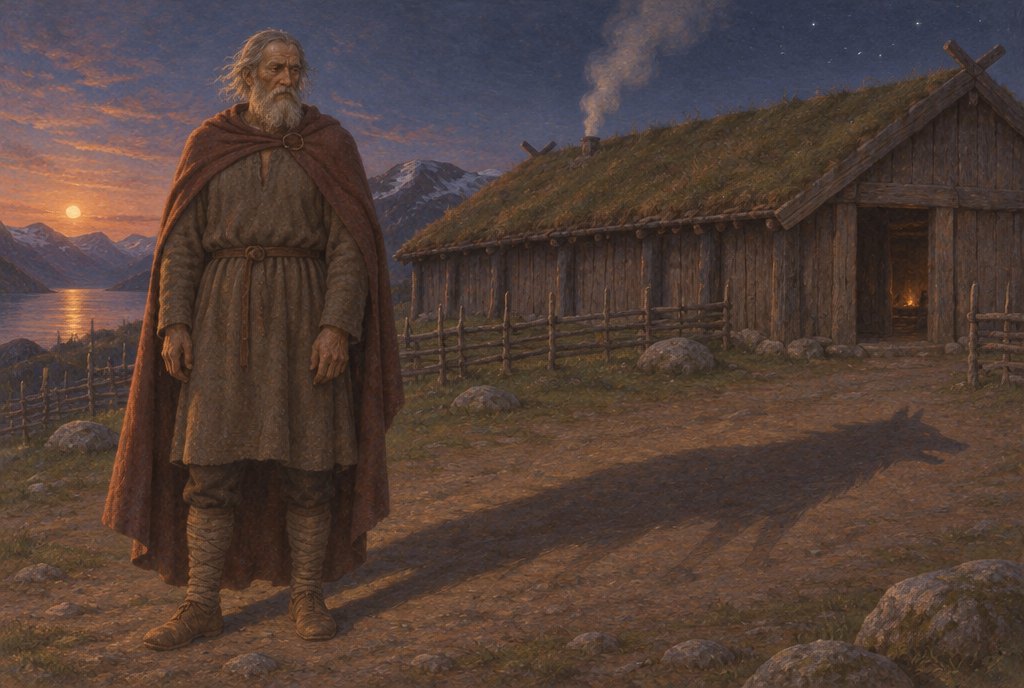
A wealthy farmer in western Norway turns sour every evening, goes to bed early, and the neighbours talk. That is all the first chapter of Egil's Saga says about what earned Úlfr Bjálfason the byname Kveldúlfr, "Evening Wolf". There is no wolfskin, no claws, no prowling at night. This article reads those few sentences closely, follows the old man to his death on the North Atlantic, and marks the point where the saga stops and interpretation begins.
Kveldulf is a character in Egil's Saga, the life story of the skald Egill Skallagrímsson. He is Egil's grandfather and dies long before the saga turns to Egil himself. It opens with him all the same, and his reputation as the werewolf of the North rests on one short passage in the first chapter.
"But every day, as evening drew on, he grew so surly that few people could get a word with him. He was sleepy in the evenings. People said that he was very hamrammr. He was called Kveld-Úlfr."Egils saga, ch. 1; own translation from the Icelandic text (modern Icelandic spelling) on WikiSaga, University of Iceland
In the original these are four sentences: En dag hvern er að kveldi leið þá gerðist hann styggur svo að fáir menn máttu orðum við hann koma. Var hann kveldsvæfur. Það var mál manna að hann væri mjög hamrammur. Hann var kallaður Kveld-Úlfur. Three words do the work. Styggur here means something like "surly, unapproachable". Kveldsvæfur describes someone who gets drowsy early in the evening. And hamrammur, Old Norse hamrammr, has no single English equivalent; more on that below.
It matters who is speaking. The saga does not itself assert that Úlfr was hamrammr. It says Það var mál manna, "it was the talk of people". The narrator reports a rumour. On this reticent way of telling, see our overview of the Sagas of Icelanders.
The first chapter introduces him like this: Úlfr was the son of Bjálfi and Hallbera. He was so tall and strong that no one could match him. In his youth he went raiding with a man called Kári of Berðla. Later he married Kári's daughter Salbjörg and became a rich and shrewd landowner. The saga places him in western Norway; chapter 24 speaks of "the Fjords" (Firðir).
Úlfr and Salbjörg have two sons. Þórólfr is handsome and popular, and goes raiding with Kári's sons Eyvindr and Ölvir. Grímr is dark and good with wood and iron; later he is known as Skalla-Grímr, "Bald Grímr". The pattern returns a generation later: Egil too has a radiant brother named Þórólfr and is himself the dark one.
The saga's first two sentences hold a hint that is easy to miss. Úlfr's mother Hallbera is the daughter of a man called Úlfr hinn óargi, "Úlfr the Fearless", and the sister of Hallbjörn hálftröll, "Half-troll", of Hrafnista. According to the saga, this Hallbjörn is the father of Ketill hængr.
The grandfather is called Wolf, the grandson is called Wolf, the uncle carries a troll name. The father fits as well: in a note quoted on WikiSaga, Benjamin Blaney finds elements pointing to wolf or bear in the names Bjálfi, Hallbera and Hallbjörn and takes hálftröll to point to a troll or giant ancestor, beings credited with changing shape. Elena Gurevich and Inna Matyushina read it similarly: Kveldulf, they are cited as saying, inherited his "wolfish" nature from his forebears, as their names show.
Hermann Pálsson, again as summarised on WikiSaga, proposed that "Half-troll" simply marks a man whose mother was Sámi. The saga sets the names side by side without comment.
Old Norse hamr is the outward form, literally the covering or skin. Rammr means "strong, mighty". Hamrammr is thus someone "strong in the skin". The older English translation on WikiSaga has "shape strong". Our article on fylgja and hamingja sets the word beside eigi einhamr, "not of one skin only", as a term for people who have more than one form.
The verb that goes with hamr is hamask. It names a state someone enters: to rage, to be beside oneself, and in some texts to change shape. Egil's Saga uses it twice at decisive moments, of Kveldulf and of his son. Neither passage mentions fur or animal form.
I did not find the phrase eigi einhamr in the chapters I checked in the original for this article (1, 24, 27, 28 and 40, each in excerpts). For Kveldulf the saga uses only hamrammr and hamask there.
A sentence in chapter 27 shows how far the words reach. There the saga names hamrammir men and those seized by berserksgangr in the same breath. Aðalheiður Guðmundsdóttir notes, in an essay on berserks summarised on WikiSaga, that Egil's Saga uses hamrammur for berserks or as a parallel to berserkr. Blaney, by the same account, goes further: hamrammr describes the mental state of berserk fury and no physical change of shape. On the berserk fit itself, see our article on berserkers.
The opening chapters turn on Harald Fairhair, who in saga tradition brings Norway under his rule in the late ninth century. Kveldulf keeps his distance: he does not go to the king himself but lets his son Þórólfr enter the royal retinue. I know these chapters (3 to 6) only from the English Wikipedia summary.
Þórólfr serves the king and later dies by his hand. Chapter 24 shows the father afterwards. The news hits him so hard that he takes to his bed, af harmi og elli, "from grief and old age". Skalla-Grímr visits often and urges him on: revenge is better than lying there. Kveldulf answers with a stanza. Its content, in prose: fate is harsh, the son was taken too soon, and old age holds him down, the wrestler whom even Thor once could not beat. There will be no quick revenge. I have not checked the wording of the stanza.
When his brother-in-law Ölvir, who is staying with the king, reports on Þórólfr's last fight, the old man asks for every detail. Þórólfr fell forward, at the king's feet. Kveldulf recalls an old saying that a man who falls forward will be avenged, and on the one who stands in front of him. He doubts they will have that luck, and leaves the journey to the king, who is to pay compensation, to his son. Chapter 25 tells the outcome: the king offers compensation only if Grímr becomes his man. Grímr refuses, Eigi mun eg þjóna þér, "I will not serve you", and escapes his pursuers. Father and son prepare to sail for Iceland.
Before leaving Norway they take revenge. Chapter 27 tells it this way: through the summer Kveldulf and Skalla-Grímr watch the sea lanes. They spot a ship that once belonged to Þórólfr and is now commanded by Hallvarðr. In the evening it puts into a harbour. The crew have tented the ship over and lain down to sleep when the two attack with two boats and twenty men in each. Kveldulf leads one, Skalla-Grímr the other.
The saga puts what follows into one sentence: svo er sagt að þá hamaðist hann, og fleiri voru þeir förunautar hans er þá hömuðust, "it is said that he then fell into a frenzy, and there were more of his companions who raged then". Kveldulf carries a bryntröll, a heavy striking weapon whose exact form is unknown. He swings it and cuts through Hallvarðr's helmet and head until the weapon sinks in to the shaft. Skalla-Grímr kills Sigtryggr, the second man on board whom the saga names.
More than fifty of Hallvarðr's men die, and more drown jumping overboard than are cut down on deck. Among the drowned are two sons of a man called Guttormr, twelve and ten years old. Skalla-Grímr spares two or three of the least important men and sends them to the king with the news.
Kveldulf rages here as a man with a weapon in his hand, and several of his men fall into the same state. The hour suits the byname: the attack falls on a sleeping crew in the evening. The word "night", though, does not occur in the passage.
Straight after the fight the saga inserts a general remark. It begins: Svo er sagt að þeim mönnum væri farið er hamrammir eru eða þeim er berserksgangur var á, "So, it is said, it went with those men who are hamrammir or on whom the berserk fit came", and it ends: en fyrst er af var gengið þá voru þeir ómáttkari en að vanda, "but as soon as it had passed they were weaker than usual". In between stands: að meðan það var framið þá voru þeir svo sterkir að ekki hélst við þeim, "while it lasted they were so strong that nothing could withstand them".
So it goes with Kveldulf. When the hamremmi, the saga's noun for it, leaves him, he is af öllu saman ómáttugur, drained by all of it, and lies down. On the crossing he falls ill. He senses his end and gives an instruction: if he dies, which now seems most likely to him, they are to make him a coffin and put him overboard. His son Grímr is to settle as near as he can to where he comes ashore.
The fugitives sail in two ships. The one on which Kveldulf died reaches Iceland under a man who is also called Grímr. His men have not gone far on land when they find the coffin washed up in a small bay: þá fundu þeir í vík einni hvar upp var rekin kista Kveld-Úlfs. They carry it to a headland, set it down and pile stones over it.
Chapter 28 picks this up. Skalla-Grímr, who landed with the other ship, finds his companions again. The following spring he moves his ship into a creek close to where his father had come ashore, builds a farm there and calls it Borg, and the fjord Borgarfjörður. This chapter no longer mentions the coffin; it only says Kveldulf had come to land there and been buried. The dead man fixes the spot where the family takes root. Melissa Berman, according to WikiSaga, put it pointedly: the corpse guides the ship to a safe landing.
Whether an old local tradition lies behind the episode is disputed. Þórhallur Vilmundarson, as his essay "Kista Kveld-Úlfs" is summarised there, thought it probably an invention of the saga author. Karl Gunnarsson, by contrast, as far as the notes there show, has suggested that the headland Kveldúlfshöfði is itself the "coffin", because the settlers regarded it as their ancestor's resting place. I know of no excavation evidence.
There is a political angle too. The saga has Skalla-Grímr claim a huge territory. Kevin P. Smith and Axel Kristinsson point out, again via WikiSaga, that other versions of the settlement tradition give him less land and that the large claim matches thirteenth-century interests, notably those of Snorri Sturluson, who lived at Reykholt and is often thought to be the saga's author. An ancestor whose coffin points out the place supports such a claim. The settlement as a whole is treated in our articles on Ingólfr Arnarson and the Vikings in the North Atlantic.
The trait is passed on. Chapter 40 is set years later near Borg. As the winter wears on a ball game takes place, knattleikr (on the game itself see glíma and knattleikr). Egil, in his twelfth winter, and his friend Þórðr Granason, about twenty, play against Skalla-Grímr. During the day the old man tires and the boys get the upper hand. Then it turns: En um kveldið eftir sólarfall þá tók þeim Agli verr að ganga, "but in the evening, after sunset, things began to go worse for Egil and his partner". Skalla-Grímr becomes so strong that he seizes Þórðr and dashes him to the ground. Þórðr dies of it, and the father reaches for his son.
A bondwoman steps in, Þorgerðr brák, who had nursed Egil as a child. She cries: Hamast þú nú, Skalla-Grímur, að syni þínum, "Are you raging now against your own son, Skalla-Grímr?" He lets Egil go and chases the woman to Digranes. She leaps into the water, he hurls a stone that hits her between the shoulders, and she does not come up again. The sound is called Brákarsund after her. That same evening Egil kills his father's steward and sits down at table. Father and son do not speak all winter.
The scene repeats the grandfather's pattern: evening, sunset, suddenly swelling strength, the verb hamask. Torfi H. Tulinius, according to WikiSaga, relates the woman's cry to Skalla-Grímr's double nature as man and wolf. Yet here too nobody transforms.
The literal reading takes the name seriously. For it, Kveldulf is a werewolf, or at least believed by his neighbours to be one. Lars Lönnroth, in an essay on the body as mirror of the soul quoted on WikiSaga, calls him an ugly berserk and hamnskiftare, shape-changer. Gurevich and Matyushina speak of a werewolf. The name, the time of day, the troll kinship and the basic sense of hamr favour it.
The metaphorical reading keeps to what is told. In the chapters checked, the saga describes no transformation. It describes bad temper, drowsiness, battle frenzy and exhaustion. Blaney's finding that hamrammr here means a state of mind fits this, as does the sentence that equates the hamrammir with men in the berserk fit.
One piece of evidence comes from outside. In 2007 Aðalheiður Guðmundsdóttir examined the werewolf narratives of Icelandic literature in the Journal of English and Germanic Philology. Her subject, according to the introduction, is accounts of men who took on wolf form and lived in the forest. The list of fourteen native sources that the site Medievalists.net reproduces from that introduction includes Völsunga saga and Gylfaginning. Egil's Saga is not on it. I could not consult the article itself; it may discuss Kveldulf elsewhere. By the standard of that list, at any rate, he lacks the decisive thing: the transformation.
The alternative may be drawn too sharply. The author wrote in Christian thirteenth-century Iceland about heathens of the ninth century, and the phrase "people said" permits both readings. Whether he preferred one cannot be established.
Kveldulf is often lined up with other animal-men of the North. The úlfheðnar, the "wolf-coats", are attested as a warrior group in a praise poem for Harald Fairhair. They are men of the very king whom Kveldulf refuses to serve, and they wear the wolf as dress and name. In the chapters checked, the saga nowhere calls Kveldulf an úlfheðinn; the identification made by the English Wikipedia, for instance, is modern.
Böðvarr Bjarki in Hrólfs saga kraka comes closer to a real transformation. There a huge bear fights in the king's army while the hero sits motionless in the hall; when he is disturbed, the animal vanishes. More tangible still is the episode of Sigmundr and Sinfjötli in Völsunga saga, who pull on wolfskins and run through the forest as wolves. That saga is on Aðalheiður Guðmundsdóttir's list. Kveldulf has neither a skin to put on nor an animal that fights for him. See also our articles on the wolf in the North and the bear.
Egil's Saga is widely thought to have been written between about 1220 and 1240. The events around Kveldulf are supposed to have taken place in the late ninth century. Some three and a half centuries lie between, and old tradition cannot be separated in detail from invention. Kveldulf also appears in Landnámabók, the Icelandic register of the first settlers (Part 1, chs. 18–19 in the Netútgáfan online edition). There his father is Brunda-Bjálfi and everything is briefer: the king will not compensate for Þórólfr's death (það vildi Haraldur konungur eigi bæta), father and son kill Hallvarðr, Sigtryggr and the crew except two men, Kveldulf falls ill, asks for a coffin and sends word that his son should settle near where it drifts ashore. I have not checked whether the word hamrammr occurs there.
The careful composition speaks against a naive reading. The doubled pairs of brothers, the recurring evening and the saying about the man who falls forward are deliberately placed. Baldur Hafstað, according to WikiSaga, relates Kveldulf's verse about wrestling with old age to Thor's bout with Old Age: Kveldulf only goes down on one knee, since revenge succeeds in the end. Kveldulf is first of all a literary figure. Whether a Norwegian landowner of that name existed cannot be proved either way.
Kveldulf sets the saga's theme. He is the first in the family to distrust a king, and events prove him right: his son Þórólfr serves the king and is killed by him, and the grandson of the same name later falls in the service of the English king Aðalsteinn. Skalla-Grímr and Egil, the dark ones of the family, remain farmers on their own land. The grandfather also explains where Egil's violent temper comes from: the saga shows the same disposition across three generations and passes no judgement on it.
What does the name Kveldúlfr mean? "Evening Wolf", from Old Norse kveld (evening) and úlfr (wolf). It is a byname; the man is Úlfr Bjálfason. The saga explains it by his evening surliness and drowsiness and his reputation for being hamrammr.
Was Kveldulf a werewolf? The saga describes no transformation. It reports a rumour and later describes a battle frenzy followed by exhaustion. Some scholars read him as a shape-shifter; others take hamrammr here to mean a state of rage.
What does hamrammr mean? Literally something like "shape-strong", from hamr (covering, form) and rammr (strong). In Egil's Saga the word stands right beside the berserk fit and denotes men who are extremely strong during the fit and weaker than usual afterwards.
How does Kveldulf die? After the attack on Hallvarðr's ship he is spent, falls ill on the crossing to Iceland and dies on board. At his own wish he is committed to the sea in a coffin. It drifts ashore in what becomes Borgarfjörður, and his son founds the farm of Borg nearby.
Was Kveldulf a historical person? That cannot be clearly established. He appears only in Icelandic texts of the thirteenth century, some 350 years after the time described. The details about him are shaped by literature.
Egill Skallagrímsson: skald, warrior, farmer · Berserkers: sources and hypotheses · Úlfheðnar: the wolf-coats · The wolf in the North · Fylgja and hamingja · Harald Fairhair · The saga of Hrólf Kraki · Sinfjötli · The Sagas of Icelanders: an overview
Egill Skallagrímsson · Berserkers · The Ulfheðnar · The Wolf in the North · Fylgja & Hamingja.
A widow who has a ship built in secret. A slave woman who stays silent for years and then reveals herself as an Irish …
Read more →„Did this actually happen?" – few questions come up in the workshop more often when we engrave a dragon, a smith or a …
Read more →Lokasenna („Loki's quarrel“ or „Loki's flyting“) is a poem of the Poetic Edda in which Loki gatecrashes a feast in the …
Read more →Loki's punishment goes like this: the gods catch him while he hides as a salmon in a waterfall, bind him in a cave …
Read more →