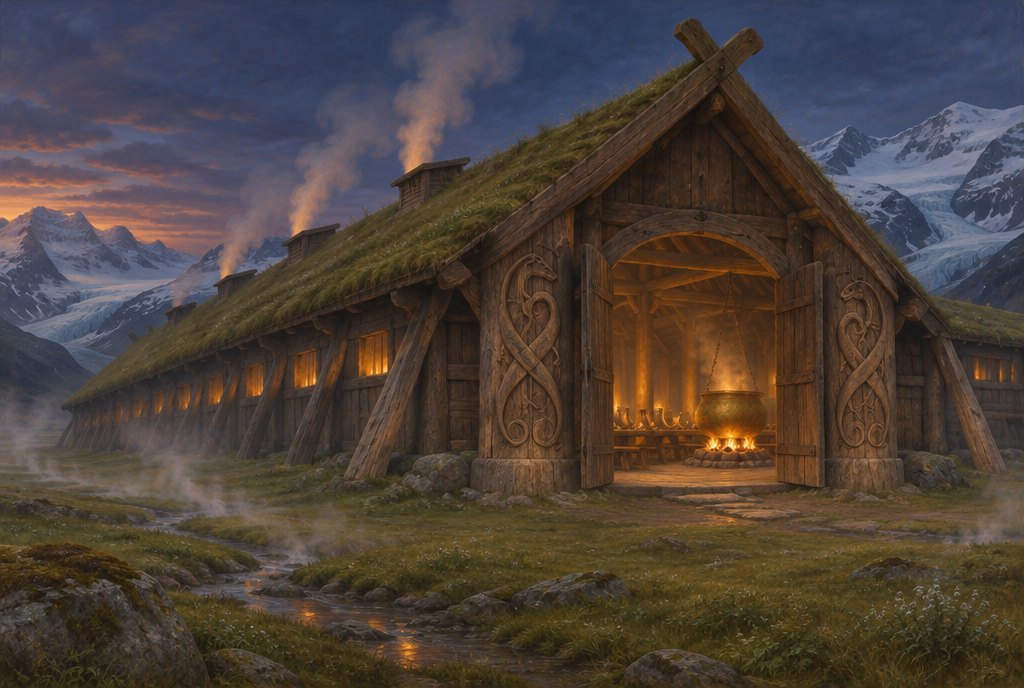
Four long lines are all we have. In the middle of Völuspá, between a river full of swords and a hall woven from snakes, stand two buildings: a golden hall for "Sindri's kin" and a beer-hall at a place called Ókólnir. Some two centuries after the poem is thought to have been composed, Snorri Sturluson turned them into two halls where good people live and drink once the world has burned. This article separates what the poem says from what Snorri built on it, and marks the points where scholarship can only guess.
Ókólnir occurs in exactly two places in the whole of Old Norse literature: one stanza of Völuspá, and one sentence of Gylfaginning, the narrative core of Snorri's Edda, which depends on that stanza. No runestone, no picture stone and no saga knows the name.
The Old Norse text of the Codex Regius, in normalised spelling, runs: Stóð fyr norðan / á Niðavöllum / salr ór gulli / Sindra ættar; / en annarr stóð / á Ókólni / bjórsalr jötuns, / en sá Brimir heitir. Henry Adams Bellows translated it in 1923:
"Northward a hall in Nithavellir
Völuspá, stanza 37 (numbering of the standard editions), translated by Henry Adams Bellows, 1923
Of gold there rose for Sindri's race;
And in Okolnir another stood,
Where the giant Brimir his beer-hall had."
Even this rendering makes a choice the original leaves open. Bellows gives the name Brimir to the giant. Karl Simrock's German version of 1851 keeps the ambiguity ("the giant's beer-hall, called Brimir") but changes something else: he writes "Nida mountains", although the Codex Regius speaks of Niðavellir, fields or plains. Later interpretation turns on both points. The complete poem with Bellows' translation is available in our bilingual reading text of Völuspá.
Many online accounts list Brimir's hall as "the beer-hall after Ragnarök". In the poem it stands somewhere else. Völuspá moves in one great arc from creation through the death of Baldr to the destruction and return of the earth. The stanza with the two halls belongs to the middle section, well before the destruction begins.
Its surroundings are bleak. Immediately before it, the seeress sees the bound Loki lying beneath a place called Hveralundr, with Sigyn sitting beside him. Then comes a half-stanza about a river that flows from the east through venom-dales, carrying knives and swords; its name is Slíðr. Then the two halls. Directly afterwards comes the hall on Náströnd, "Corpse-Strand", far from the sun, its doors facing north, its roof plaited from the backs of serpents; oath-breakers and murderers wade through heavy streams there, and Níðhöggr sucks the dead. Only then does the view shift to the old woman in Ironwood rearing Fenrir's brood, to the three crowing cocks, and finally to the refrain of the howling Garmr with which the end sets in.
The tense is just as plain. The hall "stood" (stóð), preterite. The seeress is reporting what she has seen; she announces nothing. The hall on Gimlé, many stanzas later, is in the present and future: she "sees" it, and faithful hosts "shall" dwell there. By its grammar, Brimir's beer-hall belongs to the old world. What the poem does say about the time afterwards is covered in the article on the world after Ragnarök.
Völuspá survives complete in two medieval manuscripts: the Codex Regius of the Poetic Edda, from the thirteenth century, and Hauksbók, an Icelandic miscellany of the fourteenth. To these come the stanzas Snorri quotes in Gylfaginning. The two versions differ in which stanzas they contain and in their order.
For Ókólnir that matters a great deal. The stanza is found only in the Codex Regius. In a transcript of the Hauksbók text that I searched through a retrieval tool, the words Brimir, Ókólnir, Sindri and Slíðr do not occur at all; neither the river stanza nor the hall stanza is there. Bellows says the same in the notes to his translation: Hauksbók omits both. The Náströnd stanzas, by contrast, are in Hauksbók, only in a different position.
Bellows adds that most editors assume a gap at this point. The river stanza has only four short lines, half the usual number. What has dropped out, nobody knows. Snorri at any rate knew the hall stanza around 1220, so it is older than the Codex Regius itself. The wavering numbers have a different cause: the common composite editions insert, shortly before, a short stanza found only in Hauksbók and so arrive at 37, the number the stanza also bears in Bellows. An editor who follows the Codex Regius strictly counts 36 (as Edward Pettit does in his dual-language edition of 2023).
The name is transparent. The prefix ó- negates, like English "un-"; the rest belongs to the word family of kaldr "cold" and kólna "to grow cold, to cool". Guðbrandur Vigfússon and F. York Powell wrote "Uncold" in 1883, Olive Bray "the Uncooled realm" in 1908, Bellows glosses "the Not Cold", and Carolyne Larrington, according to the English Wikipedia entry, has "Never-cooled Plain".
The stanza does not say where Ókólnir lies. "In the north" belongs grammatically to the first hall, that of the dwarfs.
Bellows remarks that Ókólnir is "possibly a volcano". That is a conjecture without evidence, and he marks it as one. It is striking that two stanzas earlier the poem names Hveralundr. Hverr means "cauldron" and in Icelandic also denotes a hot spring; Simrock translates "grove of springs". A grove of hot springs and a place that does not grow cold stand close together in the poem. Whether the poet thought of the two together is my own observation on the text, not an attested scholarly view. The one thing the name certainly does is set up a contrast: the river Slíðr carries blades, which Bellows takes as an image of cutting cold, and Náströnd lies "far from the sun". Between them stands a place that is warm.
The word bjórsalr is a compound of bjórr and salr "hall". Bjórr is cognate with English "beer", but in Old Norse it is the rarer, more elevated word. The everyday term was öl, "ale". Alvíssmál, a wisdom poem of the Poetic Edda, even distributes the words among the worlds: among men the drink is called öl, among the Æsir bjórr, in Hel mjöðr, mead (stanza 34). What exactly bjórr was is described differently in the literature; see the article on beer in the Viking Age.
That giants own such halls is no surprise in eddic poetry. The sea-giant Ægir holds a feast for the gods, and to fetch the brewing cauldron for it Thor and Týr travel to the giant Hymir; Hymiskviða tells that story, and the feast at Ægir's is the setting of Lokasenna.
Against that background, Brimir's beer-hall reads as a sign of wealth in the giant world, just as the golden hall signals wealth among the dwarfs. It becomes an afterlife dwelling only if one follows Snorri. For comparison: in Valhalla the einherjar drink, according to Grímnismál, mead with which the goat Heiðrún fills a vat, a drink that never runs out (stanza 25); Odin himself lives on wine alone (stanza 19). Nothing is said there of beer in Valhalla, and Grímnismál knows nothing of Brimir's hall, although it lists the dwellings of the gods at length.
The last half-line reads en sá Brimir heitir, "and that one is called Brimir". The demonstrative sá is masculine. But both nouns it could refer to are masculine in Old Norse: salr, the hall, and jötunn, the giant. Grammar does not settle the matter.
The translators are divided accordingly. Benjamin Thorpe (1866) has the hall called Brimir, and so do Vigfússon and Powell, who translate the name as well: a drinking hall called "Surf". Bray makes it a feast-hall called "Fire". Bellows, Lee M. Hollander (1928) and Pettit (2023) attach the name to the giant: "the beer-hall of a giant, and he's called Brimir", as Pettit has it.
Brimir has appeared once before in Völuspá, right at the beginning. In stanza 9 the gods deliberate who should create the race of dwarfs, in the wording of the common reading editions "out of Brimir's blood and the legs of Bláinn". Since Snorri has the dwarfs come to life in the flesh of the slain primeval giant, whose blood becomes the sea, the inference lies close at hand: Brimir is another name for Ymir. The name fits, for brim means "surf".
The manuscripts complicate this. A diplomatic transcript of the Codex Regius that I consulted reads or brimis bloði & or blam leGiom: "from Brimir's blood and from blue limbs". Hauksbók reads or brimi bloðgv ok or blains leggium: "from bloody surf and from Bláinn's limbs". Pettit confirms this distribution in his edition and adds that most manuscripts of Snorri's Edda also have "bloody surf". The familiar line with two giant-names is therefore an editors' blend: Brimir comes from one manuscript, Bláinn from the other.
That leaves a single reading of the Codex Regius as the textual basis for equating Brimir with Ymir. Pettit puts it cautiously: in stanza 9 Brimir is "probably" a giant-name, perhaps an alias of Ymir, suggestive of the sea.
There is a problem of substance too. Ymir is dead long before there are dwarfs, humans or halls; the world is built from his body. If Brimir is Ymir, whose is a beer-hall that "stood" in the time of the gods? One may answer that the name here denotes a different giant, or that the hall is named after the primeval giant, or that the stanza comes from another context. None of these answers can be proved from the sources.
The name turns up in a third connection as well. In Sigrdrífumál a figure stands on the mountain með Brimis eggjar, literally "with Brimir's edges" (stanza 14 in the numbering used here). Simrock simply translates "with a bright sword". Brimir evidently serves there as a sword-name or a poetic term for a sword.
The first hall of the stanza deserves a look of its own, because Snorri treats it exactly as he treats the second. Salr ór gulli Sindra ættar means "a hall of gold, belonging to Sindri's kindred". Sindri is an ancestor here, and according to the English Wikipedia article, which cites an Old Icelandic dictionary, his name belongs with sindr "slag", a word from the smithy. In Skáldskaparmál it is the name of one of the two dwarf brothers who forge the hammer Mjölnir and other treasures for the gods. The smith's name, the gold and the location on Niðavellir suggest that a family of dwarfs is meant in Völuspá; the Wikipedia article lists these reasons with a reference to John Lindow.
Bellows explains Niðavellir as "the Dark Fields", which suits beings who shun sunlight. He also considers that the word may be a corruption of Niðafjöll. The manuscript does show some uncertainty here: according to Pettit's apparatus, the scribe of the Codex Regius first wrote fiollom and then corrected it to vollom. The "Niða mountains" are named in the last stanza of Völuspá: the dragon Níðhöggr comes flying from them. Snorri does put Niðafjöll in his paraphrase, and Simrock's "Nida mountains" correspond to that reading. This has an odd consequence, which the English Wikipedia article on Sindri also notes: Snorri's golden hall of the good would stand in the very mountains from which the corpse-eater rises.
Snorri Sturluson wrote his Edda around 1220 as a handbook of poetics. In Gylfaginning he has King Gylfi, under the assumed name Gangleri, question three figures. Towards the end, when they have described the burning of the world, Gangleri wants to know what happens afterwards, when the world is burned and gods, einherjar and men are dead; had it not been said that every person would live in some world for all time? I have read the answer in Old Norse. In my own translation:
"It is best then to be on Gimlé in heaven, and there is very good provision of good drink, for those who take pleasure in it, in the hall that is called Brimir. It stands at Ókólnir. That too is a good hall which stands on Niðafjöll, made of red gold. It is called Sindri." (Bazt er þá at vera á Gimlé á himni, ok allgott er til góðs drykkjar þeim, er þat þykkir gaman, í þeim sal, er Brimir heitir. Hann stendr á Ókólni. Sá er ok góðr salr, er stendr á Niðafjöllum, gerr af rauðu gulli. Sá heitir Sindri.)
The reverse side follows at once: on Náströnd stands a great and evil hall, its doors facing north, and worst of all is Hvergelmir. Here Snorri quotes two stanzas of Völuspá on the Náströnd hall and the venomous river. Only in the next chapter does the earth rise green from the sea.
Set the source beside the paraphrase and Snorri has changed four things. "Stood" becomes "stands": the halls move out of the past into the time after the fire. The giant disappears; jötunn no longer occurs in the sentences quoted, and Brimir is the name of the hall. The ancestor Sindri likewise becomes the name of a hall. And the fields become mountains. What remains is the gold, the drink and the place-name Ókólnir. The aside "for those who take pleasure in it" is Snorri's own voice, dry and faintly amused; nothing in the poem corresponds to it.
Snorri did not record why he proceeded in this way. Two explanations stand side by side in the scholarship. One assumes a misreading: the English Wikipedia article on Sindri mentions, with a reference to Andy Orchard, the possibility that Snorri's hall "Sindri" rests on a misinterpretation of the Völuspá stanza. The ambiguous half-line with sá invites it, and a reader who takes Brimir as the name of a hall will readily take Sindri the same way.
The other explanation sees design. In Gylfaginning Snorri arranges scattered passages of poetry into a coherent picture of the world. For the time after the destruction he needed places for the good and places for the wicked, and Völuspá offered him both side by side in one spot: two splendid halls, and directly after them the venom-hall of Náströnd. That he read this group as reward and punishment is natural for an Icelander of the thirteenth century with a Christian education. Rudolf Simek, as reported on Wikipedia, sees Snorri's hall Sindri as a transposition of the Christian belief in Heaven. Only the result can be documented.
The debate about Christian traces in Völuspá is fought over other stanzas: the hall on Gimlé, "fairer than the sun, roofed with gold", where faithful hosts are to dwell; the punishment of perjurers and murderers on Náströnd; and the half-stanza about the "mighty one from above", which only Hauksbók has. The article How Christian is the Edda? sets out the positions in detail, including the comparison that has been drawn between stanzas of this section and Revelation 21:8.
For Brimir's beer-hall itself the finding is sober. The stanza contains not one word about merit, loyalty or guilt. Nobody is rewarded there, nobody moves in. It names two owners, a clan of dwarfs and a giant, and two attributes, gold and beer. The Christian colouring comes only with Snorri's frame, which declares the halls good places to be after the end of the world. Anyone who cites the stanza as evidence for a pre-Christian "paradise with beer" is in fact quoting Gylfaginning.
Read without Snorri, the stanza allows two interpretations, both of which must be labelled modern. The first is a topography of the other worlds: Bellows assigns the river stanza to the world of the giants, the hall stanza to that of the dwarfs, and the following one to the realm of the dead. On this view the seeress goes round the regions from which the disaster comes or in which it gathers.
The second is a contrast. The seeress shows three halls in succession: one of gold, one for drinking, one of snakes. Wealth and intoxication on one side, venom and torment on the other. Whether that was meant as an opposition of good and evil, as Snorri understood it, or only as a heightening of the uncanny, the text leaves open.
In reference works and on mythology websites Ókólnir mostly appears in Snorri's version: as one of three halls of the blessed after Ragnarök, often named in the same breath as Gimlé. Some accounts turn Ókólnir into a plain, which already goes beyond the wording of the stanza. I am not aware of any role for the name in films, series or games. There is no historical image of Brimir's hall; every depiction is modern invention.
What does Ókólnir mean? The name is formed from the negative prefix ó- and a word of the family "cold, to cool". It is translated "Uncold", "Not Cold" or "Never-cooled". It is a place-name; whether a plain, a mountain or a country is meant, the source does not say.
Where is Brimir's beer-hall mentioned? In a single stanza of Völuspá, transmitted only in the Codex Regius (stanza 37 in the usual numbering, 36 by the manuscript), and in chapter 52 of Gylfaginning, where Snorri turns the stanza into prose. I know of no other evidence.
Is Brimir a giant or a hall? The poem allows both, because "hall" and "giant" are both masculine in Old Norse and the pronoun fits either. Snorri makes Brimir the hall. Several recent translators read a giant's name, partly because Brimir appears as a giant in Völuspá 9 in one manuscript.
Did the Norse believe good people went to a beer-hall? Only Snorri says so, around 1220, some two centuries after Iceland changed religion. Whether people of the Viking Age held such an idea cannot be shown. The poems know Valhalla for fallen warriors and the realm of Hel; they connect Brimir's hall with no dead person at all.
Why is the stanza missing from Hauksbók? That is unknown. The two manuscripts give the poem in different extent and in a different order. Editors also suspect a gap at this point in the Codex Regius. Whether the stanza was never in the exemplar of Hauksbók or dropped out there, nobody can decide.
Völuspá: structure, manuscripts, dating · After Ragnarök: the green earth and Gimlé · Ragnarök · Ymir, the primeval giant · Dwarfs in Norse mythology · Valhalla · How Christian is the Edda? · Hymiskviða: the cauldron for the feast · Beer in the Viking Age · Mead
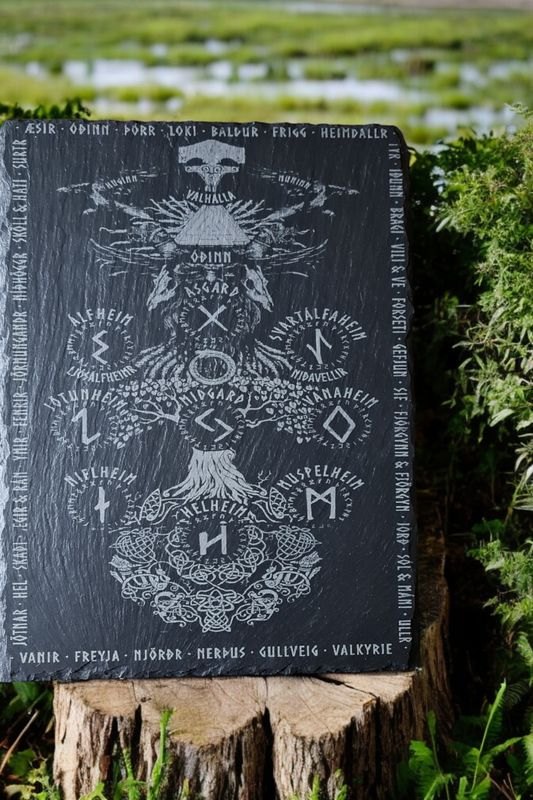
Völuspá – the Seeress's Prophecy · What comes after Ragnarök · Ragnarök · Ymir: the Primordial Giant Whose Body Became the World · Valhalla.
Can a poem save a life? The tradition says yes. The Icelandic skald Óttarr svarti, "the Black", is said to have talked …
Read more →Norse religion has no distant, all-powerful deity on a throne. It has a family – quarrelsome, cunning, loving, mortal …
Read more →Few names sound as thoroughly Viking as Ragnar Lodbrok. Television has made him the face of the entire North – the …
Read more →Ragnarök is the doom of the gods and the world in Norse mythology: the Fimbulwinter, monsters set loose, the last …
Read more →