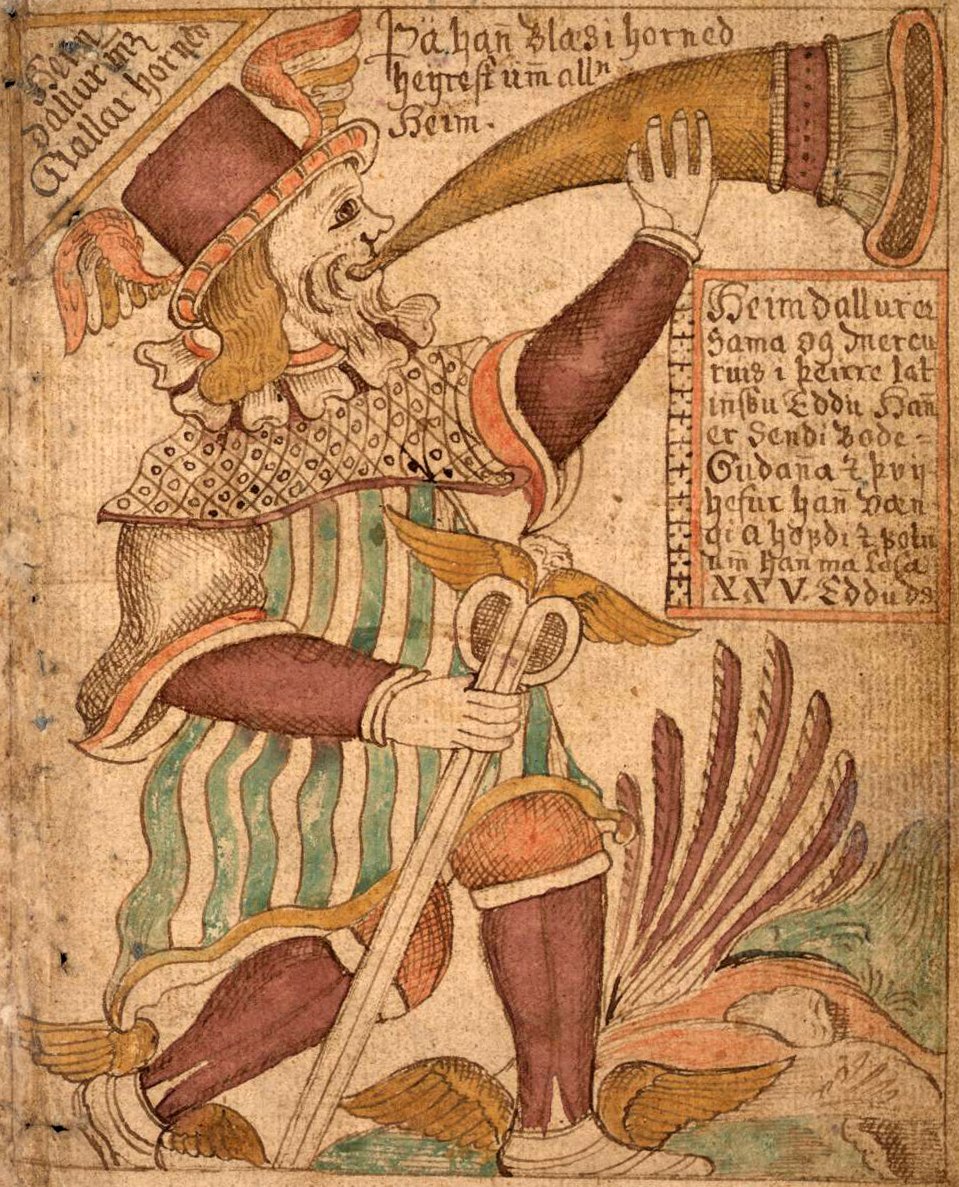
A horn that can be heard in every world: that is how most people know Gjallarhorn. In the old tradition the name occurs in exactly four places – once in Völuspá and three times in Snorri. In one of them nobody blows it at all. There the wise Mímir uses it to drink from his well. This article takes the passages one at a time, keeps wording and interpretation apart, and asks which real horns of the North are worth comparing.
The Poetic Edda gives the name a single time: in Völuspá, in the stanza where Heimdall blows at the end of the world (stanza 46 in the numbering of our source archive; other editions count differently). The other three occurrences are in Gylfaginning, the narrative part of Snorri Sturluson's thirteenth-century Edda: chapter 15 at Mímir's well, chapter 27 in the portrait of Heimdall, and chapter 51 in the account of Ragnarök. Chapter numbers also vary; the archive's are used here.
That is all. No skaldic poem known to me names the horn, no saga, no runic inscription. There is a fifth, disputed passage: Völuspá 27 speaks of Heimdall's hljóð lying hidden under the world tree. Whether that means the horn is one of the old problems of Eddic scholarship. And there is a late poem, Hrafnagaldr Óðins, which plays with the name but is no witness for the Viking Age. Both are discussed below.
The most famous signal instrument in Norse mythology thus rests on one stanza and one author. Everything else – what the horn looked like, what it was made of, where it came from – is in no source.
The second element is plain: horn is horn. The first is usually connected with the Old Norse verb gjalla, “to yell, to resound”. According to the English Wikipedia's summary, the reference works by Andy Orchard (1997) and Rudolf Simek gloss the name as “hollering horn” or “the loud sounding horn”.
A second possibility that is sometimes mentioned is “horn of Gjöll”; I cannot assign it securely to a particular scholar. In the Edda Gjöll is a river. Gylfaginning lists it in chapter 4 among the streams that flow from the spring Hvergelmir and adds: “Gjöll er næst Helgrindum” – Gjöll is nearest to the gates of Hel. Grímnismál names it in stanza 28 in a list of rivers. Grammatically the idea works, as Snorri's own text shows: the genitive of Gjöll is Gjallar. In chapter 49 Hermóðr rides “til árinnar Gjallar”, to the river Gjöll, and then onto Gjallarbrú, the Gjöll bridge. Gjallarhorn is formed exactly like Gjallarbrú.
The question cannot be settled. “Horn of the river of the dead” is not an established translation.
The stanza stands where the seeress describes the end. The cocks have crowed, the hound Garmr is baying, brothers are killing each other. Then, in Old Norse: “Leika Míms synir, en mjötuðr kyndisk at inu galla Gjallarhorni; hátt blæss Heimdallr, horn er á lofti, mælir Óðinn við Míms höfuð.” Henry Adams Bellows translated:
Fast move the sons of Mim, and fate
Is heard in the note of the Gjallarhorn;
Loud blows Heimdall, the horn is aloft,
In fear quake all who on Hel-roads are.Völuspá, st. 46, trans. Henry Adams Bellows (The Poetic Edda, 1923)
Bellows' fourth line belongs in our archive's Old Norse text to the following stanza; there stanza 46 ends with “mælir Óðinn við Míms höfuð” – Odin speaks with Mím's head. Two statements are secure. Heimdall blows loudly, and the horn is “á lofti”, in the air, raised. It is equally secure that at this moment Odin is consulting the head of Mímir.
The first half of the stanza is dark. No text says who “Mím's sons” are. And translators have understood mjötuðr kyndisk in very different ways. Karl Simrock's German has the “middle trunk” catching fire, thinking of the world tree; Benjamin Thorpe (1866) likewise wrote of the central tree taking fire. Bellows has fate being heard in the horn's note; in Guðbrandur Vigfússon and York Powell (1883) “the Judge is moving”; in Lee M. Hollander (1928) the doom breaks. The renderings are set side by side at mimisbrunnr.info.
Snorri himself offers a hint. In Skáldskaparmál, in the section on kennings for Heimdall, the sword is called “manns mjötuðr” and the head “mjötuðr Heimdallar” – there the word means something like doom or bane. So “fate” or “doom” is not an arbitrary choice.
Völuspá survives complete in two manuscripts: the Codex Regius of the Poetic Edda and Hauksbók. In our stanza they differ by one word. According to the manuscript texts that germanicmythology.com reproduces from an Icelandic transcription, the Codex Regius reads “at en galla giallar horni”, Hauksbók “at hínu gamla giallar horni”. Edward Pettit's dual-language edition (2023) records the same and counts the stanza as 45 in the Codex Regius and 38 in Hauksbók. Galla belongs with “shrill, resounding”; gamla means “old”. In one case the shrill Gjallarhorn sounds, in the other the old one.
That explains why translations diverge. The Old Norse text in our archive (after Guðni Jónsson) has galla; Gustav Neckel's edition (1914), in the form shown at mimisbrunnr.info, has gamla. Hollander combined the two and wrote of the “gleaming old” horn. Völuspá calls the horn “old” only in Hauksbók.
There is a third witness. In chapter 51 of Gylfaginning Snorri quotes the second half of the stanza word for word (“Hátt blæss Heimdallr, horn er á lofti …”). He does not quote the line containing the horn's name at that point.
Long before the end, in the middle of her look back, the seeress says: “Veit hon Heimdallar hljóð of folgit und heiðvönum helgum baðmi” – she knows Heimdall's hljóð hidden under the holy tree. Then she sees a stream pouring “af veði Valföðrs”, from Valfather's pledge. The stanza is in both manuscripts, as the 27th in the Codex Regius and the 23rd in Hauksbók.
Bellows rendered it “I know of the horn of Heimdall, hidden”; Thorpe and Simrock also chose “horn”. But the word hljóð first of all means something else. The very first line of Völuspá uses it: “Hljóðs bið ek allar helgar kindir” – in Bellows, “Hearing I ask from the holy races”. The skalds Snorri cites in Skáldskaparmál ask for attention to their poems with the same word; Eyvindr, for one, opens with “Vilja ek hljóð”. Hljóð is hearing, the silence of listening, and also sound.
The second reading starts there. Edward Pettit, in his 2023 edition, translates the Hauksbók version as “Heimdallr's hearing”. Carolyne Larrington, according to the English Wikipedia's summary, likewise has “hearing” in her Poetic Edda (1999) and notes that if this is right, Heimdall has left a body part in the well, his ear – as Odin left his eye. Paul Schach wrote in 1985, according to the same summary, that the stanzas are obscure, perhaps deliberately so; that hljóð is not otherwise attested in Icelandic in the sense “horn”; and that Snorri seems to have confused the word with Gjallarhorn. I have not checked the statements about Larrington and Schach in the books themselves.
The context favours hearing. The next stanza is about Odin's eye in Mímir's well, and both stanzas end with the same “Valfather's pledge”. It also suits Heimdall: according to Gylfaginning 27 he hears the grass growing on the earth and the wool on the sheep. In favour of the horn is that Snorri knows Gjallarhorn at precisely this spot, by the well under the root. But Snorri may have drawn his statement from this very stanza; in that case he is not an independent witness but its first interpreter. Our article on Heimdall sets out the readings side by side.
The strangest passage is Snorri's. In chapter 15 he describes the three roots of the ash Yggdrasil. Under the root that reaches towards the frost giants lies Mímir's well, “er spekð ok mannvit er í fólgit”, in which wisdom and understanding are hidden. Of its owner he says: “Hann er fullr af vísendum, fyrir því at hann drekkr ór brunninum af horninu Gjallarhorni.” Rasmus B. Anderson (1880) translated: “He is full of wisdom, for he drinks from the well with the Gjallar-horn.”
Heimdall is not mentioned here. The horn is a drinking vessel, and in this scene it goes with Mímir. Retellings that have Heimdall drinking here do not match the text.
As evidence Snorri cites Völuspá: “Drekkr mjöð Mímir morgin hverjan af veði Valföðrs” – Mímir drinks mead every morning from Valfather's pledge. Read closely, the stanza says something different from Snorri's prose. In the poem Mímir drinks from Odin's pledge, whatever that is; in the prose he drinks with Gjallarhorn. Either Snorri knew a tradition lost to us, or he read stanzas 27 and 28 together: Heimdall's hljóð as a horn lying by the well, and Mímir's drink. Which is true cannot be shown. More on the well and Odin's pledge in the articles on the three wells and Odin's eye.
Twelve chapters later Snorri introduces Heimdall: the white god, son of nine mothers, watchman of the gods, who sits at the edge of heaven and guards the bridge Bifröst against the mountain giants. He needs less sleep than a bird and sees a hundred leagues by night as by day. Then comes the sentence: “Hann hefir lúðr þann, er Gjallarhorn heitir, ok heyrir blástr hans í alla heima.” In Anderson's version: “He has a trumpet called the Gjallarhorn, and when he blows it it can be heard in all the worlds.”
Simrock too translated lúðr as “trumpet”. John Lindow, according to the Wikipedia summary of his 2002 handbook, describes the term as a long brass instrument that would answer today to an unvalved trumpet. The word is not entirely straightforward, though. In chapter 7 of the same Gylfaginning the giant Bergelmir climbs with his wife “upp á lúðr sinn” and so survives the flood of Ymir's blood. A wind instrument can hardly be meant there; Simrock made do with “boat (cradle)”. For chapter 27 the added “heyrir blástr hans” – its blast is heard – leaves no doubt that an instrument is intended.
What is missing is striking. Snorri supports Heimdall's dwelling in this chapter with Grímnismál 13, and that stanza says only that the warder of the gods gladly drinks the good mead in Himinbjörg. No horn appears in it. The list of kennings for Heimdall in Skáldskaparmál – son of nine mothers, watchman of the gods, white god, Loki's enemy – does not contain a single horn kenning either. For the skalds, as far as Snorri draws on them, the horn was apparently not a fixed attribute of the god.
In Snorri's account of the end the horn has its fixed place in the sequence. The wolf Fenrir is loose, the Midgard serpent comes ashore, Surtr and the sons of Muspell ride up, the enemies gather on the plain Vígríðr. Then: “En er þessi tíðendi verða, þá stendr upp Heimdallr ok blæss ákafliga í Gjallarhorn ok vekr upp öll goðin, ok eiga þau þing saman.” When this happens Heimdall stands up, blows mightily on Gjallarhorn and wakes all the gods, and they hold an assembly. After that Odin rides to Mímir's well for counsel.
Three things stand out. The horn is a wake-up call, not a signal to attack: it summons the gods to deliberate, and only then do they arm. Snorri also turns what stands side by side in Völuspá – the blast and Odin's talk with Mím's head – into a sequence. And after this one sentence the horn drops out of the story. At the end Heimdall fights Loki, “ok verðr hvárr annars bani”, each becomes the other's death. Nobody says what becomes of Gjallarhorn. See Ragnarök.
In Snorri the same horn serves once for drinking and once for blowing. Is that a contradiction? According to the Wikipedia summary of his dictionary, Rudolf Simek does not find the double use odd and points to Olifant, Roland's horn.
Another explanation, already touched on, lies closer. The double role may have arisen only with Snorri, when he turned the dark stanzas 27 and 28 of Völuspá into a narrative that made sense. In that case the older poetry would have known only Heimdall's blowing horn and, separately, Mímir's drink from Odin's pledge. That is conjecture, not a finding.
Some older editions of the Edda, Simrock's among them, include a poem called Hrafnagaldr Óðins, “Odin's raven-chant”. It calls Heimdall “hirðr at Herjans horni Gjallar”, keeper of Herjan's (Odin's) horn, and in its last stanza “hornþytvaldr Himinbjarga”, lord of the horn-blast of Himinbjörg. In stanza 19 mead is measured out “Mímis hornum”, from Mímir's horn or horns. The poem survives only in paper manuscripts, the oldest from the second half of the seventeenth century. Sophus Bugge already took it for a seventeenth-century work in 1867; Annette Lassen's edition of 2011 calls it post-medieval. Jónas Kristjánsson, by contrast, thought in 2002 of the fourteenth century – all three statements according to the English Wikipedia's summary. It shows how a learned Icelander developed Snorri's statements; on none of these datings is it evidence for Viking Age belief.
Two stone monuments from the British Isles are regularly cited as pictures of Gjallarhorn. The best known is the cross in St Mary's churchyard at Gosforth, Cumbria: red sandstone, about 4.4 metres high, dated to the first half of the tenth century. On its west face a figure with a horn and a staff or spear stands before two gaping animal jaws. William Slater Calverley linked the carvings to the Edda in the 1880s, and the figure has been taken as Heimdall ever since.
The second piece is a cross slab from Jurby on the Isle of Man, listed in the Manx National Heritage collections database as the “Heimdall Cross Slab” (Manx Cross 127). As described in the English Wikipedia, it shows a figure with a large horn at his lips and a sword at his hip.
Neither carving is labelled. A man with a horn is, to begin with, a man with a horn; at Gosforth the name Heimdall rests on the neighbouring scenes, which read well as the bound Loki and the fight with the wolf. No text says that the figure holds the monsters back with a staff. If the reading is right, however, the cross is a weighty witness: it is some three hundred years older than Snorri's Edda and would attest the horn-blower at the world's end for the tenth century. In detail: The Gosforth Cross and Thorwald's Cross.
The element Gjallar- occurs twice more in Snorri, and neither has anything to do with the horn. Gjallarbrú is the bridge over the river Gjöll on the road to Hel. According to chapter 49 it is thatched with shining gold and guarded by a maiden called Móðguðr; Hermóðr rides across it to fetch Baldr back. And in chapter 34 Gjöll is the name of the great slab of rock through which the gods draw the fetter of the wolf Fenrir. Horn, river, bridge and rock share a name, not a story.
What did the people who told these stories have before their eyes? Few signal instruments survive from the Viking Age itself. The Oseberg ship burial, whose chamber is dated by tree rings to 834, contained a wooden wind instrument about a metre long, made in two halves held together with willow bands. It is usually called a lur; what it was used for is not recorded. That lur signals belonged to warfare is first assumed by the sagas, and those were written down centuries later. See music in the Viking Age.
Much better known are the curved bronze lurs. They belong to the Nordic Bronze Age, about 1500 to 500 BC according to the overview on the Norwegian site “O. J.'s Trumpet Page”, and are thus more than a millennium older than the Vikings. No source links them with Heimdall.
Drinking horns, by contrast, are richly attested, from the aurochs horns with silver-gilt mounts at Taplow to the horn remains from Sutton Hoo; see our article on the drinking horn. A special case are the two Golden Horns of Gallehus, found in 1639 and 1734 in southern Jutland, made around AD 400, and stolen and melted down in 1802. Whether they were for drinking or blowing is open. According to the Wikipedia summary, Simek sees such sacral horns of the Iron Age as earthly counterparts of Gjallarhorn. That is a modern interpretation: some eight hundred years lie between the golden horns and the writing of the Edda, and no text links the two.
The name has had a long afterlife. Best known is probably the ritual of the American football team Minnesota Vikings, where a large horn called the Gjallarhorn is sounded at the opening of home games. In engraving and jewellery Gjallarhorn usually appears as a curved cattle horn with mounts – a defensible design idea, but the sources do not describe its shape.
What is Gjallarhorn? A horn in Norse mythology. According to Völuspá and Snorri's Gylfaginning the god Heimdall blows it when Ragnarök begins; according to Gylfaginning 15 Mímir also uses it to drink from his well of wisdom.
What does the name Gjallarhorn mean? It is usually explained as “resounding” or “loud-sounding horn”, from Old Norse gjalla. “Horn of Gjöll”, after the river on the border of Hel, is also possible. The question cannot be decided.
Whose is Gjallarhorn – Heimdall's or Mímir's? Snorri says expressly in chapter 27 that Heimdall has it. In chapter 15 Mímir uses it as a drinking vessel. Völuspá names only Heimdall as the one who blows it. No source explains how the two fit together.
Where is Gjallarhorn mentioned in the Edda? In the Poetic Edda in Völuspá 46, in the Prose Edda in Gylfaginning 15, 27 and 51 (numbering varies by edition). Whether Völuspá 27 also means the horn is disputed.
Is there a picture of Gjallarhorn from the Viking Age? Perhaps. The Gosforth Cross in Cumbria and a cross slab from Jurby on the Isle of Man show figures with a horn that are often read as Heimdall. They are not labelled; the identification remains an interpretation.
Heimdall – watchman of the gods · Mímir and his well · Völuspá · Ragnarök · Bifröst · The Gosforth Cross and Thorwald's Cross · The Golden Horns of Gallehus · The drinking horn · Music in the Viking Age · Húsdrápa
Heimdall – the White God, Watchman of Bifröst and Keeper of the Gjallarhorn · Mímir – the counselling head · Ragnarök · The Gosforth Cross and Thorwald's Cross – Ragnarök on Christian Stones · Vígríðr: the last battlefield.
Gleipnir is the third and final fetter the gods used to bind the wolf Fenrir: a ribbon as smooth and soft as silk, made …
Read more →He wrestles a dead man to the ground, breaks into a burial mound, cuts the paw off a bear and holds out for almost …
Read more →A man in a blue cloak sits between two fires for eight nights and says nothing about himself. Then a ten-year-old hands …
Read more →A Danish king buys two giantesses, sets them to a magic mill and has them grind gold and peace without ever letting …
Read more →