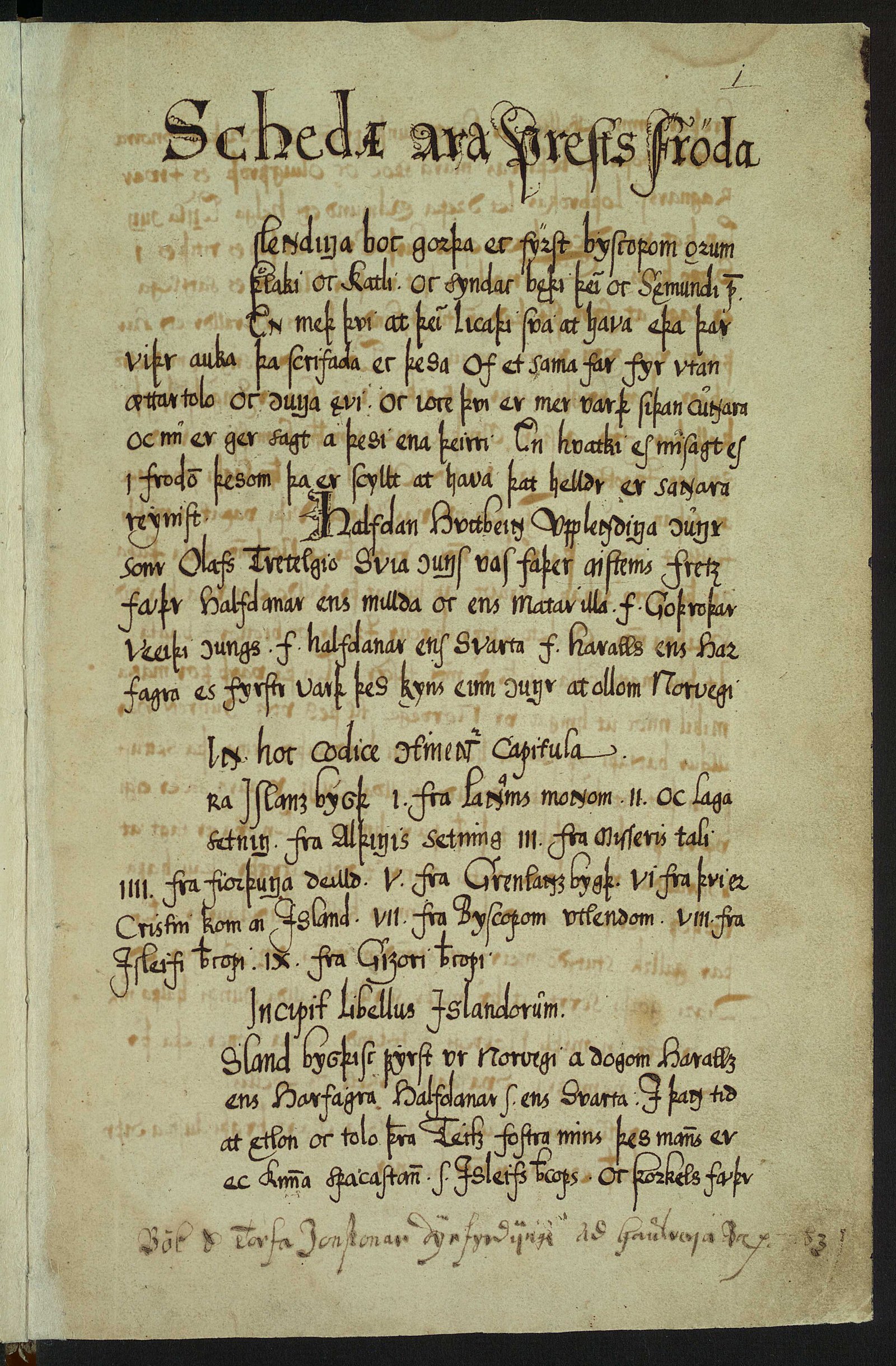
Ten short chapters, a prologue, two genealogies: that is all Íslendingabók amounts to. Yet nearly everything the history books say about Iceland's first 250 years hangs on this slim text by the priest Ari Þorgilsson. It gives the year of the settlement, the man who brought the laws, the calendar reform, the voyage to Greenland, and the day a heathen lawspeaker lay under his cloak and then led a whole country into Christianity. This article goes through the text chapter by chapter and asks at each step: how does Ari know this, and who gains from his telling it this way?
After the list of chapters, the edition I used has a Latin line announcing the “libellus Islandorum”, the “little book of the Icelanders”, followed in Icelandic by “Hér hefur Íslendingabók”: here begins the Book of Icelanders. The literary scholar Vésteinn Ólason also cites the learned title “Schedæ Ara prests fróða”.
It is written in Old Icelandic, not Latin. The Viking Society calls it the first surviving written history of the Icelanders; the word “surviving” matters.
According to the list in the text, the ten chapters deal with the settlement of Iceland, the settlers and the making of law, the founding of the Althing, the reckoning of the year, the division into quarters, the settlement of Greenland, the coming of Christianity, the foreign bishops, Bishop Ísleifr and Bishop Gizurr. For the settlers in detail the place to go is Landnámabók.
Ari Þorgilsson bears the byname “inn fróði”, the learned or knowledgeable. His dates are given as 1067 or 1068 to 1148; Siân Grønlie thinks 1068 the likelier year of birth. The year of birth can be worked out from the book itself. In chapter 9 Ari says he was twelve winters old when Bishop Ísleifr died, and he puts that death eighty winters after the fall of Olaf Tryggvason, which he dates to the year 1000. That gives 1080 and a birth around 1067/68. The year of death is not in the text; Grønlie, following Icelandic annals, gives 9 November 1148.
At seven he came to Hallr at Haukadalr, the winter after the death of his grandfather and foster-father Gellir Þorkelsson, and stayed there fourteen winters (“ok vark þar fjórtán vetr”). Teitr, a son of Bishop Ísleifr whom Ari calls his foster-father, lived at Haukadalr too. Ari thus grew up among the family that produced the first bishops of Skálholt.
At the end of the text stands a line of ancestors with 36 numbered entries. It begins with “Yngvi, king of the Turks”, Njörðr and Freyr, runs through the Swedish kings of Ynglinga saga and ends with Gellir, father of Þorgils, “my father, and I am called Ari” (“en ek heitik Ari”). A priest here traces himself back to gods who have become kings of a distant past.
In the prologue Ari says he first made the Book of Icelanders for “our bishops” Þorlákr and Ketill and showed it to them and to the priest Sæmundr. He then wrote this version on the same subject, without the genealogy and the lives of kings, adding what he had since learned more fully. What survives is therefore the revision; the first version is lost. Snorri Sturluson, Vésteinn Ólason notes, mentions Ari with great respect.
The two bishops' names date the work. Þorlákr Runólfsson was bishop from 1118 to 1133 and Ketill Þorsteinsson from 1122 to 1145, according to English Wikipedia. They held office together only between 1122 and 1133. Grønlie accordingly dates the work to 1122–33 and notes that the second version is sometimes put at 1134; the Norwegian encyclopaedia Store norske leksikon says about 1130.
Then comes a sentence one rarely meets in a medieval preface:
En hvatki er missagt er í fræðum þessum, þá er skylt at hafa þat heldr, er sannara reynist.
“But whatever is wrongly stated in this lore, one is bound to hold rather to that which proves to be more true.”Ari Þorgilsson, Íslendingabók, prologue; Old Norse text after Guðni Jónsson's edition (heimskringla.no), my own translation
An author reckons with his own mistakes and gives the reader the right to correct them. On selection it is silent.
In the edition used, the prologue is followed by a short line of kings from Hálfdan Whiteleg to Harald Fairhair, and genealogies stand at the end. How that squares with “without the genealogy” is unsettled, according to Grønlie's introduction; the genealogies at the end may be extracts from other writings or fillers in the manuscript.
Ari builds a framework from three elements: a fixed point from English history, intervals counted in winters, and the terms of office of the lawspeakers.
The fixed point is the killing of the English king Edmund. Iceland was first settled from Norway in the days of Harald Fairhair, at the time when “Ívarr, son of Ragnarr loðbrók” had Saint Edmund killed. That was 870 winters after Christ's birth, “according to what is written in his saga” (“at því er ritit er í sögu hans”). Our article on Ivar the Boneless shows that the year of death varies in the literature between 869 and 870.
Sixty winters after Edmund's death Hrafn Hæingsson takes up the office of lawspeaker, which would be 930. A hundred and thirty winters after it Olaf Tryggvason falls, “a thousand after the birth of Christ by the common reckoning”. At the end of chapter 10 Ari gathers everything into one year: 120 winters after Olaf's fall, 250 after the killing of Edmund, 516 after the death of Pope Gregory, who died 604 years after the birth of Christ. “That makes eleven hundred and twenty years altogether.”
Between the fixed points runs the series of lawspeakers with their years in office: Hrafn twenty summers, Þórarinn twenty, Þorkell máni fifteen, Þorgeirr seventeen, and so on down to Ari's present. The first three lead from 930 to 985, and Þorgeirr's term includes the year 1000. Ari had the list from the lawspeaker Markús Skeggjason, who for the earlier period relied on his brother, father and grandfather.
A Norwegian named Ingólfr, “as is truly said”, first went to Iceland when Harald Fairhair was sixteen winters old and a second time a few winters later; he lived in the south at Reykjavík. Ari has nothing about high-seat pillars; that scene belongs to Landnámabók. See the article on Ingólfr Arnarson.
Two sentences describe the country. “Í þann tíð var Ísland viði vaxit á milli fjalls ok fjöru”: at that time Iceland was grown with wood between mountain and shore. And there were Christians there whom the Norse call papar; they went away because they would not live alongside heathens, and they left behind Irish books, bells and croziers. From that, Ari writes, one could tell they were Irish.
The chapter ends on a question of tolls: King Harald forbade emigration until a payment of five aurar for each man leaving was agreed, the origin of the charge “now” called landaurar.
In chapter 2 Ari names four settlers, one for each quarter of the country: Hrollaugr in the east, Ketilbjörn in the south, Auðr in the west, Helgi the Lean in the north. The text itself gives away the reason for the choice. In the appendix, headed “This is the kin of the bishops of the Icelanders”, a line runs from each of the four to a bishop: from Ketilbjörn to Ísleifr and Gizurr, from Hrollaugr to Jóan, first bishop at Hólar, from Auðr to Þorlákr, “who is now bishop at Skálholt”, from Helgi to Ketill, “who is now bishop at Hólar”. Grønlie makes the same point: the main settler in each quarter provides an ancestor for one of the first four bishops. The settlement as Ari tells it is the prehistory of his patrons.
When Iceland had been widely settled, a man named Úlfljótr brought the first laws from Norway; “so Teitr told us”. They were for the most part modelled on the Gulathing laws of the time, on the advice of Þorleifr the Wise. Úlfljótr's foster-brother Grímr geitskör explored the whole of Iceland before the Althing was set up; every man in the country gave him a penny for it, and he later gave the money to the temples.
Chapter 3 explains how the assembly site became common property: a man who owned land at Bláskógar had been outlawed for the murder of a slave or freedman, and his land fell to the community. Here too it is said that Iceland was fully settled in sixty winters.
Chapter 5 derives the division into quarters from a lawsuit. Þórðr gellir prosecuted a case of burning; there was fighting at the local assembly in Borgarfjörður and again at the Althing. Þórðr then made a speech at the Law Rock, and the land was divided into quarters with three assemblies in each, four in the north because people there could not agree. The procedure is described in the article on the thing.
Chapter 4 is the oddest. The year had been reckoned at 364 days, fifty-two weeks, and people noticed from the sun's course that summer was slipping back towards spring; no one knew that a day was missing. Then Þorsteinn surtr, a man from Breiðafjörður, dreamed that he stood awake at the Law Rock while everyone else slept; then he fell asleep and all the others woke. Ósvífr Helgason read the dream: all would be silent while Þorsteinn spoke and then approve his proposal. So it happened. Þorsteinn proposed adding a week every seventh summer, and it became law. The text names no year.
The week-based calendar is explained in the article on Viking time-reckoning. It is the only place in the book where a dream brings anything about, and it foretells only the success of a speech.
Chapter 6 is the shortest. Greenland was discovered and settled from Iceland. Eiríkr the Red, a man from Breiðafjörður, took land there at the place since called Eiríksfjörðr. He called the country Greenland, saying that people would be eager to go there if the land had a good name (“at landit ætti nafn gott”).
Then the most quoted sentence of the chapter. In the east and west of the country the settlers found traces of human habitation, “keiplabrot ok steinsmíði”, usually understood as fragments of boats and stone implements (I have not checked that against a dictionary), from which one could tell that the same kind of people had passed there “who have inhabited Vínland and whom the Greenlanders call Skrælingar”. Ari mentions Vinland in passing and tells of no voyage there. The oldest mention, according to our Vinland article, is in Adam of Bremen around 1075; the Skrælingar have an article of their own.
Ari gives the date with his typical margin: fourteen or fifteen winters before Christianity came to Iceland, in modern terms 985 or 986. He names the chain as well: a man who had himself gone out with Eiríkr told it in Greenland to Þorkell Gellisson, Ari's uncle.
Chapter 7 is the longest. King Olaf Tryggvason sent the priest Þangbrandr to Iceland. Hallr of Síða, Hjalti Skeggjason and Gizurr the White had themselves baptised, but the majority spoke against it. After one or two winters Þangbrandr left, having killed two or three men who had mocked him. The king meant to have the Icelanders then in Norway maimed or killed. Gizurr and Hjalti got them off by promising to try again.
The following summer the two came to Iceland. Hjalti had been outlawed the year before as a blasphemer because of a mocking verse. At the assembly it nearly came to a fight. The next day Christians and heathens declared themselves out of law with each other. The Christians asked Hallr of Síða to proclaim their law; he got out of it by striking a bargain with the lawspeaker Þorgeirr, still a heathen, that he should proclaim it.
Þorgeirr lay down in his booth, “spread his cloak over himself and rested all that day and the night after”, and spoke not a word. Next morning at the Law Rock he said: let all have one law and one faith (“höfum allir ein lög ok einn sið”), for “if we tear the law apart, we shall tear the peace apart too”. Both sides agreed to abide by what he proclaimed.
It was this: all people in the country were to be Christian and accept baptism. For the exposure of infants and the eating of horseflesh the old laws were to stand. People might sacrifice in secret; if witnesses came upon it, the penalty was what the text calls fjörbaugsgarðr, usually explained as the lesser form of outlawry (not checked here). “A few winters later this heathen practice was abolished like the rest.” Ari closes with his source: “Teitr told us of this event.”
What Þorgeirr did under the cloak is not stated. Ari himself says a thousand but adds “by the common reckoning”. Grønlie's introduction writes “999/1000”; the reasoning behind the earlier year I have not seen in a source.
The last three chapters concern the Church: first foreign bishops, then native ones. Ísleifr, son of Gizurr the White, was consecrated bishop at fifty. His son Gizurr succeeded him and, according to Ari, achieved three things: Skálholt became a fixed episcopal see, a second was founded in the north at Hólar, and the country accepted the tithe. All men were to value their property under oath and pay a tenth, a law passed because of Gizurr's popularity, at Sæmundr's urging and with the counsel of the lawspeaker Markús.
And then Ari reports what made his own book possible. In the first summer that Bergþórr recited the law it was decided to have the laws written in a book the following winter at Hafliði Másson's. “Vígslóði”, usually explained as the section on homicide, and much else was written, and the summer after, clerics read it out in the Law Council. Grønlie places this in 1117–18. Íslendingabók is therefore not the first thing written in Iceland. It says so itself.
Ari is unusually open about his sources. He says what makes each person credible. Teitr, his foster-father, is the wisest man he knows. Þorkell Gellisson, his uncle, remembered far back. Þuríðr, daughter of Snorri the goði, was “margspök ok óljúgfróð”, wise in many things and truthful in her knowledge. Others are Hallr Órækjuson, the lawspeakers Úlfheðinn and Markús, Sæmundr and Bishop Gizurr.
The method is clearest with Hallr of Haukadalr. He remembered his own baptism, Ari writes: Þangbrandr baptised him at three, a winter before Christianity became law. He set up a household at thirty, lived sixty-four winters at Haukadalr and died at ninety-four, in the tenth winter after Ísleifr's death. That fits Ari's own figures: he came to Hallr at seven and stayed fourteen winters, roughly until Hallr died. Between the child baptised shortly before the decision at the Althing and the man writing around 1130 lies exactly one conversation.
For the conversion the chain reaches an eyewitness. For the settlement, 250 years before the writing, it does not. There the text has “so it is said”; Ari marks the difference himself.
Vésteinn Ólason couples his favourable verdict on Íslendingabók with a qualification: the work selects its facts and presents history from the point of view of the Church and the ruling class; he sees no reason to suspect untruth.
The book was written for two bishops and ends with their kin. The leading figures of the conversion, Gizurr the White and Hallr of Síða, are forebears of Ísleifr and Jóan. The chief informants, Teitr and Hallr, belong to the household at Haukadalr. Of the old religion one learns almost nothing, and of the content of Úlfljótr's law nothing at all; what Hauksbók later knows about it is not yet in Ari.
Ari tells the history of a country as the history of its law and its Church. Almost every step is carried by a speech at the Law Rock. Vésteinn Ólason holds that Ari gave the Icelanders a history and an identity of which they cannot have been so well aware before.
No medieval manuscript of Íslendingabók exists any longer. The text survives in two paper copies, AM 113 a fol. and AM 113 b fol., both in the hand of the pastor Jón Erlendsson of Villingaholt (died 1672). Commissioned by Bishop Brynjólfur Sveinsson of Skálholt, he copied a very old, fragile vellum manuscript in 1651, according to Vésteinn Ólason, and tried to preserve its spelling. The bishop was not satisfied and had him copy the text again. Both copies survive; the vellum was lost. Scholars call AM 113 b fol. “A” and AM 113 a fol. “B”; B, according to Grønlie, is dated 1651.
The exemplar is dated to about 1200, as Grønlie also says. Árni Magnússon looked for it some fifty years later without success. The work was first printed at Skálholt in 1688. The copies went to Denmark with Árni and returned to Iceland in 1974. Between Ari and the oldest witness lie more than five hundred years and at least two acts of copying.
The Old Norse text is freely available online, for instance in Guðni Jónsson's edition at heimskringla.no, from which I quote. The standard edition is Jakob Benediktsson's in Íslenzk fornrit I (1968). In English there is Siân Grønlie's translation (Viking Society for Northern Research, 2006), together with Kristni saga, and an older one by Halldór Hermannsson (1930). Of Grønlie's volume I have seen only extracts from the introduction, of the other editions nothing.
When reading, watch the small formulas: “so Teitr told us”, “so it is said”, “one or two winters”. Later writers built on Ari, the sagas of Icelanders as much as Heimskringla.
What does “Íslendingabók” mean? “Book of the Icelanders”. The text also carries the Latin “libellus Islandorum”.
When was Íslendingabók written? Between 1122 and 1133. That is when the two bishops Ari names in the prologue were in office together.
How does it differ from Landnámabók? Íslendingabók is a brief history of Iceland in ten chapters and singles out only Ingólfr and four other settlers for the settlement. Landnámabók lists more than four hundred, arranged by district, and survives only in later versions.
Does the original survive? No. What survives are two copies that Jón Erlendsson made around 1651 from a vellum manuscript of about 1200. That exemplar has been missing since the late seventeenth century.
How reliable is Ari? For the period on which he could question eyewitnesses or their pupils he is considered very reliable. For the settlement he passes on what was said about it around 1100. His selection follows the interests of the Church and of the families he wrote for.

Landnámabók · Ingólfr Arnarson · The Thing · The Icelandic Sagas · Hauksbók: the book of Haukr Erlendsson.
All History & Finds articles →
Of all the sons of Ragnar Lodbrok, Ivar is the easiest to grasp. Where the father dissolves into saga mist, the son …
Read more →Most runestones say: he had this stone raised in memory of his father. The stone on Frösön says something else. Östman …
Read more →"And he alone owned all of Täby." Few sentences on a Swedish runestone have been quoted as often as this one. It stands …
Read more →No jarl ever lived at Jarlshof. The name was made up by a novelist, Walter Scott, after a visit in the summer of 1814 …
Read more →