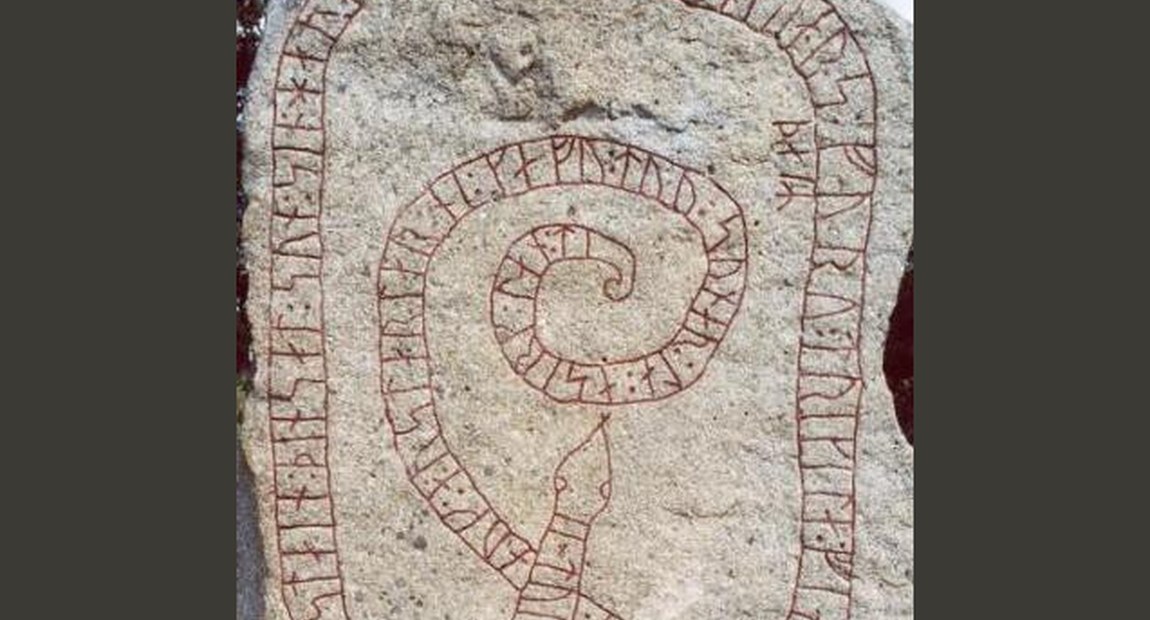
"And he alone owned all of Täby." Few sentences on a Swedish runestone have been quoted as often as this one. It stands on several stones in Uppland, north of Stockholm, raised by a man called Jarlabanke, who set up a monument to himself while still alive and had a bridge built "for his soul". What we know about him comes almost entirely from inscriptions that he and his relatives commissioned. This article reads those texts closely, separates wording from interpretation and says plainly where specialists disagree.
The name Jarlabanke (Old Norse Iarlabanki) appears on the runestones of the Täby area more than once. Researchers usually speak of "the" Jarlabanke, meaning the man who appears as the patron on the Täby causeway and at Vallentuna. Older corpus volumes and the later literature order the bearers of the name and their family relations differently in places. That is no minor detail: a statement such as "Jarlabanke was the son of Ingefast" rests on combining several stones, not on a single sentence.
The inscriptions date to the 11th century, when Uppland between Lake Mälaren and the Baltic was a densely settled farming region and Christianity was gaining ground step by step. The setting is well documented through cemeteries, picture stones and trading places such as Birka. Jarlabanke himself appears in no chronicle, no saga and no charter of his time. For us he exists only in stone.
Runestones are monuments, not reports. Whoever had one set up wanted to say something about himself, his family and his salvation, and paid a carver to put the text into stone. Three things follow for any reading. First, the statements are self-referential: they say what the patron wanted people to read. Second, there is no counter-voice. We know of no neighbour, rival or cleric who confirmed or disputed Jarlabanke's claim. Third, the texts are terse and presuppose knowledge that readers then had and we lack.
The standard text edition today is the Scandinavian Runic-text Database (Rundata), built on the corpus "Upplands runinskrifter" (Sveriges runinskrifter). Numbers with the letter U refer to the Uppland corpus. For this article I read the Rundata sheets for U 164, U 150, U 136 and U 212, and a summary of U 101, through a retrieval tool; for the other stones I rely on English Wikipedia and a popular archaeology blog, which themselves point to Rundata. Where that is second-hand, the text says so.
Täby lies north of today's Stockholm area, in a landscape of clay hollows and low hills where streams and wet meadows ran in the Viking Age. At the edge of such a wet hollow stands the structure known as Jarlabanke's bridge. It is not a bridge with piers over a river but a causeway: a raised roadway edged with large stones and accompanied by paired standing stones. English Wikipedia gives its size as roughly 116 metres in length and 6.4 metres in width; I have not checked these figures against a primary source.
Two inscribed stones, U 164 and U 165, stand at the ends. According to the Rundata description, U 164 is light grey granite, stands about 2.20 metres above ground and carries a deeply cut, well-preserved text. U 165, the eastern stone, is smaller, of faintly reddish granite, broken at the top and rejoined with cement in the late 19th century. Its text matches that of U 164 but is damaged and partly restored. Two further uninscribed stones stood about 55 metres to the south.
Excavations in 1934 and 1935 showed that the original causeway was laid on clay with stones, sand and gravel. No datable finds turned up, and pollen analysis gave no year either. The age of the bridge therefore cannot be read from the ground, only from the runes and their style.
In the normalisation of the edition, U 164 reads: Iarlabanki let rœisa stœin[a] þessa at sik kvikvan, ok bro þessa gœrði fyr and sina, ok œinn atti allan Tœby. Gud hialpi and hans. The words are simple, yet they hold several statements.
"Jarlabanke had these stones raised for himself while he was alive, and he made this bridge for his soul, and he alone owned all of Täby. May God help his soul."Inscription U 164, Täby (Uppland), 11th century; my own translation from the normalisation in Rundata, sheet U 164
Three things stand out. The stone was put up in his lifetime (at sik kvikvan, "for himself living"). That is unusual, since the great majority of runestones commemorate the dead. The bridge is explicitly meant for salvation. And the patron records what belonged to him: all of Täby, alone. The closing prayer to God frames the monument as explicitly Christian.
The same text, repeated on four stones according to the Rundata description, shows a practised carver. The corpus volume calls him "skriftkunnig och yrkesskicklig", literate and professionally skilled. His name is unknown. The idea that this amounted to a kind of trademark has been voiced in the literature; what is documented is only the repetition of the wording.
The stone U 212 in Vallentuna church shows that Jarlabanke's claim reached beyond a village. It is inscribed on both sides. Side A is broken at the top; Rundata reads it as follows: Jarlabanke had the stone raised for himself while he lived; "he alone owned all of Täby"; may God help his soul. Side B, which English Wikipedia says was added later and which the corpus volume treats as the reverse, reads in normalisation: Iarlabanki let rœisa stœin penna at sik kvikvan, ok þingstað þenna gœrði, ok œinn atti alt hundari þetta. In sense: Jarlabanke had this stone raised for himself while he lived, made this assembly site and alone owned this whole hundred.
A hundred (Swedish hundare) was an administrative and judicial district with its own assembly, where free men met to settle disputes and handle common affairs; more on such gatherings is in the articles on the Thing and on assembly sites. That Jarlabanke claims to have "made" an assembly site is remarkable, because assembly places are, as far as we know, places of the community, not private property.
On the find history of U 212: the stone served as a threshold in the porch (Swedish vapenhus) of Vallentuna church. After the porch was demolished following a lightning strike in 1856 it was buried, rediscovered in spring 1905 during grave digging on the south side of the church and re-erected on the spot. Only then was the reverse noticed. The evidence, in other words, is shaped by chance; much that once stood on stones is lost.
The verb atti belongs to Old Norse eiga, which means "to own" but also "to have, to hold, to command". Whether Jarlabanke truly owned an entire district or exercised an office there is disputed in the research. English Wikipedia calls him "probably" a hersir, a local leader who may have been responsible for the district's levy (the leidang organisation), and cites the 1996 handbook "Sveriges historia". That cannot be established clearly; hersir is a term from saga and legal literature, and applying it to 11th-century Uppland is a modern interpretation.
What matters is that both readings point to a wealthy man. Whoever "owns" an area controls land, dues and labour. Whoever "holds" it controls dispute settlement, military levy and the link to higher power. The wording of the stones does not decide the question, and no second source exists that would.
The Täby stones are among the few sources from which a multigenerational family can be reconstructed. Part of what follows is secure, part is combination.
Secure, through the stone U 150 (Rundata), is that Jarlabanke and a woman named Fastvi jointly had stones raised "for Sven, their son". Rundata gives Karby in Täby parish as the find spot. Fastvi, according to the combined literature, was Jarlabanke's wife, and Sven apparently died before his father. A son named Ingefast is linked in the literature to a second wife, Ketilaug (Kättilö); this link comes from English Wikipedia and the archaeology blog mentioned, and I have not checked it against the stones themselves.
The older generation includes the Broby stone U 136. Its normalisation reads: Æstriðr let rœisa stæina þessa at Østæin, bonda sinn, es sotti Iorsali(r) ok œndaðis uppe i Grikkium. In translation: Estrid had these stones raised for Östen, her husband, who travelled to Jerusalem and died in Greece. U 136 forms a double monument with U 135, by the same carver; the sons are not named on U 136 itself. On U 135 (Rundata) Ingefast, Östen and Sven have the stones raised for their father Östen and build a bridge and a mound. So Östen and Estrid are attested as parents of an Ingefast; that this Ingefast is the father of our Jarlabanke (making Östen and Estrid his grandparents) follows from the shared name with U 101 and from the literature, not from an explicit sentence on the stones. A differing statement in the old corpus volume (Östen's sons given as Sigvid, Ingvar and Jarlabanke, Harg stones) I could not re-check. The blog's claim that Jarlabanke himself died "in the same place as his grandfather" seems to rest on a fragmentary stone; I could not verify it and list it only as open.
The stone U 101 from Södra Sätra names, according to a Rundata summary that I could read only through a retrieval tool, Hemingr and Jarlabanke as patrons: they had "roads cleared and bridges made" for their father, and Estrid did the same for her sons Ingefast and Ingvar. Such a sheet connects brothers, mother and dead relatives; whether Hemingr was a full or half brother the source does not show clearly, and English Wikipedia speaks of a half brother. The older edition and newer summaries differ in places on the names. That is why I speak of combination above.
That Jarlabanke built a bridge "for his soul" is not a one-off. In 11th-century Uppland, bridge building is among the works that runestones name as service to salvation. The idea behind it, as usually interpreted, was a practical one: a bridge or a cleared road helps everyone who later uses it, and the donor accumulates merit. It is a Christian-shaped thought, and the inscription confirms it with the prayer "May God help his soul". For how old beliefs and the new faith mixed in this period, the article on Christianisation gives the background.
A group of stones along the road from Täby and Hagby to Ed on the bay of Edsviken belongs to the same context. That the corpus entry on U 150 speaks of a family group of such stones I have not re-checked. Roads and causeways through the wet lowland connected the farms with the water. Whoever built up this route also controlled a line of traffic, even if the inscriptions do not say so. That is an inference from where the stones stand, not wording.
The self-regard of the texts is often read as vanity. That is a modern judgment. From an 11th-century point of view, a monument in one's lifetime may also have had a legal and political function: it makes claims public long before anyone can contest them. This is not documented; it is one possibility to be weighed against the other, that it was simply prestige. Both have parallels in the Swedish runestone landscape, but neither is forced by the evidence.
The style of repetition matters. When the same sentence stands on several stones, the message is no longer tied to one place but to the person. Anyone travelling from the bridge to the assembly site and on to the road met the name Jarlabanke several times. That makes the stones a kind of landscape narrative whose effect we can only guess at today, because many stones were moved, broken or built into church walls. The stone U 127, which carries the same wording (bridge "for his soul", "alone owned all of Täby"), now stands at Danderyd church (Rundata); whether and when it was moved there I have not documented.
The stones themselves give no answer. English Wikipedia refers to the historian Omeljan Pritsak, who suggested that the family's wealth came from Danegeld and mercenary service in the Varangian Guard and in Kievan Rus; where Pritsak sets this out I have not seen, and it remains a hypothesis. What is certain is only that relatives died far away: Östen died, according to U 136, on the way back from Jerusalem "in Greece", and according to the summary of U 101 an Ingvar, a son of Estrid, appears in the family. Connections with the eastern expeditions described in the article on the Ingvar runestones are conceivable; whether the Ingvar of Estrid's family is the same as the commander Ingvar whom the corpus volume uses for dating, I leave open. For background on voyages east and south see the articles on Vikings in the East and on the Varangians, and for stones with a Greek link the article on the Greece runestones.
Runestones carry no date. Researchers sort them by the design of the serpent band, the runestone style, into style groups that translate roughly into decades. English Wikipedia assigns the Jarlabanke stones to groups from the first half to the end of the 11th century, the stone at the Vallentuna pharmacy even into the early 12th. For U 164 the corpus volume refers to an older consideration by Hildebrand that Jarlabanke "cannot have lived much later than the commander Ingvar". That is a range, not a year. The archaeology blog gives both the beginning and the end of the century without support; I therefore do not pass that on.
Why this blur? Style changes gradually, patrons sometimes economised on execution, and older stones were partly supplemented later. For U 212, Wikipedia notes that the reverse was probably added after part of the stone was destroyed; Rundata gives no date for it. Anyone who states a precise sequence of Jarlabanke's inscriptions goes beyond what the sources bear.
The stones have been known since the 17th century. Antiquarians such as Johan Bureus, Johan Hadorph and Johan Peringskiöld drew them, as the Rundata entries on U 212 list. In the 19th century Richard Dybeck documented the stones; according to English Wikipedia, knowledge of a lost stone from Hagby rests on his drawing of 1840. For modern work the archaeology blog lists Mats G. Larsson (1996, "Tvegifte i Täby?" in the journal Fornvännen) and Michael Olausson (2008, "Hem till Jarlabanke"); what each argues in detail I have not read. They are named here only as a way into the specialist literature.
There are several reasons. The Täby stones lie in a region where one can touch the Viking Age a few kilometres from Stockholm. The bridge is visible, the text readable, the story catchy. In addition, few sources show so clearly how a man of the 11th century described his own role. It pays to stay sober: a sentence such as "he alone owned all of Täby" is a claim the patron had chiselled. That it was true follows from the durability of the monuments, not from an independent check.
To ask what rights such a man had, it helps to look at the legal life of the period, summarised in the article on Viking law. For the script itself see the overview in Runes and, in a scholarly frame, Runes in research.
Who was Jarlabanke? A patron of runestones in 11th-century Uppland who had himself presented at Täby and Vallentuna as owner or holder of a district. Beyond the inscriptions of his family and himself we know nothing.
Where is the Täby bridge? In Täby north of Stockholm, where the causeway with stones U 164 and U 165 at its ends survives. Visitors should rely on local signage and the information of the Swedish heritage authorities.
What does "for his soul" mean? The bridge counted as a pious work for the benefit of salvation, within a Christian-shaped way of thinking; the words stand explicitly in the text, supplemented by the prayer "May God help his soul".
Did he really own all of Täby? He claims so himself. The verb can mean ownership or power of disposal; no independent confirmation exists.
Is Jarlabanke in the sagas? Not to my knowledge; I found no saga or chronicle that mentions him, and can report the absence only as an open finding.
Ingvar runestones · Greece runestones · Runes · Runes in research · Runology overview · The Thing · Assembly sites · Viking law

The Ingvar runestones · The Greece runestones · Runes & their meaning · Viking Thing Sites – from Þingvellir to Tynwald: the places where the North made its law · Viking Law & Thing.
All History & Finds articles →
No jarl ever lived at Jarlshof. The name was made up by a novelist, Walter Scott, after a visit in the summer of 1814 …
Read more →The great Jelling stone tells us who ordered it: King Harald Bluetooth. It does not tell us who planned it, drew it …
Read more →The Jelling stones are two 10th-century runestones in Jelling, Jutland: the small one was raised by King Gorm the Old …
Read more →A sea fortress with a harbour inside its walls, a stone arch over the entrance, an iron door and catapults: that is how …
Read more →