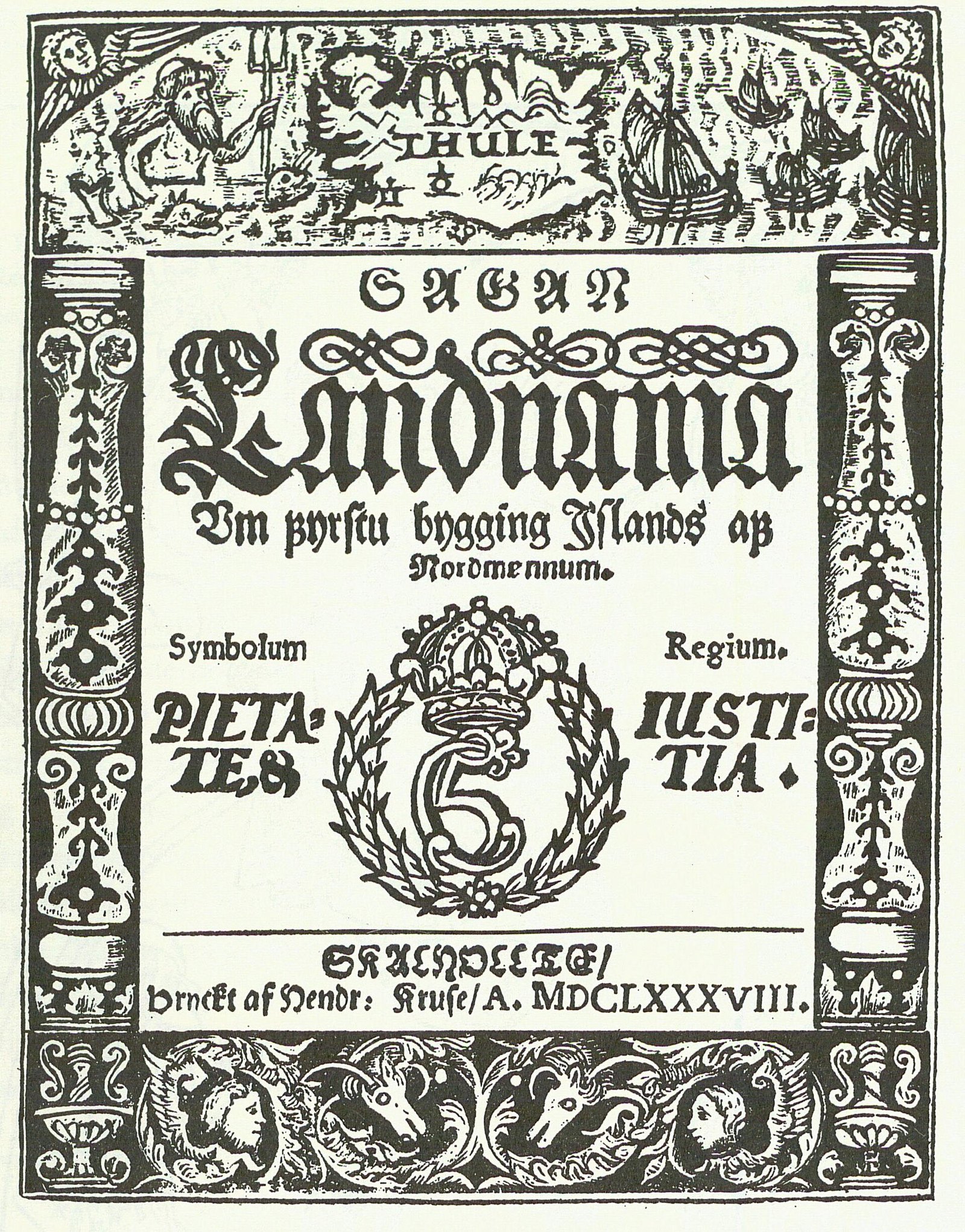
No other country in Europe has a book that names its first inhabitants fjord by fjord and farm by farm. Landnámabók, the “Book of Settlements”, does exactly that for Iceland. It is not, however, a record kept in the ninth century. The oldest surviving versions date from the late thirteenth and early fourteenth centuries, and every redactor added, cut and rearranged. This article sets out what the book contains, how it grew, why it was written, and where archaeology supports the text, corrects it or leaves it on its own.
Landnám literally means “land-taking”: the first act of claiming a piece of land. A landnámsmaðr is the person who makes the claim, and Landnámabók is the register of those people. It works its way round the island district by district and says who came, where they were from, what land they took, where they built their farm and who descends from them. In between are short stories: a quarrel, a dream, a killing.
The figures in circulation vary slightly. The historian Sverrir Jakobsson, in an article published in 2023, speaks of about 430 settlers. English Wikipedia counts 435 and also gives more than 3,000 people and some 1,400 settlements; I have not checked those counts myself. Some of the settlers are women, the best known being Auðr the Deep-Minded.
Anyone expecting a narrative will find the book dry. Anyone who wants to know how Icelanders of the high Middle Ages ordered their own origins has the key source in front of them. Almost every saga of Icelanders touches it somewhere, in names, pedigrees and farm sites.
For the wording I rely on the Sturlubók version in the Icelandic online edition (Netútgáfan/Snerpa), which gives the text in modern spelling; I received extracts from it verbatim through a retrieval tool. That edition has a preface (Formáli) and numbered chapters grouped into parts (hlutar). The first part runs from chapter 1 to chapter 21 there. English Wikipedia gives five parts and 102 chapters for the whole. Scholarly editions count differently and in much smaller units, which is why chapter references in the literature often fail to match. The Hauksbók passage on Úlfljótr's law, for instance, is number 268 in that system.
The first part tells how the island was found and then follows the earliest settlers. The remaining parts, according to the Wikipedia summary, go round the quarters of the country, beginning in the west and ending in the south. The organising principle is space, not time.
The preface of Sturlubók opens not with a viking but with an English monk. In the “book on the ages of the world” (aldarfarsbók) that the holy priest Bede composed, it says, an island called Thile is mentioned; wise men hold that Iceland is meant. Bede, the text adds, died 735 years after the incarnation of the Lord.
Then comes the sentence that still raises questions. Before Iceland was settled from Norway there were people there whom the Norse call papar. They were Christians, and it is thought they had come from the west across the sea, because Irish books, bells and croziers were found after them (“bækur írskar, bjöllur og baglar”). Much the same already stands in Ari Þorgilsson's Íslendingabók, the “Book of Icelanders”, which our article on the sagas of Icelanders dates to about 1122–1133: there too the papar leave Irish books, bells and staffs behind.
The word papar is usually explained as “fathers”, meaning clerics; I have not checked the derivation. That Irish monks sailed the North Atlantic is attested independently of the Icelandic texts; our article on Ingólfr Arnarson discusses the Irish scholar Dicuil, who wrote in 825 of clerics on an island called Thule. Whether that Thule is Iceland cannot be established beyond doubt. I know of no archaeological find that securely proves papar in Iceland.
After the preface Sturlubók has three men come upon the island one after another, and each gives it a different name. “Some name” the viking Naddoddr as the first; the caution is the text's own. His men call the land Snæland, “Snowland”. The second is Garðarr, after whom it is called Garðarshólmur, “Garðarr's isle”. The third is Flóki, who takes three ravens to sea; the third bird flies ahead over the prow in the direction where they find land. From a mountain Flóki sees a fjord full of drift ice; that is why his men call the country Ísland, “as it has been called ever since”.
The sequence is neatly built: three voyages, three names, rising to the one that stuck. It shows an ordering hand. The versions also differ from each other, and the raven scene has a biblical counterpart in Noah's birds. The Icelandic historian Gunnar Karlsson, as summarised on Wikipedia, pointed out the resemblance while stressing that it does not disprove the account. The details are in our article on Hrafna-Flóki.
The settlement proper begins with Ingólfr. The best-known scene in the whole book stands in chapter 6 of the online edition. Öndvegissúlur, high-seat pillars, are the carved posts that framed the householder's seat of honour in the hall. Ingólfr brings his from Norway and lets them choose where he will live.
Þá er Ingólfur sá Ísland, skaut hann fyrir borð öndugissúlum sínum til heilla; hann mælti svo fyrir, að hann skyldi þar byggja, er súlurnar kæmi á land.
“When Ingólfr saw Iceland, he cast his high-seat pillars overboard for good luck; he declared that he would make his home where the pillars came ashore.”Landnámabók (Sturlubók), ch. 6 in the Netútgáfan/Snerpa online edition, modern Icelandic spelling; my own translation
Chapter 7 resolves the suspense: two men of Ingólfr's household, Vífill and Karli, find the pillars “by Arnarhvoll below the heath”. The same sixth chapter carries a double date. Since the beginning of the world 6,073 winters had passed, and since the incarnation of the Lord 874 years. That is where the familiar year comes from.
Ari reckons differently. In Íslendingabók the settlement begins “in the days of Haraldr Fairhair”, 870 winters after the birth of Christ, and he ties the figure to the death of the English king Edmund. Sverrir Jakobsson sets the two side by side: “around 870” in Ari, 874 in Sturlubók. Both are back-calculations by learned men of the twelfth and thirteenth centuries. For the pillar-casting as a motif, for Hjörleifr and for the question of where the farm stood, see the article on Ingólfr Arnarson; for the Norwegian king, the one on Harald Fairhair.
There is no single Landnámabók. Five versions survive, three medieval and two from the seventeenth century. Behind them stand at least two lost stages.
Sturlubók is the work of Sturla Þórðarson (1214–1284). Sverrir Jakobsson places it in the 1270s and early 1280s; Sturla probably began it during his time as lawman (lögmaðr, a senior judicial office) from 1272. Wikipedia gives 1275–1280. According to our article on Flóki it survives only in a seventeenth-century copy; I have not checked that against a manuscript description.
Hauksbók is by Haukr Erlendsson, probably born about 1264. Large parts were written between 1302 and 1310, according to Sverrir Jakobsson. Haukr is the only redactor who accounts for his sources. In his epilogue he says he worked from the book that “Sir Sturla the lawman” had written and from a second one written by Styrmir the Learned. That Styrmisbók, by Styrmir Kárason (died 1245), is lost.
Melabók survives only in fragments; Wikipedia speaks of two leaves and puts the version at about 1300. According to Sverrir Jakobsson it ends with a list of lawspeakers down to 1271, so it may have been composed soon after or later, and contains 43 genealogies converging on the farm of Melar. Snorri Markússon (died 1313) is a possible compiler. Behind it scholars posit a lost source from the years 1200 to 1240, most probably the 1220s.
Two composite versions were made in the seventeenth century. Skarðsárbók was compiled before 1636, Wikipedia says, by Björn Jónsson of Skarðsá from Sturlubók and Hauksbók. Þórðarbók, by Þórður Jónsson, rests on Skarðsárbók and on material resembling the Melabók fragments. That is its value: it preserves pieces of a medieval version that would otherwise be gone. That Þórðarbók used Melabók was argued by Jón Jóhannesson in 1941. Auður Ingvarsdóttir disputed in 2004 that Melabók represents an earlier stage of the text than the others. The ranking of the versions is therefore not settled.
Who started it? The only medieval answer again comes from Haukr. The settlements have been gone through, he writes, “according to what wise men have written, first the priest Ari Þorgilsson the Learned and Kolskeggr the Wise” (“fyrst Ari prestr hinn fróði Þorgilsson ok Kolskeggr hinn vitri”). Sverrir Jakobsson stresses that this one sentence is the entire evidence for an original Landnámabók of the early twelfth century. Nothing of it survives.
Ari's own work, Íslendingabók, does survive, and it is far shorter: ten chapters on the settlement, the making of law, the Althing, the calendar, the division into quarters, Greenland, the acceptance of Christianity and the first bishops. In the prologue Ari says he revised an earlier version, and genealogies and lives of kings are mentioned in that connection. Wikipedia draws the obvious inference that early settlement registers may have grown out of the genealogical material Ari removed from the Book of Icelanders. It cannot be proved.
What is instructive is how little Ari names. Besides Ingólfr he lists four settlers, one for each quarter: Hrollaugr in the east, Ketilbjörn in the south, Auðr in the west on Breiðafjörður and Helgi the Lean in the north on Eyjafjörður, each with the kindred descended from them. Ari also has the statement that wise men said Iceland was fully settled in sixty winters, after which no new land was taken. Four names in Ari become more than four hundred in Landnámabók. Between the two books lie, depending on the version, roughly 150 to 180 years of collecting, supplementing and inventing.
The most famous answer is given by an epilogue that stands in Þórðarbók and, according to Sverrir Jakobsson, most likely comes from Melabók; its origin is not certain. It opens with an objection: many people say that writing about the settlements is irrelevant learning (“Þat er margra manna mál, at þat sé óskyldr fróðleikr at rita landnám”). The author disagrees. One can answer foreigners better when they taunt Icelanders with being descended from slaves or scoundrels (“komnir af þrælum eða illmennum”) if one knows one's true ancestry for certain. All sensible peoples, it continues, want to know the origin of their land and their kindreds.
A medieval text states its purpose here, and the purpose is standing. Sverrir Jakobsson calls Melabók the version most overtly national in tone. Of Sturlubók he observes that it stresses the noble birth of the settlers and shows them entangled in high politics in Norway. The taunt about slaves had a kernel of truth that the book itself supplies: it mentions unfree people, starting right at the beginning with the Irish slaves of Ingólfr's foster-brother Hjörleifr. More on that in the articles on slavery in the Viking Age and the vikings in Ireland.
Standing is not the only reading. Sveinbjörn Rafnsson sees behind the original Landnámabók a secular elite of big farmers, possibly in opposition to the Church; such a book would have backed claims to property. Einar Gunnar Pétursson linked it in 1986 to the administration of the tithe and compared it to the English Domesday Book. Adolf Friðriksson and Orri Vésteinsson read it in 2003 as an attempt to endow the landscape with history. I know these positions only from Sverrir Jakobsson's survey, not from the works themselves. They do not exclude one another. Sturla was a lawman, and Sverrir Jakobsson calls the redactors “lawmen” in his very title: men whose profession dealt with property, inheritance and descent.
Haukr added a good deal of material on the pagan period to his version. The best-known piece is a section on Iceland's oldest law, chapter 268 in the usual numbering. According to Ari, a man named Úlfljótr brought the first laws from Norway, for the most part modelled on the Gulathing law, and the Althing was established on his advice (see the article on the thing). Ari says nothing about their content. Hauksbók fills the gap.
At the head of the heathen laws, it says, stood a rule about ships: no one should have a ship with a carved head at sea. Anyone who did must remove the head before coming in sight of land, lest the landvættir, the guardian spirits of the land, be frightened. According to our articles on landvættir and oath-rings, the same section also regulates the temple ring: in every chief temple there should lie a ring of at least two ounces, which the goði wears on his arm at assemblies and on which oaths are sworn, with a formula invoking Freyr, Njörðr and the “almighty god”.
How old is this? The manuscript is nearly four hundred years younger than the law it claims to quote. The historian Oren Falk, in teaching material at Cornell University, notes that the alleged dependence on the Gulathing law may have run the other way, and asks what to make of a rule that states a prohibition and at once supplies a fallback for those who break it. A similar temple ring appears in Eyrbyggja saga. That is not independent confirmation: Björn M. Ólsen showed between 1904 and 1908 that Landnámabók took in material from sagas, and Sverrir Jakobsson names Eyrbyggja saga explicitly among Sturla's sources. The texts prop each other up. Whether Úlfljótr's law holds real memory of the tenth century or learned reconstruction of the thirteenth cannot be decided with certainty.
The hardest cross-check comes from the soil. Across large parts of Iceland lies a layer of ash that researchers call the “landnám tephra”, because the oldest traces of settlement cluster closely around it. Tephra is loose volcanic material; such a layer falls within days and so works like a date stamp. For a long time its age was given as 871 ± 2. A 2017 study by Schmid, Dugmore, Vésteinsson and Newton, after an adjustment of the Greenland ice-core chronology, puts it at 877 ± 1.
The same study reaches two findings. It finds occupation before the ashfall at only two sites, Húshólmi and Reykjavík, both in the south-west. Continuous, large-scale settlement of all habitable parts of the island begins only afterwards. In broad outline that fits what Ari and Landnámabók say: a start around 870, in the south-west, then rapid spread. But it confirms a time and a region, not a name. No find is labelled “Ingólfr”, and no farm ground-plan can be securely assigned to a settler in the book.
Archaeology also corrects the book. Jakob Benediktsson, editor of the standard edition, held that the settlers named were only a very small fraction of the immigrants. Landnámabók records the people someone wanted remembered: leaders, ship-owners, ancestors of important families. Farmhands, maids, the unfree and families whose line died out are largely missing.
There is no single answer, because the book is made of very different material. Three layers can be told apart.
First, the genealogies. Icelandic families of the twelfth and thirteenth centuries knew their forebears over many generations; descent decided inheritance and rank. Such a line can be remembered faithfully; it can equally be lengthened, or attached to a grander ancestor, when that is useful. The 43 genealogies of Melabók converging on a single farm show how close the redactors' interests sit to the text.
Second, the place-names. Many stories explain why a bay, a mountain or a farm bears its name. Such tales may preserve real memory, or may have been spun out of the name itself. In the individual case this can rarely be decided.
Third, the narrative pieces. Here circular reasoning is the main danger. Anyone who “confirms” a statement in Egils saga from Landnámabók may be comparing a text with itself, since Sturla, according to Sverrir Jakobsson, worked in material from Egils saga, Hænsa-Þóris saga and Eyrbyggja saga. Conversely, saga authors used Landnámabók; related material is found, for example, in Laxdæla saga.
Then there is the colouring given by the redactors. Sveinbjörn Rafnsson, as cited on Wikipedia, holds that Sturlubók and Hauksbók stress Christianity more strongly than Melabók. For Ingólfr's settlement Helgi Þorláksson, likewise via Wikipedia, regards the account as accurate in essence and consistent with other evidence. The frame agrees with archaeology; the individual detail remains unproven.
The scholarly edition, from which Sverrir Jakobsson also quotes, is volume I of the series Íslenzk fornrit, edited by Jakob Benediktsson; as far as I know it prints Sturlubók and Hauksbók side by side, but I have not consulted it. Freely available online is Sturlubók in modern Icelandic spelling at Netútgáfan. In English there is the translation by Hermann Pálsson and Paul Edwards (1972). I know of no complete German translation, though I did not search for one specifically.
For comparison it is worth looking at another great Icelandic compilation, Flateyjarbók: it too is late, it too is the only witness for some texts, and with it too one has to ask what the patron wanted from the book.
What does “Landnámabók” mean? “Book of Settlements”, literally of land-takings. Landnám is the first claiming of land, landnámsmaðr the person who makes the claim. The title is often shortened to “Landnáma”.
Who wrote Landnámabók? Several redactors over a good two hundred years. The versions of Sturla Þórðarson and Haukr Erlendsson survive, along with fragments of Melabók. Haukr names Ari Þorgilsson and Kolskeggr as the first authors; their text is lost.
How many settlers does the book name? About 430; one count arrives at 435. Thousands of further personal and place-names come on top. The figures depend on version and method of counting.
How does it differ from Íslendingabók? Ari's Book of Icelanders is a brief history of Iceland in ten chapters and names, apart from Ingólfr, only four settlers, one per quarter. Landnámabók is a register arranged by district with more than four hundred settlers.
Is Landnámabók historically reliable? In broad outline, yes: a start in the 870s, first in the south-west, rapid spread; that matches archaeology. Individual persons, dates and stories cannot be checked independently, and some of the material comes from sagas or from place-names.
Ingólfr Arnarson · The Icelandic Sagas · The oath rings · Eyrbyggja saga · Raven-Flóki.
All History & Finds articles →
In the first century the Lombards were a small tribe on the lower Elbe. In 568 they founded a kingdom in Italy that …
Read more →A Viking longship was a long, narrow, clinker-built warship that could be both sailed and rowed and carried up to a …
Read more →At the northern tip of Newfoundland lie the remains of eight buildings raised in turf and timber by Norse people in the …
Read more →In early October 1263 a few hundred Norwegians fought a Scottish force on a shingle beach in the Firth of Clyde while a …
Read more →