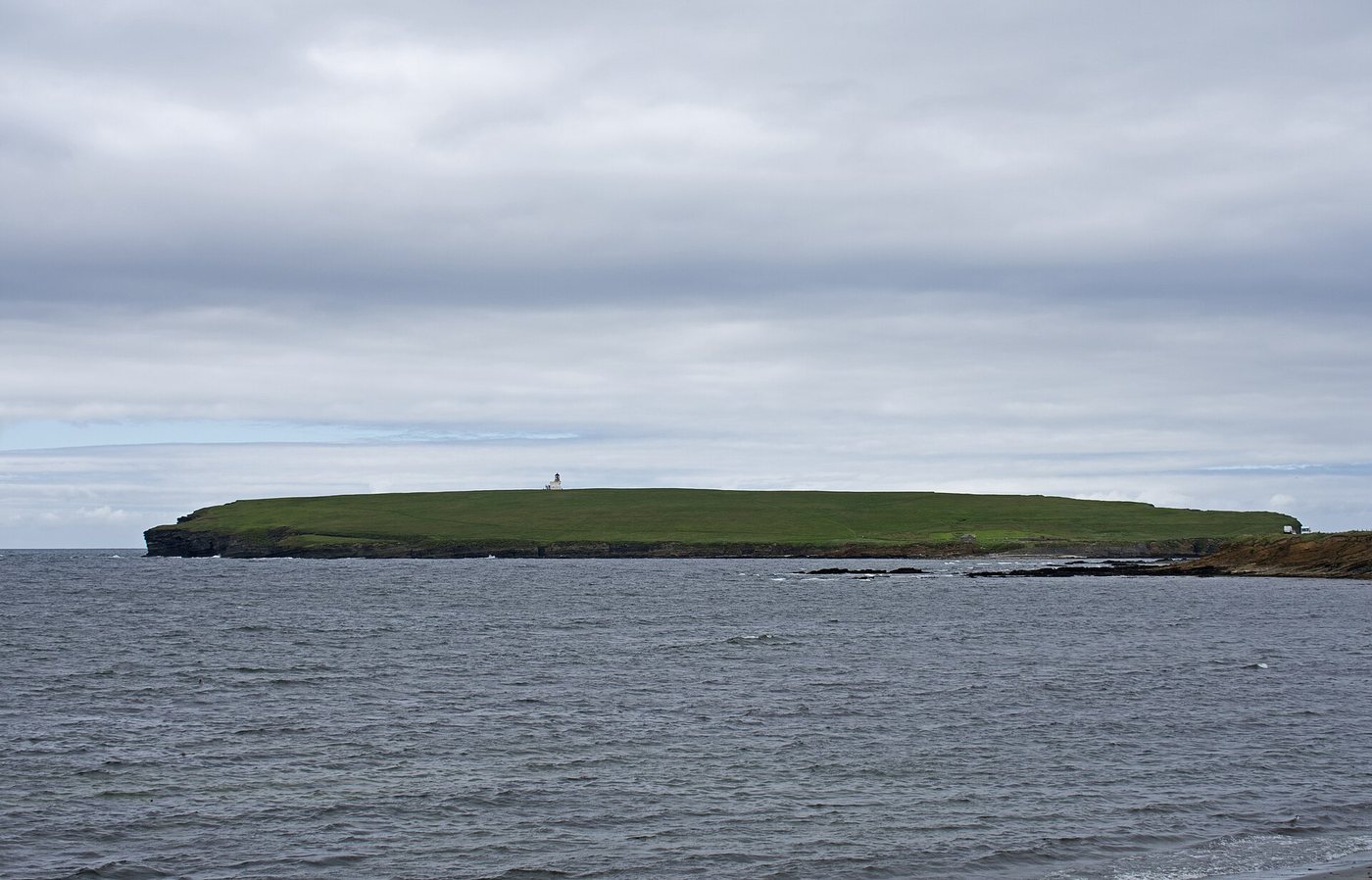
In early October 1263 a few hundred Norwegians fought a Scottish force on a shingle beach in the Firth of Clyde while a gale scattered King Haakon IV's fleet offshore. Nobody clearly won. Even so, Scotland has remembered Largs as a great victory since the late Middle Ages, and popular accounts call it "the end of the Viking Age". Its consequences were real: Haakon died two months later in Kirkwall, and three years after that his son sold the Hebrides and the Isle of Man to Scotland. This article follows the main source, Hákonar saga, checks the numbers, reads the Treaty of Perth closely, and keeps event, chronicle and legend apart.
"Largs 1263" usually conjures up a decisive battle: Vikings land, Scots drive them into the sea, an era closes. The sources disagree. In the summer of 1263 King Haakon IV Haakonsson of Norway sailed west with a large fleet to defend his overlordship of the Hebrides and the Isle of Man against the claims of King Alexander III of Scotland. The Scots avoided a pitched battle and kept talking until autumn arrived. A gale on the night before 2 October drove several Norwegian ships ashore at Largs, and a fight developed on the beach around the stranded vessels. By evening both sides had pulled back.
Militarily minor, it was politically the beginning of the end of Norwegian rule in western Scotland. The king died on Orkney in December, and his successor Magnus VI concluded the Treaty of Perth in 1266. Campaign, skirmish and treaty need to be kept apart to see why 1263 is at once overrated and underrated.
Scandinavians had settled in the Hebrides, on Man and along the west coast since the ninth century. From Norse and Gaelic families grew a warrior elite that Irish annals called the Gall-Goídil, the "foreign Gaels" (see the article on the Gall-Goídil). Norway's formal claim to the islands dates from 1098, when King Edgar of Scotland yielded the islands off the west coast to the Norwegian king Magnus Barefoot.
In the twelfth and thirteenth centuries the Crovan dynasty ruled Man and the northern Hebrides, while the descendants of Somerled, a ruler of mixed ancestry who fell in 1164, held the southern isles and Argyll. Both acknowledged the Norwegian king as overlord, often only nominally. The diocese of the Isles, "Sodor and Man", belonged from the mid-twelfth century to the church province of Nidaros, the archdiocese of Trondheim. Church, tribute and oaths of homage tied the islands to Norway. See also the overview of the Viking islands.
Haakon IV, born around 1204 and proclaimed king in 1217, had brought peace to Norway after decades of civil war. His later reign saw the Norwegian realm at its greatest extent: the Norse in Greenland submitted to him in 1261, and Iceland followed between 1262 and 1264.
On the Scottish side Alexander II had already tried to buy the islands and been refused. He died in 1249 on the island of Kerrera near Oban, in the middle of a campaign against the lords of Argyll. His son Alexander III was then a child and only began to rule in his own right in the early 1260s; in 1263 he was about 22. He offered money and threatened too. In 1262 Scottish magnates led by the Earl of Ross raided Skye. According to the saga, the island kings complained of this in letters to Norway, and rumours spread that Alexander meant to conquer the isles outright. Haakon decided on a great show of force.
Almost everything we know about the course of events comes from a single detailed source, Hákonar saga Hákonarsonar. It was written by the Icelander Sturla Þórðarson, a nephew of Snorri Sturluson, for Haakon's son Magnus in the years immediately after the king's death. Sturla was not in Scotland himself, but the account of the fight reads as if built on eyewitness reports. Yet it was commissioned by the hero's son. It explains failure by weather, cunning and the will of God, hardly ever by Haakon's mistakes.
The saga survives in several manuscripts, among them Flateyjarbók and the manuscript known, after a former owner, as Codex Frisianus. As early as 1782 the clergyman James Johnstone published an English translation of the section on the campaign; George Webbe Dasent's complete English translation appeared in 1894 in the Rolls Series. Both are in the public domain. On the Scottish side there are only brief near-contemporary notes, chiefly in the Chronicle of Melrose, and the much later accounts of John of Fordun (fourteenth century), Andrew of Wyntoun (around 1420) and Walter Bower (1440s).
In July 1263 the fleet left the Bergen area. The saga stresses that no larger fleet had ever sailed from Norway, and later gives a figure: off Kerrera, on the coast of Argyll, Haakon had more than 120 ships, most of them large. The 200 ships often quoted are not in the saga. How many men were aboard cannot be stated reliably; projections of 10,000 or 20,000 rest on assumptions about crew sizes.
The route ran via Shetland to Orkney. While the fleet lay at Orkney the saga records a darkening of the sun, which Dasent in his introduction identifies as the annular eclipse of 5 August 1263. The fleet then sailed south through the Minch, past Skye, to Kerrera. Dubhghall mac Ruaidhrí, King Dugal in the saga, stood firmly with Haakon, as did Magnus Óláfsson, King of Man. Eóghan Mac Dubhghaill, Lord of Argyll, who held lands from both the Scottish and the Norwegian king, came to Haakon and declared he would keep the oath he had sworn to Alexander. Haakon let him go.
The fleet divided. One squadron plundered Kintyre, another took Bute. A third, by the saga's account 60 ships under Magnus of Man and Dubhghall, sailed into Loch Long, hauled boats across the narrow neck of land at Tarbet into Loch Lomond and ravaged the Lennox. The main body anchored off the Cumbrae islands in the Firth of Clyde, opposite Largs.
Alexander III avoided open battle. He sent barefoot friars, that is Franciscans, and envoys who entered into talks without ever concluding them. According to the saga the Scottish king at one point offered to give up part of the islands but named Bute, Arran and the two Cumbraes as islands he would not surrender. Haakon claimed all the islands west of Scotland that Magnus Barefoot had held. The saga says bluntly that the Scots deliberately delayed any settlement because summer was ending and the weather was turning.
The strategy was sound: a fleet could not lie for months in foreign waters without supplies running short and autumn gales arriving. Alexander did not need to win, only to wait, and meanwhile he gathered troops on the Ayrshire coast.
In early October the weather the Scots had been counting on arrived. The saga dates it precisely by the church calendar: Michaelmas, 29 September, fell on a Saturday in 1263, and on the night into the following Tuesday a heavy gale broke. A transport and other ships were driven ashore; even the king's ship held only by putting out many anchors.
"King Hakon lay in the Cumbraes – Michaelmas was then on a Saturday. But the Monday night after came a violent storm with hail and tempest."Hákonar saga Hákonarsonar (Sturla Þórðarson), section on the Scottish expedition of 1263; translated by G. W. Dasent, The Saga of Hacon, Rolls Series 88, vol. 4, London 1894 (public domain). Meant is the night of Monday 1 into Tuesday 2 October.
On the morning of 2 October Norwegians tried to salvage the stranded ships. Soon a Scottish force appeared. The saga describes horsemen, some in mail, and many foot soldiers with bows and spears. The Norwegians put the horsemen at about 500, one version of the text at 1,500; the saga admits estimates differed. On the Norwegian side some 800 to 900 men were ashore, about 200 of them on a hillock under the royal retainer Ögmundr krækidans, Ogmund Crouchdance in English accounts. Haakon's men urged him back to the ships.
When the men on the hillock tried to fall back to the beach, the others took it for flight. Some rushed for the boats, and several capsized. On the beach a small band fought on against superior numbers. A young Scottish knight fell there whom the saga calls Perus; later writers identify him with Piers de Curry, though this cannot be confirmed. Late in the day reinforcements got through the gale from the ships. The Norwegians retook the hillock, and, in the saga's words, "the Scots fled away from the hillock as fast as each man could to the fells". The Norwegians then rowed back to their ships. Next morning they returned to the beach to recover their dead.
The exact site is unknown. According to the Battlefields Trust the sources are too vague; tradition places it south of the Gogo Water. There is no archaeological evidence.
Read the saga alone and the Norwegians held the field: the Scots withdrew, the Norwegians stayed until the next day and gathered their dead. The Scottish chronicles make it a Scottish victory. Both readings are partisan: the saga wants to save Haakon's honour, and the Scottish writers wrote generations later.
The Chronicle of Melrose, closest in time to the events, credits the Norwegian failure chiefly to the power of God rather than Scottish arms, and calls the infantry, rather dismissively, men of the locality. John of Fordun in the late fourteenth century saw the storm as an act of God. Andrew of Wyntoun around 1420 made it a hard-won Scottish victory. Walter Bower, in his Scotichronicon of the 1440s, names Alexander Stewart of Dundonald, the Steward of Scotland, as commander and tells how St Margaret, the eleventh-century queen of Scotland, appeared and helped the Scots. Bower also has a nephew of Haakon killed.
Later figures overshoot wildly. A magazine text of 1787, claiming to draw on an "Icelandic chronicle", had 16,000 Norwegians fall; others spoke of 25,000. The Battlefields Trust calls such figures spurious. Modern historians think in terms of a few hundred men on each side; there are no reliable casualty figures. Most specialists today see Largs as an indecisive engagement within a failed campaign. The campaign was decided by weather, time and Alexander's refusal to give battle.
After the storm Haakon regrouped the fleet, rewarded loyal island lords with land and sailed north. On Orkney part of the fleet went home; the king stayed, intending to resume the war in spring, and took up quarters with his household in the Bishop's Palace at Kirkwall beside St Magnus Cathedral.
There he fell ill. First he had the Bible and Latin books read to him. Then he wanted books in the vernacular: lives of saints, the history of the Norwegian kings from Halfdan the Black onward, and finally the saga of his grandfather Sverrir. On Thursday, St Lucy's day, 13 December, his condition worsened. On the Saturday after he lost his speech, and at midnight, the saga says, God called King Haakon out of this life. That means the night of 15 to 16 December 1263.
The body was buried in the choir of St Magnus Cathedral and taken to Bergen in spring 1264, where it was laid in Christ Church. That church was demolished in 1531 and the grave was lost. The Bishop's Palace in Kirkwall is today a ruin open to visitors. For the rulers of Orkney themselves, see the article on the Earls of Orkney.
Alexander III seized the moment. In 1264 his forces punished Haakon's allies in the isles. Magnus Óláfsson, King of Man, travelled to Dumfries the same year, submitted, did homage to Alexander and handed over hostages. When he died at Castle Rushen on 24 November 1265, the line of Crovan kings of Man ended with him. The Chronicle of Man notes briefly that kings had now ceased to reign on Man. More in the article on the Isle of Man.
Norway was now ruled by Haakon's son Magnus VI, later called Lagabøte, the "law-mender", for his reform of the national law. He did not want another war. After embassies in both directions the treaty was concluded at Perth on 2 July 1266. The Latin chirograph, a duplicate charter cut apart as a safeguard against forgery, was agreed in the Dominican friars' church. Norway was represented by the chancellor Askatin and the baron Andrew Nicholasson.
The contents are well preserved. Norway renounced Man, the Sudreyjar, the "southern isles" or Hebrides, and all other islands to the west and south. Orkney and Shetland were expressly excluded and remained the Norwegian king's own domain. The ceded islands were to be governed by Scottish law. Those islanders who had sided with Haakon were not to be punished for it and kept their inheritance. Inhabitants could stay as Scottish subjects or leave with their goods; nobody was to be forced either way.
The church stayed with Nidaros for the time being: the Scottish king received the patronage of the bishopric of Man, but the rights of the archbishop of Trondheim over the bishop and church of Man were preserved. In return Scotland paid. The sums were 4,000 marks sterling, payable over the following four years, plus 100 marks a year in perpetuity. Payment was to be made in St Magnus' church in Orkney, within the octave of the feast of St John the Baptist at the end of June, to the bishop of Orkney or the king's agent. Whoever withdrew from the treaty was to pay a penalty of 10,000 marks, and both kings submitted themselves for this to papal jurisdiction.
Norway gained money, a permanent income and a recognised frontier in the north. On Man the new rule met resistance: in 1275 the island rose under Godred, a son of the last king, and was crushed by a Scottish army at Ronaldsway. The annual 100 marks were not paid regularly. In 1312 Robert I of Scotland and Haakon V of Norway confirmed the Perth settlement in the Treaty of Inverness. The payment, known as the "Annual of Norway", still fell into arrears again and again.
The treaty's exclusion of Orkney and Shetland is often overlooked. The Northern Isles remained part of the Norwegian realm, and from 1397 of the Danish-Norwegian union, for more than 200 years after 1266. Only in 1468 did King Christian I pledge Orkney to secure the dowry of his daughter Margaret on her marriage to James III of Scotland. The dowry was set at 60,000 Rhenish florins, Orkney standing for 50,000. In May 1469 Shetland followed as a pledge for another 8,000, because Christian raised only 2,000 of the cash payment. At the same time the annual payment under the Treaty of Perth lapsed. On 20 February 1472 the Scottish parliament annexed the islands to the crown. The pledge was never redeemed.
On Shetland, Norn, a Norse language that survived into the eighteenth century, and many place-names recall this long connection. How deep Norse settlement there goes is shown by the site of Jarlshof on Shetland. Today's fire festivals such as Up Helly Aa in Lerwick, by contrast, are nineteenth-century creations, not an unbroken Norwegian-era tradition.
Guidebooks like to call Largs the last Viking battle or the end of the Viking Age. The label misleads. Scholars place the Viking Age roughly between 800 and 1050 or 1100. The year 1066 often serves as its end point, when Harald Hardrada fell at the Battle of Stamford Bridge. In the west, Magnus Barefoot's expedition of 1098 and his death in Ireland in 1103 mark a similar break.
Haakon IV was not a Viking chieftain but a crowned Christian king of the High Middle Ages. He had a chancery and had courtly literature translated from French. His fleet was a levy raised under the leidang, the legally regulated duty of coastal districts to provide ships and crews. The ships still followed Norse building traditions, but raiding was not the purpose. The issues were oaths of homage, revenues and the border between two kingdoms.
Finds such as the Lewis chessmen, probably carved in Norway in the late twelfth or early thirteenth century, also belong to this high medieval world rather than to the Viking Age. Only this much of the label is right: 1266 ended the political tie between the Hebrides, Man and Scandinavia that had begun in the Viking Age. To say that Largs ended Scandinavian rule in western Scotland is closer to the truth, provided Orkney and Shetland are left out.
In the fourteenth and fifteenth centuries Largs became the story of a Scottish king repelling invaders. Nineteenth-century antiquarians placed it alongside Wallace and Bruce. The most visible result stands south of the town: a slender conical round tower of whinstone, some 21 metres high, designed by James Sandyford Kay and unveiled on 12 July 1912. Locals call it "The Pencil". It has been listed since 1971, but in the view of researchers it does not mark the probable site of the fighting.
Since 1981 Largs has held a Viking Festival with camps, fireworks and a re-enacted battle. Nowadays it usually falls at the end of August or the beginning of September. An overview of such events is given in the article on Viking festivals 2027.
Anyone looking for motifs from this world will find ships, knots and animals in Norse style at Glanz & Gravur, engraved reminders of stories like this one.
When exactly was the Battle of Largs? On Tuesday, 2 October 1263. The saga dates it from Michaelmas, 29 September, which was a Saturday that year; the gale came on the Monday night after, the fight on the following day.
Who won the battle? Neither side clearly. According to the saga the Norwegians held the field at the end, but the Scots achieved their aim, because the campaign failed. The great Scottish victory was the creation of later chroniclers.
How many ships did Haakon have? Hákonar saga gives more than 120 ships off Kerrera. Figures of 160 or 200 ships are later estimates with no better basis.
What did Norway receive under the Treaty of Perth? 4,000 marks sterling in four annual instalments and an annual payment of 100 marks, plus recognition of its rule over Orkney and Shetland. The annual payment was cancelled in 1469 with the marriage treaty between James III and Margaret of Denmark.
Can you visit the sites today? In Largs "The Pencil" stands on the shore south of the town; in Kirkwall the ruined Bishop's Palace where Haakon died stands right next to St Magnus Cathedral.

The Earls of Orkney · The Vikings in Ireland, Scotland & the Isles · The Norse on the Isle of Man · The Lewis Chessmen · Jarlshof and the Shetlanders.
All History & Finds articles →
Some weapons give their name to an entire age. The long iron sword of the Celts is one of them: after the find-spot of …
Read more →Look up "Lebus" in a history book and you will soon meet Thietmar of Merseburg, said to describe the siege of a …
Read more →Leif Erikson (Old Norse Leifr Eiríksson) was a Norse seafarer from the Greenland colony who, around the year 1000 …
Read more →It stands 18 millimetres tall, weighs nine grams and sits on a throne with a bird perched on each armrest. When Tommy …
Read more →