A settler throws his high-seat pillars overboard and builds a temple where Thor washes them ashore. A shepherd sees a mountain standing open and hears drinking horns clank inside. A farm loses eighteen people in one winter, until the dead are summoned to court and actually leave. All of this is in a single saga. Eyrbyggja saga is the main source for much of what is said today about Norse temples, holy mountains and the walking dead, which is reason enough to look closely at what it tells, when it was written and how far it can be trusted.
Most sagas of Icelanders have a central character or at least a central family. Eyrbyggja saga has a district instead: the north side of the Snæfellsnes peninsula in western Iceland, with the headland Þórsnes, the hill Helgafell, Álptafjörðr and the farm of Fróðá. The title means “saga of the people of Eyrr”; William Morris and Eiríkr Magnússon rendered it in 1892 as “The Story of the Ere-Dwellers”.
It opens with the settlement of Iceland in the ninth century, most of the events fall in the late tenth and early eleventh centuries, and chapter 65 traces the descendants of the chieftain Snorri down to the Sturlungs of the thirteenth century. In between come feuds, lawsuits, witchcraft, the discovery of Greenland and a string of ghost stories. What holds it together is the place, and one man who pulls most of the strings: Snorri goði.
For the history of religion the saga matters for another reason. It contains one of the fullest descriptions of a pagan temple in Old Norse, the clearest evidence for the belief that the dead go into a mountain, and the best-known stories of the walking dead apart from Grettis saga. Each was written down some 250 to 350 years after the events it describes.
Þórólfr, an emigrant from Norway, bears the nickname Mostrarskegg, “Most-Beard” in Morris; the saga presents him as a close friend of Thor. Sailing to Iceland, he leaves the choice of a home to the god: he throws the pillars of his high seat overboard and settles where they drift ashore. The high seat (Old Norse öndvegi) was the householder's place of honour in the hall. The headland where they land is called Þórsnes from then on, “Thor's ness”.
There Þórólfr builds a farm the saga calls Hofstaðir, “temple-stead”, and a temple beside it. He also lays down two things that shape the rest of the saga. The assembly of the district is to meet on the ness where Thor came ashore, and one hill on the peninsula is so holy to him that nobody may look at it unwashed.
The temple description stands in chapter 4. The temple was a large house with a door in the side wall, near the gable. Just inside stood the high-seat pillars, and in them were nails called reginnaglar. Morris and Magnússon translate: “they were called the Gods' nails.” The saga does not say what they were for.
The space beyond counted as a sanctuary. Further in was an annexe which the author compares to the choir of a church. In its middle stood a platform, the stallr, set up in the manner of an altar. On it lay “a ring without a join that weighed twenty ounces”, on which all oaths were sworn and which the temple priest was to wear on his arm at gatherings. Our article on oath rings discusses the fact that Landnámabók, the “Book of Settlements”, gives temple rings a weight of two ounces or more. The platform also carried the hlautbolli, the bowl for the sacrificial blood (hlaut), with the hlautteinn, a twig for sprinkling it. The images of the gods stood around the platform.
A due was attached to the temple. All men of the district were to pay a toll and follow the temple priest on his journeys; he in turn had to maintain the building and hold the sacrificial feasts. This is the goði, the Icelandic combination of cult leader and chieftain.
The passage is often quoted as if it were a ground plan. The text itself argues against that. The author explains the temple in church vocabulary: the annexe is likened to the choir of a church, the platform to an altar. He is making an unfamiliar building vivid for Christian readers of the thirteenth century, and the model may well have shaped the description.
There is also a cluster of related texts. Kjalnesinga saga (ch. 2) describes a temple with an image of Thor, a silver ring, a copper blood bowl and a temple fee; Snorri Sturluson's Heimskringla repeats the details of blood, bowl and twig in the saga of Hákon the Good. Whether these are three independent witnesses or one learned notion passed from text to text is disputed. The Danish archaeologist Olaf Olsen reached a sceptical conclusion in “Hørg, hov og kirke” (1966): according to the summary of his work, he could not confirm a single case of a pagan temple beneath a church, and he understood the hof as the feasting hall of a large farm that served the cult at certain times.
A common confusion begins here. The excavated Hofstaðir, dug by Daniel Bruun and Finnur Jónsson in 1908 and by Olsen in the mid-1960s and reinvestigated from 1992, lies near Lake Mývatn in northern Iceland and shares only its name with Þórólfr's farm on Snæfellsnes. Excavators there found a hall 38 metres long and the skulls of at least 23 cattle that had been beheaded and their heads put on display; Gavin Lucas and Thomas McGovern interpreted this in 2007 as seasonal sacrificial acts held in the context of feasting and gatherings. More on this in our article on places of sacrifice. I know of no excavation that has identified Þórólfr's temple on Þórsnes.
Sacrificial feasts in the hall, blood, oaths on a ring and a chieftain as cult leader fit what finds and other texts suggest. A separate cult building with “choir” and “altar” cannot be demonstrated for settlement-age Iceland. Chapter 4 shows reliably how an educated Icelander around 1250 imagined a temple; whether Þórólfr's building looked like that cannot be established.
The same chapter contains the passage about the hill. Þórólfr names it Helgafell, “holy fell”, and, in Morris's words, “he laid down that no man unwashed should turn his eyes thither”. Nothing may be killed on it, neither man nor beast. And “he trowed that thither he should fare when he died, and all his kindred from the ness.”
Seven chapters later the saga makes good on this. Þorsteinn þorskabítr (“Codbiter”), Þórólfr's son, has gone out fishing. A shepherd is out near Helgafell.
“… there he saw how the fell was opened on the north side, and in the fell he saw mighty fires […] and heard huge clamour therein, and the clank of drinking-horns […] he heard that there was welcomed Thorstein Codbiter and his crew …”Eyrbyggja saga, ch. 11; trans. William Morris and Eiríkr Magnússon, The Story of the Ere-Dwellers, London 1892 (abridged)
The shepherd tells Þóra, and the next morning news arrives that Þorsteinn has drowned. The dead here sit neither in Valhalla nor with Hel. They go on feasting inside a hill within sight of their own farm, among their kin. Scholars speak of a “mountain of the dead”; further examples are discussed in our article on holy mountains.
The saga is the chief witness for this belief, and it is a late one. That the hill was regarded in the thirteenth century as an old holy place is certain. Whether a ninth-century settler laid down exactly these rules, nobody knows.
Þórólfr's third legacy is the assembly. On the ness where the pillars landed he sets up a thing for the district, the regular meeting of free men at which law was administered. Chapter 22 shows how it works. Snorri rides into Álptafjörðr with eighty men to deliver a summons. The chieftain Arnkell forbids his men to attack, in Morris's words: “Snorri's law shall we bear.” At the Þórsnes assembly the defendant Þórarinn is then found guilty, and Snorri collects the fines. Violence and law are constantly entangled in this saga.
Snorri is Þórólfr's great-grandson, chieftain at Helgafell and the dominant figure of the saga. His father Þorgrímr is killed by Gísli Súrsson, and his mother Þórdís is Gísli's sister; Gísla saga tells that story from the other side. Chapter 15 describes his looks and character.
His great rival is Arnkell, also a chieftain. In chapter 37 Snorri and his foster-brothers, the sons of Þorbrandr, attack Arnkell at work on his farm and kill him. The saga gives him an epitaph in one sentence: in paraphrase, of all men in the old heathen days he was the most accomplished in every respect. In court only one man is outlawed for the killing, Þorleifr Þorbrandsson.
Then come the battle of Vigrafjörðr (ch. 45–46), after which Snorri rescues his wounded foster-brothers, and his failed attempt to kill Björn Ásbrandsson, the lover of his half-sister Þuríðr (ch. 47). Björn's story, down to his puzzling trace in the west, is told in our article on Björn Breiðvíkingakappi. In chapter 62 Snorri defeats the raider Óspakr, and the final chapter lists his descendants, among them, through his son Halldórr, the Sturlungs, the most powerful family in thirteenth-century Iceland, to which Snorri Sturluson belonged.
Between the feuds stand self-contained episodes. The first concerns two women skilled in magic, Geirríðr and Katla. Katla's son Oddr has cut off a woman's hand and boasted of it. When Arnkell and Þórarinn search the farm they cannot find him although he sits before their eyes: Katla hides him by illusion, and once the men see only a household boar in his place. Only when Geirríðr comes along does this fail. A sealskin bag is pulled over Katla's head, Oddr is hanged and Katla stoned (ch. 20). Arnkell remarks that Oddr had an ill mother; Katla wishes him an ill father.
Chapter 24 touches wider history. Þorgestr prosecutes Erik the Red for manslaughter; Erik sails away, finds Greenland, stays three winters and returns to Iceland. The saga dates this fourteen winters before Christianity became law. Chapter 25 takes the Icelander Vermundr to the court of Earl Hákon in Norway and announces two berserks in its heading. I have not read their later story in the text for this article and leave it open.
Arnkell's father shares the settler's name but is nicknamed bægifótr, “twist-foot” or “lame-foot”. After losing a dispute he sits down in his high seat, says nothing, and is dead by morning (ch. 33). Arnkell approaches the corpse from behind, has the wall broken open behind it and carries it out through the hole, not through the door.
In chapter 34 a shepherd lies dead by the cairn, and birds that settle on it fall dead. Arnkell reburies his father and has a stone wall built round the new grave. After Arnkell's death the haunting begins again, until in chapter 63 the body is dug up, undecayed and swollen, and burnt. Even the ashes work on: a cow licks the stones they fell on and bears the bull calf Glæsir, which ends by killing a man. For the details and the comparison with Glámr of Grettis saga, see our article on the draugr; for what doors and breached walls could mean in house and grave, see longhouse, the dead and magic.
The saga's most famous haunting is set shortly after the conversion. Chapter 49 notes that churches were now being built on Snæfellsnes but that there were no priests to say mass in them. Into this situation comes Þórgunna, a wealthy woman from the Hebrides, who takes lodging at Fróðá and owns strikingly fine bed-hangings that the mistress of the house, Þuríðr, covets.
During haymaking a black cloud comes up from the north and it rains blood, at Fróðá and nowhere else (ch. 51). Þórgunna falls ill, asks to be buried at Skálholt and demands that her bedding be burnt. Þuríðr gets her way and it is kept. On the journey to Skálholt the dead woman appears at night and prepares a meal for her bearers.
On the panelling of the fire-hall a half-moon appears and moves against the sun around the house, evening after evening for a week; the saga calls it urðarmáni, Morris's “Moon of Weird”, a moon of fate (ch. 52). The shepherd turns strange, talks to himself and dies at the beginning of winter; others of the household follow. A seal's head rises through the floor of the fire-hall. In the store-room, where the stockfish is piled up to the tie-beam, people hear fish being torn from the skin, and out of the heap sticks a tail “as big as a singed neat's tail” that strips the skin from the palms of those who pull at it (ch. 53–54).
The master of the house, Þóroddr, drowns at sea with his men. At the funeral feast the drowned come dripping into the hall and sit by the fire, and from the other side come the dead from the churchyard. The saga gives the tally: “At harvest-tide there had been thirty serving-folk there, but eighteen were dead, and five fled away”, leaving seven.
In the middle of this stands a sentence that says much about how the author saw the period: “in those days little of the olden lore was cast aside, though men were baptized and were Christian by name” (ch. 54).
Kjartan, the son of the house, seeks advice from his uncle Snorri goði. Snorri recommends three things: burn Þórgunna's bedding, bring a priest, and hold a duradómr against the revenants, a door-court, that is, a court convened at the door of the house. The dead are summoned one by one and charged with walking in the house without leave and robbing people of life and health. Witnesses are named and verdicts given.
The dead comply. In Morris: “each arose as the sentence fell on him, and all said somewhat at their going forth.” The priest then goes through the house with holy water, and the next day the hours and mass are sung. With that, the saga says, “there was an end thereafter to all walkings and hauntings at Frodis-water.”
The scene combines three remedies: a last will finally honoured, a legal procedure and the rite of the church. The text does not say which of them works. John D. Martin showed in 2005 how closely the haunting is tied to legal thinking (as reported in our draugr article; I have not read the paper itself for this piece). The passage cannot serve as proof of a real legal custom against the dead, for I know of no second testimony for such a procedure. See also law in the Viking Age.
The author is unknown. The Arnamagnæan Collection in Copenhagen gives composition around the middle of the thirteenth century as the usual view; other surveys leave room into the later thirteenth century. Internal evidence shows that the author knew Laxdæla saga and Egils saga. With Gísla saga it shares the back-story of Snorri's parents.
Its antiquarian interest is striking. The narrator explains old institutions such as temple, ring and toll, and separates “then” from his own time, as in the sentence about the baptised people of Fróðá. That makes the saga valuable and calls for caution: an author who sets out to explain paganism also tidies it.
According to the critical edition by Forrest S. Scott (“Eyrbyggja saga. The Vellum Tradition”, Editiones Arnamagnæanæ A 18, 2003) there are four vellum witnesses. The oldest, AM 162 E fol., dates from the thirteenth century and consists of only two leaves. The Wolfenbüttel saga manuscript belongs to the fourteenth century; Melabók, with seven surviving leaves and a strip that turned up in a Reykjavík attic in the mid-twentieth century, to the fifteenth. AM 309 4to was written in 1498. Wolfenbüttel and AM 309 are sister manuscripts for this saga and together cover almost the whole text.
The text on which the older editions were based, however, rests on a lost manuscript. Vatnshyrna was kept in the University Library of Copenhagen and perished in the city fire of 1728; seventeenth-century copies survive. Earlier editors distinguished three branches of transmission. Scott reckons with two: one that generally preserves the older wording (the old fragment, Wolfenbüttel and AM 309) and one that was revised and modernised step by step (Melabók and Vatnshyrna). Figures and single words can therefore differ from edition to edition.
The saga was first printed in Copenhagen in 1787, with a Latin translation, by Grímur Jónsson Thorkelín. Walter Scott wrote an English summary, the “Abstract of the Eyrbiggia-Saga”, dated 1813 and published in 1814 in the volume “Illustrations of Northern Antiquities” (Edinburgh and London), which Scott brought out with Henry Weber and Robert Jamieson.
Scholarly editions followed from Guðbrandur Vigfússon (Leipzig 1864) and Hugo Gering (Halle 1897); the standard edition today is volume 4 of Íslenzk fornrit by Einar Ól. Sveinsson and Matthías Þórðarson (Reykjavík 1935). The first complete English translation is that of William Morris and Eiríkr Magnússon (1892); it is in the public domain. More recent versions are by Paul Schach and Lee M. Hollander (1959) and by Hermann Pálsson and Paul Edwards (Penguin Classics).
The saga still echoes in literature: in 2011 Ármann Jakobsson published a novel titled “Glæsir”, the name of the bull calf.
What does “Eyrbyggja saga” mean? “Saga of the people of Eyrr”. The saga nevertheless deals with several families of the district, not just this one.
When was Eyrbyggja saga written? Around the middle or in the second half of the thirteenth century. The oldest surviving fragment, two vellum leaves, dates from the same century.
Is the temple description in chapter 4 reliable? As evidence for the thirteenth century, yes; as a building description of the ninth, only with reservations. Sacrificial feast, blood and ring oath have parallels in other texts and finds; the cult building with “choir” and “altar” is explained on the model of a church.
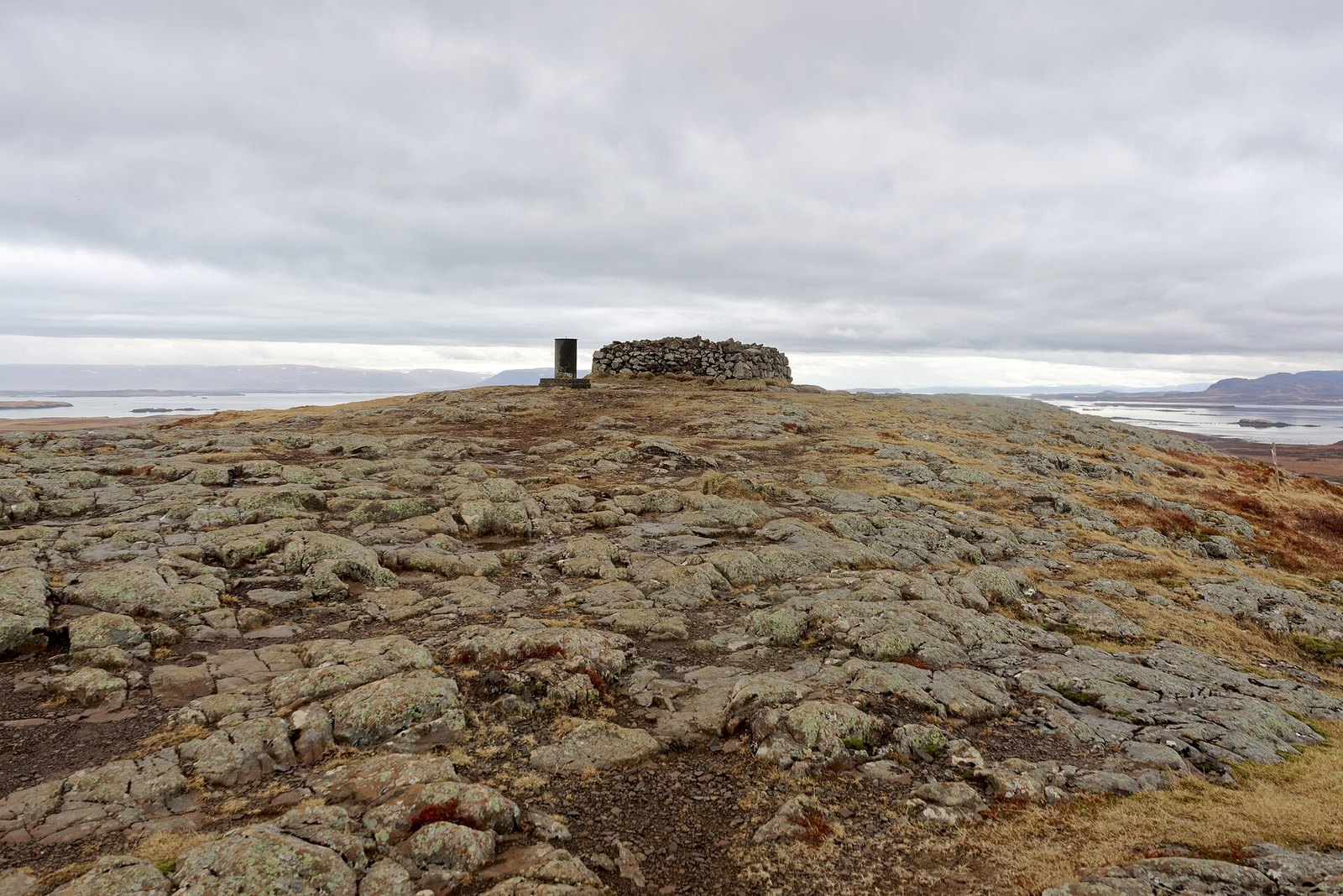
Does Helgafell really exist? Yes. The hill lies on the Snæfellsnes peninsula. Our article on holy mountains shows a photograph with the memorial stone for Guðrún Ósvífursdóttir, the central figure of Laxdæla saga.
What is a duradómr? A “door-court”: a court held at the door of a farm. In Eyrbyggja saga the revenants of Fróðá are charged, sentenced and ordered out of the house in this way.
The Icelandic Sagas · The Draugr – the walking dead · Sacred Mountains & Rocks · The oath rings · Gísla saga Súrssonar.
Eyvindr Finnsson, called skáldaspillir, lived in the tenth century and composed two of the best-known Norwegian skaldic …
Read more →Fáfnir is the most famous dragon in Norse tradition – and he was not born one. In the Eddic poems he is a son of …
Read more →There is not a single story about Loki's parents. No poem tells how they met, no scene shows them with their son, no …
Read more →Fenrir (also Fenrisúlfr, the "Fenris wolf") is the monstrous wolf of Norse mythology: a son of Loki and the giantess …
Read more →