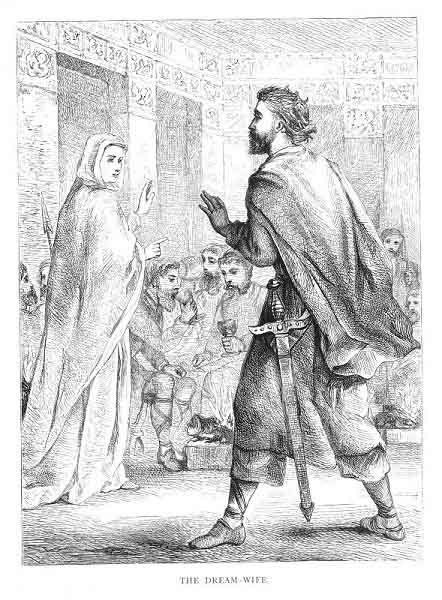
A man is stabbed in his bed at night with a spear, and the saga does not say who did it. A year later a second man dies the same way, by the same weapon, and this time the reader looks over the killer's shoulder. Gísla saga Súrssonar, the saga of Gísli, son of Súrr, is one of the shorter sagas of Icelanders and one of the most tightly built. It tells of a sworn brotherhood that fails, thirteen years of outlawry in the Westfjords and two women who visit the hunted man in his dreams. Along the way it supplies some of the most quoted passages on pre-Christian belief: hel-shoes, a sacrifice to Freyr at the Winter Nights, a burial mound on which no snow will lie. This article follows the plot and asks of each of those passages what it proves and what it does not.
Gísla saga belongs to the sagas of Icelanders, the prose narratives written down in Iceland in the thirteenth and fourteenth centuries about people of the settlement and saga age. Its action is set in the tenth century, first in Norway, then in the Westfjords of Iceland: in Haukadalr on Dýrafjörður, later in remote Geirþjófsfjörður.
What sets it apart from larger works such as Njáls saga or Laxdæla saga is how narrow it is. It concerns a few people and two neighbouring farms. Killers and victims are brothers, brothers-in-law and friends.
The dreams are covered in our article on dreams in the sagas, the autumn feast in the one on the Winter Nights.
The saga opens a generation earlier. An older Gísli, the hero's uncle, avenges his brother Ari in Norway with a sword called Grásíða, “Grey-side” or “Grey-blade”. He has borrowed it from a thrall named Kolr and does not give it back. In the longer version of the saga Kolr curses the weapon.
Then comes the next generation: Þorbjörn with his sons Þorkell, Gísli and Ari and his daughter Þórdís. Gísli kills a man called Bárðr who is pursuing his sister and ends up in a duel with Hólmgang-Skeggi, a professional duellist whose sword is named Gunnlogi (see holmgang). Skeggi loses. His sons then set fire to the family's house. Those trapped inside put out the flames with whey, and from then on Þorbjörn bears the byname súrr, “whey”. That is why the hero is called Súrsson.
The family emigrates to Iceland and settles in Haukadalr. Grásíða comes along and, later reforged as a spear, links the prelude to the two killings of the main plot.
In Iceland the siblings marry. Gísli takes Auðr as his wife, the sister of his friend Vésteinn. Þorkell marries Ásgerðr. Þórdís becomes the wife of the chieftain Þorgrímr Þorsteinsson, a goði in the Icelandic term. The four men – Gísli, Þorkell, Þorgrímr and Vésteinn – appear together at the thing, the assembly. A wise man named Gestr says something that anticipates the whole saga (ch. 6): by the third summer, not all of those now in that company will be of one mind.
To defeat the prediction Gísli proposes sworn brotherhood, Old Norse fóstbræðralag. The men walk out onto the spit Eyrarhvolsoddi and cut up a strip of turf, a jarðarmen, “earth necklace”. They set a spear beneath it. They let their blood run into the soil and mix it, kneel, and swear to avenge one another like brothers, calling on the gods.
Then it breaks down. Þorgrímr declares that he owes nothing to Vésteinn. Gísli pulls his hand back: he will not bind himself to anyone who will not also bind himself to his brother-in-law Vésteinn. The famous blood brotherhood is never concluded.
How much old custom the scene preserves is open. The text dates from the thirteenth century and describes an act said to lie some two hundred and fifty years back.
The prediction comes true. The trigger is a conversation Þorkell overhears (ch. 9): Auðr and Ásgerðr sit sewing in the women's room and talk about earlier affections. Ásgerðr reminds Auðr that she is said to have met Þorgrímr very often before she was married to Gísli. Þorkell moves away from Gísli and from now on farms with Þorgrímr at the neighbouring farm of Sæból. The two have Grásíða made into a spear.
At the Winter Nights, the feast at the turn to the winter half of the year, Gísli holds a banquet. The saga remarks that he had given up sacrificing since he had been in Vébjörg in Denmark, today's Viborg (ch. 10); he celebrates the feast all the same. Vésteinn is among the guests. A storm rages that night. Someone enters the house and drives a spear through the sleeping man's chest. Vésteinn manages two words: Hneit þar, roughly “That struck home”. Auðr asks a farmhand whom the saga calls Þórðr the Coward to draw out the weapon. Gísli draws it out himself and hides it (ch. 13).
The shorter version does not name the killer at this point; it says only that the man then walked out. The longer version, according to the overview in the English Wikipedia, names Þorgrímr as the culprit, and most readers of the shorter one infer the same from what follows. Anne Holtsmark proposed instead that Þorkell was meant to be seen as the real murderer; that too is reported by Wikipedia. In the shorter version Gísli acts as though he knew, and the reader is left in doubt.
At Vésteinn's burial Þorgrímr steps up to the dead man and speaks one of the saga's best-known lines:
“It is the custom to tie hel-shoes on men, in which they are to walk to Valhalla […] I do not know how to tie hel-shoes if these come loose.”Gísla saga Súrssonar, ch. 14, Icelandic text after sagadb.org (“Það er tíska að binda mönnum helskó …”); own translation
Helskór, hel-shoes, are shoes for the journey of the dead. The name points to Hel, the realm of the dead; yet Þorgrímr speaks of Valhalla, Odin's hall for those fallen in battle. Vésteinn was stabbed in his sleep.
As evidence for a widespread custom the sentence is of little use. Our article on Helheim notes that hel-shoes occur in this one passage of Old Norse literature only, and I know of no second one either. Within the saga the scene also has a narrative job: it sets up a reply Gísli gives a year later.
A year passes. The Winter Nights come round again, and now Þorgrímr is the host. He intended, says chapter 15, to hold an autumn feast, welcome the winter and sacrifice to Freyr: hafa haustboð að veturnóttum og fagna vetri og blóta Frey. What the sacrifice looked like the saga does not say: no animal, no altar, no words.
That same night Gísli goes over to Sæból. In the byre he ties the cows' tails together, puts out the lights and feels his way to the bed of his sister and brother-in-law. His hand is cold, and Þórdís notices. Then he kills Þorgrímr with Grásíða. Þórdís calls into the dark hall: wake up, Þorgrímr is slain, my husband (ch. 16).
The second killing mirrors the first: same season, same weapon, a sleeping man, an unseen killer.
Þorgrímr is laid in a ship, and a mound is raised over it. Gísli helps. He lifts a huge stone and sets it in the ship so that it nearly splits, and says he does not know how to make a ship fast if the wind carries this one off (ch. 17). The sentence copies the one about the hel-shoes, and the saga notes that people caught the echo. It is nearly a confession.
Then comes the passage about the snow. On the outer and the southern side of Þorgrímr's mound snow never settled, and it did not freeze there. People guessed that he had been so dear to Freyr on account of his sacrifices that the god did not want frost to come between them (ch. 18). The saga claims no miracle. It reports an observation and a guess. The value lies in the interpretation, which shows how people in the thirteenth century pictured the bond between a sacrificer and his god, namely as a friendship that outlasts death.
Þorgrímr's brother Börkr marries the widow Þórdís. Since nobody knows who the killer is, he turns to other means. He has a man named Þorgrímr nef, “Nose”, work a seiðr, a piece of harmful magic: nothing is to turn out well for the man who killed Þorgrímr, even if people want to help him. The sorcerer is paid with a nine-year-old ox. He builds himself a platform, a hjallr, and performs the rite, as the saga puts it, með allri ergi og skelmiskap – “with all shamefulness and devilry” (ch. 18).
Ergi denotes a disposition regarded as unmanly and dishonourable. The saga does not describe the magic neutrally. It condemns it in the vocabulary of its own Christian age, and it gives no detail of the procedure: no chant, no staff, no words.
Gísli gives himself away. He speaks a stanza hinting at the deed; Þórdís hears it, remembers it and tells her new husband. Börkr brings the case, and Gísli is outlawed. Outlawry meant the loss of all legal protection (more in our articles on Viking Age law and on Grettis saga).
Gísli holds out for thirteen years. The figure is the one given in the summaries, and it fits the text: chapter 21 says he has now been six winters an outlaw, and in the dream that follows he sees seven fires, which stand for the years he has left. He hides mostly with Auðr in Geirþjófsfjörður. Börkr sets a kinsman on him, Eyjólfr the Grey, and promises him three hundred in silver (ch. 22). A scout, Njósnar-Helgi, searches the fjord. Eyjólfr offers Auðr much money to betray her husband. She refuses.
Þorkell helps half-heartedly. He refuses Gísli any lasting protection but in the end gives him a boat, food and homespun (chs. 23–24). In the end Þorkell is himself cut down, by the sons of Vésteinn – the nephews of Gísli's wife.
As the outlawry drags on, the story turns inward. Gísli dreams and puts his dreams into verse. Two women come to him, whom the saga calls draumkonur, dream women. The better one leads him into a hall where seven fires are burning, some almost burnt down, others bright. She advises him to leave the old custom, to learn no sorcery or ancient lore – nema enga galdra né forneskju – and to be good to the weak. The worse one foretells nothing but ill (ch. 22). In later dreams she prevails and drenches him in blood.
What are these women? The saga gives them no other name. Possible comparisons are the dísir and the guardian spirits presented in our article on fylgja and hamingja, and equally the Christian image of the good and the bad angel. Her admonition certainly sounds like a thirteenth-century sermon. The text does not commit.
Whether the stanzas are older than the prose and go back to a historical poet Gísli is disputed; I have not checked that question against the scholarship.
The end comes on the last night of summer, once more on the threshold of winter. In George Webbe Dasent's English version the air is still, a heavy rime-frost has fallen, and Eyjólfr arrives with fourteen men (ch. XVIII in his numbering). With Gísli are Auðr and Guðríðr. Auðr strikes Eyjólfr on the arm with a club. Gísli retreats, fighting, onto a solitary rock that Dasent calls “Oneman's Crag”.
He kills several men. Two spears tear his body open; he gathers up his entrails in his shirt, ties them fast with a cord, cleaves a last opponent down to the belt and falls dead on top of him. According to Dasent's text, eight of Eyjólfr's men die in the fight or of its consequences. The saga's own verdict: never did one man make a more famous defence, as far as anyone knows for certain. And it adds that Gísli was a great champion but not a lucky man in all things.
I have read the ending only in Dasent and give figures and names as his; other versions may differ.
Eyjólfr rides to Börkr to report his success. Þórdís, who once betrayed her brother, receives him coolly. While serving the food she drops a tray of spoons, reaches under the table for Gísli's sword, which Eyjólfr has laid there, and thrusts. The hilt catches on the edge of the table, and the blow lands only in the thigh. Börkr disarms her and pays Eyjólfr compensation. Þórdís declares herself divorced from Börkr before witnesses and moves to a farm of her own.
From her first marriage to Þorgrímr comes Snorri goði, one of the best-known chieftains in saga literature and a leading figure of Eyrbyggja saga. Þórdís first betrays her brother, then attacks his killer. The saga itself reaches for heroic poetry here: according to the summary in the English Wikipedia it refers to Guðrún Gjúkadóttir as the image of the old duty of vengeance and family honour.
Auðr takes another road. With Gunnhildr, Vésteinn's widow, she sails to Denmark, to Hedeby. There both change their faith, go on to Rome and never return. Of Vésteinn's two sons, one is killed in Norway by Ari, the third brother of Gísli and Þorkell; the other reaches Greenland.
Strictly speaking there is no single Gísla saga. According to the overview in the English Wikipedia, the saga survives in 33 manuscripts and fragments from the Middle Ages to the twentieth century, and three versions are distinguished:
The shorter version (siglum M for minni, “lesser”, or E for eldri, “older”) is found chiefly in the manuscript AM 556a 4to, Eggertsbók, from the later fifteenth century. It is the earliest extensive witness; most other manuscripts appear to descend from it. The longer version (S for større or Y for yngri, “younger”) rests on a lost medieval vellum codex of the Royal Library in Copenhagen, the Membrana regia deperdita. Two post-medieval transcripts survive, AM 149 fol and NKS 1181 fol, which Wikipedia places in the eighteenth century; Agnete Loth edited them in 1960. In addition there is a fragmentary version (B for brot, “fragment”) in the oldest witness of all, AM 445 c I 4to, from around 1400.
The difference between M and S lies mainly in the Norwegian opening, which the longer version tells at greater length; the Icelandic sections largely agree. “Older” and “younger” are scholarly judgements, not manuscript statements. Some four hundred years separate the story's tenth century from the oldest surviving vellum.
The written composition is generally placed in the thirteenth century, by most commentators between 1225 and 1250. Emily Lethbridge re-examined this dating in 2013; according to the summary, hard evidence for it is thin. No author is known.
A historical core is suggested by the fact that the characters appear elsewhere too. Eyrbyggja saga also tells the events around Þórdís and her son Snorri in brief and reports that the bones of both were later moved when a church was relocated (I have not checked the date against the text). Whether and how Landnámabók, the Book of Settlements, names the family I was unable to check against the text. Against a literal reading stands the artful construction: mirrored killings, paired sentences, a prediction fulfilled. Tommy Danielson has discussed whether oral tradition lies behind the saga; that cannot be proved.
The cultic passages have one thing in common: they are short, and they serve the plot. The hel-shoes exist so that Gísli can answer with the stone. The sacrifice to Freyr marks Þorgrímr as a pagan, whereas Gísli has already given up sacrificing. The snow-free mound is a rumour. Such a narrator may be using old knowledge, but need not be.
There is also a clear tendency. Gísli is moved away from paganism step by step: he no longer sacrifices, his good dream woman warns against sorcery, his widow goes on pilgrimage to Rome. The other side sacrifices to Freyr and pays a sorcerer. Christian Icelanders saw their pagan ancestors this way: sympathetic to the hero, suspicious of the cult.
The oldest English translation I know of is by George Webbe Dasent: The Story of Gisli the Outlaw, published in Edinburgh in 1866 with illustrations by C. E. St. John Mildmay. It is in the public domain, numbers its chapters differently from the Icelandic editions and has the tone of the nineteenth century. More recent English versions are George Johnston's The Saga of Gisli (1963, with introduction and notes by Peter Foote) and Martin S. Regal's translation in the Penguin collection The Sagas of the Icelanders (2000). Two novels take up the material: Maurice Hewlett's The Outlaw (1919) and Kári Gíslason's The Sorrow Stone (2022), which centres on Þórdís as “Disa”.
Best known is the film Útlaginn (“The Outlaw”) by Ágúst Guðmundsson, who also wrote the screenplay. According to Wikipedia it was released on 31 October 1981. Arnar Jónsson plays Gísli. Iceland submitted it for the 54th Academy Awards in the foreign-language category; it was not nominated.
What is Gísla saga about? About Gísli Súrsson, who in tenth-century Iceland secretly kills his brother-in-law Þorgrímr to avenge the murder of his friend Vésteinn. He is outlawed, lives thirteen years on the run and falls in a last fight at the side of his wife Auðr.
Who killed Vésteinn? The shorter version names no killer in the murder scene. Gísli acts as if it was Þorgrímr, and the longer version names Þorgrímr outright. For the shorter one Anne Holtsmark proposed Gísli's brother Þorkell instead.
What are hel-shoes? Shoes tied on the dead for the journey to the otherworld. They are attested only in Gísla saga, chapter 14, where Þorgrímr ties them on Vésteinn and names Valhalla as the destination. Whether a real custom lies behind this cannot be clearly established.
How many versions of the saga are there? Three: a shorter one (M), from which most manuscripts descend, a longer one (S), which mainly tells the Norwegian opening at greater length, and a fragment (B).
Is the story true? Individual figures such as Þórdís and Snorri goði also appear in other sources, which speaks for a historical core. But the saga was written a good two and a half centuries after the events and is artfully constructed.
Sagas of Icelanders: genre, origins, source value · Draumar: dreams in the sagas · Winter Nights and winter blót · Freyr · Seiðr · Helheim · Grettis saga · Njáls saga · Glíma and knattleikr: ball games in the sagas · Viking Age law
The Icelandic Sagas · Draumar – dreams as omens · Winter blót: the Winter Nights (Vetrnætr) · Freyr – god of fertility · Grettir's saga.
Gleipnir is the third and final fetter the gods used to bind the wolf Fenrir: a ribbon as smooth and soft as silk, made …
Read more →He wrestles a dead man to the ground, breaks into a burial mound, cuts the paw off a bear and holds out for almost …
Read more →A man in a blue cloak sits between two fires for eight nights and says nothing about himself. Then a ten-year-old hands …
Read more →A Danish king buys two giantesses, sets them to a magic mill and has them grind gold and peace without ever letting …
Read more →