In the North, once the cattle were in the byre and the slaughtering knife had been sharpened, the winter half of the year began. Icelanders called that threshold vetrnætr, the Winter Nights. In the sagas these are days of ale, guests and ball games – but also days when Freyr receives a sacrifice, when the dísir demand blood and when people die. This article follows the passages one by one: what the texts actually say, what the calendar has preserved, what belongs to later interpretation – and why the sources know no single, unified “Winterblót”.
At the farm of Sæból in Dýrafjörður, in the far north-west of Iceland, the floor is strewn with reeds. They were cut at Seftjörn, the rush pond below the farm. Hangings are put up along the walls of the hall, ale stands ready, and guests ride in: Börkr the Stout, Eyjólfr Þórðarson and many men of standing, about sixty in all. The master of the house, Þorgrímr, means to hold an autumn feast. It is the time of the Winter Nights, and he intends to welcome the winter and sacrifice to the god Freyr.
That same night snow falls without a sound, so thick that it covers every path. Inside, the men are drunk. A man from the neighbourhood creeps through the darkness into the bed-closet where Þorgrímr lies beside his wife. He warms his hand, touches the woman, and she asks, half asleep, why his hand is so cold – she takes him for her husband. A few moments later Þorgrímr is dead. The killer is Gísli Súrsson, and the woman in the bed-closet is his own sister, Þórdís.
This scene from Gísla saga Súrssonar is the most vivid account of a Winter Nights feast that survives. It is also a warning to anyone who wants to turn sagas into a history of religion. The sacrifice itself gets half a sentence, the feast is the backdrop for a revenge killing, and the saga was written down only in the thirteenth century, some two and a half centuries after the events it describes. This article gathers passages of this kind and sorts them by age. The wider frame of the festival year – Yule, dísablót, sigrblót, midsummer – is covered in our overview of the Germanic festivals. Here the focus is one threshold in October, examined as closely as the sources allow.
The Old Norse word vetrnætr is a plural: “winter nights”. Vetr is winter, a cognate of the English word, and nætr is the plural of nótt, “night”. In the texts it almost always appears in a fixed phrase, at vetrnóttum, “at the Winter Nights”. Counting in nights rather than days fits an old Germanic habit already noted by Tacitus in the Germania (ch. 11): the Germanic peoples reckoned by nights, and to them night seemed to lead the day.
The modern Icelandic form is veturnætur. In the calendar it names the last two days of the summer half-year, immediately before the first day of winter. So the word first of all marks a point in the calendar, not a festival. It is the sagas that tie this point to feasts and sacrifices.
The feast itself goes by several names. The most common is haustboð, “autumn feast”, or simply veizla, “banquet”. A dedicated compound for a sacrifice held at this time is rare. Gísla saga does have one: vetrnáttablót, “Winter Nights sacrifice”. The saga survives in two versions, a shorter and a longer one. The text behind the standard editions is the shorter version, and there, in chapter 10, we read: Þat var þá margra manna siðr at fagna vetri í þann tíma ok hafa þá veizlur ok vetrnáttablót – “It was the custom of many people at that time to welcome the winter then and to hold feasts and Winter Nights sacrifices.” As far as could be checked for this article, this is the clearest attestation of a sacrifice named after the Winter Nights.
The word “Winterblót”, by contrast, is a modern coinage. It turns up in books, calendars and on the websites of present-day heathen groups, often as a synonym for “Vetrnætr” or “Winter Nights”. An Old Norse vetrarblót did not appear in any of the texts consulted. The term suggests a single, unified festival that the sources do not show. The sagas know an autumn feast, a sacrifice to Freyr, a dísablót and an álfablót – all at the same seasonal threshold, but under different names.
To see why this date mattered, one has to know how Icelanders divided their year. The Old Icelandic calendar had no four seasons in the modern sense. It had two half-years, called misseri: summer and winter. The year had 52 weeks of seven days, which makes 364 days. It consisted of twelve months of 30 days each, six in summer and six in winter, plus four extra nights, the aukanætur, inserted in the middle of summer.
Three hundred and sixty-four days is just over a day too short. A calendar like that drifts through the seasons. Ari Þorgilsson, known as the Learned, tells in his Íslendingabók (around 1125) how a man named Þorsteinn surtr, around the middle of the tenth century, dreamed that he was awake at the Law Rock of the Althing while everyone else slept, and then fell asleep as the others woke. The dream was read as a sign. Þorsteinn proposed adding a week to every seventh summer to move the summer back into place. This was done, and the leap week is called sumarauki, “summer’s addition”. How exactly Ari’s rule should be read is disputed among calendar scholars. At some point in the eleventh or twelfth century, at any rate, the calendar was linked to the average Julian year, with five leap weeks in 28 years. That is how the computistical treatise Rím of the late twelfth century describes it, and how the Swedish mathematician Svante Janson summarises it in his study of the Icelandic calendar.
In this system the Winter Nights are not fixed by the sun or the moon. They are a product of counting. Summer begins on a Thursday, sumardagurinn fyrsti. From there one counts 26 summer weeks. Two days then remain before the first day of winter is reached – and those two days are the vetrnætur. They still belong to summer; they close it and open the door to winter. The summer half-year thus has 184 days, 191 in leap years, and the winter half-year 180.
The layers need to be kept apart here. This exact reckoning is attested in a Christian, medieval setting: in Rím, in the law book Grágás (preserved in thirteenth-century manuscripts) and in later almanacs. Whether the heathen Icelanders of the tenth century already calculated the Winter Nights the same way, we do not know. The Swedish historian of religion Andreas Nordberg has argued for Scandinavia that pre-Christian festivals were tied to phases of the moon and that only the Church fixed them to set weekdays and calendar dates. It is a well-argued hypothesis, not a proven one. For the Winter Nights it remains open whether the new moon, the full moon or simply a count of weeks was decisive.
The first day of winter, fyrsti vetrardagur, is still a familiar date in Iceland. The learned medieval sources and Grágás place it on a Saturday, just as summer begins on a Thursday. In the Julian calendar it fell between 11 and 18 October. With the calendar reform of 1700, when Iceland adopted the Gregorian calendar, all dates moved on by ten days. Since then the first day of winter has fallen on a Saturday between 21 and 27 October; in rare exceptional years, which the calendar calls rímspillir, “calendar spoiler”, the count shifts by a day.
Practice was not entirely uniform. From the sixteenth century many Icelanders counted the start of winter from a Friday, and the 1700 law on the calendar change also spoke of Friday. Only with the Icelandic almanac, published since 1837, did Saturday prevail again. For anyone who wants to do the arithmetic: in 2026, summer began on Thursday, 23 April. One hundred and eighty-four days later, on Saturday, 24 October 2026, came the first day of winter; the Winter Nights were 22 and 23 October.
Its spring counterpart, the first day of summer, is still a public holiday in Iceland, when people give each other summer gifts. The first day of winter is not. It is a day with a tradition behind it, but not a day off work.
In Norway and Sweden things developed differently. There the farming calendar put the start of winter on a fixed day, 14 October. On Norwegian primstaver – wooden calendar staves marked with signs for the feast days – this was where the count switched from the summer side to the winter side. The sign is almost always a mitten. The day was called vinternatt, “winter night”, in the singular. According to the Norwegian reference work Store norske leksikon, it was a weather-sign day in many places: in Verdal it was called the “winter prophet”, in Seljord good weather promised a good winter, and in Solør everything had to be under cover by then. Horses got their bells from this day, and in many places it was when farm servants changed masters. This is folklore of the early modern period, not the Viking Age – but it shows how firmly the threshold stayed anchored in the farming year.
With the first day of winter, the Icelandic calendar entered the first winter month, gormánuður. The name is usually derived from gor, the half-digested contents of the stomach and gut of slaughtered animals. Gormánuður, then, is the slaughter month. The explanation is obvious and widely accepted, but like many old month names it is not backed by any medieval explanation. The name itself is among the well-attested ones; other month names of the Icelandic calendar, such as harpa or skerpla, appear only around 1600. More on the old month names and their age can be found in our article on the Germanic month names.
Economically, autumn was the season of hard decisions. A farm in Iceland, Norway or Sweden lived off its livestock – cattle, sheep, goats, horses – and in winter the livestock lived off the hay brought in during summer. How much hay was in the barn decided how many animals could be kept through the winter. Anything beyond that had to be slaughtered. In late autumn the animals were at their heaviest after a summer on pasture, the weather turned cold enough to store meat, and salting, smoking, souring in whey and drying made it keep.
By this time the livestock had also come back from the summer grazing. In Iceland the sheep were rounded up from the highland pastures in September and driven into the folds, the réttir, a custom still very much alive; how far back into the Viking Age it reaches cannot be said in detail. In Norway the animals returned from the mountain dairy huts, the sætrar, to the home farm. The Winter Nights therefore fell at a point when the harvest was in, the livestock indoors, the slaughtering under way and the ale brewed. There was more to eat than at any other time of the year.
That is the sober core of many theories about the Winter Nights feast. Where animals were being killed anyway, it made sense to combine the slaughter with a sacrifice and share the meat in a great meal. An Old Norse blót, as far as the sources let us see it, was exactly that: a killing, a hallowing of the blood, a shared meal, drinking with set formulas. How such a sacrifice unfolded in detail, and which parts of it are reconstructed today, is discussed in our article on blót and sumbel.
The most quoted sentence about the Norse festival year stands in chapter 8 of Ynglinga saga, the first part of Heimskringla by the Icelander Snorri Sturluson (around 1230). Snorri presents Odin there as an immigrant king who gives his people laws, and among them is a rule for sacrifices: one should sacrifice í móti vetri til árs, “towards winter for a good year”, then at miðjum vetri, “at midwinter for growth”, and a third time at sumri, “towards summer” – that was the victory sacrifice. Our overview of the Germanic festivals quotes and translates the passage in full.
For the Winter Nights the first part is what matters. Ár means “year”, but in formulas like this it is closer to “the year’s blessing”, “a good harvest”, “a fruitful year”. It is worth noticing that the sacrifice at the start of winter is not aimed at the winter but at the year that follows: at the beginning of the dark season, people ask for good times afterwards. The same formula returns when Snorri elsewhere describes drinking to Njörðr and Freyr til árs ok friðar, “for a good year and peace”.
Snorri’s scheme cuts two ways. On the one hand it matches the individual saga scenes that place sacrificial feasts at exactly these three thresholds. On the other hand it is a learned retrospective, written by a Christian author two centuries after the conversion and embedded in a story that turns Odin into a man. It does not follow from it that there were exactly three festivals everywhere. Snorri later puts a second version of the same threefold scheme into the mouth of a Norwegian steward – more on that below, in connection with Ölvir of Egge.
Back to Gísla saga, which as a whole is one of the finest of the sagas of Icelanders and is set in the tenth century. Gísli Súrsson lives in Dýrafjörður with his brother Þorkell, his brother-in-law Þorgrímr and his sworn brother Vésteinn. A blood-brotherhood ritual beneath a raised strip of turf fails, the men drift apart, and in the end there are two killings, both linked to the Winter Nights.
The first hint comes in chapter 10. Summer passes, “and it comes to the Winter Nights”. Then follows the sentence quoted above about the custom of welcoming winter with feasts and Winter Nights sacrifices, and a crucial afterthought: Gísli had given up sacrificing since he had been in Vébjörg in Denmark – that is, Viborg in Jutland, where, according to the saga, he had come into contact with Christianity. He still holds a great feast and invites kinsmen and friends. The saga thus shows both things at once: that the feast belonged to the season, and that one could hold it without sacrificing. The feast was a social obligation; the sacrifice was a religious choice.
A year later, in chapter 15, which in the editions bears the heading “Of ball games and autumn feasts”, comes the decisive sentence about Þorgrímr:
Þorgrímr ætlaði at hafa haustboð at vetrnóttum ok fagna vetri ok blóta Frey.
Gísla saga Súrssonar, ch. 15, Old Norse text after the edition on heimskringla.no; our own English translation
“Þorgrímr intended to hold an autumn feast at the Winter Nights, to welcome the winter and to sacrifice to Freyr.”
Three acts in one sentence: holding a feast, welcoming the winter, sacrificing to Freyr. The order is telling. First comes the social event, then the turn of the season, then the god. In tradition Freyr was the god of fertility, prosperity and good years; Snorri calls him the lord of rain and sunshine and thus of the growth of the earth. More about him in our article on Freyr. That he of all gods receives a sacrifice at the start of winter fits Snorri’s formula til árs: what is at stake is the yield of the coming year.
At the same time Gísli holds a feast on his own farm and invites his kinsmen from Arnarfjörður. Two feasts, then, on two neighbouring farms on the same night – a hint that the Winter Nights feast was not a central gathering for a whole district but the business of each substantial household.
The saga describes the preparations with an eye for detail: the houses are decked with wall hangings, the floor strewn with rushes from Seftjörn. In the evening snow falls, the guests drink heavily, and in the night Gísli kills his brother-in-law with the spear Grásíða. A year earlier, Vésteinn had been murdered with the same spear.
For the history of religion this means: we learn that Þorgrímr wanted to sacrifice to Freyr, we learn how the house was prepared, and we learn that there was plenty of drinking. We do not learn which animal was sacrificed, who performed the sacrifice or what words were spoken. In the text the sacrifice is a label, not a scene. And that is precisely what makes the passage valuable: the narrator did not need to explain what an autumn feast at the Winter Nights was. He assumed that his thirteenth-century audience knew – or believed it knew.
Gísla saga returns to Þorgrímr’s sacrifices once more in chapter 18, this time with a twist. Þorgrímr is buried in a mound. Then something happens that people find strange: on the seaward and southern side of the mound snow never settles, and the ground there does not freeze. Ok gátu menn þess til, at hann mundi Frey svá ávarðr fyrir blótin, at hann myndi eigi vilja, at fröri á milli þeira – “And people guessed that he had been so dear to Freyr because of the sacrifices that the god did not want frost to come between them.”
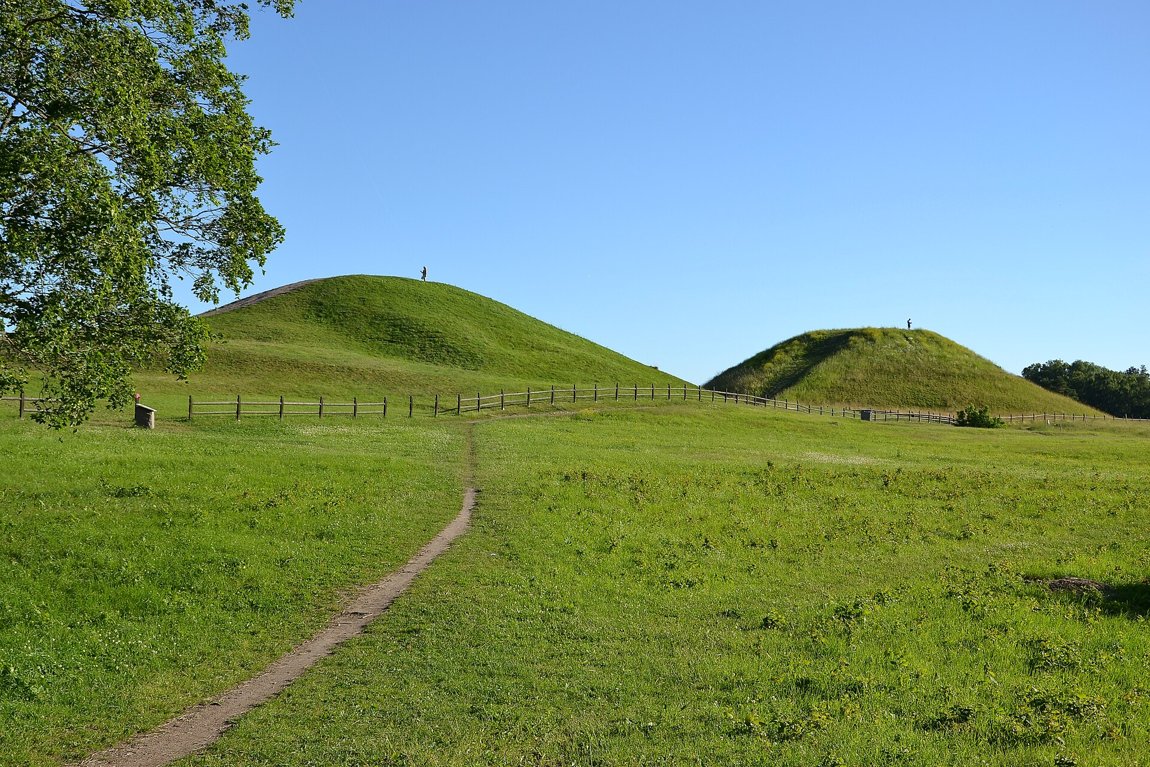
This passing scene shows, first, that the narrator saw Þorgrímr as a regular sacrificer to Freyr, not a one-time host. Second, it links Freyr with the burial mound, a motif we also know from Snorri’s Ynglinga saga: there Freyr dies as king at Uppsala and is laid in a mound, and the Swedes go on paying him tribute because good years and peace continue. Third, it is a story about the boundary between summer and winter: the god of fertility keeps the frost away from his worshipper, quite literally beyond death.
No ritual should be deduced from this. But the scene shows how thirteenth-century Icelanders imagined the relationship between a sacrificer and his god: as a friendship based on reciprocity, one that extends to the seasons. How such ideas connect with the cult of the dead is covered in our article on ancestor veneration at Yule, which also discusses the mound kings.
The second major saga scene is set not in Iceland but in Norway. Víga-Glúms saga, probably written in the thirteenth century and set in Eyjafjörður in the north of Iceland, tells in its sixth chapter how young Glúmr Eyjólfsson sails to Norway to visit his grandfather Vigfúss. Vigfúss is a powerful man in Voss, in the hinterland of Hordaland. The welcome is cool. Glúmr sits silent most of the time, and nobody thinks much of him.
Whenever the others were drinking or amusing themselves, Glúmr would usually lie there with his cloak pulled over his head. Then autumn comes. The text says that at the Winter Nights a feast was prepared there and a dísablót held, a sacrifice to the dísir, and that everyone was to take part in this commemoration – minning. Sir Edmund Head’s translation of 1866 renders this, very freely, as “a sacrifice to the gods” at the beginning of winter. Glúmr stays away from the sacrifice: he sits in his place and does not go. When people have sat down at table, word comes that a feared man has arrived at the farm with eleven companions – Björn, called Iron-skull (járnhauss), a berserk who goes looking for trouble and challenges the men on the benches. When he reaches Glúmr, the young Icelander leaps up and stands against him; the scene ends with the berserk humiliated. From then on the grandfather sees his grandson with different eyes.
Three things matter for our subject. First, the feast is explicitly dated to the Winter Nights. Second, it is a dísablót, so it is directed not at Freyr but at female guardian powers whose nature is disputed – kin mothers, women of fate, spirits of fertility. Third, the feast is compulsory: everyone is to come. A great farm gathered its people, neighbours and guests at this time. More about the dísir and their sacrifice in our article on the dísir.
The scene contains one more thing that is easily overlooked: Glúmr takes no part in the sacrifice, and nobody holds it against him. Like Gísli in his saga, he stands at the edge. The sagas were written by Christians and often portray their heroes as having only marginal contact with the old cult. That Víga-Glúms saga knows a temple of Freyr elsewhere – in Head’s translation “south of the river at Hripkelsstaðir” – shows that its narrator otherwise takes the cult quite seriously.
A scene from Egils saga Skallagrímssonar is often mentioned in the same breath as Voss. In chapter 44 young Egill and his companion Ölvir come to the island of Atley off the Norwegian west coast. There Bárðr manages a farm for King Eiríkr Bloodaxe. That same evening the king and Queen Gunnhildr arrive, ok skyldi þar vera dísablót, “and a dísablót was to be held there”. There is heavy drinking, Bárðr hands Egill a horn of poisoned ale, Egill cuts his palm, carves runes on the horn, colours them with his blood – and the horn shatters. By the end of the evening Egill has killed the steward. The full story is told in our article on Egill Skallagrímsson.
The chapter, however, does not support a dating to the Winter Nights. In the text as it could be checked for this article, the word vetrnætr does not occur; the season is not named. That the Atley feast was a Winter Nights feast is therefore an assumption, not something the source says. This matters, because the dísablót in Sweden – the Disting at Uppsala – fell, according to later testimony, in late winter, around February. Dísablóts were evidently held at different times. A dísablót is not automatically a Winter Nights sacrifice.
The most famous description of a sacrifice in Old Norse literature again comes from Snorri, this time from Hákonar saga góða, the saga of King Hákon the Good of Norway, who ruled around the middle of the tenth century. Hákon had been brought up a Christian at the court of King Æthelstan in England, and he tried to bring Norway to Christianity. The farmers of Trøndelag, led by Earl Sigurðr of Hlaðir (today Lade near Trondheim), would have none of it. Who Hákon was is told in our article on Hákon the Good.
In a chapter of its own, headed “Of the sacrifices” in Samuel Laing’s translation (1844), where it is numbered 16, Snorri describes how a great sacrificial feast was conducted. It was an old custom for all the farmers to come to the temple and bring food and drink with them. Cattle were slaughtered, and horses too. The blood was called hlaut; it was caught in bowls and sprinkled with twigs, the hlautteinar, onto the altars, the walls and the people. The meat was boiled in cauldrons over fires burning in the middle of the floor. The host blessed the cups, and then the drinking began: first Odin’s cup for victory and the king’s power, then the cups for Njörðr and Freyr til árs ok friðar, for a good year and peace, then the bragafull, over which vows were made, and finally the memorial cups for dead kinsmen. At this point Laing’s translation mistakenly turns Freyr into Freyja.
Two chapters later comes the scene that concerns us here. In autumn, as winter approached, a sacrificial feast was held at Hlaðir, and the king had to attend. Laing translates the time reference as “in harvest time toward the winter season”; whether the Old Norse wording explicitly names the Winter Nights at this point could not be checked against the original for this article. Hákon sits on the high seat, Earl Sigurðr blesses the first cup in Odin’s name and hands it to the king. Hákon makes the sign of the cross over it. The farmers grumble; the earl calms them: the king is doing what all who trust in their own strength do – he is hallowing the cup to Thor with the sign of the hammer. The next day the farmers demand that the king eat horse meat. He refuses. They settle on a compromise: he opens his mouth over the cauldron from which the steam of the horse broth rises. Neither side is satisfied. At the next feast, at Yule in Mære, Hákon is then made to actually eat some of the horse’s liver.
The scene is superbly told and certainly not an exact record. Snorri wrote it nearly three centuries later, and he needed it to make the clash between a Christian king and a heathen farming community tangible. For our subject it is revealing all the same: it shows the autumn sacrifice as a political event. Whoever did not drink placed himself outside the community. How such a sacrifice unfolded, as current scholarship sees it, is discussed in our article on Germanic sacrifice.
A second autumn scene from Heimskringla takes place some seventy years later, under Olaf Haraldsson, later the Saint. In Laing’s numbering these are chapters 113 and 115 of Óláfs saga helga. In autumn the king learns that the farmers of inner Trøndelag held a great feast on the eve of the first day of winter, with many people and much drinking. He is told that the memorial cups were hallowed to the Æsir in the old heathen manner, that cattle and horses were slaughtered, the altars reddened with their blood and prayers made for good seasons. People were also saying, he hears, that the gods were angry because the people of Hålogaland had become Christians.
The king summons the leading men. Ölvir of Egge, a powerful man of distinguished family, speaks for them. His defence is a small masterpiece: these were the usual autumn feasts, friendly gatherings and drinking among friends; what drunkards and fools said on such occasions no one could prevent. The king lets the farmers go. The following spring his steward informs him that sacrifices are still being made in Trøndelag: it is the custom there to hold one sacrifice in autumn, a second at midwinter and a third in summer, and twelve men preside over these feasts; this year it is Ölvir who is hosting the spring feast. Olaf sails with his ships to Mære, surrounds the house at night and has Ölvir killed. Laing dates this to the year 1021.
For the Winter Nights the first scene is the more important. Here we have an autumn feast, explicitly placed at the start of winter, with animal sacrifice, blood consecration and toasts – and at the same time the defence that it was nothing but sociability. A Winter Nights feast could be sacrifice and banquet at once, and anyone standing before a Christian king stressed the banquet. The threefold division the steward describes is the same as in Ynglinga saga – written by the same author. That it occurs twice does not make it twice as certain; it shows how firmly Snorri believed in this scheme. The king himself is the subject of our article on Olaf the Saint.
According to the sagas, the Winter Nights were also a dangerous time, when beings moved about that were otherwise unseen. The most striking example is a short tale preserved in the manuscript Flateyjarbók (late fourteenth century) within the great saga of Olaf Tryggvason: Þiðranda þáttr ok Þórhalls. A Winter Nights feast is held at the farm of the chieftain Síðu-Hallr in the east of Iceland. The seer Þórhallr warns that no one must go outside that night, even if there is knocking at the door. Hallr’s son Þiðrandi, eighteen years old, thinks it rude to leave guests standing outside and opens the door at the third knock. Outside he sees nine women in black clothes with drawn swords riding in from the north, and nine in bright clothes on white horses from the south. The black women reach him first. In the morning he is found mortally wounded.
Þórhallr interprets the women as the family’s fylgjur, its guardian spirits: the black ones belonged to the old faith and demanded a sacrifice before the new faith arrived; the bright ones had wanted to help Þiðrandi but could not yet do so. The tale is a Christian conversion story set shortly before the year 1000; the Dutch historian of religion Jan de Vries saw in it the testimony of a time when the old ideas had already grown blurred. For the Winter Nights it shows that, in the narrator’s imagination, a household feast at this season was connected with dísir who could demand blood. We discuss it at greater length in our articles on the dísir and on fylgja and hamingja.
The second piece of evidence is older and the only one from a contemporary. Around 1018/19 the skald Sigvatr Þórðarson travelled to Sweden on behalf of Olaf the Saint and recorded his experiences in the Austrfaravísur. At several farms he was turned away because an álfablót, a sacrifice to the elves, was taking place. One housewife blocked his way and declared that the house was holy; she feared Odin’s wrath. The verse mentions autumn, and the scholar Jonas Wellendorf considers the Winter Nights the most likely time. The details, and the question of who the elves were, are covered in our own article on the álfablót; here it is enough that in Sigvatr’s day the autumn sacrifice was evidently a matter for individual farms, which closed their doors.
So the Winter Nights did not centre on a single power but on several, all connected with fertility, household and kin. Kormáks saga also knows a sacrifice to the elves at a mound to bring healing, with no reference to the Winter Nights. Whether these different names hide a single festival called differently from region to region and farm to farm, or whether they really were different sacrifices, cannot be decided.
The sagas often use the Winter Nights as a date for entirely worldly business. In Gísla saga people play knattleikr at this time, a rough ball game with bats in which bones were broken and feuds began; Eyrbyggja saga has Snorri goði hold a Winter Nights feast in autumn at his farm on Snæfellsnes. Vatnsdæla saga and Gunnlaugs saga place weddings at the Winter Nights; Valla-Ljóts saga speaks of the “third Winter Night”, which points to a feast lasting several days. The folklorist Terry Gunnell, who teaches in Reykjavík, gathered these passages in a widely cited article (“The Season of the Dísir”, 2000) and interpreted the Winter Nights as a time especially associated with female powers, prophecy and fertility – a stimulating reading, given here on the basis of summaries of his argument.
The dreams fit this picture. In the nights before Vésteinn’s death Gísli dreams heavily and at first refuses to say what he has seen; later he tells of a snake and a wolf that kill Vésteinn. In scenes like these the Winter Nights appear as a time when what is to come shows itself.
A glance across to England shows that splitting the year in two was no Icelandic peculiarity. The Anglo-Saxon scholar Bede reports in 725, in De temporum ratione (ch. 15), that the old English divided the year into summer and winter. They called October Winterfilleth, because winter began with the full moon of that month, and November Blodmonath, the month of sacrifice, because they dedicated to their gods the cattle that were to be slaughtered. This is some five centuries older than the sagas and written by a man who could still talk to people whose grandparents had been heathens. Bede does not, however, name a festival for the start of winter.
In Scandinavia the Winter Night survived as a legal date. According to summaries of the research, the Swedish Dalalagen permits hunting only in the winter half of the year, between the Winter Nights and the Summer Nights, and the Norwegian Gulaþingslög requires ale to be brewed for All Saints, shortly after the old start of winter. The Church, in other words, did not simply ban the autumn feast; it tied the obligation of festive ale to a Christian date.
A Winter Nights feast cannot be dated in the ground; slaughter waste is a better prospect. At the farm of Hofstaðir by Lake Mývatn in northern Iceland, excavators led by Gavin Lucas and Thomas McGovern found the skulls of at least 23 cattle with marks of blows and decapitation, which had apparently been displayed on the great hall building; they interpret this as a recurring, seasonal sacrificial practice tied to feasts and assemblies (European Journal of Archaeology, 2007). Beneath the church at Mære in Trøndelag, where Snorri sets the Yule feast and Ölvir’s end, excavations in the 1960s uncovered small gold-foil figures pointing to a pre-Christian cult site. Both attest to sacrifice and cult places, but not to a calendar: whether the Hofstaðir animals died precisely at the Winter Nights is something the bones do not clearly tell. More on such sites in our article on blót sites.
The closeness in time to the Irish Samhain on 1 November and to All Saints and All Souls invites people to equate them. What they share is a turning point in the pastoral year, the slaughter season and, in the later stories, a sense that the uncanny draws nearer at this boundary. But the sources are separate: we know Samhain from Irish literature and the Winter Nights from Icelandic literature, and no dependence between them can be shown. All Saints, for its part, is a Roman feast whose date of 1 November is older than the conversion of the North and cannot be derived from it. The similarities are most simply explained by the same farming year. Our article on Samhain has a section devoted to this comparison.
Laid side by side, the passages give a picture with clear lines and blurred edges. The Winter Nights were a fixed threshold in the year at which substantial farms held feasts. The sources connect sacrifices to various powers with this threshold. A festival with a single name, a fixed sequence and one particular deity is something they do not show.
Three questions above all remain open: whether the feast was tied to the moon before the conversion, as Nordberg supposes; whether dísablót, álfablót and the sacrifice to Freyr were different festivals or different names for the same date; and how much the saga writers of the thirteenth century still really knew.
For present-day heathen communities the Winter Nights are a fixed point in the year. The Icelandic Ásatrúarfélagið, founded in 1972 and officially recognised since 1973, holds a blót at the start of winter; the American organisation The Troth lists “Winter Nights” as a festival of its own. Celebrations usually take place around the Icelandic first day of winter or in mid-October, often with thanks for the year and remembrance of the dead – a modern elaboration that appeals to the sources but goes beyond them. Our article Ásatrú today gives an overview. Our workshop in Alsdorf makes laser-engraved Norse motifs on the theme.
When are the Winter Nights? In the Icelandic calendar they are the two days before the first day of winter, a Saturday between 21 and 27 October; in 2026 that meant 22 and 23 October. In Norway and Sweden the folk calendar used 14 October.
Who received sacrifices at the Winter Nights? The sources name Freyr (Gísla saga), the dísir (Víga-Glúms saga, Þiðranda þáttr) and the elves (Sigvatr). There is no single deity of the feast.
Is “Winterblót” an Old Norse word? No, it is a modern term. What is attested is vetrnáttablót, haustboð and the phrase at vetrnóttum.
How long did the feast last? Probably several days; Valla-Ljóts saga speaks of a third Winter Night. No text records a fixed length.
Is there archaeological proof? For sacrifices and cult sites, yes – Hofstaðir and Mære, for example. For the date of the Winter Nights, no.
Germanic festivals through the year · The old wheel of the year · The dísir · Álfablót · Freyr · Samhain · Ancestor veneration at Yule · Germanic month names · The Yule log and the Yule fire · Remembering the ancestors in the Twelve Nights
The Germanic feasts · Álfablót: the feast of the elves · The Dísir – guardian spirits of the kin · The old year's cycle up close · Jól – the Yule feast.
All Festivals & Belief articles →
Between Christmas and Epiphany time seems to stand still, or at least it feels that way. Many families use these days …
Read more →At midwinter, it is often said, the dead draw near. Is that true for the age of the Vikings and the Germanic peoples? …
Read more →For our ancestors the year was no sheet on a wall but work: sowing, herding, harvesting, storing. The festivals sat at …
Read more →"Asatru" sounds ancient, yet as an organisation it is younger than many rock bands: the Icelandic association was …
Read more →