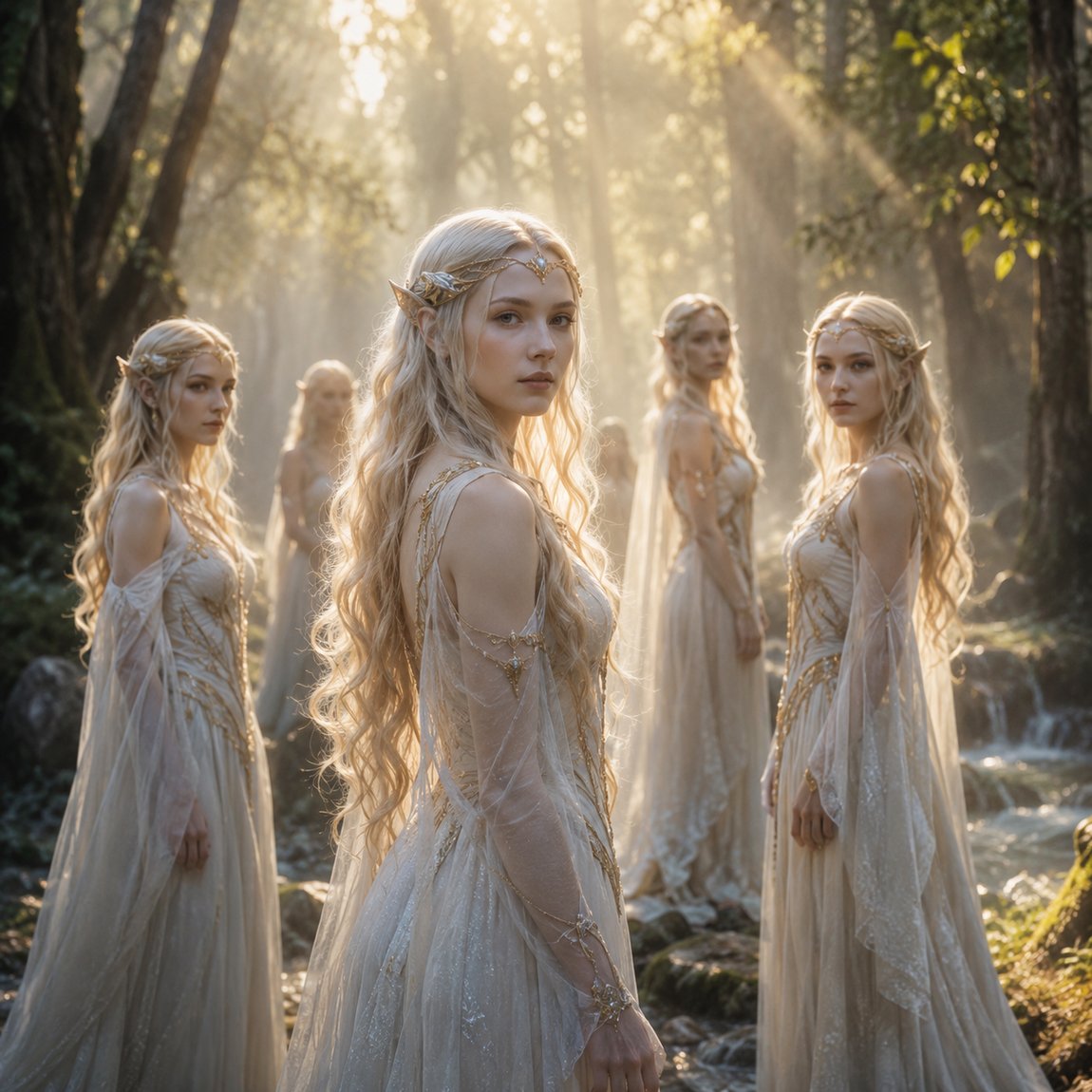
A Christian poet knocks at a door in Västergötland, and a woman sends him away: she fears Odin's wrath, they are heathens, and they are holding a sacrifice to the elves. Little else survives of the álfablót. This article checks what Sigvatr Þórðarson actually wrote, what Kormáks saga says, how far autumn, ancestors and secrecy are attested, and where modern scholarship only offers possibilities.
Álfablót means literally "sacrifice to the elves": álfar are the elves of Old Norse tradition, blót is the sacrifice and, more broadly, the sacrificial feast. Anyone looking for this feast finds surprisingly little. There is no description of the rite, no mythological poem that explains it, no calendar entry and no archaeological find that can be tied to it with confidence. I know of none; that holds for the texts I read for this article and is no claim about every excavation.
What remains are two passages. One is a stanza by the Icelandic poet Sigvatr Þórðarson from about 1019 (a date I give after English Wikipedia; I have not checked it in an edition). The other is a scene in Kormáks saga, an Icelandic saga written down long after the events it narrates. The two passages do not describe the same event, although the literature often merges them into a single "álfablót". That merger is one of the problems of the topic, and this article follows it.
For the wider background see Germanic religion, Germanic sacrifice and the places of blót. Here the subject is this one feast.
Sigvatr Þórðarson was an Icelandic skald (court poet in the tradition of Old Norse praise poetry) in the service of King Óláfr Haraldsson of Norway, later Saint Olaf. More on that king is in our article on Olaf the Saint. According to Wikipedia, the king sent him with a delegation to the court of the Swedish king Olof; the mission led to a reconciliation of the two kings and to Óláfr's engagement to the Swedish princess Astrid. I have read this only in that summary.
The poem of this journey is called Austrfaravísur, "verses of the eastern journey". It is composed in dróttkvætt, the courtly skaldic metre with strict alliteration, internal rhyme and kennings (circumlocutions such as "sea of wounds" for blood). Maria Cristina Lombardi describes it in 2023 as a loose sequence of 21 stanzas; the standard edition is by Russell D. Fulk (2012, in Poetry from the Kings' Sagas 1, ed. Diana Whaley, pp. 578–614). The tone is not solemn but caustic. Sigvatr describes a wearying journey, poor lodgings and unwelcoming hosts, and he enjoys the mockery.
A word on transmission: the stanzas stand within the tradition of the kings' sagas, prose works that came later and quote the verses to support their narrative. The prose frame is therefore not the same as the poem. Jonas Wellendorf points out in his 2022 study that the prose tells of the journey over two nights, while the stanza speaks of a single evening. To read the stanzas cleanly, one separates verse from saga prose.
Sigvatr and his companions are on the way to Sweden, cross the border forest and reach settled land in Västergötland. In Wellendorf's arrangement (stanzas 4 to 8, as ordered in Skj and in Fulk; English Wikipedia gives only stanzas 4 to 6 for the álfablót verses) four stations can be distinguished.
The first is a farm called Hof. In Old Norse the word means "temple" or "cult building"; Wikipedia considers modern Stora Hov near Edsvära the probable site, but this is not certain. The door stays shut. The people say the place is holy, and Sigvatr wishes ogres upon them. At the next farm a woman tells him not to go further, says she fears Odin's wrath, says they are heathens, and drives him off "like a wolf". That an álfablót is going on inside is stated in the same passage, according to Wikipedia in Sigvatr's description of the woman, not in her direct speech. Her speech reads, per English Wikipedia: "Gakkat inn," kvað ekkja, "armi drengr, en lengra; hræðumk ek við Óðins – erum heiðin vér – reiði." I have not seen the stanza text in an edition myself. In free rendering: Do not go further in, said the woman, poor fellow; I fear Odin's wrath, we are heathens.
Third station: three men who all call themselves Ǫlvir turn him away. Fourth: the man reputed to be most hospitable scowls and offers nothing. Sigvatr remarks bitterly that if this is the best, the worst must be dreadful. Wellendorf also treats a stanza in which an "unchristian" man turns him away four times in a single evening. How these scenes fit the farms, and how many farms there were, is given differently in different accounts; Wellendorf himself concedes that the sequence could be read another way.
What matters is what this material does not supply. It tells of no act of sacrifice. Sigvatr stays outside the door. All we "know" of the feast is that it is supposed to be taking place indoors, that it has to do with elves, and that strangers, or at least this stranger, are not admitted.
The word ǫl means "ale", and the name Ǫlvir contains that element. English Wikipedia connects this with an observation: during the rites the master of the house was called Ǫlvir, and the lady of the house conducted the sacrifice. I cannot tie that statement to a primary text. Wellendorf reads the name differently: as a possible pun on ǫlværr, "friendly", and perhaps as a dig at an Ǫlvir á Eggju (I leave open whom exactly). The joke would then be that men named "ale-friendly" show no hospitality at all. Both readings are possible; what is attested is only that men named Ǫlvir appear in the stanza. That Ǫlvir was a title for hosts at the álfablót is an inference, not evidence.
The second passage is in Kormáks saga, the story of the Icelandic poet Kormákr and his unhappy love for Steingerðr. I read it in the English translation by W. G. Collingwood and Jón Stefánsson (Project Gutenberg), but only through a retrieval tool that returned excerpts and summaries. It is chapter 22.
The background: Thorvard, Steingerðr's husband, was wounded in a fight with Kormákr and heals slowly. He turns to Þórdís, a spákona (seeress, soothsayer). She names a nearby hill where elves dwell. He should take the bull that Kormákr killed, redden the outside of the hill with its blood and prepare a feast for the elves from the meat. Then he will be healed. Kormákr will sell the bull only in exchange for Steingerðr's ring; the other side agrees, and Steingerðr is furious. Chapter 23 reports that Thorvard was soon healed afterwards; whether the saga explicitly credits the sacrifice, I could not establish with certainty from the excerpt.
"A hill there is, not far away from here, where elves have their haunt."Kormáks saga, ch. 22, W. G. Collingwood and Jón Stefánsson, English translation (public domain)
It is worth seeing how different this is from Sigvatr's scene. There is no seasonal reference, no household behind a closed door and no ban on strangers. It is a single healing sacrifice for a sick man, advised by a specialist, at a particular place. Nor can I attest the word álfablót for this scene; the translation speaks of a "feast for the elves", and whether the original uses the term I did not check. English Wikipedia nevertheless cites the scene as a second support for the álfablót and itself notes that it is not tied to a season.
A side glance: healing sacrifices, hills and wise women belong to the circle described in our article on seiðr, and the saga as a genre is introduced in this piece. What remains important: a thirteenth-century saga (the dating is not freshly checked here) tells of a time well over a century earlier. It may preserve customs, but it may also shape the picture its own age had of the heathen past.
Strictly speaking only Sigvatr supplies a case that is called álfablót. Kormáks saga offers an elf sacrifice without that label, as far as I could see. From both, scholarship and especially popular literature built an annual festival. That is a typical process: when sources are thin, later accounts fill the gaps from neighbouring evidence, such as the dísablót (sacrifices to the dísir, female protective beings; see our article on the dísir) and from the general image of an autumn feast.
Wellendorf puts it cautiously: the evidence for a particular feast associated with ancestral alfar seems "fragile" (p. 481). This is not a quarrel over details. Anyone who presents the álfablót as an established ancestor feast turns an assumption into a fact.
The timing is the best-supported detail, yet it too hangs on few threads. Wikipedia names late autumn after the harvest, when the animals are fattest; the page gives no primary source for this in what I could read. Wellendorf argues more precisely. He considers the vetrnætr, the "Winter Nights", the most likely time (p. 481). His reasons: the first stanza mentions autumn (at hausti), and the prose places the journey at the beginning of winter. The Winter Nights were in the Old Norse year the turn from the summer to the winter half, a multi-day festival; in our calendar this falls roughly in the second half of October (that date is unchecked).
For comparison Wellendorf draws on the dísablót as it appears in Víga-Glúms saga, Egils saga and the short tale "Af Þiðranda ok dísunum". There we see a festival without central direction, celebrated at individual farms. That fits Sigvatr's experience at several doors in a row. It is a plausible link, not an equation. Whether álfablót and dísablót coincided in time or were merely organised alike, the sources do not say.
For the Norse year see our article on Yule and on ancestor veneration at Yule. An autumn connection for the álfablót is well founded; a dated feast day does not exist.
The impression of a "secretive feast" goes back to Sigvatr's scene: a traveller is not let into the house while a sacrifice is under way. Older scholarship turned this into a rule. For this line Wellendorf names Jan de Vries (1932), who linked the álfablót with a feast of the dead and took it for private and closed, and Neil Murphy (2018), who reads it as a domestic, sacrally charged event connected with ancestral spirits.
Wellendorf disagrees. He grants that there may have been rites in the house, but doubts that the privacy of the ritual was the reason for the refusals. The most straightforward explanation, he argues, is Sigvatr's Christianity: a baptised stranger would violate the sanctity of the place or the feast. The images in the poem fit. The woman fears Odin's wrath, not the elves'. And the comparison with the wolf recalls the vargr í véum, the "wolf in the sanctuaries", the lawbreaker who stays in a consecrated place. The farm is also named Hof, which may point to a cult site; Wellendorf follows Magnus and Olaf Olsen, for whom the hof was a place of public cult.
Two things must therefore be kept apart. That Sigvatr was not allowed in is attested. That the álfablót was a fundamentally secret feast meant for the household alone does not follow necessarily. Hospitality adds to this: sheltering travellers was a duty and an honour, which is exactly why the refusals in the poem are so pointed. They are material for the poet's mockery, and mockery exaggerates.
Wellendorf offers a further line of interpretation with the distinction between orthopraxy and orthodoxy. Norse religion, he suggests, was concerned above all with correct action, Christianity more with correct belief. For the woman at the farm the problem is then not an unbaptised guest as such but a guest whose presence could disturb the ritual. That is an interpretation, not a source.
The equation "elves equal ancestors" stands in many accounts as a fact. In the sources it does not. The álfar of the Old Norse texts are a blurred group. In Eddic literature they appear beside the Æsir as a group belonging to the gods; according to Grímnismál Freyr receives Álfheimr, "elf world", as a tooth-gift, and Snorri distinguishes light elves from dark elves in his Edda. I cite these Eddic passages from general familiarity with the texts; for this article I did not look them up again in full. On the dark elves and Álfheimr see the article on Svartalfheim and the one on Freyr.
Wellendorf collects the scholarly positions. Gunnell links Ǫlvir and the elves with the Vanir, Kuhn takes the álfar to have been originally closer to the gods, Hall places them with the Æsir, and Ármann Jakobsson understands them as a wide category of "paranormal others". Anyone interested in the Vanir will find background in our piece on the Vanir. Wellendorf himself regards the category as unstable and the sources as contradictory and thin. A metrical reason may even have shaped the wording: alfablót alliterates and rhymes with ulfi, "wolf". That would mean Sigvatr chose the word partly because it sounded right in the verse, not only because he knew a cult name. This is a possibility, not proof.
For the ancestor interpretation speak the Kormáks scene (elves live in the hill; whether graves were in mind the text does not say), the proximity to the dísablót and de Vries's feast-of-the-dead thesis. Against a simple equation speaks that neither passage calls the elves dead people and that Sigvatr's woman fears Odin. "The álfar were the venerated dead of the family" is thus a hypothesis compatible with the sources, but no more.
Summing up what the literature I read offers, three camps emerge. The first reads the álfablót as a private household feast for ancestral and fertility powers (de Vries, Murphy; for the related dísablót also Gunnell). The second holds that feasts of this kind were rather public or at least communal (Sundqvist and Vikstrand for the dísablót, Magnus and Olaf Olsen for the cult at the hof). The third, represented by Wellendorf, sees in Sigvatr's scene above all a testimony to the conflict between the old religion and the mission. The papers I used are Wellendorf 2022 in the Religionsvidenskabeligt Tidsskrift and Lombardi 2023; Fulk's edition I know only through references.
A brief look at the present: some modern heathen groups celebrate an álfablót in autumn, usually as a small feast among family or group. Such celebrations are reconstructions on a narrow source base, which does not reduce their value for the participants but should not be mistaken for historical knowledge. An introduction to the practice is this article on blót and sumbel today.
What does álfablót mean? Literally "sacrifice to the elves" (álfar plus blót). As a feast it is attested only in one stanza of Sigvatr; Kormáks saga knows an elf sacrifice of a different kind.
When was the álfablót held? The sources point to autumn and the start of winter, in Wellendorf's view most likely the Winter Nights. No fixed date is recorded.
Were the elves ancestors? That cannot be clearly proven. The interpretation is widespread and plausible, but no source says it, and other scholars place the álfar nearer the gods.
Why was Sigvatr not allowed in? Accounts differ on this. Either the feast was a closed household rite, or a Christian was unwelcome in the consecrated space. Wellendorf prefers the second explanation.
Are there archaeological finds for the álfablót? I know of no find that can be tied securely to this feast.
The dísir: female protective beings · Ancestor veneration at Yule · Germanic sacrifice · Places of blót · The Vanir · Svartalfheim · Olaf the Saint · Icelandic sagas

The Dísir – guardian spirits of the kin · Ancestor veneration at Yule · Blot Sites: Horgr, Hof & Cult Hall · Olaf the Saint · The Icelandic Sagas.
All History & Finds articles →
The Allobroges lived between the Rhône, the Isère and the Alps, beside one of the busiest roads of the ancient world …
Read more →"Vikings died at thirty" circulates widely, and in that form it is wrong. What can be shown is less dramatic and more …
Read more →An army shouts its own name, and from the far bank the word comes back. That is how Plutarch opens the battle of Aquae …
Read more →