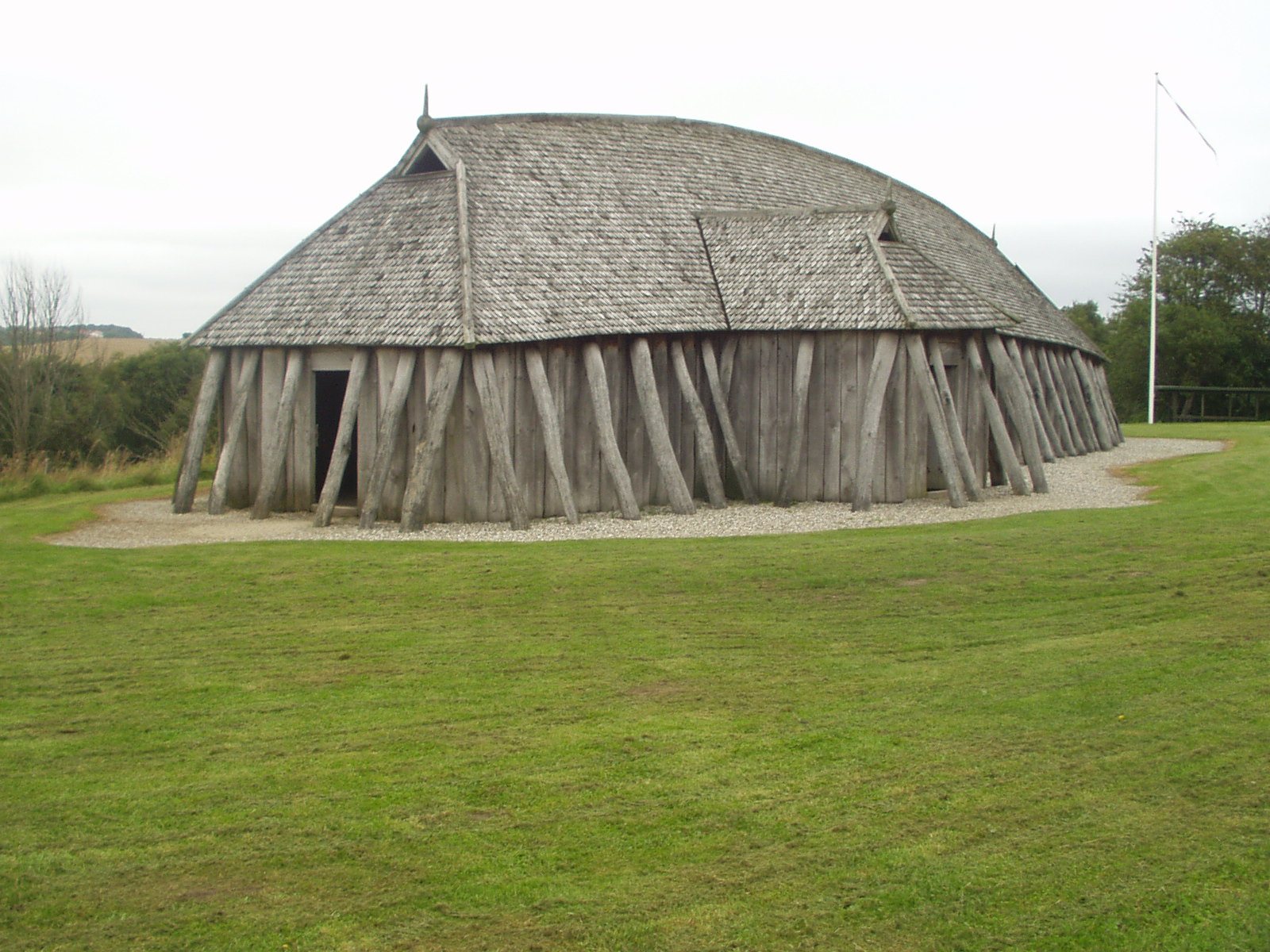
Some people in Iron Age and Viking Age Scandinavia walked over human bone every day. The dead lay in postholes, hearths and wells, and burial grounds had doors that led into no house at all. The archaeologist Marianne Hem Eriksen has built a new view of Norse domestic life from such finds. This article sets out what was found, what the sagas tell, and where interpretation begins.
Postgården in northern Jutland, a longhouse of the Pre-Roman Iron Age. Between two floor phases of the house lay part of the frontal bone of a boy aged two to four, his sex established genetically. The bone carries a sharp-force injury from around the time of death. An earlier osteological report suggested a sword or similar heavy-bladed weapon, and Eriksen speaks to the press of a sword cut. Radiocarbon dating then produced something odd: the bone is about 200 years older than the relative date of the house. Someone evidently kept this piece of a child for generations and then built it into a floor that people went on living on. "This means that someone has walked over a child's skull day after day," Marianne Hem Eriksen told the press.
The case comes from a study she published with five colleagues in autumn 2026. One caveat belongs right at the start: this boy was no Viking. He lived long before the Viking Age, and headlines that place his skull under a "Viking house" shorten the story. He still belongs here, because the practice of bringing the dead and parts of the dead into the home runs across more than a millennium and reaches into the Viking Age, with finds of its own.
Viking studies long looked to the sea and the great graves: ships, trade, warriors. Eriksen, now a research professor at the National Museum of Denmark, starts somewhere else, at the door. Her book Architecture, Society, and Ritual in Viking Age Scandinavia: Doors, Dwellings, and Domestic Space appeared with Cambridge University Press in 2019. It is the first synthesis of the Late Iron Age and Viking Age house remains of Norway, and its appendix lists the sites. The central claim is that domestic space was never neutral. Doors governed who came in and how people moved, and they were also objects of ritual. Daily dealings with them helped to produce the social order.
A 2020 review roundup in Antiquity praised the theoretical framework and said the book overturns the claim that settlement evidence cannot answer such questions. I could not read the full text of the book for this article, as it sits behind a paywall. What appears here rests on the table of contents, the publisher's description, that review and Eriksen's own papers and articles. How a longhouse was built and furnished is covered in our article on the Viking longhouse. This one deals with what the floor plans leave out.
Eriksen describes the Viking Age household as a mixed group: a couple, perhaps with concubines, subordinates, farmhands, warriors, itinerant workers, guests, livestock and children of several unions. Some sat in the high seat and others slept among the cattle. Some scholars argue that unfree people lived in a side room with its own hearth at the byre end of the longhouse. That is an interpretation and no universally attested floor plan. Eriksen points to the telling name Fjósnir, "of the byre", borne by one of the thrall's sons in the eddic Rígsþula. More on the unfree is in our article on Viking Age slavery.
In such a house, the door decided more than the draught. Which entrance you used, how far in you might go, whom you had to pass: all this made rank a bodily, daily experience.
The new study, "Broken Bodies in Domestic Spaces", appeared in the Journal of Archaeological Method and Theory in 2026. Its authors speak of an "atypical" mortuary dataset: around 192 unburnt individuals from 197 contexts, including longhouses, pits, wells, postholes, hearths, floors, yards and feasting halls. Most survive only as single bones or partial skeletons, or are foetal and infant remains. Only about 23 look like ordinary inhumations. The paper's abstract and introduction give the period as about 500 BCE to 1050 CE, its dataset description as up to 1100; videnskab.dk begins it in the Late Bronze Age, so the accounts differ here.
The team examined 123 of the finds osteologically and assessed the other 74 from excavation and archive reports. Such bones used to be easy to explain away as stray remains, or as older graves that a later house happened to hit. The videnskab.dk report gives the counter-position like this: the pattern repeats systematically across hundreds of settlements, and the living deliberately dwelt beside the dead. The paper itself is more cautious and warns against assuming one explanation for the deposits. In any single case this is harder to decide.
Our overview of Viking Age burial describes the cemeteries, mounds and ship graves. These dead are missing from that picture, and that is exactly Eriksen's argument: cemeteries show only part of a population.
Twelve of the individuals carry 19 injuries between them, sustained before or around death. Six had head trauma and four had multiple injuries. The authors judge that at least eight probably suffered deliberate violence, while the cause is less clear for the other four. Only two of the twelve date from the Viking Age:
At Sønder Tranders in northern Jutland, a man of 25 to 35 lay in a Roman Iron Age pit with two cuts on his eleventh rib and possibly bound wrists. At Tokkendrup on Funen, a male cranium with two blunt-force injuries came from a pit full of horse bones, which suggests a horse sacrifice. Uppåkra in Scania produced a piece of shoulder blade with a penetrating wound, probably from behind, which ended up in a posthole of the hall.
The authors weigh three explanations that need not exclude one another: warlike violence, violence within the community, and ritual violence up to possible human sacrifice. They add the idea of "slow" violence: the man from Lejre, for instance, may have been a repeated victim over years. Much remains uncertain, as the authors say themselves. The material is fragmentary, and some injuries may come from accidents or post-mortem handling.
Objections came at once, in the first report on the study. The Danish archaeologist Pernille Pantmann of Museum Nordsjælland, who was not involved in the study, told videnskab.dk that some 180 individuals show no clear signs of violence, that the most macabre finds paint too dramatic a picture of the Iron Age, and that injuries could just as well come from accidents or work. She points to other motives for the deposits: ancestor veneration, family remembrance, even the practical reuse of bone as tools. The boundaries between settlement, grave and offering site, she suggests, were probably far more fluid than assumed. Eriksen replies that even a few cases matter, since these stories were almost unknown. The study is new and the debate has only begun.
The most delicate part of this material concerns the smallest dead. In 2017 Eriksen examined, in World Archaeology, children deposited in settlements and wetlands in the first millennium CE. According to a report on sciencenorway.no, this involved 52 infants and children, found in ditches, beside hearths or in postholes inside houses. Eriksen speaks of deposits, because they do not seem to have been buried in the usual sense.
The paper bears the provocative title "Don't all mothers love their children?". It challenges the older reading that grieving mothers wanted to keep dead babies close. Eriksen asks whether infants were seen as animate objects more than as full human beings until social acts made them persons. A deposit in the house would then take on another meaning, as one gift among others, like silver, grain or tools, meant to bring protection or prosperity. That is a question and a hypothesis, not a finding. The cause of death usually cannot be established: stillbirth, premature birth, sudden infant death and infanticide are all possible. Eriksen herself says it is hard to know.
The written sources know the exposure of newborns, as our article on Viking Age children shows. That does not mean an infant in a posthole was killed. Newborns rarely appear beside women in cemeteries either: a 2025 study by Eriksen, Olley, Marshall and Tollefsen counted only 14 reported possible mother-infant burials among thousands of Viking Age graves.
Human bones are only the most lurid part of a wider custom. In a paper of 2005, the archaeologist Ann-Britt Falk defined the building offering as an artefact placed in or under a building and sealed by the continuing construction. For first-millennium southern Scandinavia she recorded finds from every period: 38 from the Roman Iron Age, 2 from the Migration Period, 5 from the Vendel Period and 19 from the Viking Age. This says little about true frequency, she warns, since the thinly represented periods have simply seen less excavation.
Deposits went mainly into the postholes of roof-bearing posts and the entrance area. Most were modest: animal bones, pottery, tools. There are exceptions such as silver arm rings and guldgubber, the tiny gold-foil figures. At Slöinge on the Swedish west coast, a house dendro-dated to 710 held a large concentration of finds in the north-west corner of its hall, with gold-foil figures, loom weights, glass and animal bones among other things, although they come from the upper layer, probably a floor, so that Falk thinks they were mixed into it more than buried. In Falk's material, weapons occur only in Viking Age fortifications. The gateway of the Fyrkat ring fortress also held a deposit, and she lists two foundation sacrifices from the Birka garrison.
Falk's comparison is the interesting part. Descriptions of the cult of the Æsir in Old Norse texts barely match these finds: there, offerings are consumed or left in the open, leaving no such trace. The finds have more in common with folk belief of the 19th and 20th centuries, in which metal or animal bones went under thresholds and into postholes, and young animals were meant to protect a house for its lifetime. Falk concludes that building offerings belong to the sphere of family and farm more than to the great cult of the gods. A comparison across more than a thousand years remains an analogy. Falk herself calls folk belief no fixed world of ideas but a dynamic tradition, and the informants often hedged with phrases like "it was known to happen".
Eriksen has drawn attention to a group of Viking Age finds: pots, knives and iron rings buried in or close to doorways. She considers that they may have guarded the house against powers from outside. A second suggestion is that some objects came from an older house, perhaps at a marriage, and were placed in the entrance or a posthole to tie people and buildings together across time. Whether a knife by the door was magic or a lost tool has to be argued from the find in each case.
One find showing door and ritual close together comes from Uppåkra. In 2007 Lars Larsson described the timber ritual building at this central place. A bronze-and-silver beaker and a glass bowl were placed in the floor south of the central hearth. From the fill of the north-western roof post came an iron door ring about 15 centimetres across. Uppåkra, however, was no farmhouse, so everyday practice cannot be inferred from it.
In 2013 Eriksen published "Doors to the dead" in Archaeological Dialogues. It starts from the observation that people of the Viking Age built doors for the dead: freestanding portals, ring-ditches with a causeway, thresholds to burial mounds. On occasion they buried their dead in doorways. Eriksen assigns these doors three functions: they connected the dead and the living, they formed boundaries that could possibly be controlled, and they created in-between spaces that could also express deviance. Her conclusion is that the dwelling strongly shaped burial custom.
The paper's bibliography shows how old this trail is. It lists "Tür der Toten" by Arrhenius (1970), "Doors to other worlds" by Andrén (1993) and "Den döde vid dörren" ("The dead at the door") by Artelius (1999), on human bones in two longhouses in Halland. A paper on Birka by Holmquist Olausson (1996) is titled "Älgmannen under tröskeln", "The elk-man under the threshold". I know these works only from the bibliography.
The most famous written parallel comes from outside. The Arab envoy Ibn Fadlan watched the funeral of a Rus chieftain on the Volga in 922. The slave woman chosen to die was led to a structure resembling a door frame and lifted up three times by men. She looked over it and said she saw her parents, her dead kin and at last her master. Eriksen sets beside this a second, obscure text in which a lady of the house asks to be lifted "over hinges and door-beams" to see if she can save a sacrifice. I could not check which text she means against the original. Two scenes do not make a general rite, and Ibn Fadlan saw one single case far from Scandinavia, in a language he did not understand.
Eriksen's 2016 paper "Commemorating Dwelling" in the European Journal of Archaeology goes further. It treats seven house burials from five places: Högom and Brista in Sweden, and Ullandhaug, Jarlsberg and Engelaug in Norway. Burial mounds were raised over the remains of three-aisled longhouses there. Sometimes the inner posts were removed first, then the house burned, then came the mound. Sometimes the mound went up generations after the fire.
The striking point is that human remains are sometimes absent even where they should have survived. Eriksen infers that some of these mounds commemorated the house and no person. She wonders whether the burning was a kind of cremation that released a house's life force, and she draws comparisons from Madagascar and the Batammaliba of West Africa. This too remains a hypothesis. Parallels from other continents show what can be thought, not what was thought in Norway. What is firm is the labour a mound over a ruin required, and the fact that some mounds covered doorways, as if to close them.
This is where many accounts reach for the sagas, because there a dead man really does speak from the door. The 13th-century Laxdæla saga tells of the violent Víga-Hrappr, who gives his wife Vigdís an order on his deathbed:
"Now, when I am dead, I wish my grave to be dug in the doorway of my fire hall, and that I be put thereinto, standing there in the doorway; then I shall be able to keep a more searching eye on my dwelling."Laxdæla saga, ch. 17, trans. Muriel A. C. Press, The Laxdale Saga, London 1899 (public domain)
Vigdís obeys, the saga says, because she dares not do otherwise. Hrappr then walks, kills most of his servants, and the farm falls empty until he is dug up and reburied in a remote spot. The rest of the tale is in our article on the draugr.
Eyrbyggja saga, from the same period, offers the counterpart. When old Þórólfr bægifótr ("Twist-foot") sits dead in his high seat, his son Arnkell has the wall behind him broken through and takes him out by the gap (ch. 33). The public-domain translation by William Morris and Eiríkr Magnússon puts it briefly: "Then he let break down the wall behind him, and brought him out thereby." The dead man apparently is not to leave through the door. Later, in the Fróðá wonders (ch. 55), dead members of the household are driven out by a duradómr, a court held at the door. This was no stranger to the saga's world: back in chapter 18 a farmer holds just such a door-court at another man's house over stolen horses.
These stories are literature, written some three centuries after the time they depict, in Christian Iceland. John D. Martin showed in Saga-Book in 2005 that Eyrbyggja saga alone sets several different ideas of the revenant side by side. A Viking Age rite cannot be read off them. No direct link joins the saga account to the finds: I know of no archaeological find of a person buried upright in a doorway. The sagas prove that 13th-century Icelanders thought of door, dead and house together. That fits the far older bones remarkably well, but it proves no unbroken tradition.
The words in the headlines easily mislead. "Portal", "magic" and "human sacrifice" sound like certainty about intentions. What can be excavated, though, is a bone in a certain spot and not what someone was thinking at the time. Eriksen herself works with the idea of ritualisation: everyday acts and places gain special meaning through repetition and form.
"Uncanny" is also our word. Whether the inhabitants feared or treasured the skull in the floor we do not know. Eriksen sees both sides: the dead could be protective ancestors and also a cause of anxiety, so the boundary between them and the living needed watching. Either way, these people lived closer to their dead than present habits allow. How they imagined the afterlife is a separate question, taken up in our article on Viking ideas of death.
Were Vikings normally buried in the house? No. Cemeteries, mounds and cremation graves were the rule. Remains in settlements are a minority whose true share cannot be stated exactly, especially as children are underrepresented in the cemeteries.
What is a building offering? In Ann-Britt Falk's definition, an object, bone included, placed in or under a building and sealed by the continuing construction. Postholes and entrances were the usual places, often with quite everyday things.
Why the threshold in particular? The door governed who belonged. Eriksen reads it as an image of transition, boundary and in-between state, which made the threshold a natural place for protective acts. Why something was placed there in any given case cannot be clearly shown.
Do these finds prove the draugar of the sagas? No. They show a particular way of dealing with the dead in the home, and nothing about walking corpses. Belief in revenants can be grasped in writing for the 13th century and can only be surmised for the Viking Age.
Were people killed for these deposits? That is open. The 2026 study considers ritual violence possible in some cases, along with violence in war or within the community. Most finds lack any sign of violent death.
The Viking longhouse · The draugr · Viking Age burial · The bear in the North: claws in the grave and other traces · Ibn Fadlan on the Volga · Laxdæla saga · Uppåkra · Viking Age children · Germanic sacrifice

The Viking Longhouse · The Draugr – the walking dead · Viking burials · Beliefs about Death · Seiðr – the magic.
All Everyday Life & Craft articles →
Leather was the quiet everyday material of the Viking Age: under every step, on every belt, around every blade. Because …
Read more →The Mästermyr tool chest is the largest single tool find of the Viking Age: an oak chest turned up by a farmer's plough …
Read more →Mead is fermented honey wine – honey, water and yeast, nothing more – and one of the oldest intoxicating drinks in …
Read more →Few gemstones carry a name as poetic and as misleading as moonstone. It has nothing to do with the moon – and yet a …
Read more →