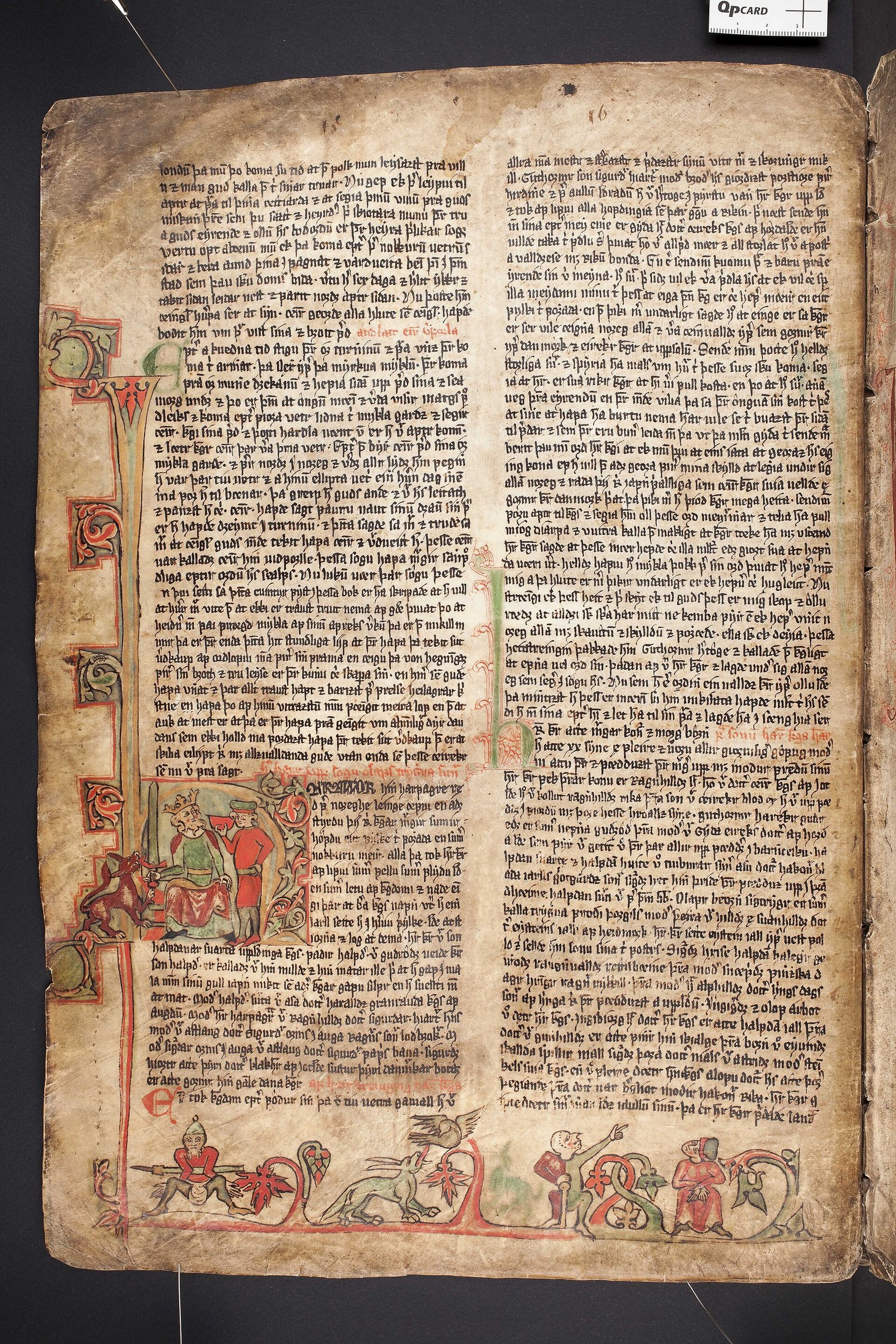
Flateyjarbók is the largest manuscript to survive from medieval Iceland: 225 vellum leaves in large format, written between 1387 and 1394 by two priests for a wealthy farmer in the north of the island. It consists chiefly of sagas of the Norwegian kings, with dozens of shorter tales inserted into them, together with annals, poems and genealogies. Some texts exist only here, among them Grœnlendinga saga with its voyages to Vinland and the eddic poem Hyndluljóð. This article treats the book as an object and as a source: who made it, what is in it, how it reached Copenhagen and came back to Iceland in 1971, and how far a compilation of the late 14th century can be trusted.
Most medieval Icelandic manuscripts say nothing about how they were made. The Codex Regius of the Poetic Edda, for instance, names neither scribe nor patron. Flateyjarbók is different. On the verso of its first leaf stands a preface that names the owner, Jón Hákonarson, and records that two priests wrote the book. So the conservators of the Árni Magnússon Institute in Reykjavík, where the manuscript is kept today, describe it. I have not seen its wording and do not quote it.
The shelfmark is GKS 1005 fol. GKS stands for Gammel kongelig samling, the “Old Royal Collection” of the Royal Library in Copenhagen; “fol.” means folio, the largest book format. The name “Flateyjarbók”, “Book of Flatey”, dates only from the 17th century, when the manuscript belonged to a farmer on the island of Flatey in Breiðafjörður in western Iceland.
The manuscript has 225 vellum leaves (450 pages). According to Eva Rode, who described it for a Canadian history project, the leaves measure 42.5 by 29 centimetres. The English Wikipedia, Store norske leksikon and the Árni Magnússon Institute agree in calling it the largest surviving Icelandic manuscript of the Middle Ages.
What that meant in material was worked out by the Icelandic philologist Sigurður Nordal. According to Rode he arrived at 113 calfskins for the 225 leaves, because at this format one skin yielded only two leaves. Grœnlendinga saga, which fills a little over two leaves, thus cost slightly more than one calf. The figure is a calculation, but it shows the scale of the expense.
Not all 225 leaves belong to the original book. 202 date from the 14th century; 23 were inserted later. The institute's conservators identify leaves 188 to 210 as this addition and date it “probably to the fifteenth century”.
The book is richly illuminated, with coloured pictures and decorated initials. Minjie Su, in a conference report of 2018, calls that “highly unusual for Icelandic manuscripts”.
The patron was Jón Hákonarson, a wealthy farmer at Víðidalstunga in northern Iceland. According to the Saga Heritage Foundation he was a grandson of Gizurr galli, a retainer of the Norwegian king Hákon V Magnússon, who died in 1319. His dates are plainly garbled in the overviews I consulted, so I give none.
The date rests on the book itself. According to the English Wikipedia, internal evidence shows that it was being written in 1387 and was finished in 1394 or very soon afterwards. An article in the journal Gripla (2012), drawing on Kolbrún Haraldsdóttir, is more precise: the bulk was written in 1387, and Magnús Þórhallsson added text in the latter half of 1389 or in 1390 and sporadically between 1391 and 1394. The annals at the end run to 1394. The German Wikipedia adds that the preface mentions the capture of Albrecht of Mecklenburg, so that this part cannot have been written before 1389.
Why such a costly book about Norwegian kings? Iceland was then subject to the Norwegian crown, and Jón's family had ties to the court. According to Minjie Su's report, Rowe argues that the book was meant as a gift for the young King Olav IV, who was named after St Olaf. The Saga Heritage Foundation says much the same: the work was to teach the king about his Norwegian ancestors. Olav became king of Denmark in 1376 and, by the same account, died in 1387, still in his teens. The news, Su writes, did not reach Iceland until the following summer, when the work had barely begun.
A second observation fits. According to Alison Finlay and Thomas A. DuBois, as cited by Su, the book was probably planned to contain only three texts: Eiríks saga víðförla, the saga of Olaf Tryggvason and the saga of St Olaf. Only later did it grow into the present compilation. The gift theory is not proven, and I have not read Rowe's book itself. A 2010 article by Kolbrún Haraldsdóttir asks in its very title for which recipient the book was originally conceived; the question is evidently open.
The two scribes were Jón Þórðarson and Magnús Þórhallsson, and their shares can be told apart. According to the English Wikipedia, Jón Þórðarson wrote the section from the tale of Eiríkr the Far-Travelled to the end of the two Olaf sagas, that is, the original core. Magnús Þórhallsson wrote what comes before and after, and also painted the pictures and initials.
The German Wikipedia reports two traces of Jón Þórðarson's life: in 1384 he is said to be named as a witness in a charter from Víðidalstunga, and the annals are said to record his return in 1394 after six years in Norway. If so, he left around 1388, which fits the change of hands.
Where the priests worked is not recorded. Víðidalstunga itself, the neighbouring monastery of Þingeyrar, and the monasteries of Helgafell and Reynistaður have been proposed. The institute writes cautiously “in northern Iceland, possibly at Þingeyrar monastery”. Su reports Haraldur Bernharðsson's observation that a church façade in one of the historiated initials closely resembles the seal of Þingeyrar.
This outline follows the list of contents in the German Wikipedia; I have not checked it against a catalogue. At the front stand the gatherings Magnús Þórhallsson later placed before the core: the poem Geisli on St Olaf; Óláfs ríma Haraldssonar, regarded as the oldest surviving ríma (rímur are Icelandic narrative poems in rhymed stanzas); Hyndluljóð; an excerpt from Adam of Bremen's history of the archbishops of Hamburg; Sigurðar þáttr slefu; and Hversu Noregr byggðist, “How Norway was settled”, a genealogy of the Norwegian kings.
Then comes the core in Jón Þórðarson's hand: Eiríks saga víðförla, followed by the saga of Olaf Tryggvason and the saga of St Olaf, both in heavily expanded versions. After that Magnús takes over again with Sverris saga, on King Sverre, and Hákonar saga Hákonarsonar. The saga of Edward the Confessor (Játvarðar saga helga) and the annals close the book.
Between Hákonar saga and the close now stands the 15th-century addition: a saga of the kings Magnús the Good and Harald Hardrada with insertions of its own. A later owner thus filled out the line of kings.
The relation to Heimskringla is often described too briefly. Flateyjarbók is not a copy of Snorri's book of kings. It covers some of the same kings but uses other, fuller versions and inserts dozens of further texts.
The hallmark of the book is its insertions. A þáttr (plural þættir), literally a “strand”, is a short, self-contained tale. In Flateyjarbók such pieces stand in the middle of the kings' sagas, sometimes split into several parts.
By the German Wikipedia's list, the saga of Olaf Tryggvason contains some thirty insertions. Among them are whole sagas: Jómsvíkinga saga on the Jomsvikings, Færeyinga saga on the Faroe Islands, and Grœnlendinga saga. Others are only loosely tied to the king, such as Sörla þáttr, which tells how Freyja came by her necklace and leads into the everlasting battle between Heðinn and Högni. As our article on Brísingamen shows, the necklace story stands only here and is late.
The saga of St Olaf continues in the same way: Fóstbrœðra saga, Orkneyinga saga on the earls of Orkney, a further part of Færeyinga saga, and a number of þættir. One of them is Völsa þáttr, extant only in this book according to the English Wikipedia: on a remote farm a household venerates a horse's penis until King Olaf arrives in disguise and converts them. The tale is probably from the 14th century but set in 1029.
One consequence: Grœnlendinga saga, as Rode puts it, is found not as an independent text but as part of a saga about Olaf Tryggvason. Printing and reading it as a work of its own is an editors' decision.
For some texts Flateyjarbók is the only witness. The best known is Grœnlendinga saga, which according to Rode survives in no other manuscript. Without this book there would be only one narrative account of the voyages to Vinland, Eiríks saga rauða, and that differs on important points. Only Grœnlendinga saga knows the merchant Bjarni Herjólfsson, who sights the unknown land and does not go ashore; Leif Eriksson follows him only later. It goes its own way in details too: for the emigration to Greenland under Erik the Red it gives 35 ships where the other tradition has 25.
The second unique text is Hyndluljóð. The poem, in which Freyja makes the giantess Hyndla recite the ancestry of her protégé Óttarr, stands in none of the Edda manuscripts but only here – on folios 2v–3r according to Edward Pettit's edition. In its opening stanzas Freyja praises Odin as a giver:
“Triumph to some, and treasure to others,
To many wisdom and skill in words,
Fair winds to the sailor, to the singer his art,
And a manly heart to many a hero.”Hyndluljóð, st. 3, translated by Henry Adams Bellows (1923); Old Norse text and Simrock's German version in this site's source archive
The Old Norse begins Gefr hann sigr sumum, en sumum aura: victory he gives to some, wealth to others. The whole text is in our reading edition.
Third, the annals, Flateyjarannáll. The English Wikipedia calls them unique; they run from the creation of the world to 1394.
There are smaller pieces as well. The English Wikipedia names Nornagests þáttr as preserved only here; I have not checked that. For other works Flateyjarbók is not the only witness but the fullest. Færeyinga saga survives only in pieces embedded in the Olaf saga and in this book, and Orkneyinga saga is complete chiefly here; so our articles on the Faroes and the earls of Orkney report.
Little is known about the book's first hundred years; the institute's conservators call its early history poorly documented. In the late 15th century it belonged to Þorleifur Björnsson, a hirðstjóri, that is a royal governor, in north-western Iceland. From him it passed to his grandson Jón Björnsson of Flatey and from him to his grandson Jón Finnsson, also of Flatey. That is how the book got its name.
The institute and Rode give 1647 as the year in which Jón Finnsson handed it to Bishop Brynjólfur Sveinsson of Skálholt. The English and German Wikipedias set the story in 1651: with the permission of King Frederik III the bishop called on Icelanders to give up old manuscripts to the king, as a gift or for payment. Jón Finnsson is said to have refused, even when the bishop visited him and offered five “hundreds” of land, and to have given way only as the bishop was leaving. Which year is right I cannot decide; in favour of 1647 is that it comes from the present keepers.
All agree that in 1656 Brynjólfur passed the manuscript on to Frederik III, and it entered the Royal Library. He did not send the Codex Regius of the Poetic Edda until 1662. The two books that came home together in 1971 did not travel out together.
According to the German Wikipedia the historian Þormóður Torfason (Torfæus) translated it into Danish; the Saga Heritage Foundation speaks of a commission from Frederik III and says the translation was never printed. By the same account he was allowed to borrow the original in 1682 and kept it for 22 years at his farm on Karmøy in Norway, using it for his Latin history of Norway published in 1711.
Not everyone shared the enthusiasm. On 4 September 1690 Árni Magnússon, the great collector of manuscripts, is said to have written to Torfæus that Flateyjarbók was full of nonsense, false traditions and verbiage. So the German Wikipedia reports; I have not seen the letter. By the same account the book's standing among scholars declined as a result.
The book survived the Copenhagen fire of 1728 because the fire did not reach the king's library (so Rode), and it came through the fighting for the city in 1807. According to the German Wikipedia and the Saga Heritage Foundation, Denmark declined on security grounds to lend it to the Chicago World's Fair of 1893; a facsimile of the Vinland pages was published in Copenhagen that year instead.
Its present binding dates from the second half of the 18th century: two volumes in full leather, like other books in the royal collection. Whether it was divided only then can no longer be established, the institute says, because no earlier description exists. For the facsimile edition of 1930 the book was taken apart, photographed and rebound. A thick layer of animal glue then applied to the spines seeped into the folds, affected marginal notes and initials, later split and damaged leaves. The conservation work was described in 2023 by Vasarė Rastonis, Jiří Vnouček and Svanhildur Óskarsdóttir.
The background to the return is set out in our article on the Codex Regius. In 1965 the Danish parliament decided to hand over to Iceland manuscripts that could count as Icelandic cultural property. Two books were named individually because they did not readily meet the general definition: the Codex Regius and Flateyjarbók.
These two volumes opened the transfer. The Danish warship “Vædderen” carried them to Reykjavík, where, according to a retrospective by the Icelandic government, it docked on 21 April 1971. The German Wikipedia gives 21 July 1971 instead; the other accounts consulted have April.
The institute has kept the manuscript ever since. Reports on the exhibition “World in Words”, which opened in the Edda building in Reykjavík in November 2024, name Flateyjarbók among the items shown; the originals there are rotated.
Flateyjarbók was first printed by Guðbrandur Vigfússon and Carl Rikard Unger: three volumes, published in 1860, 1862 and 1868 in Christiania, now Oslo. It reproduces the spelling of the manuscript (a “diplomatic” edition). Sigurður Nordal produced an edition in normalised spelling in four volumes (Akranes, 1944–45). The facsimile of 1930 appeared as the first volume of the series Corpus Codicum Islandicorum Medii Aevi, with an introduction by Finnur Jónsson.
In 1906 Rasmus B. Anderson published the Vinland sections in English, with facsimiles and a Danish translation. A complete Norwegian translation, Flatøybok, appeared according to the English Wikipedia in six volumes from 2014 to 2019 with Saga Bok in Stavanger. By Su's report Alison Finlay (Birkbeck, University of London) is working on an English one.
Flateyjarbók was written almost four centuries after the time of Olaf Tryggvason and the Vinland voyages. For the Viking Age it is therefore never an eyewitness. That holds for the manuscript, not for every text in it.
Three layers have to be kept apart. The first is the book of 1387 to 1394: selection, arrangement, pictures, preface. It shows what an Icelandic patron at the end of the 14th century took the history of the Norwegian kings to be. The second layer is the exemplars the scribes copied, many of them considerably older. The Vinland sagas are currently held to have been composed in the 13th century; Færeyinga saga, according to the overviews, shortly after 1200. And one stanza of the “Short Völuspá” embedded in Hyndluljóð is already quoted by Snorri in Gylfaginning, more than a century and a half before Flateyjarbók. The third layer lies behind the exemplars: oral tradition, whose age can seldom be fixed with confidence.
The statement “it is in Flateyjarbók” therefore says little about the age of a report. A late book can preserve old texts. Conversely, a tale that stands only here may be a creation of the 14th century. Where its version is longer than others, the surplus may come from a lost exemplar or from the redactor.
The best check is a second tradition or a find. With Vinland there is one. The settlement at L'Anse aux Meadows in Newfoundland proves that Norse people reached North America; which of the two sagas is right in detail it does not decide. Most of the þættir have no such support. They show how Christian Iceland imagined its pagan forebears, not what those forebears did.
The verdict of 1690 attributed to Árni Magnússon and today's esteem therefore contradict each other less than it seems. A reader looking for a reliable chronicle finds much that cannot be verified; a reader asking what stories medieval Iceland told has here the largest manuscript that survives.
What is Flateyjarbók? An Icelandic vellum manuscript with the shelfmark GKS 1005 fol., written from 1387 to 1394. It contains chiefly sagas of the Norwegian kings with many inserted tales and, at 225 leaves, is the largest surviving manuscript of medieval Iceland.
Where does the name come from? From the island of Flatey in Breiðafjörður in western Iceland. In the 17th century the book belonged to the farmer Jón Finnsson there, who let Bishop Brynjólfur Sveinsson have it. It was made elsewhere, in the north of the island.
Who wrote Flateyjarbók? Two priests: Jón Þórðarson wrote the core with the two Olaf sagas, Magnús Þórhallsson the beginning and the end, and he painted the pictures. The patron was Jón Hákonarson of Víðidalstunga. A third part was added by other hands in the 15th century.
Which texts exist only in Flateyjarbók? Grœnlendinga saga with its account of the voyages to Vinland, the eddic poem Hyndluljóð, the book's annals and, according to the overviews consulted, several short tales such as Völsa þáttr. For Orkneyinga saga and Færeyinga saga it is the most important witness.
Where is Flateyjarbók today? At the Árni Magnússon Institute for Icelandic Studies in Reykjavík. It arrived there from Copenhagen on 21 April 1971, together with the Codex Regius of the Poetic Edda.
The Codex Regius · Hyndluljóð · Heimskringla: Snorri's history of the kings · The Edda · The Icelandic Sagas.
All History & Finds articles →
Between the Broads and the North Sea, a cluster of Norfolk villages carry names that sound as if they came from …
Read more →A man takes three ravens to sea, lets them fly and follows the third. He winters in a fjord in north-western Iceland …
Read more →The Fosi were a Germanic people known from exactly one sentence. Around AD 98 Tacitus names them in the Germania as …
Read more →Step out of our workshop in Alsdorf and look west, and you are looking at the heartland of a power that grew out of a …
Read more →