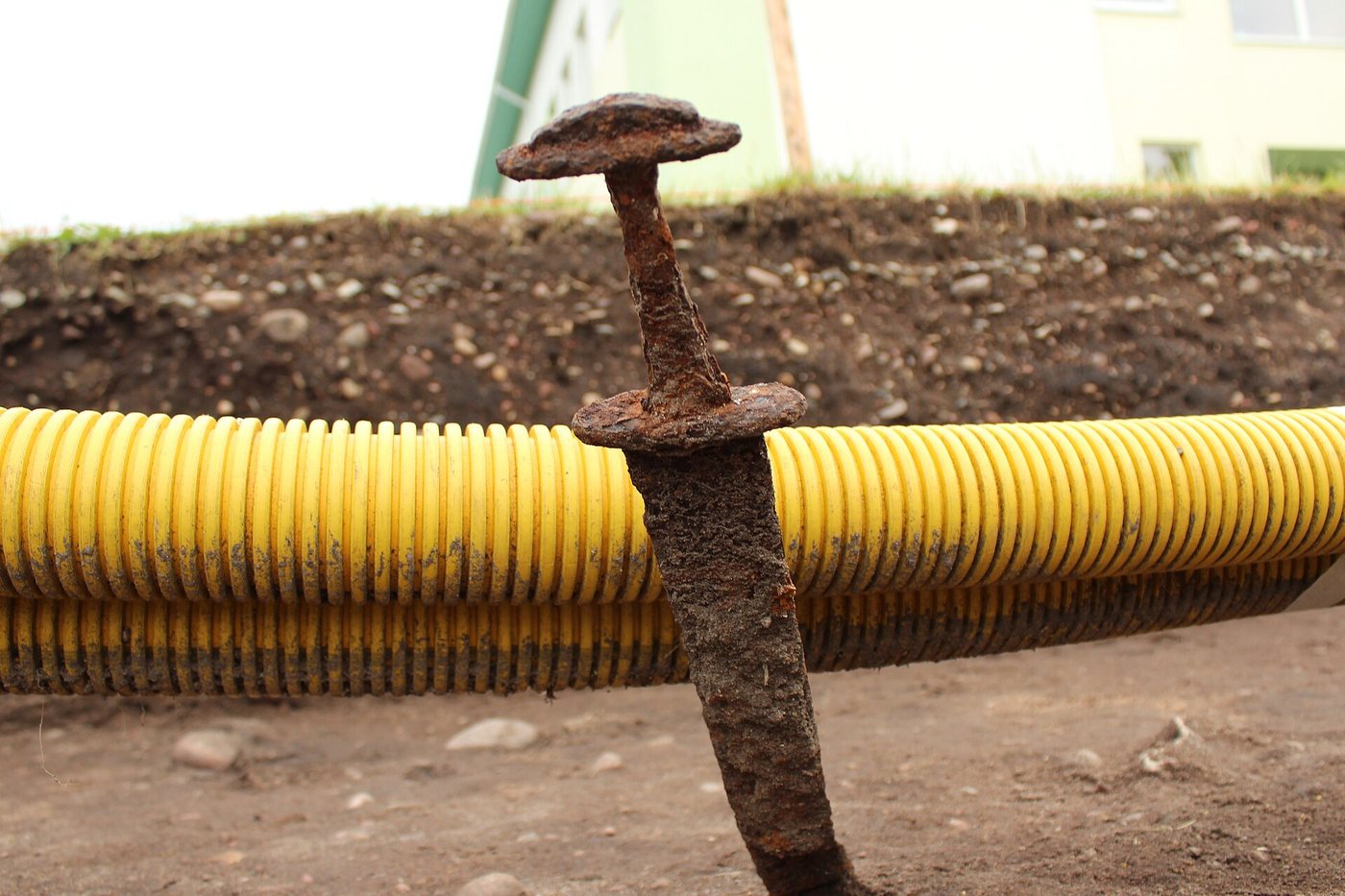
Long after the Scandinavian Viking Age had passed, Danes, Swedes and Germans in the Baltic were still worrying about the ships of one Estonian island. Saaremaa, known in German as Ösel, held out against the crusaders until early 1227, when an army arrived across the frozen sea. Nearly everything we read about its people was written by their opponents, or by Icelanders long after the events. This article sets sagas, chronicles, charters and excavations side by side, and says where an attractive connection does not hold.
Saaremaa is Estonia's largest island. It sits at the mouth of the Gulf of Riga, the point every ship bound for Riga has to pass. Icelanders called the area Eysýsla, roughly "the island district". Latin writers used Osilia and called the people Osilienses, which English renders as Oeselians or Osilians. The Estonian name Saaremaa simply means "island land".
The Oeselians left no history of their own. What survives from their own mouths would fit on a few lines, and even that comes to us through a mission priest. Anyone writing about them works with material of very uneven quality: Icelandic sagas written centuries later, crusade chronicles from the conquerors' camp, and finds from the ground, which take no sides but name no names. The charters of the 13th century add a fourth kind of evidence, and they paint a surprisingly different picture from the chronicles.
The island's most famous find is not about the Oeselians at all. The two ship burials at Salme held seven and 34 dead, plus a single skull, and date to around 750. T. Douglas Price and his colleagues concluded in Antiquity in 2016 that the isotope values and grave goods point to the Mälaren region of central Sweden as the most probable homeland. Their story has its own article, on the Salme warriors.
In the mid-8th century, armed men from central Sweden came to this coast and died here, so these waters were already a place where violence was expected some 450 years before the crusades. Salme says nothing about the islanders of the time, beyond the likelihood that they lived nearby and heard of the fight, if it took place locally.
The archaeologist Marika Mägi spent years surveying Saaremaa's coasts, using field walking, phosphate analysis and old maps. Her 2004 paper borrows a line of the Rhymed Chronicle for its title, "Ships are their main strength", and focuses on the period from 900 to 1400. She describes the 12th century as the island's era of prosperity.
Mägi describes harbour sites that always lay close to good arable land; she recorded none in sandy or stony areas. Some go back to the 6th and 7th centuries, and activity intensifies from the 8th and 9th. In the 11th and 12th centuries harbours moved closer to the open sea, because ships were growing and the land was rising: she puts the uplift at two and a half to three metres per thousand years. The Viking Age shoreline now lies inland, which is why these places cannot be found at today's water's edge.
In her model, stone graves belonged to elite families who controlled the best farmland and the more important harbours, taxed visitors and guaranteed their safety in return. That is interpretation, not a document. It does explain why Mägi refuses to reduce seafaring to robbery. Fishing, seal hunting, barter and control of long-distance trade probably counted for more in the economy, and she links the elite's interest in harbours to trade and piracy alike. The picture of a pure pirate people comes from the texts of its victims.
Viltina is a good example: a site on a former islet, fortified shortly before the Viking Age and abandoned by the 11th century at the latest. Mägi once thought it a war harbour. In her 2005 fieldwork report she leans towards a meeting place for rituals and negotiations, where warships may also have gathered. A researcher openly shifting her reading like this shows how thin any statement about function remains.
Anyone who counts Asva, in the east of the island, among the Oeselian strongholds is off by centuries. It is above all a Bronze Age settlement. According to a summary of current research, its main use ran roughly from 850 to 500 BC, with some 60,000 sherds and about 3,000 clay casting moulds. Mägi suspects a centre of bronze casting and long-distance trade, then on a small islet near the coast.
What makes Asva interesting is a later, smaller phase. The excavations by Uwe Sperling and Valter Lang revealed a rampart with what was probably a burnt palisade and three radiocarbon dates between AD 669 and 775, along with arrowheads resembling those from the Salme ships and bone gaming pieces. It would be tempting to conclude that these were the opponents of the Salme men. The dating permits that; nothing proves it. Either way, Asva has no bearing on the raiders of around 1200: some 450 years separate this phase from Henry's chronicle. I have these figures only from a summary, not from the excavation reports themselves.
The best-known appearance of Estonian raiders in Norse literature comes in Snorri Sturluson's Heimskringla, written around 1230. Astrid, widow of King Tryggve, flees across the Baltic towards Novgorod with her small son Olaf. At sea they fall into the hands of vikings from Eistland, who take people and goods as booty. Olaf is parted from his mother and ends up, with his foster-father Thorolf and Thorolf's son Thorgils, in the possession of a man called Klerkon.
Klerkon decides Olaf's foster-father Thorolf is too old to be worth working and kills him. He sells the boy and his foster-brother to a man called Klerk for a stout ram. A third man, Reas, buys Olaf for a good cloak. Years later Astrid's brother Sigurd comes to Eistland from Novgorod, notices a strikingly handsome boy in the marketplace and recognises his nephew. Back in Novgorod, Olaf one day spots Klerkon in the market and splits his skull with a little axe.
Two things deserve attention. First, Snorri says Eistland, not Saaremaa. The passages I checked place neither Klerkon nor the market on the island; anyone who makes Olaf a prisoner of the Oeselians is adding something. Second, the story changes between versions. In the Old Norse saga after the monk Oddr Snorrason, which goes back to a Latin work of the 1190s, the corresponding passage has "ránsmenn" attack the ship, simply robbers, with no origin given. So the vikings of Eistland would be more precise in Snorri than in his older model. Whether he had a source for this or was using an image from his own day cannot be clearly established, and I have not compared the other manuscripts and versions.
For Olaf himself, king of Norway from 995 to 1000, the episode therefore remains saga rather than biographical evidence. It is still valuable here: it shows that an Icelandic author around 1230 found Estonian vikings and a slave market an entirely believable setting. More on the king is in the article on Olaf Tryggvason, and on the trade in people in slavery in the Viking Age.
Where the kings' sagas name the island itself, it is often the victim. In the saga of Olaf the Saint, the young Olaf Haraldsson sails in spring to Eysýsla, Laing's "Eysyssel", lands and plunders. The islanders come down to the shore and give battle; Olaf wins and lays waste the land with fire and sword. Snorri cites the skald Sigvat here and remarks that the islanders had brought no tribute, only their weapons.
This fits a pattern: tribute and plunder ran in both directions along this coast. Scandinavians collected dues on the islands, and islanders raided at sea. The neat split into Vikings and victims belongs to later handbooks. Marika Mägi, according to a report in Estonian World, argues that "Viking" was more a profession than an ethnicity, and that coastal warriors in today's Estonia belonged to it as well. I have not read her 2018 book In Austrvegr, where the case is set out.
Our main source for the years around 1200 is the Chronicon Livoniae by the priest Henry. According to the Neue Deutsche Biographie, he came to Riga in 1205, was ordained in 1208 and received a parish on the Ymera near Wenden. His origins, the NDB says, are unknown. The dating varies between accounts: the NDB gives 1225/26 and 1227, a review of Piero Bugiani's Italian edition August 1224 to spring 1226. The NDB and Alan V. Murray treat the last chapter, on the fall of Ösel, as an addition made shortly after the events of early 1227.
So Henry stands very close to events, and he works for the winners. Bishop Albert of Riga is his master, and in 1225 he accompanied the papal legate William of Modena. Conversion is sacred history to him, his language is steeped in the Bible, and an enemy painted especially black always helps to justify a war. I could not read his text in context for this article, only single phrases quoted by Murray and Hildebrand. The digitised copy of Eduard Pabst's 1867 German translation could not be retrieved as text. Everything said here about Henry comes from scholarship and reference works that report him.
Evidence for the raids comes from three directions. Saxo Grammaticus writes from the Danish side in the late 12th century. According to the usual summary, Book 14 of his Gesta Danorum describes how Valdemar I mustered his whole fleet off Öland in 1170 against Estonians and Curonians. The Livonian Rhymed Chronicle, a German verse work that runs to 1290, says in the lines Mägi quotes in translation that the Oeselians are wicked pagans and neighbours of the Curonians, and that ships are their main strength. In summer, according to the summary, they fell on Christians and pagans alike. Henry, finally, is said to tell of 16 ships and 500 Oeselians ravaging what was then Danish southern Sweden. Reference works state this without giving the passage; I did not find it in his text, nor a year. And 500 men would be no muster roll in any case.
You will often read that the Rhymed Chronicle distinguishes two ship types: the piratica, with about 30 men, a high dragon- or snake-headed stem and a square sail, and the liburna, a merchant vessel. The attribution wavers, though: other accounts name a "Livonian Chronicle" rather than the Rhymed Chronicle, and Latin words sit oddly in a Middle High German rhyming text anyway. I found no support for the 30 men. I could check none of this against an original, and Mägi's 2004 paper does not use either term. The comparison with longships further north still works as background, but I know of no find of an actual Estonian piratica.
Things become solid in 1221. In his study of Valdemar II, Kurt Villads Jensen records an Oeselian attack on the Danes in newly conquered Tallinn, beaten off only with difficulty. Then there is Lihula in western Estonia in 1220: a Swedish army had taken the fort, and Oeselians and men from the coastal district of Rotalia attacked the garrison and killed it, along with Bishop Karl of Linköping and Jarl Karl. The exact day is uncertain. Operations like these against fortified points, with allies from the mainland, require more organisation than the word "pirate" suggests.
The most famous case probably does not belong here: the attack on Sigtuna in 1187. The Annals of Visby are said to speak only of "heathens", the Erik Chronicle of the 1320s names Karelians, and only Swedish authors of the 16th century such as Olaus Petri name Estonians. I have not come across any naming of the Oeselians specifically. A burn layer matching a catastrophe is missing, according to the reports available. The article on the Curonians also discusses this.
At one point we almost hear the islanders directly. Around 1215, according to Henry, they captured the missionary Frederick of Zelle and a companion and tortured them, shouting (XVIII.8): "Laula! Laula! Pappi", meaning: sing, sing, priest. The historian Alan V. Murray considers this probably the oldest sentence in Estonian preserved in writing, and shows how rarely Henry leaves Estonian words untranslated. For language history the line is a gift: it proves that someone in the mission's circle knew this language. It does not prove that the scene happened exactly so. A martyr ordered to sing is a motif that suits a clerical author very well.
Tharapita calls for similar caution. Under the year 1220, in XXIV.5, and again in chapter XXX, Henry writes of this god of the Oeselians, said to have been born on a wooded hill in Virumaa and to have flown from there to Saaremaa. Lennart Meri, later president of Estonia, linked the flight with the impact that created the Kaali crater on Saaremaa. Dates for the crater vary widely: a 2016 study (Losiak et al.) arrives at shortly after 1530–1450 BC, one of 2001 (Veski et al.) at 800–400 BC. Even the youngest of these puts the impact some 1,600 years before Henry. An attractive thought, but impossible to prove.
In 1206 Valdemar II of Denmark landed on the island with Archbishop Andreas of Lund. Jensen writes that he took part of it and built a garrison fort, but abandoned and demolished it the same year. For 1216 the summaries report a march across the ice by the Sword Brothers, a military order based in Riga, and Bishop Theoderich, followed the next spring by Oeselian reprisals in Latvia. Then came Lihula in 1220 and Tallinn in 1221.
Valdemar returned in 1222, this time with a punitive fleet, and had a stone fort built on Saaremaa. The historian Piia Sandra Palm, in a report by Estonian broadcaster ERR, mentions a meeting there with the Sword Brothers and Theoderich. On the accounts available, the Oeselians then besieged the fort; it gave up after five days and was razed. For 1225 Palm has a revealing detail: island representatives approached the legate William of Modena, asked for protection against the Danish king and promised to accept Christianity. The last pagans of the Baltic, in other words, practised diplomacy and played their opponents off against each other.
The ice took away the Oeselians' strength. Henry describes the campaign in his final chapter. One sentence reaches me in the public-domain German of the historian Hildebrand.
… when snow covers the earth and ice the waves, and the surface of the deep grows firm and the waters turn hard as stones.Henry of Livonia, Chronicle XXX.3, in the German rendering by Hildebrand, Die Chronik Heinrichs von Lettland (Berlin 1865); English from the German, my own translation
Hildebrand uses the passage to describe the winter campaigns against the Estonians in general, which usually assembled around Christmas; I have not read its context in Henry. The wording echoes Job 38:30, which suits Henry's biblical language. The army gathered at the legate's urging: Sword Brothers, men of Riga, Livs, Letts and baptised Estonians. Reference works give January 1227, while Aita Kustin in 1959 placed the fall of Muhu in February; I could not find support anywhere for the occasionally cited date of 6 January. The figure of 20,000 is attributed to the chronicle. I know it only at second hand, and it would in any case be a chronicler's order of magnitude rather than a count.
According to a brief retelling, the army marched from the mouth of the Pärnu over slippery ice and reached the stronghold of Muhu, Henry's Mone, on the ninth day. The Muhu people offered peace and baptism, but most of the Germans wanted to fight. After stone-throwers, a siege tower and undermining, the army broke in on the sixth day, killed the garrison, took cattle and horses and burned the fort. Palm reads events differently from the crusade narrative: the elite first met the newcomers in a settlement, and the fighting flared up somewhat by accident.
Then came Valjala, in Henry's words (XXX.5) the island's strongest fort. In the usual account the defenders surrendered after a siege and accepted baptism. Palm stresses that the people of Valjala were never conquered: they ritually welcomed the new lords, symbolically accepted baptism and only then let them into settlement and fort. That same year showed how quickly the island counted in the new order. Lübeck asked the islanders for armed help against the Danish king, Bishop Albert agreed on their behalf, and on 22 July came the battle of Bornhöved. Whether Oeselians fought there is unknown.
The ring fort of Valjala, Latin Waldia, is where you come closest to this story. In her 2023 fieldwork report Marika Mägi dates the great stone rampart, on radiocarbon evidence, to around the first half of the 12th century and hardly earlier. Aita Kustin dug here in the 1960s and found remains of wooden buildings in the inner yard, at least eight according to Wikipedia. About a kilometre away, work began on Valjala church right after 1227, in one account the oldest stone church on the island and possibly the oldest surviving one in Estonia.
Kuressaare, by contrast, has nothing to do with the Oeselian raiders. The castle visitors see first today is not mentioned until 1381 and was founded as a residence of the bishops of Ösel-Wiek. Mägi does name Kuressaare as a main harbour in the power system of the island's medieval overlords. As a backdrop for pirates around 1200 the bishop's castle fails; as evidence of who ran things afterwards it serves very well. It passed to Danish rule in 1559 and Swedish in 1645.
And the islanders? The treaties with the Teutonic Order of 1241 and 1255 show that 1227 drew no final line. According to Palm they treated land as belonging to kin groups and covered fines and courts; the one of 1255 names eight signatories: Ylle, Culle, Enu, Muntelene, Tappete, Yalde, Melete and Cake. These rare names stand not in a denunciation of heathens but in a legal text. After the Order's defeat at Durbe in 1260 there were further revolts. In 1297 the Order locked 80 islanders in the tower at Pöide. In July 1343 the island rose in the wake of the St George's Night Uprising, and in February 1344 the Order's army came over the ice once more and hanged the leader, Vesse.
Were the Oeselians Vikings? If Viking means an activity, yes: Saxo is reported to speak of vikings from Estonia, and Mägi reportedly takes this view. They were not Scandinavians by ethnicity; the phrase "Laula, pappi" points to a Finnic language.
Was Olaf Tryggvason really captured by Estonians? Snorri says so around 1230. The Oddr version has only robbers in the passage checked. I know of no confirmation outside the sagas.
Why did the island fall in winter? On the ice no fleet counted any more. The frozen sea opened the way for a land army with siege equipment.
Can you visit Oeselian strongholds? Valjala is the best known. Kuressaare Castle dates only from the time of the bishops, and Asva chiefly from the Bronze Age.
The Salme warriors · Vikings in the Baltic · The Curonians · Olaf Tryggvason · Olaf the Saint · Slavery in the Viking Age · Saxo Grammaticus · Longships

The Salme Warriors · Vikings on the Baltic · The Curonians · Olaf Tryggvason – missionary king and the fall at Svolder · The Vikings in the East – Varangians, the Rus & Byzantium.
All History & Finds articles →
The Saxons lived several lives: sea raiders on the North Sea coast, settlers in Britain, a federation without a king …
Read more →There are peoples we know everything about, and peoples of whom we know a name. The Sagudates belong to the second …
Read more →Few names of early history are as famous and as poorly secured as that of the Salians. A Roman officer wrote it down in …
Read more →The Salluvii (Salyes) were a league of Celtic-Ligurian groups in the hinterland of Massalia, with the hill town of …
Read more →