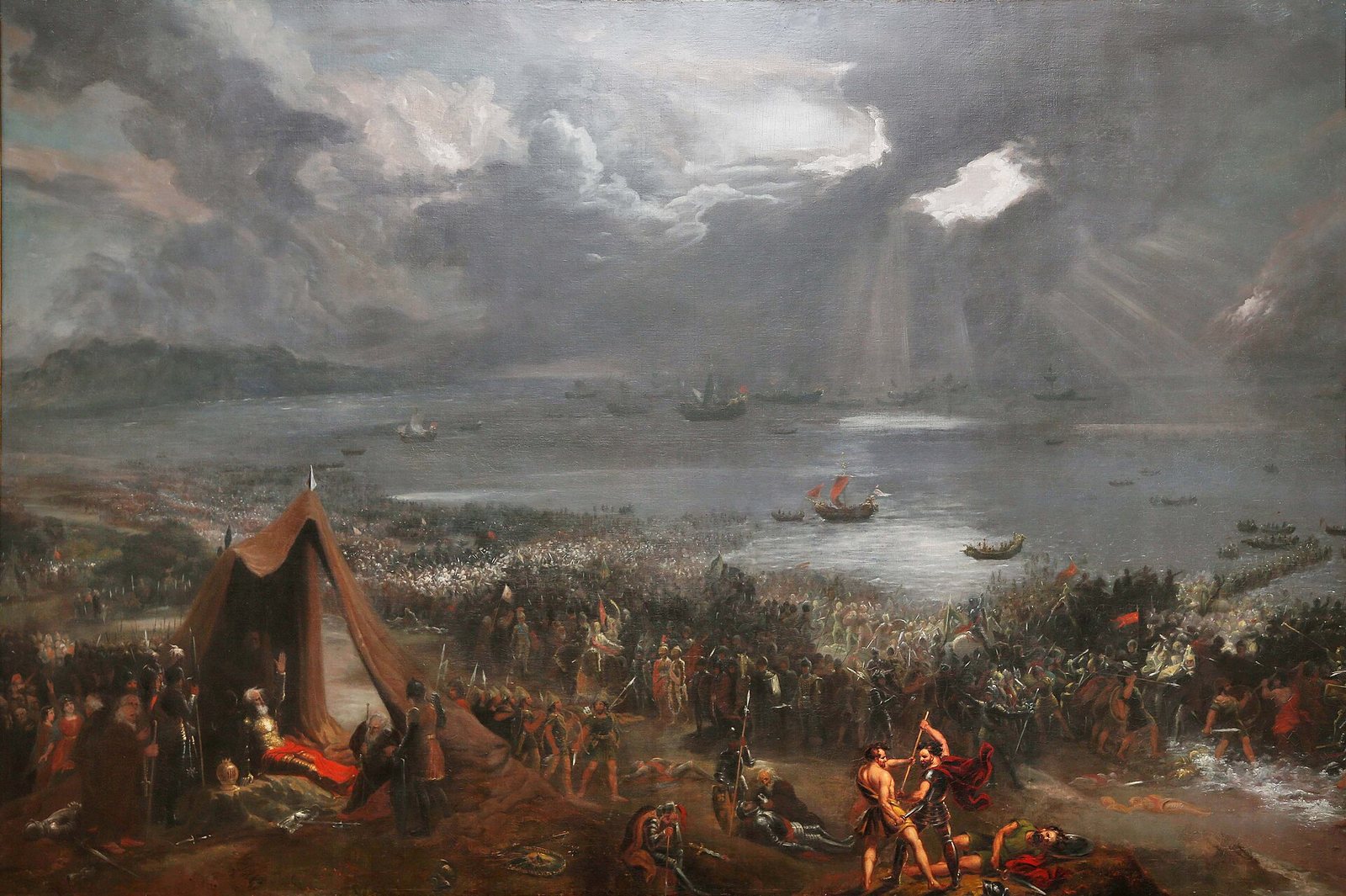
He struck the first coins ever minted in Ireland, married the daughter of his greatest opponent, watched the Battle of Clontarf from the walls of his town if the Irish tradition is right, and travelled to Rome as an old man. Sigtrygg Olafsson, known as Silkbeard, was king of Norse Dublin for almost half a century. The Irish annals portray a tough ruler, often beaten but never finally defeated. The Icelandic sagas turned him into a character in a novel. This article keeps the two apart.
Anyone reading about Sihtric Silkbeard soon meets half a dozen forms of his name. The Irish annals call him Sitriuc mac Amlaíb, "Sitriuc son of Amlaíb". His own coins spell the name in an English-influenced way as Sihtric, often heavily abbreviated. In the Icelandic sagas he is Sigtryggr silkiskegg, "Sigtrygg Silk-beard", and this is the source of the English "Silkbeard". All of these refer to one man: a king of the Uí Ímair, the descendants of the Viking leader Ívarr who had ruled Dublin, and at times York, since the ninth century.
Modern historians usually number him Sihtric III of Dublin, since two earlier kings of the same name preceded him. Reference works give his reign as roughly 989 to 1036, some 45 years. That figure suggests a stability he never had. Sihtric was driven out of his town at least twice, had to submit to several Irish overkings, and lost battles, fleets and sons. That he remained king for so long nonetheless makes him one of the most remarkable rulers of the late Viking Age in Ireland. For the town itself, see our article on the Vikings in Dublin.
Sihtric's father was Olaf Cuarán (Irish Amlaíb Cuarán), who in the mid-tenth century was for a time king of York and for decades king of Dublin. Olaf gave up power after losing the Battle of Tara in 980 and died as a monk on Iona.
His mother was Gormflaith ingen Murchada, daughter of the Leinster king Murchad mac Finn and sister of the later Leinster king Máel Mórda. Gormflaith became a figure of legend in her own right. After Olaf's death she married, in turn, two of the most powerful Irishmen of her age: first Máel Sechnaill mac Domnaill, king of Mide and high king, and later Brian Boru. The order and length of these marriages are not clear in every detail. For Sihtric this meant that he was related through his mother to the royal house of Leinster, and that his mother was at times married to the very men he fought.
Before him his half-brother Glúniairn ("Iron-knee"), another son of Olaf, ruled Dublin. When Glúniairn was killed in 989, Sihtric took over, though not unchallenged.
Irish annals. The main basis are the annals, year-by-year records in which monasteries noted brief entries. For Sihtric the Annals of Ulster, the Annals of Tigernach, Chronicon Scotorum and the Annals of Inisfallen matter most. They are terse: one sentence on a raid, a handing over of hostages, a death. Their entries go back to near-contemporary records, even if the surviving manuscripts are later. The Annals of the Four Masters, by contrast, were compiled only in the seventeenth century from older material; they contain valuable information, but also embellishments, and their dates are often a year out.
Cogad Gáedel re Gallaib. "The War of the Irish with the Foreigners" is a prose narrative from the early twelfth century, written for the descendants of Brian Boru. It glorifies Brian and paints the Scandinavians as cruel invaders. It is dynastic propaganda, not a chronicle. Yet it preserves details found nowhere else, such as the scene in which Sihtric watches the Battle of Clontarf from the town.
Icelandic sagas. Njáls saga and Gunnlaugs saga ormstungu were written down in the thirteenth century, more than 200 years after Sihtric's death. They are literature with a historical core.
Coins. The only source produced by Sihtric's own administration are the silver pennies struck in his name in Dublin. They tell us nothing about battles, but a good deal about trade, models and self-image.
The years after 989 are confused. A rival named Ivar, usually identified by scholars with the king of Waterford, also claimed Dublin. According to the reconstruction of the historian Benjamin Hudson, as summarised in overview works, Sihtric pushed him out in 993, was himself expelled around 994 and returned within a year. Whether Ivar of Waterford really ruled Dublin, and for how long, cannot be established with certainty; the accounts differ. For the other great Viking town on the south coast, see our article on Waterford.
What is certain is that Sihtric appears in the annals of the 990s as an active warlord. Together with a nephew he attacked targets in Mide (Meath), the heartland of Máel Sechnaill. Máel Sechnaill struck back: Irish annals report that he took Dublin and carried off two famous treasures of the town, the "ring of Thor" and the "sword of Carlus". The sword of Carlus turns up again decades later as part of a ransom.
In 997 Sihtric raided the monasteries of Kells and Clonard. In 998 Máel Sechnaill and Brian Boru, who had shortly before divided overlordship of Ireland between them, together forced Sihtric to recognise their authority and give hostages.
At the end of 999 Leinster under Máel Mórda, Sihtric's uncle, and Norse Dublin rose together against Brian Boru. Brian defeated the allied army at Glenmama, a valley near present-day Dublin. The Annals of Ulster date the battle to 30 December 999; the Annals of Inisfallen place Brian's capture of Dublin on 1 January 1000. Brian plundered the town and burned its fortifications.
Sihtric fled north, to the Ulaid in what is now Ulster and to Áed of Cenél nEógain. Both refused to help him. Submission was all that was left. He returned, gave Brian hostages and got Dublin back, now as a dependent king under Brian's overlordship. A double marriage alliance belongs to this period and sums up the situation: Sihtric married Brian's daughter Sláine, and Brian took Sihtric's mother Gormflaith as his wife. The exact dates of both marriages are not securely recorded, but they are usually placed in this phase.
For a good decade Dublin was part of Brian's system of power. Dublin warriors and ships fought in Brian's campaigns, for instance against the Ulaid and the northern Uí Néill.
Sihtric's most consequential innovation falls in the years around 1000. For the first time in Ireland, coins were struck in Dublin. Before that, people on the island paid with cattle, with weighed silver in the form of ingots, rings and hacksilver, or with imported coins. The new pennies carried Sihtric's name.
The numismatic literature usually dates the first issue to "about 997"; some dealers' catalogues give 995. The model is clear: the Dublin pieces imitate the silver pennies of the English king Æthelred II, the earliest ones the so-called Crux type, with a cross and the letters C-R-V-X in its angles on the reverse. Michael Dolley divided the Hiberno-Scandinavian coins, the issues of the Norse towns in Ireland, into phases. In his Phase I the Dublin types follow the English changes almost in step: Crux, Long Cross, Helmet, Small Cross, and later the Quatrefoil type of Cnut the Great.
The legends are often hard to read. Some coins carry the king's name and a form of the town's name such as DYFLIN or DIFLIN, and on the reverse the moneyer's name with "of Dublin". Others simply copy the names of English moneyers and mints. Evidently the main aim was for the coins to look familiar in trade across the Irish Sea.
The coins should not be overstated. They show a king who controlled silver and had the English market in view. They do not show that all of Ireland suddenly paid in money; outside the Norse towns cattle and weighed silver long remained the norm. How bullion and coins lie side by side in hoards is shown in our piece on silver hoards.
Around 1012 the arrangement broke apart. Máel Mórda of Leinster rebelled against Brian, and Sihtric joined him, as did several Irish kings from the north. The allies defeated Máel Sechnaill near Swords, north of Dublin. Sihtric's son Oleif (Olaf) attacked the Norse settlement at Cork and raided Cape Clear; he was killed in 1013, according to the annals in revenge for the burning of Cork.
For the decisive campaign of 1014 the rebels sought help from overseas. The Irish sources name warriors from Orkney and from the Isle of Man. Njáls saga turns this into a dramatic recruiting voyage: Sihtric travels in person to Sigurd the Stout, earl of Orkney, and wins him by promising that he may marry Gormflaith and become king in Ireland. He then wins over the Viking Bróðir, lying off Man, with the same promise, to be kept secret from Sigurd. That Sigurd of Orkney fell at Clontarf is confirmed by the Irish annals. The twice-promised hand of the king's mother, on the other hand, is a thirteenth-century story without any contemporary support. More on Sigurd's dynasty can be found in our article on the earls of Orkney; Sigurd's son Thorfinn the Mighty was still a child when his father died.
On Good Friday 1014, 23 April, the armies met at Clontarf, north of the mouth of the Liffey. Brian's side won, but Brian himself was killed, as were his son Murchad, Máel Mórda and Earl Sigurd. The course of the battle and its interpretations are covered in detail in our article on the Battle of Clontarf 1014.
For Sihtric's biography one question is decisive: did he fight himself? Here the traditions contradict each other. The Irish sources say no. According to them Sihtric kept his garrison inside the town, and Cogad Gáedel re Gallaib describes him watching the fighting from Dublin's defences. The Icelandic tradition puts him on the battlefield instead: in Njáls saga he leads a wing of the army and is put to flight by Óspak, Bróðir's brother. Orkneyinga saga likewise places him in the battle.
Most historians follow the Irish sources here. The historian Donnchadh Ó Corráin is quoted in overview works as saying that Sihtric wisely stayed within the city and lived to tell the tale. Another point in favour of this reading is that Sihtric was the only leading figure on the losing side to survive the battle and that he went on ruling immediately afterwards. That Dublin warriors took part in the fighting cannot be ruled out, of course; many of the Norsemen on the field came from Dublin itself.
Brian's death brought Sihtric no relief. Máel Sechnaill became high king again and burned Dublin's suburbs as early as 1015.
In 1017 Sihtric allied with Leinster against Mide, but then had his cousin Bróen, son and heir of Máel Mórda, blinded. That ended the alliance with Leinster. In 1018 he plundered Kells again; the Annals of the Four Masters say that he carried off countless spoils and prisoners and killed many people in the middle of the church. In 1021 he was defeated at Delgany in today's County Wicklow by the Leinster king Augaire mac Dúnlainge, and in 1022 Niall mac Eochada of the Ulaid destroyed the Dublin fleet.
In the mid-1020s Sihtric again gave hostages, this time to Flaithbertach Ua Néill and to Donnchad mac Briain, a son of Brian Boru. In 1029 his son Olaf, the child of his marriage to Sláine, was taken captive by Mathgamain Ua Riagáin. The ransom recorded in the tradition shows what people in Ireland counted in: 1,200 cows, 140 British horses, 60 ounces each of gold and silver, the sword of Carlus, and hostages. Whether the figures are exact cannot be checked.
Sihtric was never entirely down. In 1032 he won a battle at the mouth of the Boyne against a coalition, without allies. In 1035 he plundered Ardbraccan in Mide; according to the annals 200 people were burned in the church and another 200 carried off. In the same year he had Ragnall, king of Waterford, killed in Dublin. Wales was within reach too: Dublin ventures there are mentioned for the years around 1030, and historians have considered that Sihtric may have acted together with Cnut the Great. No such alliance is firmly attested.
For 1028 an entry in the Annals of Ulster reports that Sitriuc, "king of the foreigners", and Flannacán Ua Cellaig, king of Brega, went to Rome. Chronicon Scotorum and the Annals of Tigernach also record the journey. Incidentally, the Annals of Ulster have a form that can be read as "grandson of Amlaíb"; scholars nonetheless refer the entry to Sihtric Silkbeard, Olaf's son.
How Sihtric travelled is not recorded. Anyone going from Ireland to Rome had to cross England or France and then the Alps; any more specific route would be invention. A year earlier, in 1027, Cnut the Great had gone to Rome to attend the imperial coronation of Conrad II, the Salian ruler whose realm included Aachen and the Rhineland, where our workshop is based. Whether Sihtric passed through this region we do not know, and there is no evidence for it at all.
Sihtric is also associated with the creation of a bishopric in Dublin and the founding of the Church of the Holy Trinity, today's Christ Church Cathedral. According to the cathedral's tradition, Sihtric gave the first bishop, Dúnán (Latinised Donatus), the site, gold and silver for building, and lands. These reports come from late books of the cathedral, among them the so-called Black Book of Christ Church and its book of obits. They are not contemporary. The common dating "around 1030" is a reconstruction; older studies even placed the foundation after Sihtric's departure, between 1038 and 1042. Whether Dúnán was consecrated at Canterbury, as one tradition holds, is disputed. What is secure is that Dublin acquired its own bishop in the first half of the eleventh century, whom the annals called "chief bishop of the foreigners", and that the first church on the site of today's cathedral dates from this period and was rebuilt in stone after the Anglo-Norman conquest.
A sad postscript to the pilgrimage: some years later Sihtric's son Olaf also set out for Rome. The Annals of the Four Masters report for 1034 that he was slain "by the Saxons" on the way, that is, in England.
Around 1035 or 1036, the annals differ by a year, Sihtric left Dublin. The Annals of Tigernach say he went "over the sea". Power passed to Echmarcach mac Ragnaill, a ruler from the island realm of the Hebrides and Man whose exact origins are debated. Whether Sihtric was driven out or withdrew, perhaps into religious life, cannot be established with certainty. Modern accounts speak sometimes of abdication, sometimes of expulsion; the terse entries allow both readings.
Sihtric's death is recorded for 1042. Where he died is unknown. He was probably around seventy years old, an unusually great age for a king of his time.
His family lived on by roundabout ways. Several of his children are known from the annals, most of whom died before him. Through his son Olaf a line leads to Wales: in Welsh tradition Olaf's daughter Ragnhild was the mother of Gruffudd ap Cynan, who became king of Gwynedd at the end of the eleventh century. Gruffudd was born in Ireland and relied on warriors from Dublin in his struggles for Gwynedd.
Outside Ireland Sihtric lived on above all in Icelandic literature. Two sagas matter most.
In Gunnlaugs saga ormstungu, the "Saga of Gunnlaug Serpent-Tongue", the Icelandic skald Gunnlaug Illugason visits the king in Dublin and recites a praise poem for him. A skald was a court poet who praised rulers in strictly regulated metres and expected gifts in return. According to the saga, the poem celebrates Sihtric's royal ancestry. The king first wants to give the poet ships, but his treasurers talk him out of it and he gives him costly clothing instead. Whether the stanzas quoted in the saga are really Gunnlaug's, and whether the visit took place, cannot be proved. The saga places it around the turn of the millennium.
Njáls saga works the prelude to Clontarf into the so-called Brjáns þáttr, the "tale of Brian". Here Sihtric is the hesitant son of a power-hungry mother. Gormflaith, called Kormlöð in the saga, drives him on; he recruits allies on her behalf and promises the same reward twice. The tone is that of a family drama. A short sentence from George Webbe Dasent's public-domain English translation shows how the saga has the king act:
"Then King Sigtrygg stirred in his business with Earl Sigurd, and bade him go to the war with him against King Brian."Njáls saga, ch. 154 (Dasent's numbering); G. W. Dasent (trans.), The Story of Burnt Njal, 1861
The saga tells this more than 200 years after the events. That Sihtric sailed to Orkney in person is attested nowhere else. The poem Darraðarljóð, a song about valkyries at the loom of battle, is also linked with Clontarf in Njáls saga; how closely it originally belonged to that battle is debated.
In Ireland, Cogad Gáedel re Gallaib shaped the picture: Sihtric as the foreign king watching from a safe distance as his allies go down. Both images, the saga's mother's boy and the onlooking foreigner, are literary. The Sihtric of the annals is plainer: a warlord, coin-issuer and pilgrim who changed alliances when he had to and survived for a long time doing so.
Why is Sihtric called "Silkbeard"? The nickname comes from Old Norse literature (Sigtryggr silkiskegg) and literally means a beard of silk. What it alluded to is not recorded, and the Irish annals do not use it.
Was Sihtric Silkbeard at the Battle of Clontarf? Not according to the Irish sources. He stayed in Dublin with his garrison; Cogad Gáedel re Gallaib has him watch the battle from the town's defences. Only the Icelandic sagas put him on the battlefield.
How was Sihtric related to Brian Boru? Twice over by marriage: Sihtric married Brian's daughter Sláine, and Brian married Sihtric's mother Gormflaith. Even so, the two stood on opposite sides in 1014.
Did Sihtric issue the first Irish coins? Yes. From about 997 silver pennies were struck in his name in Dublin, the first in Ireland. They imitate English pennies of King Æthelred II.
When and where did Sihtric die? The annals record his death for 1042. They do not name the place. He had already left Dublin around 1036.
Olaf Cuarán · Viking Dublin · The Battle of Clontarf 1014 · Njáls saga · Norse Kings.
All History & Finds articles →
Around 1108 a young Norwegian king left home with a fleet and did not return for more than three years. In between lay …
Read more →Sigurd Snake-in-the-Eye is said to have been a son of Ragnar Lodbrok who bore a ring in his pupil that looked like a …
Read more →Silver was the money of the Viking Age, weighed rather than counted, chopped rather than struck. Three finds show how …
Read more →The Silingi appear once, in the second century, in a geographer's list of peoples. Then the sources fall silent for …
Read more →